State of the Graduate Program, April 2022
April 26, 2022
PAER-2022-11
Dr. Nicole Olynk Widmar, Professor of Agricultural Economics


State of the Graduate Program, April 2022
It has been an exciting year in Purdue’s Agricultural Economics Graduate Programs! We welcomed the largest cohort of MS-MBA in Food and Agribusiness Management students to-date in the Fall of 2021. And, we were excited to welcome new residential MS and PhD students to our West Lafayette, IN campus community.
The Fall of 2021 saw the completion of our new Undergraduate Advising space on the 5th floor, alongside our newly renovated and reconfigured Graduate Student Lounge Space on the 5th floor and within the main office on the 6th floor. We continue to strive towards safe and inclusive activities in the Department, taking into account the continued health concerns in and around our communities – but – also the academic and social needs of our AgEcon family.
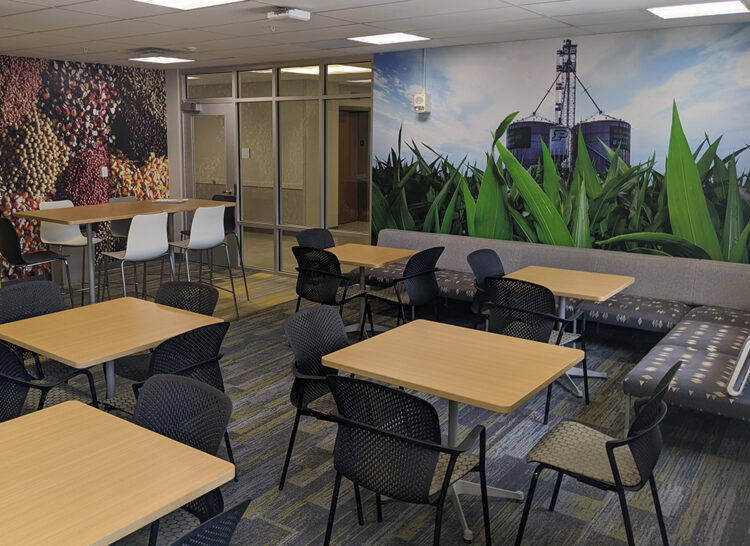
Graduate Student Lounge Space on the 5th floor of Krannert
Our Graduate Students are working actively in all facets of our Land Grant Mission areas, including guiding in the educational endeavors of our undergraduate students via classroom and extracurricular activities, providing leadership in Extension and engagement activities, and conducting research. This year AGEC Graduate Student Profiles were launched to provide details about current graduate students work and passions in their own words.
The Department recently received approval to offer a new Professional Masters in International Agriculture entirely online, which will enable us to extend the expertise of our faculty and staff to reach new students. Furthermore, our new Professional Masters in International Agriculture degree allows students to select one Graduate Certificate to complete within (and towards!) their MS degree, either the Online Graduate Certificate in Spatial Data Science offered by the College of Agriculture or the Biotechnology Quality & Regulatory Compliance Graduate Certificate offered by Agricultural and Biological Engineering. We plan to offer this new online program for the first time next year alongside our residential MS and PhD programs, hybrid MS-MBA, and online MS-MJ programs.
We are thrilled to be able to safely invite admitted prospective graduate students physically to our campus this Spring 2022 semester. We are looking forward to inviting the largest incoming classes of in-residence MS and PhD students into our Department in the last 5 years this coming Fall. Graduate Programs in the Department of Agricultural Economics are continuing to grow. We’re excited to continue to nurture the diverse community of scholars comprised of our graduate students, faculty, and staff in the Department of Agricultural Economics.
If you have questions about our AgEcon MS, PhD, MS-MJ, or Professional Masters in International Agribusiness (PMIA) Programs, please reach out to Ryan Good, Graduate Program Administrator, at rrgood@purdue.edu If you have questions about the MS-MBA in Food and Agribusiness Management, please reach out to MS-MBA Program Manager Taryn Nance, at tnance@purdue.edu
Nicole Olynk Widmar
Dr. Nicole Olynk Widmar
Professor |Associate Head and Graduate Program Chair
Department of Agricultural Economics |Purdue University
Krannert Building | Room 656 | 403 W. State St. |West Lafayette, IN 47907-2056
Office: 765-494-2567 | Cell: 516-318-1736
Email: nwidmar@purdue.edu | Website: www.agecon.purdue.edu