USDA: 2013 Cropland Value by State

August 24, 2013

PAER-2013-06

Unattributed


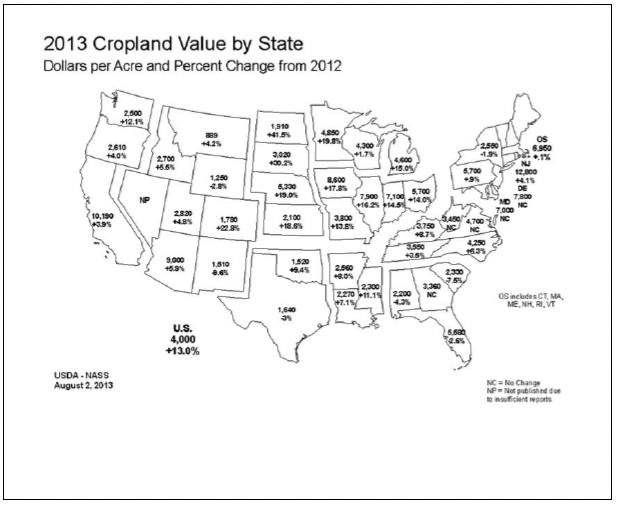
2013 Cropland Value by State: Dollars per Acre and Percent Change from 2012

2013 Cropland Value by State: Dollars per Acre and Percent Change from 2012


USDA completes a survey of cropland values each year in June that is released in August. The map above provides their estimates for cropland values in each state and the percentage changes from 2012. These vary somewhat from the Purdue survey because the Purdue survey is more detailed and precise in defining the quality of land being evaluated. 

This map provides a broader geographic perspective across the country. Some of those broader observations are that Indiana has the third highest cropland values in the Midwest after Iowa and Illinois. For these lower 48 states, cropland values rose the most in the Midwest. The states in the western side of the Corn Belt generally had greater percentage increases than the eastern side of the Corn Belt in the past year. Cropland values in some states were unchanged or down in the past year, most notably in the Southeastern and Northeastern U.S 
Publication Appeared Within:

Latest Articles:

The Iran Conflict and Global Food Security: Why the Burden Falls Hardest on the World’s Most Vulnerable

March 31, 2026

When an energy shock ripples out from the Persian Gulf, the headlines focus on oil prices, gasoline costs, implications for value chains and the profit margins of U.S. producers.

READ MORE

The Iran Conflict and Consumer Food Prices: A Broad but Lagged and Sticky Shock

March 31, 2026

The initial public reaction to an oil price shock reaching $110 per barrel is often to project near-immediate, dramatic increases in grocery prices. This instinct overstates the direct farm-to-retail transmission channel in a straightforward and measurable way. The USDA Economic Research Service tracks how each dollar of consumer food spending is distributed across the supply chain in its Food Dollar Series. The picture it reveals is sobering for those who expect large and rapid retail food price responses driven purely by higher farm input costs.

READ MORE

The Iran Conflict, Energy Prices, and U.S. Farm Profitability: A Balanced Assessment

March 31, 2026

The conflict that began on February 28, 2026, with U.S.-Israeli airstrikes on Iran triggered the closure of the Strait of Hormuz — the narrow chokepoint through which approximately 20 percent of the world’s traded oil and significant volumes of liquefied natural gas (LNG) flow. Within days, Brent crude oil surged from roughly $70 per barrel to over $110, the highest level since Russia’s 2022 invasion of Ukraine. Gasoline prices at the pump rose roughly 17 percent in the first two weeks of the conflict, and diesel — the lifeblood of farming operations — followed closely.

READ MORE