

Exploring the Impact of Financial Incentives on Cover Crop Adoption
Authors
Anuoluwa O. Sangotayo
Postdoctoral Research Associate
Department of Agronomy
Purdue University
asangota@purdue.edu
Callum W. Alexander
PhD Candidate
Department of Land Economy
University of Cambridge
cw840@cam.ac.uk
Shalamar Armstrong
Professor of Agronomy
Department of Agronomy
Purdue University
sarmstro@purdue.edu
Executive Summary / Highlights
Government-funded incentives are critical in encouraging cover crop adoption, but their effectiveness varies by design and delivery. This study finds that:
- Direct grants exceeding $30/acre are the most effective incentive, particularly when regionally tailored and offered with flexible contract lengths.
- Contract length had a negligible effect on adoption decisions, with no significant preferences for longer-term (3- or 5-year) commitments.
- Farmers who derive a lower percentage of their income from farming tend to prefer grants, those with a moderate percentage prefer insurance discounts, and those with a higher percentage prioritize flexible contracts over long-term commitments.
- Younger (18–30) and older (60+) farmers in the Midwest respond well to larger grant amounts, making them ideal for targeted financial incentives. Older farmers also respond well to insurance discounts but prefer short-term flexibility over long contracts.
- Older farmers (60+), male farmers, and those with 25+ years of farming experience are the most responsive to crop insurance discounts.
- Previous adopters of cover crops exhibited stronger preferences for larger grant amounts and insurance discounts compared to non-adopters.
- This study provides strong empirical evidence that a one-size-fits-all conservation incentives program may not be the most effective method of increasing farmer participation in incentive programs. Instead, targeted financial incentives based on farm income, experience level and regional factors could maximize participation and long-term sustainability.

Introduction
The sustainability of Midwest row crop agriculture is increasingly threatened by nutrient loss and soil erosion, contributing to downstream environmental issues, such as hypoxia in the Gulf of Mexico and agricultural greenhouse gas (GHG) emissions (FAO, 2021). As the nation’s leading producer of corn, soybeans and wheat, the Midwest plays a dual role in global food security and emissions (USDA NRCS, 2022), making it particularly vulnerable to soil degradation, nutrient runoff and extreme weather (Zhou et al., 2023). Extensive research has demonstrated that the adoption of cover crops is an effective strategy for mitigating nutrient loss, erosion and soil degradation while simultaneously enhancing carbon sequestration and climate resilience (Kaye & Quemada, 2017). However, despite overwhelming scientific evidence supporting their benefits, cover crop adoption in the Midwest Corn Belt and the Upper Mississippi River Basin remains under 10% (Zhou et al., 2023). Among conservation practices, cover cropping is widely regarded as one of the most accessible and beneficial methods for improving soil health and reducing nutrient leaching into major waterways (Fanning, C. 2024, Wood & Bowman, 2021).
Studies indicate that the primary barrier to adoption is the economic risk associated with cover cropping, including uncertainty about short-term profitability, additional labor costs and potential yield impacts (Thompson et al., 2021, Ma et al., 2023). While financial incentives through programs like the Environmental Quality Incentives Program (EQIP), Conservation Reserve Program (CRP), and Conservation Stewardship Program (CSP) exist, their impact remains limited. Between 2006 and 2023, less than one-sixth of EQIP and CSP funds were allocated to climate-smart agricultural (CSA) practices, and even among CSA initiatives, cover cropping received only 21.8% of funding, covering merely 5% of U.S. cropland (Environmental Working Group, 2023).
Therefore, this research seeks to address a critical question: Which financial mechanisms are most effective in driving the adoption of climate-smart soil practices — specifically, cover cropping among Midwest farmers? Using a discrete choice experiment (DCE), this study examines how different financial incentives, including cost-share grants (via EQIP), crop insurance premium discounts (via the Federal Crop Insurance Program), and contract lengths, shape farmers’ decision-making. By identifying which policy levers most effectively mitigate economic risks and encourage CSA adoption, this research aims to inform targeted policy reforms that enhance both regional sustainability and national GHG mitigation efforts. The null hypothesis posits that these financial incentives do not significantly influence cover crop adoption decisions among Midwest farmers.

Literature Review
Financial incentives and technical support significantly influence farmers' adoption of climate-smart agriculture (CSA) practices globally (Pan et al., 2022), but their specific impact on climate-smart (CS) soil practices, such as cover cropping, remains underexplored, especially in developed nations like the U.S. While federal programs such as EQIP and CSP offer cost-share payments to offset cover crop implementation costs, these payments often cover only basic expenses and fail to account for yield variability and long-term risks (Roth, 2021). Moreover, payment structures vary across states, with capped acreage and short durations limiting broader adoption.
Crop insurance discounts, such as the $5/acre premium reductions in Iowa, Illinois and Indiana, offer accessible incentives for cover cropping but cover only a fraction of costs and have strict eligibility criteria (Roth, 2021). While easier to enroll in than other conservation programs, chronic underfunding, especially in Illinois and Wisconsin, creates a scarcity effect, discouraging farmers who assume enrollment spots will fill too quickly. The interplay between cost-share grants and crop insurance discounts remains an under-researched area, raising questions about whether these programs encourage CSA adoption or inadvertently foster complacency (Barnett, 2014). Carbon credit programs like California’s Cap and Trade offer additional revenue streams, but their nascent nature and limited adoption data precluded their inclusion in this study.
Beyond financial incentives, contract length is a critical factor influencing cover crop adoption. Research suggests that multiyear commitments through government programs increase adoption likelihood by reducing financial risk over time (Roesch-McNally et al., 2018; Golden et al., 2023). This study contributes to the literature on Payment for Ecosystem Services (PES), which uses financial mechanisms to promote environmental benefits from land management practices (Muradian et al., 2010). However, PES success is often skewed toward affluent farmers with clear property rights and lower transaction costs (Lansing, 2017).
Cover Crops
Cover cropping planting species such as clover and cereal rye have been shown to significantly reduce nutrient runoff, protect soil carbon and improve soil health (Wood & Bowman, 2021; Scavo et al., 2022). In Midwestern systems, cover crops have been found to decrease nitrate losses by up to 61%, mitigating nutrient leaching into waterways (Johnson et al., 2024). Long-term adoption benefits include increased corn and soybean yields after continuous cover cropping for five years or more (SARE, 2023). Nevertheless, economic risks and perceived agronomic challenges continue to limit widespread adoption, with cover crops accounting for just 3.4% of total USDA practice funding between 2006 and 2023, despite being the most popular CSA practice (Koudahe et al., 2022).
This study addresses these gaps by exploring how different financial levers — such as cost-share payments, crop insurance discounts, and contract lengths — influence cover crop adoption, particularly in Midwest states, where environmental challenges and diverse farming systems offer a critical context for understanding CSA adoption dynamics.
Methodology
This study employed a Discrete Choice Experiment (DCE) to investigate the impact of various financial incentives on the adoption of cover crops in the Midwest, focusing on public grants, crop insurance discounts and contract lengths. DCEs are ideal for climate-smart agriculture (CSA) studies, where no active markets exist to naturally reveal farmer preferences (Schaafsma et al., 2019). By presenting farmers with hypothetical scenarios that mimicked real-world policy options, the DCE identified the incentive structures most likely to influence adoption decisions.
Rooted in the Random Utility Model (RUM) developed by McFadden (2001) and originally established in 1974, the DCE assumed that farmers were rational actors seeking to maximize utility when presented with different combinations of incentives. Participants chose between multiple multi-attribute alternatives, including an opt-out (status quo) option, allowing researchers to capture preferences that extend beyond current market conditions.
The selection of attributes and their levels was informed by expert consultations with agricultural researchers, Extension agents and NRCS employees during the Midwest Cover Crop Council Conference (February 2024). These consultations helped refine critical aspects of the DCE, including:
- Grant payment amounts, designed with agri-economic experts to reflect the opportunity costs of adopting cover crops.
- Seeding rates for cover crops like clover (6-15 lbs/acre), ensuring realistic cost calculations for adoption scenarios.
- Financial risk considerations, ensuring that the incentive packages offered in the choice sets adequately compensated for the risks associated with cover cropping, such as seed costs, planting, management and potential yield reductions.
Choice Set Design Strategy
The DCE survey and choice set design process was guided by three goals: a) to convey the information in an intelligible way, b) to develop a rounded understanding of the farmer’s decision-making process and c) to provide options in the choice scenarios that each at least offset the risk of implementing and managing cover crops.
Each choice set within the DCE was designed to feature four alternatives: three incentive options and an opt-out (status quo) option. This approach ensured the capture of preference data by requiring respondents to choose among distinct alternatives. The attributes cost-share grants, crop insurance discounts and contract length were selected to reflect realistic, policy-relevant scenarios.
This study utilized a Discrete Choice Experiment (DCE) to evaluate how cost-share payments, crop insurance discounts and contract lengths influenced Midwest farmers' decisions to adopt cover crops. Based on USDA data and consultations with NRCS experts, a benchmark cost-share payment of $42/acre was set, reflecting typical implementation costs for farmers (Roth, 2021). NRCS recommended shifting from percentage-based cost shares to fixed dollar amounts for clarity, ensuring farmers could easily compare payments with actual costs. Farmers received this payment annually for the duration of their contract, covering both initial implementation and ongoing management expenses. Crop insurance discounts included in the DCE were modeled after existing programs in Illinois, Indiana, Iowa and Wisconsin, offering $3, $5, and $10/acre levels to assess their relative importance in decision-making. Contract length represented the number of years farmers received both payments.
A D-efficient choice set design was employed to minimize attribute correlation and maximize statistical precision, using noninformative (zero) priors due to limited empirical data on Midwest farmer preferences. To prevent participant fatigue, eight choice sets were determined optimal through a pilot study, balancing robust data collection with manageable respondent effort. Each set featured three incentive combinations and a status quo opt-out option. Ngene 1.4 software was used to generate the final design, ensuring statistical rigor and participant comprehension.

Outreach Strategy
The outreach strategy targeted a sample of 400 farmers, emphasizing the Midwest due to its agricultural prominence and varied environmental challenges. Collaborations with co-authors Anuoluwa Sangotayo and Shalamar Armstrong at Purdue University facilitated access to farmer networks via national corn and soybean associations, Farm Bureaus, and Sustainable Agriculture Research Education (SARE) agencies. Additional partnerships with USDA NRCS and land-grant universities (e.g., the University of Missouri and the University of Georgia) broadened the national sample. Particular focus was placed on Iowa, Illinois and Indiana — states with existing crop insurance discount programs, diverse cropping systems and varying conservation practice adoption levels. The sample included both cover crop adopters and nonadopters, allowing for comparative analysis of barriers and motivators, with attention to farm size, cropping systems, and prior conservation experience. This comprehensive approach ensured the findings could be generalized across diverse agricultural contexts.
Data
To ensure validity and reliability in the Discrete Choice Experiment (DCE), a diverse sample of 524 respondents was recruited, surpassing the recommended minimum of 200 participants for robust DCE analysis (Johnston et al., 2017). Recruitment was conducted through farmer-led agencies, such as the state and national commodity associations, farmer organizations and state Extension agencies, ensuring diversity in crop types, farm sizes and geographic representation. Participants received a gift card as compensation, and the survey was administered pre-harvest to maximize response rates.
The survey included three sections:
- Demographic and farm attributes (age, state, gender, crop type, farm size, cover crop adoption status, and land ownership).
- Experience and knowledge of cover crops through short-answer questions.
- Eight DCE choice sets, presenting farmers with various combinations of financial incentives.
Model Justification
Data analysis was conducted using a Conditional Logit (CL) model, a widely accepted approach for adoption studies using DCEs (Kuhfuss et al., 2015; Haile et al., 2019). The CL model was preferred over the Multinomial Logit (MNL) due to its ability to handle attribute-specific preferences and avoid the Independence of Irrelevant Alternatives (IIA) assumption, which is often unrealistic in DCE contexts. Unlike the MNL model, which assumes that the relative likelihood of selecting between two options remains constant regardless of other alternatives, the CL model effectively captured nuanced choices between similar incentive combinations.
Although a Random Parameters Logit (RPL) model could have accounted for preference heterogeneity more robustly, it was not selected due to the policy-oriented focus of this study, which prioritized ease of interpretation. The CL model allowed for straightforward integration of demographic interactions, making the results more accessible for policy formulation. Statistical computations were conducted using Stata (Version 18).
In summary, the Conditional Logit model was chosen for its balance of rigor and interpretability, making it well-suited to analyze the influence of financial incentives on cover crop adoption while ensuring that the results remained actionable for policy design.
Results & Discussion
| Category | Key findings (total number of respondents = 524) |
|---|---|
| Gender | Male: 59% Female: 41% |
| Age Group | Most are 46-60 years old (61%), followed by 60+ (20%), then 18-30 years old (4%), and 31-45 (15%). |
| Farming Experience | 42% have 6-15 years of experience, 28% have 16-25 years, 21% have 25+ years, and 9% have 6-15 years of experience. |
| Farm Size | 35% manage 151-500 acres, 31% manage over 500 acres, and 15% manage 0-50 acres. |
| Land Tenure | 52% own their land, while 48% rent. |
| Organic Practices | 57% use organic methods, while 43% do not. |
| Farming Income Source | 78% rely on farming for at least 50% of their income. |
| Primary Crop Type | 37% grow corn, soybeans and wheat, with corn and soybeans being the most common crops. |
| Government Involvement Opinion | 49% prefer less involvement, 26% find the current level appropriate. 21% want more involvement, and 4% are unsure. |
| USDA Funding | 81% have received USDA funding, while 19% have not. |
| Cover Crop Adoption | 84% have used cover crops, while 16% have not. |
General incentive preferences:
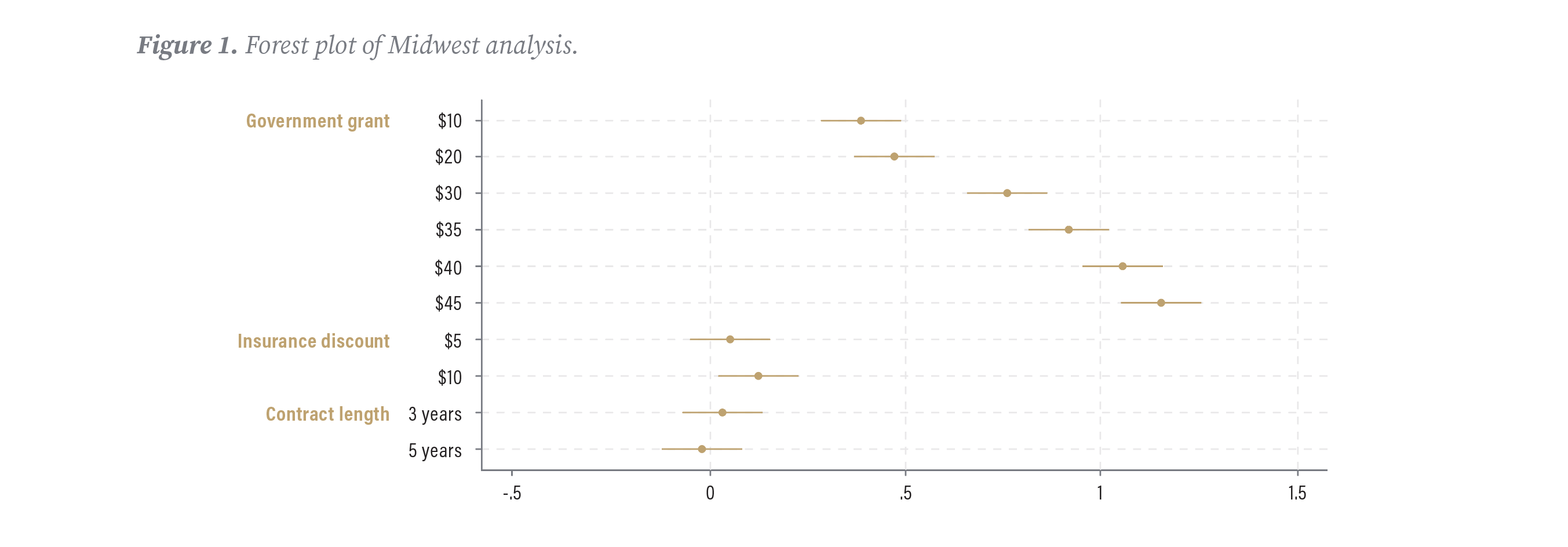
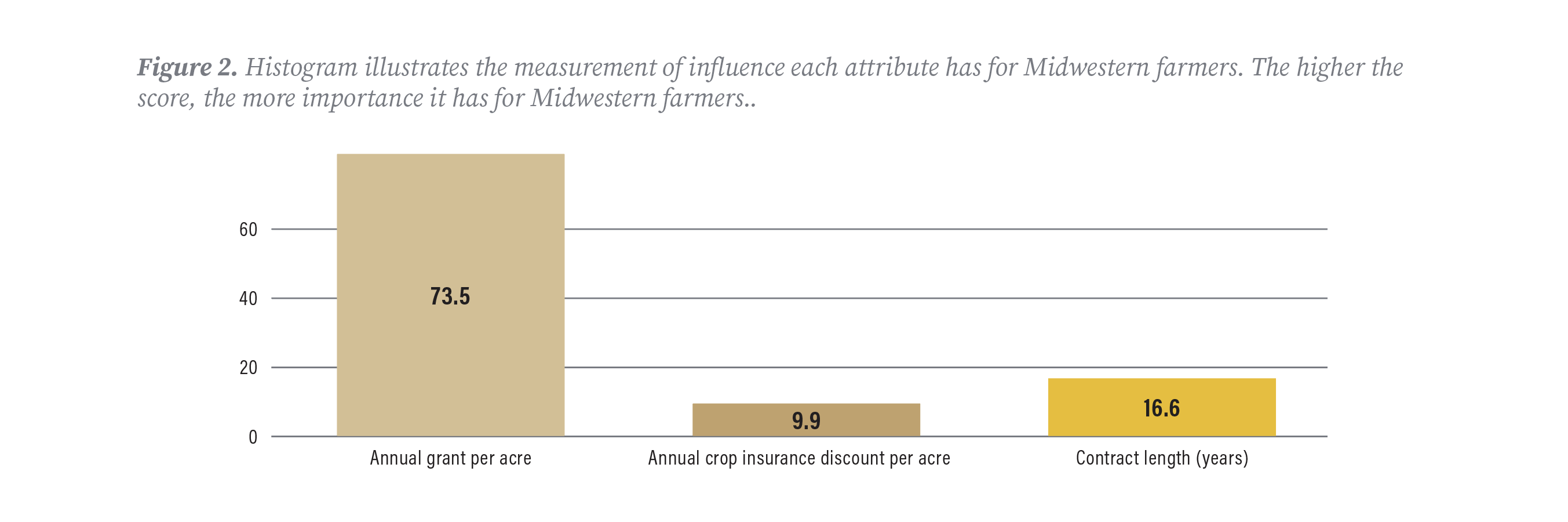
- Government grants: Midwest farmers demonstrate a strong preference for government grants, with the adoption likelihood increasing as the grant amount increases from $10 to $45 per acre. Grants above $30 are particularly influential, indicating that substantial financial incentives are key drivers of cover crop adoption.
- Insurance discounts: Insurance discounts ($5 and $10 per acre) help but matter less than grants. The $10 discount is more impactful, but direct financial support is key.
- Contract length: Contract length has a minimal impact on adoption decisions, with no significant preferences for longer-term commitments. Flexibility in contract duration may be more appealing to Midwest farmers.
Demographic preferences:
- Age: Younger farmers (18-30) and older farmers (60+) prefer larger grant amounts, suggesting these groups may benefit from targeted financial incentives. Interestingly, older farmers (60+) also respond positively to insurance discounts but prefer short-term flexibility.
- Gender: Male farmers prefer grants above $30/acre and respond positively to $10 insurance discounts. Female farmers are unresponsive to discounts. Female farmers prefer longer-term contracts, whereas males slightly prefer shorter terms. However, the sample size imbalances of male to female may have influenced these findings, particularly for contract preferences, warranting further study for validation.
- Farming experience: Farmers with 25+ years of experience exhibit the strongest preference for larger grant amounts and are most responsive to insurance discounts, reflecting their focus on risk mitigation. Newer farmers (0-5 years) also respond to grants but show minimal preference for insurance discounts.
- Farm size: Larger farms (350+ acres) have the highest preference for grants and are most responsive to insurance discounts, particularly at $10 per acre. Smaller farms show positive responses to grants but less sensitivity to insurance discounts and longer contracts.
- State differences: Indiana farmers exhibit the strongest preference for grants, while Iowa farmers show the least sensitivity to financial incentives. Illinois farmers value both grants and insurance discounts, suggesting state-specific policies may enhance adoption rates.
Attitudinal and operational preferences:
- Government involvement: Farmers prefer reduced government involvement but still respond strongly to larger grant amounts — and indication that financial incentives are effective. Those advocating for more government involvement prefer moderate contracts (3 years), while those desiring less involvement are averse to longer contracts.
- Farm income: Farmers deriving 0-25% of their income from farming show the strongest response to grants, while those deriving 50-75% of their income from farming are more responsive to insurance discounts. Farmers deriving 75-100% of their income from farming exhibit a slight aversion to longer contracts, favoring flexible terms.
- Crop type: Corn and soy farmers display similar strong preferences for larger grant amounts, while wheat farmers show slightly lower sensitivity. Soy farmers are most responsive to insurance discounts, whereas wheat farmers exhibit mild preferences for longer contracts.
- Land ownership: Both renters and owners strongly prefer grants, with owners showing greater sensitivity at lower grant levels. Insurance discounts are equally valued by both groups, though renters exhibit a slight aversion to longer contracts compared to owners.
- Farming practices: Nonorganic farmers prefer government grants and insurance discounts compared to organic farmers. Organic farmers show more openness to longer contracts; nonorganic farmers are averse to longer contracts. These differences highlight distinct financial preferences and contract flexibility needs between the two groups.
- USDA program participation: Farmers without prior USDA funding exhibit the strongest preference for larger grant amounts, indicating that financial incentives are key motivators for this group. Those with prior participation are more responsive to insurance discounts, reflecting familiarity with such programs.
- Cover crop adopters vs. nonadopters: Previous adopters of cover crops place more importance on grants and insurance discounts, indicating that financial incentives can encourage continued adoption. Nonadopters are less responsive but still exhibit significant preferences for larger grant amounts, suggesting that combined financial incentives and outreach could improve adoption rates.

Conclusion
This study confirms that direct grants over $30/acre are the most effective financial incentive for boosting cover crop adoption, particularly in Indiana and Illinois, where farmers show the highest sensitivity to grants. Crop insurance discounts, while moderately influential, are most appealing to older, experienced farmers who prioritize risk mitigation. Additionally, flexible contracts are preferred over long-term commitments, as many farmers, especially those skeptical of government involvement, seek adaptability in financial agreements.
Despite the well-documented environmental and agronomic benefits of cover crops, adoption remains below 10% in the Midwest, largely due to economic barriers. To bridge this gap, policies should focus on expanding direct grant programs, refining crop insurance discounts, and offering flexible funding mechanisms that align with diverse farmer preferences. A targeted, regionally adaptive approach to financial incentives is key to scaling adoption rates and ensuring the long-term sustainability of Midwest agriculture.
Barnett, B. (2014). Multiple-peril crop insurance: successes and challenges. Agricultural Finance Review, 74(2), 200-216.
Environmental Working Group. (2023). Conservation Database: EQIP and CSP Payments for Cover Crops.
Fanning, C. (2024). Cover-Crop Effects on Near-Surface Soil Properties Over Time in the Lower Mississippi River Valley (Master's thesis, University of Arkansas).
Food and Agriculture Organization of the United Nations. (2021). Greenhouse gas emissions from agrifood systems: Global, regional and country trends, 2000–2019. FAOSTAT Analytical Brief 50.
Golden, L.A., Hubbard, M.L., Utych, S., Newman, S.M., Hines, S., Thomas, J., Andrews, N., Som Castellano, R.L., Collins, D.P., & Sullivan, C. (2023). Benefits, barriers, and use of cover crops in the western United States: Regional survey results. Journal of Soil and Water Conservation, 78(3), 260-271.
Haile, K.K., Tirivayi, N., & Tesfaye, W. (2019). Farmers’ willingness to accept payments for ecosystem services on agricultural land: The case of climate-smart agroforestry in Ethiopia. Ecosystem Services, 39, 100964.
Johnson II, F.E., Roth, R.T., Ruffatti, M.D., & Armstrong, S.D. (2024). Cover crop impacts on nitrogen losses and environmental damage cost. Agriculture, Ecosystems & Environment, 363, 108859.
Kaye, J.P., & Quemada, M. (2017). "Using cover crops to mitigate and adapt to climate change. A review." Agronomy for Sustainable Development, 37(1), 4.
Kuhfuss, L., Préget, R., Thoyer, S., & Hanley, N. (2015). Nudging farmers to sign agri-environmental contracts: the effects of a collective bonus. (Doctoral dissertation, auto-saisine).
Lansing, D.M. (2017). Understanding smallholder participation in payments for ecosystem services: the case of Costa Rica. Human ecology, 45, 77-87.
Ma, M., Reeling, C., Hughes, M.N., Armstrong, S., & Roth, R. (2023). Comparison of conservation instruments under long-run yield uncertainty and farmer risk aversion. European Review of Agricultural Economics, 50(5), 1685-1714.
McFadden, D. (2001). Economic Choices. American economic review, 91(3), 351-378.
Muradian, R., Corbera, E., Pascual, U., Kosoy, N., & May, P. H. (2010). Reconciling theory and practice: An alternative conceptual framework for understanding payments for environmental services. Ecological economics, 69(6), 1202-1208.
Natural Resources Conservation Service. (2022). NRCS Delivering Climate Solutions through the Inflation Reduction Act. United States Department of Agriculture.
Pan, Y., Xu, Y., Yu, R., Xu, G., Zhou, Y., & Li, Y. (2023). Climate-smart agriculture research: hotspots, trends, and prospects. Chinese Journal of Eco-Agriculture, 31(1), 136-148.
Roth, R.T. (2021). A characterization of cereal rye cover crop performance, nitrogen cycling, and associated economic risk within regenerative cropping systems. (Doctoral dissertation, Purdue University Graduate School).
Roesch-McNally, G.E., Arbuckle, J.G., Tyndall, J.C. (2018a). Barriers to implementing climate resilient agricultural strategies: The case of crop diversification in the U.S. Corn Belt. Global Environmental Change. 48. 206-215. 10.1016/j.gloenvcha.2017.12.002.
Scavo, A., Fontanazza, S., Restuccia, A., Pesce, G., Abbate, C., Mauromicale, G. (2022). The role of cover crops in improving soil fertility and plant nutritional status in temperate climates. A review. Agronomy for Sustainable Development. 42.
Schaafsma, M., Ferrini, S., & Turner, R.K. (2019). Assessing smallholder preferences for incentivised climate-smart agriculture using a discrete choice experiment. Land Use Policy, 88, 104153.
Sustainable Agriculture Research and Education (SARE). (2023). 2022-2023 National Cover Crop Survey Report.
Thompson, N.M., Reeling, C.J., Fleckenstein, M.R., Prokopy, L.S., and Armstrong, S.D. (2021). Examining intensity of conservation practice adoption: Evidence from cover crop use on U.S. Midwest farms. Food Policy, 101, 102054.
Wood, S.A., & Bowman, M. (2021). Large-scale farmer-led experiment demonstrates positive impact of cover crops on multiple soil health indicators. Nature Food, 2(2), 97-103.
Zhou, Q., Guan, K., Wang, S., Jiang, C., Huang, Y., Peng, B., Chen, Z., Wang, S., Hipple, J., Schaefer, D. and Qin, Z., & Cai, Y. (2022). Recent rapid increase of cover crop adoption across the U.S. Midwest detected by fusing multi‐source satellite data. Geophysical Research Letters, 49(22), e2022GL100249.

| Variable | Category | Count | Percentage |
|---|---|---|---|
| Gender | All | 524 | 100 |
| No data | Male | 309 | 58.96 |
| No data | Female | 215 | 41.03 |
| Age Group | All | 524 | 100 |
| No data | 18-30 | 23 | 4.38 |
| No data | 31-45 | 77 | 14.69 |
| No data | 46-60 | 321 | 61.25 |
| No data | 60+ | 103 | 19.65 |
| Farming Experience Group | All | 524 | 100 |
| No data | 0-5 years | 49 | 9.35 |
| No data | 6-15 years | 221 | 42.17 |
| No data | 16-25 years | 145 | 27.67 |
| No data | 25+ years | 109 | 20.8 |
| Farming Size Group | All | 524 | 100 |
| No data | 0-50 acres | 78 | 14.88 |
| No data | 51-150 acres | 97 | 18.51 |
| No data | 151-500 acres | 185 | 35.3 |
| No data | 500+ acres | 164 | 31.29 |
| Land Tenure (Rent/Own) | All | 524 | 100 |
| No data | Own | 271 | 51.71 |
| No data | Rent | 253 | 48.28 |
| Organic Practices | All | 524 | 100 |
| No data | Yes | 297 | 56.67 |
| No data | No | 227 | 43.32 |
| Farming Income Bracket | All | 524 | 100 |
| No data | 75-100% | 206 | 39.31 |
| No data | 50-75% | 201 | 38.35 |
| No data | 25-50% | 79 | 15.07 |
| No data | 0-25% | 38 | 7.25 |
| Crop Type | All | 524 | 100 |
| No data | Corn, Soybeans, Wheat | 196 | 37.4 |
| No data | Corn, Soybeans | 134 | 25.57 |
| No data | Corn | 45 | 8.58 |
| No data | Corn, Wheat | 30 | 5.72 |
| No data | Soybeans | 25 | 4.77 |
| No data | Soybeans, Wheat | 21 | 4 |
| No data | Wheat | 18 | 3.43 |
| No data | Other | 12 | 2.29 |
| No data | Corn, Soybeans, Wheat, Other | 23 | 4.38 |
| No data | Corn, Soybeans, Other | 8 | 1.52 |
| No data | Corn, Wheat, Other | 3 | 0.57 |
| No data | Corn, Other | 2 | 0.38 |
| No data | Wheat, Other | 2 | 0.38 |
| No data | Soybeans, Other | 1 | 0.19 |
| No data | Soybeans, Wheat, Other | 1 | 0.19 |
| Government Involvement Opinion | All | 524 | 100 |
| No data | More Involvement | 108 | 20.61 |
| No data | Current Level Is Appropriate | 138 | 26.33 |
| No data | Less Involvement | 259 | 49.42 |
| No data | Unsure | 19 | 3.62 |
| USDA Funding | All | 524 | 100 |
| No data | Yes | 422 | 80.53 |
| No data | No | 102 | 19.46 |
| Previous Cover Crop Adopter | All | 524 | 100 |
| No data | Yes | 438 | 83.58 |
| No data | No | 86 | 16.41 |
