


Farmer Sentiment Rebounds, but Future Expectations Continue to Slide
Michael Langemeier and Joana Colussi, Purdue Center for Commercial Agriculture
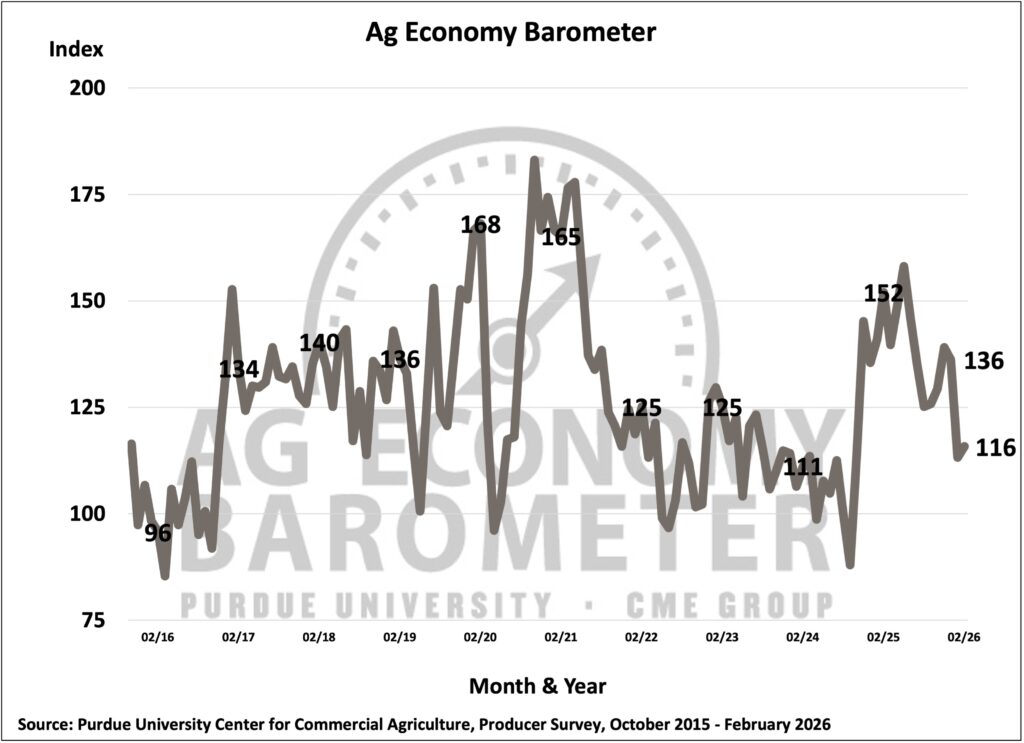
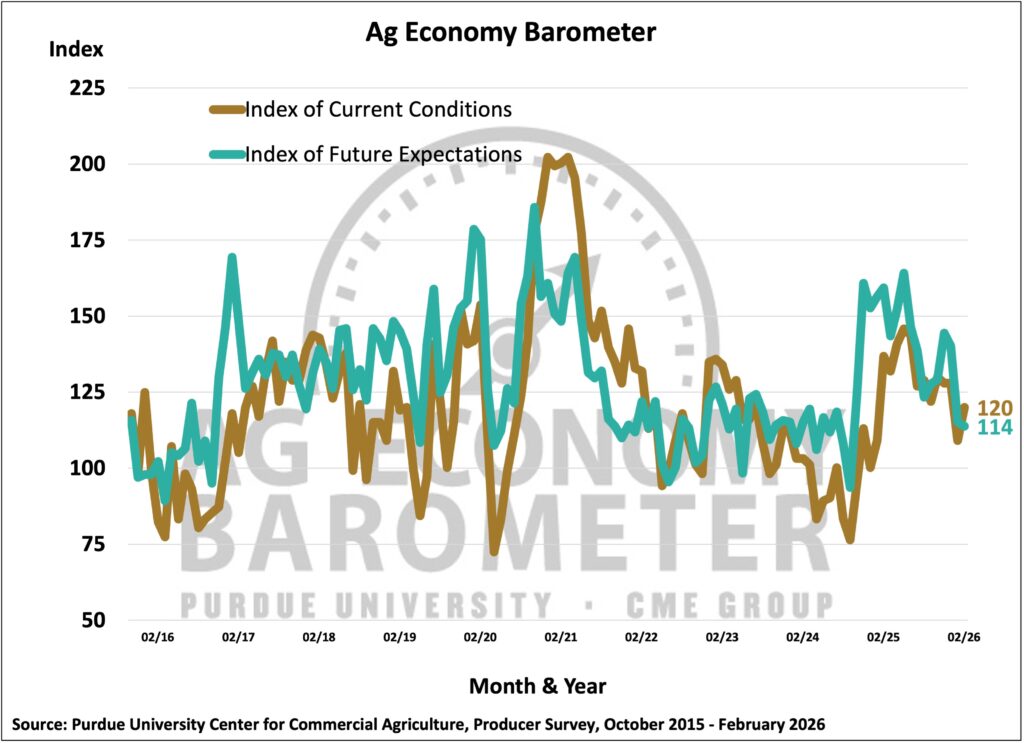
Farmer sentiment improved in February as the Purdue University-CME Group Ag Economy Barometer (AEB) Index rose from 113 points in January to 116 (see Figure 1). The Current Conditions Index increased by 11 points, while the Future Expectations Index dropped 1 point (see Figure 2). The Future Expectations Index this month was 45 points lower than last year’s February index, reaching its lowest level since September 2024. Although concerns about agricultural exports moderated somewhat from the previous month, they are still higher than those expressed in December. In addition, the percentage of respondents who think the U.S. is headed in the “right direction” declined for the second month in a row. The February barometer survey took place from February 2-6, 2026.
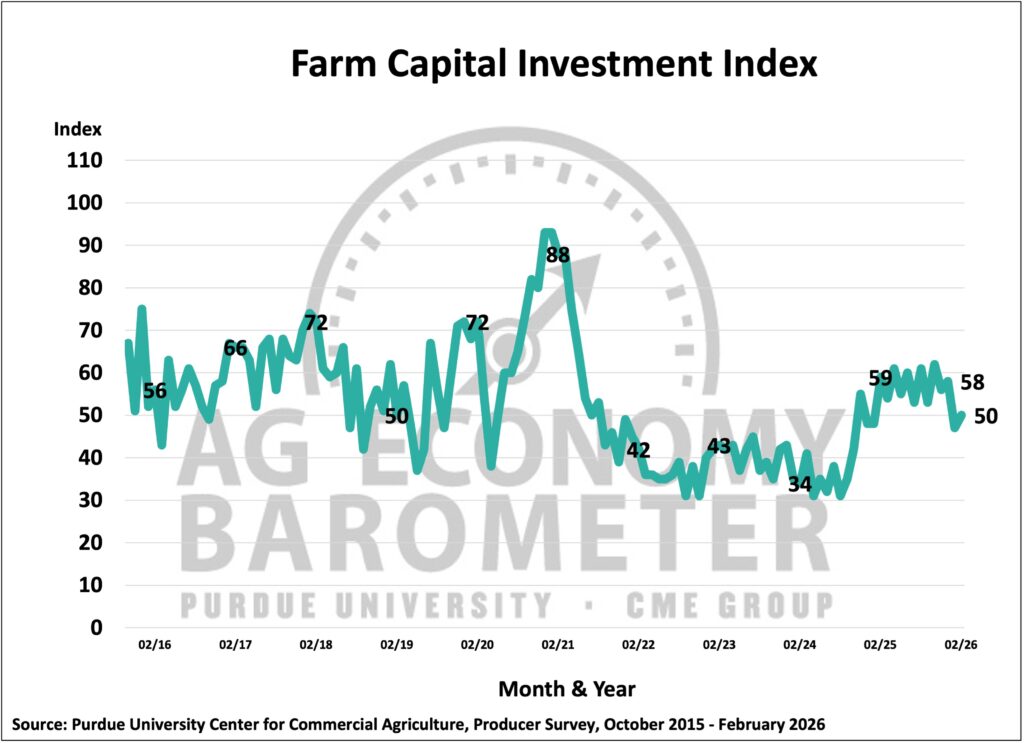
Approximately 44% of respondents indicated that their farm operations were worse off in February than they were a year earlier. Looking ahead 12 months, 29% expected worse financial performance, compared with 18% who expected better financial performance. The Farm Capital Investment Index rose 3 points to 50 (see Figure 3). However, only 7% of survey respondents indicated that they plan to increase farm machinery purchases in the upcoming year.
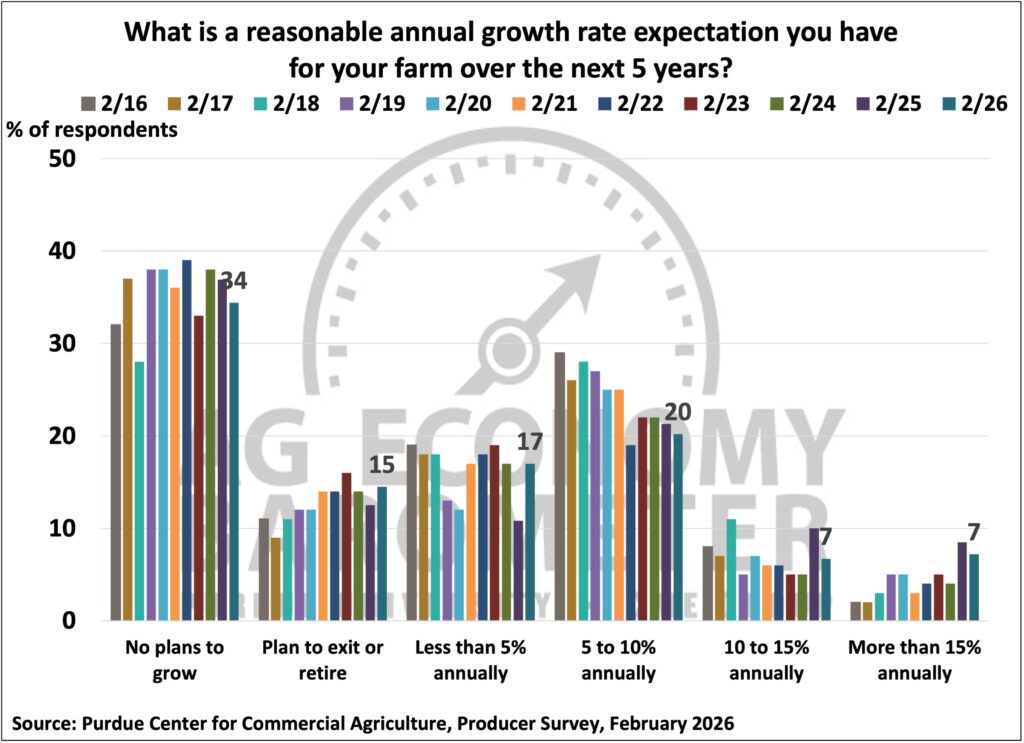
Since 2016, the February barometer survey has included questions about farmers’ growth plans. Approximately 15% of respondents indicated that they plan to reduce the size of their operation, and another 34% indicated that they do not plan to grow (see Figure 4). Of the 51% who plan to expand their farms in the next 5 years, 14% plan to increase their farm size by 10% or more. If these plans materialize, this group will double in size in 5 years or less. This month’s survey also asked respondents whether they plan to bring in another family member into the business in the next 5 years. Results indicated that 36% plan on bringing in another family member into the business within the next 5 years.
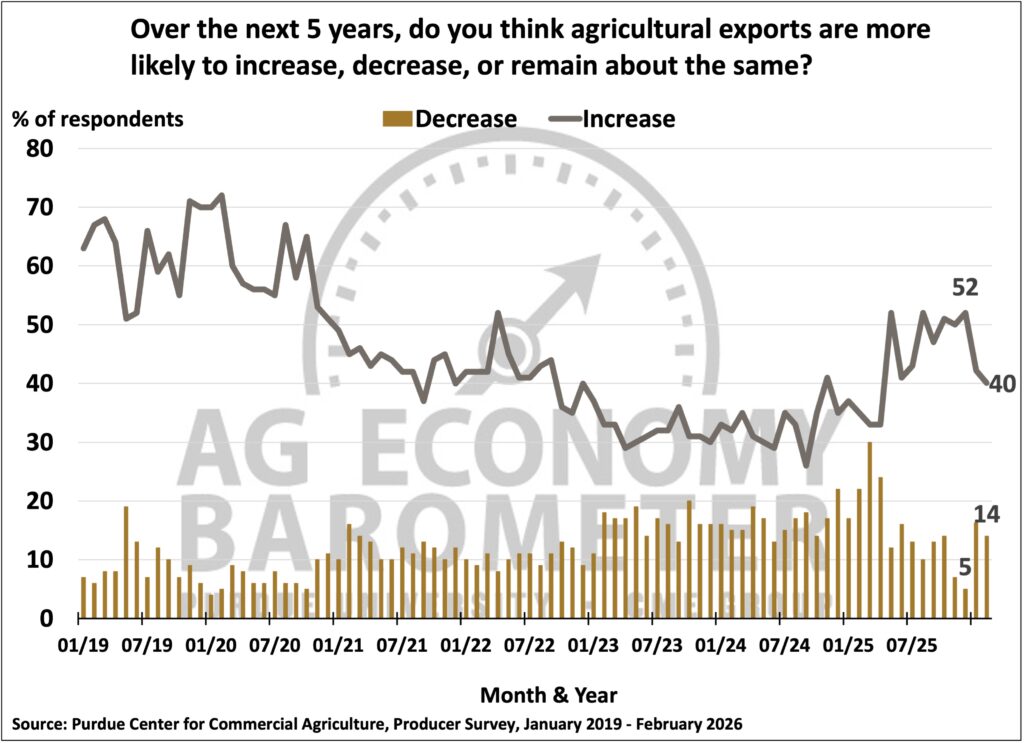
Farmers’ perspective on U.S. agricultural exports was less pessimistic in February than in January but more pessimistic than in December 2025. Responding to a broad question about the future of agricultural exports, 14% of respondents in February expected exports to decline over the next five years, down from 16% in January and up from 5% in December (see Figure 5).
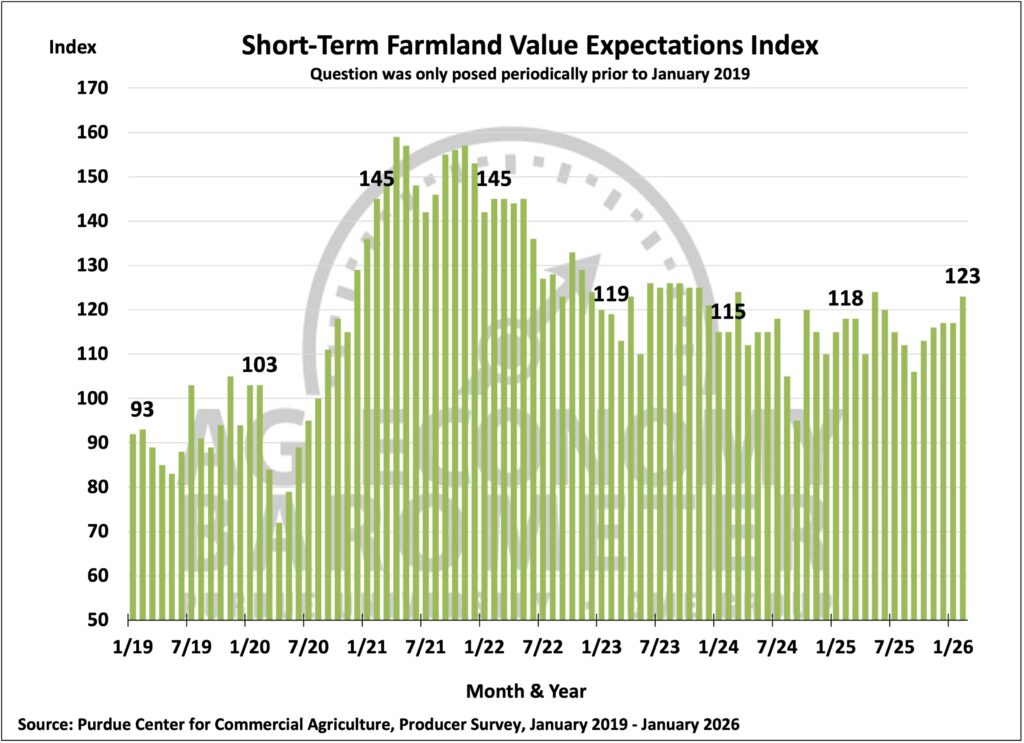
Meanwhile, respondents remained optimistic about short-term farmland values in February, but optimism regarding long-run land values continued to wane. The Short-Term Farmland Value Expectations Index increased from 117 to 123 (see Figure 6). After reaching a new record high of 166 in December, the long-term index declined to 152 in January and 150 in February. Alternative investments, net farm income, and interest rates were cited as the three factors having the most influence on farmland values.
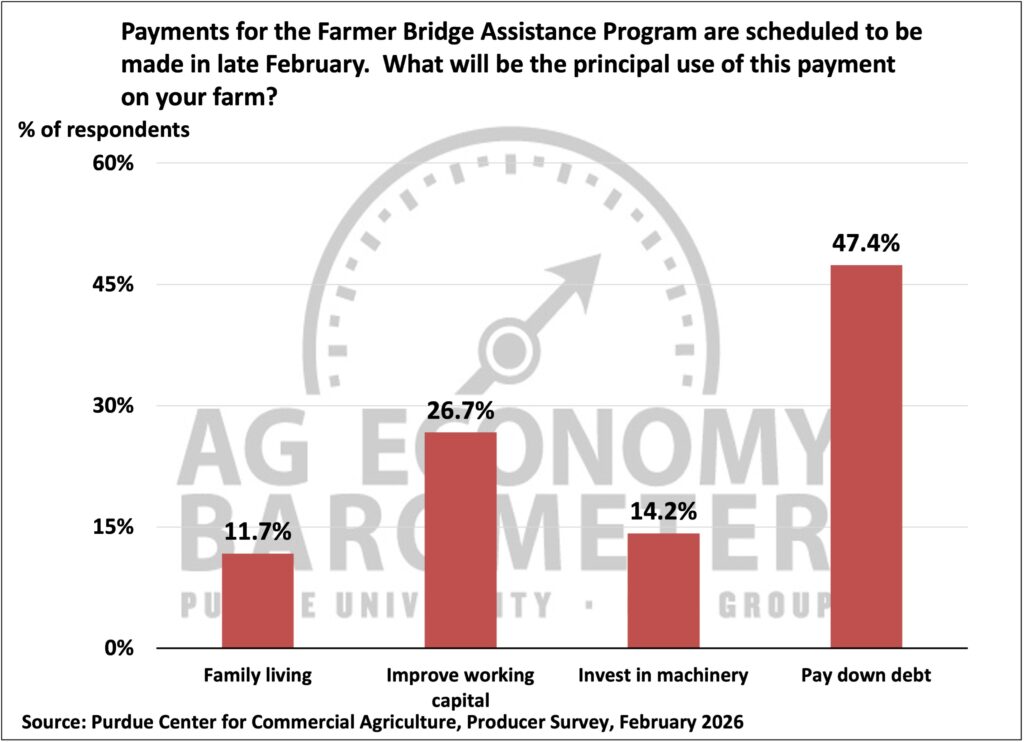
This month’s survey included a question related to the Farmer Bridge Assistance Program announced in late December. Respondents were asked how they plan to use these payments. Approximately 47% of respondents indicated that these payments would be used to pay down debt. Another 27% of respondents said that they would use these payments to improve working capital. The remainder noted that these payments would be used for family living (12% of respondents) or to invest in farm machinery (14% of respondents) (see Figure 7).
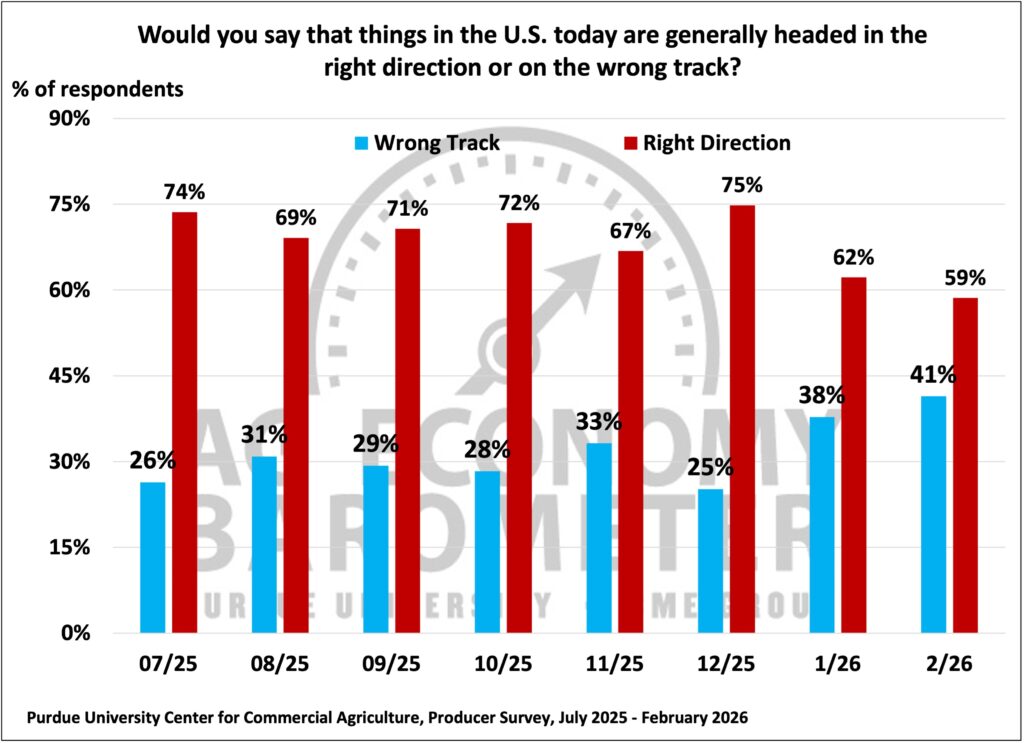
As in the last few months, producers were asked whether the U.S. is headed in the “right direction” or on the “wrong track”. The percentage of producers who indicated the U.S. is headed in the “right direction” dropped from 62% in January to 59% in February (see Figure 8).
Wrapping Up
Farmer sentiment increased from 113 in January to 116 in February. Sentiment regarding current conditions rebounded by 11 points, while sentiment regarding future expectations continued to decline. The percentage of producers who expected bad times in February was 48%, double the share reported in February 2025. There was a large disparity in expectations between crop and livestock producers. Approximately 63% of respondents expected bad times for crop producers, while only 17% expected bad times for livestock producers.
Approximately 50% of respondents indicated that they plan to expand their operations in the next 5 years, and 36% expect to bring another family member into the business. Producers’ biggest concerns included input costs and lower commodity prices. Finally, despite the prospects for upcoming payments under the Farmer Bridge Assistance Program, the percentage of producers who thought the U.S. was heading in the right direction has dropped from 75% in December to 59% in February.
Overall, the February results suggest that while producers report improved current conditions, confidence in the longer-term outlook continues to weaken. Although many operations are planning to expand, persistent concerns about input costs, commodity prices, and the broader direction of the U.S. economy appear to be limiting optimism about the years ahead.