


Current report published: September 1, 2026
Upcoming release: October 6, 2026
About the Ag Economy Barometer
The Purdue University/CME Group Ag Economy Barometer is a nationwide measure of the health of the U.S. agricultural economy. On the first Tuesday of each month, the Ag Economy Barometer provides a sense of the agricultural economy’s health with an index value. The index is based on a survey of 400 agricultural producers on economic sentiment each month. Quarterly, the index is accompanied by an in-depth survey of 100 agriculture and agribusiness thought leaders.
As CME Group’s roots are in agriculture, and Purdue University’s Center for Commercial Agriculture has a long history of producing cutting-edge agricultural research, this partnership is designed to create a new and important tool for producers, economists, traders, finance industry professionals and journalists who are interested in understanding the agriculture industry and the broader global economy.
Find the Ag Economy Barometer on the Bloomberg Terminal: AGECBARO, AGECCURC and AGECFTEX.
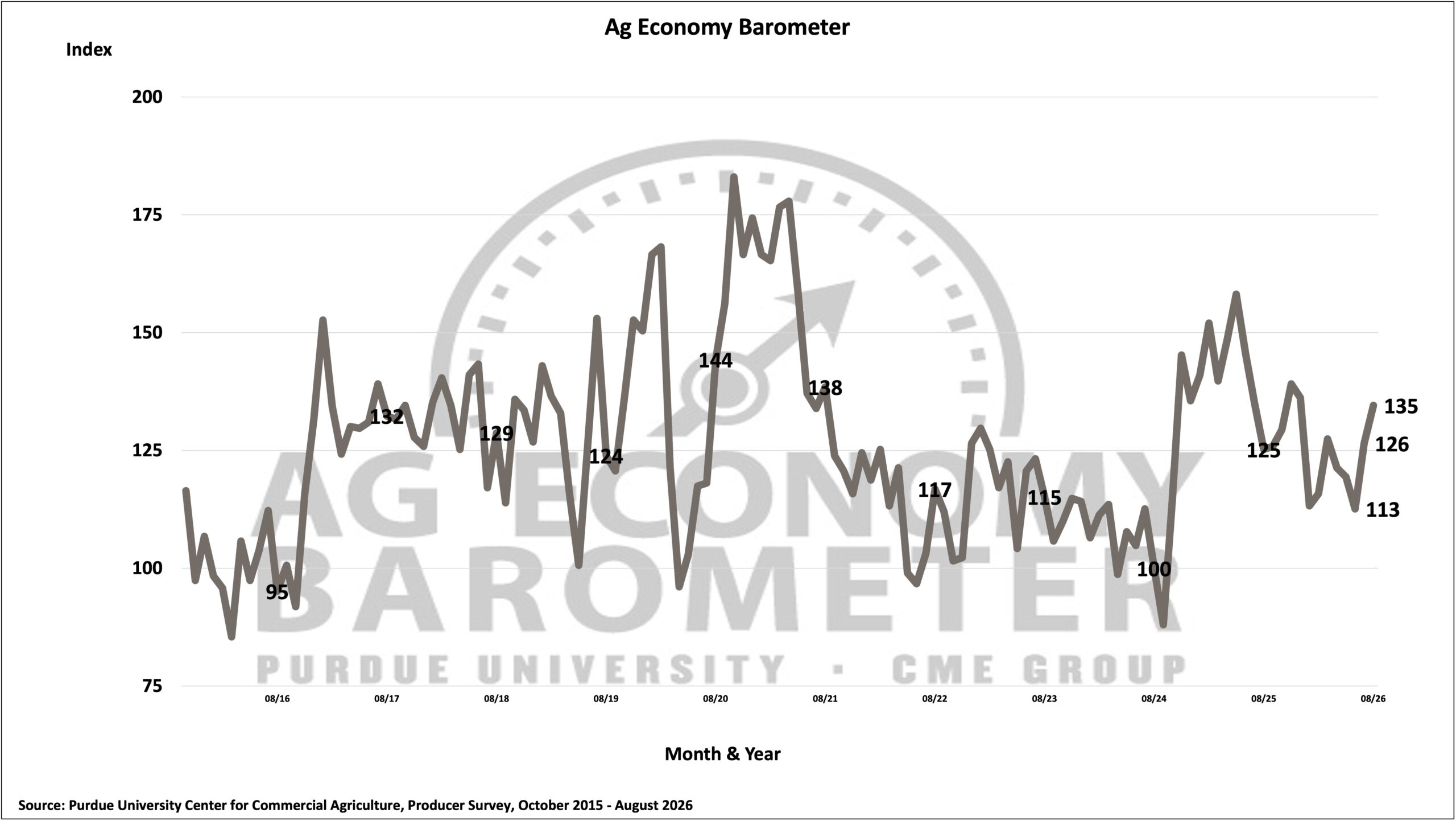
Michael Langemeier and Joana Colussi, Purdue Center for Commercial Agriculture Download report (pdf) Farmer sentiment improved for the second month in a row, with the Purdue University-CME Group Ag Economy Barometer (AEB) Index increasing from 126 points in July to 135 points in August (see Figure 1). Both subindices also increased; however, the Index of Current Conditions rose by only 1 point, while the Index of Future Expectations increased by 11 points (see Figure 2). For the first time since June 2025, a higher proportion of respondents expect their operation to be better off financially (28%) than worse off (24%)…
Read the Full ReportFarmer sentiment dropped again in June as the Purdue University-CME Group Ag Economy Barometer (AEB) Index declined from 119 points in May to 113 points in June. Sentiment declined with drops in both current conditions and future expectations. Input costs remain a top concern, with high input costs identified as the most important factor limiting improvements in financial performance.
Read the Full ReportFarmer sentiment dropped again in June as the Purdue University-CME Group Ag Economy Barometer (AEB) Index declined from 119 points in May to 113 points in June. Sentiment declined with drops in both current conditions and future expectations. Input costs remain a top concern, with high input costs identified as the most important factor limiting improvements in financial performance.
Read the Full Report