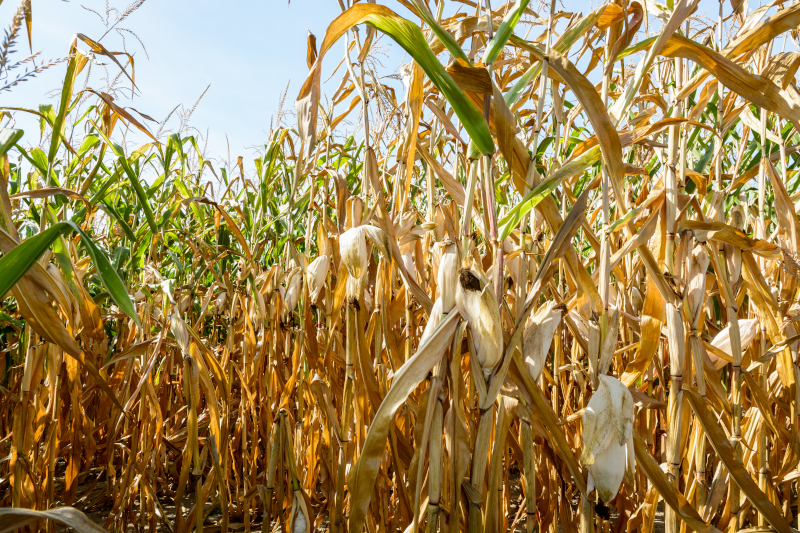
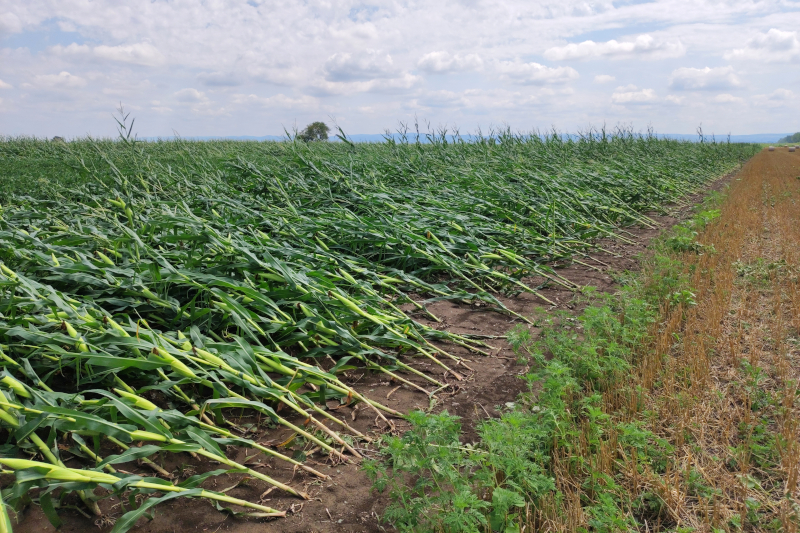
Transcript for How Weather Stress Impacts Corn Yield and What Farmers Can Do About It
Hello, I'm Alex Lindseay, an associate professor at Ohio State University in the department of horiculture and crop science. And today I'm excited to be talking with you a little bit about some work that we've done here in Ohio as well as um throughout the United States about dealing with weather stress through informed corn management. This is kind of a multi-tiered approach at tackling this complex topic. A lot of the work that's going to be presented today actually comes from a review article that came from some of the literature for work done throughout the US Midwest called adapted from severe storm damage and short-term weather stresses on corn. Uh that was written by myself and Dr. Osler Ortez kind of as lead authors here at Ohio State University. But some of the data that's presented in this presentation also comes from my own personal research program and hopefully will get us to the point where we can understand what to expect if we have weather stress occur and what we can do about it either from a remedial management or a prevention standpoint uh before this stress ends up happening. We know that throughout much of the United States, precipitation patterns are changing. Either distribution of precipitation during the growing seasons in places like the Great Plains, North, the Midwest, and the Northeast. In general, we've been seeing an increase in the amount of precipitation in recent years compared to our longer historical averages. So seasonality is starting to shift with regards to that precipitation events. And not only are we getting more precipitation on average, but that precipitation tends to be falling in heavier events. Uh we're getting an increase in the prevalence of extreme storm events. Anywhere from 16% in the upper Midwest to 71% in the Northeast. So that old adage, when it rains, it pours, is really starting to ring true in many of our states uh during the growing season in particular. So these strong storms are kind of a concern because they can bring with them strong winds at times heavy precipitation that may exceed the infiltration capacity of our soils leading to ponding water or flooded conditions. We also might experience some hail events that can cause tissue damage or stock damage in our crops. And so some of the questions come around with regards to these strong storms. How bad is the damage? What can we expect? And maybe what can we do about it or how can we prevent it in the future? The rain also is distributed throughout the season where our days suitable for fieldwork are starting to change as well. We're seeing increasing temperatures during the season, meaning that our frostfree date in the spring is happening about a week sooner than it has been historically. And we're also gaining about 2 weeks of frostfree temperature phase in the back end of the season, kind of in that fall throughout much of the Midwest. But even if we're above freezing, it doesn't necessarily mean those temperatures are particularly warm or conducive to crop growth. Those environments could still be cool or cold at times below 50 degrees Fahrenheit, even if they're not below that freezing threshold. With this change in seasonality, we may also see a change in that precipitation, especially leading up to the days of planting or other field work. We could have cold rain, nonfrozen precipitation instead of snow. and that could be falling into soil that is already wet, stays wet, and could potentially lead to issues with crop growth and development. The declining days for fieldwork also mean that growers might be more prone to perform agronomic activities in conditions that may be less than optimal for our soil environments. If it's marginal, growers may choose to do some activities in the field because they know if they don't get in now, they might get rained out because a cold front, for example, is coming through and rain might be coming, which could delay them another week or two or in some cases three. So, if they don't do some activities now, what implications could that have moving forward? So there's a lot of points of stress e either from these extreme rain events, these storm events, but also from if I don't do it now, am I going to be able to do it in the future? And so it may not be as stressful in the moment, but what happens in the next day or two could be really stressful for that crop. So that leads to a lot of questions, especially regards to our aggronomic practices with regards to these planting decisions. If we're our season is increasing and we're planting earlier in the year, what happens if the soil conditions aren't necessarily very good or conditions are good now, but it looks like things could change in the next 2 to 3 days. Are there concerns after planting for our immediate future of crop success? With regards to field activities, how are things going to be changed with regards to tillage, fertilizer applications, our weed control strategies? Are these things going to have to change as we start to look at these extreme events and how could they influence these? We can think about things like maturity and how that's going to change and also abiotic stress tolerance within our hybrids. For example, could hybrids that are more tolerant of certain herbicides become more popular or more adopted? Maybe we're adopting a different morphology. For example, short corn or short statured corn hybrids might be a choice or an option in the future. But some of this relates back to the stress and how much we're anticipating and what the potential yield losses could be. With any of these storms, there's things we can choose to do ahead of time, but there's also the reactionary measures. Some of those reactionary measures are going to depend on this the damage itself. How bad was it? what really are our options and in the future should we do things differently to prevent this damage from occurring and I think that's kind of where a lot of this presentation is going to focus is in our response after storms understanding a little bit of the damage or the yield losses that we might be able to expect what we can do about it after it occurs but also ways that we can prevent it or minimize the damage from occurring in the first place I'm going to focus on kind of the progression through the growing season for this presentation. The first thing we're going to talk about is kind of these idea of frontal boundaries bringing cold temperatures, particularly for early spring planted fields. Then we're going to talk about flooding and water logging in corn, particularly in the early season when the crop is most susceptible. We'll talk a little bit about hail and yield losses that could be experienced from those types of events. and then we're going to round out the presentation with some information on wind damage which can come with these strong storm events. So, as I mentioned early on, our seasons are lengthening, our springs are coming sooner because our above freezing temperatures are happening at an earlier calendar date. So, this means growers may push the envelope to plant earlier than they normally would. We're also seeing crop insurance dates earlier than we have in the past. Uh sometime between 10th of April and 15th of April is fairly common throughout much of the United States Midwest. And so growers are able to plant and receive full insurance coverage after those first planting dates. And so growers may decide to push some of their planting a little bit earlier in the season where it may be marginal or suboptimal to maximize that speed of emergence, growth, and development. Some of the issues from planting early into cooler soils or soils that are wet um could be things like sidewall compaction leading to issues with seedto soil contact and also early season root growth and development. But another issue that we might experience, particularly if we get rain shortly after planting, is that the soil above the seed furrow could end up becoming crusted. Even in a no-ill scenario, the process of planting agitates the soil in the furrow and it creates a localized zone of tilled soil material. If we get a pounding rain or heavy rain shortly after planting, it could lead to surface crusting and could lead it to issues with emergence success in that crop. Even if the seed germinates, those messodles may not be able to be pushed through the soil and emerge through that soil surface if it's crusted. If we plant too early as well, there could be issues with soil temperatures. In general, we recommend planting when soil temperatures are 50° for corn. But some of the questions come about with regards to what is that 50° temperature threshold mean? Does it mean that's the maximum temperature for the day? Does that mean average temperature, minimum temperature for the day? Is there a critical duration where that soil is at 50° or not? And so we may see 50° in the middle of the afternoon, but it could mean that the soil returns to a cooler temperature, 40, 35 Fahrenheit in some cases, which could lead to damage during the emergence window. So if we have cold temperatures after planting, often times growers ask the question, is my crop going to come up because it's experiencing inhibitional chilling? It could be imbivisional chilling or it could be the possibility that the seed embibes and germinates but this plant just doesn't emerge because it has cold damage or is experiencing cold damage during that emergence window. So it's important for us to understand the difference because if we're targeting the wrong problem, we may not be able to solve it very effectively. So the difference between inhibitional chilling and cold injury is that inhibitional chilling occurs when cold water is absorbed by the seed in the first stage of germination. Damage of this type typically occurs within the first day or two after planting. But the exact temperature range where this damage can be occurred and time frame of this damage occurring is not really well known. We know that it does tend to occur when temperatures are at least below 40° F, but the exact time exposure to that cold water temperature is not really known for what will trigger inhibitional chilling. The other type of injury that can occur prior to emergence is just cold injury after inhibition occurs during the emergence period. This can occur when seedlings are exposed to cold temperatures, typically those below 46 Fahrenheit for extended durations. But again, we're not really quite sure what brief periods of cold temperatures end up doing to these plants or where that injury is really stemming from. But it can cause issues with emergence. Maybe the seed germinates but growth stops or that plant doesn't have enough reserves to push through a compaction layer above the seed furrow. So regardless of whether the injury comes from inbitional chilling or cold damage, the result is similar. You'd have uneven emergence and poor stands develop. So what really can we do to avoid this type of damage from cold temperature stress particularly in those few days after planting between planting and emergence? The best option is if we're going to risk pushing planting date earlier that we stagger the planting dates to avoid having all of the fields be susceptible at the same time. If we can try to avoid soil temperatures of 40 to six degrees or colder during the emergence window, particularly for prolonged periods of time, that could be one way to avoid this idea of the cold stress impacting emergence. There's been consistent work that has shown that phosphorus starter fertilizers can improve early season growth if soils are on the lower side for the fertility level and a phosphorous fertilizer is recommended for your soil based on the soil test. It's not necessarily a guarantee that starter fertilizer is going to improve growth, though it can improve early season growth, though it's unlikely this will translate into a yield benefit at the end of the season. So, for early season growth, phosphorus starter fertilizer could potentially help improve it, but there's going to be limited yield implications from its use um just solely from having that early season growth potential. Another consideration from a grower perspective is to look at the seed lot vigor prior to planting. This isn't something that is reported on a seed tag necessarily, but many companies do screen their genetic material and seed lots for some sort of vigor assessment. In general, a higher vigor score is correlated to better emergence under stressful conditions. A poorer vigor score generally means poorer in emergence under stressful conditions. So positioning seed lots or varieties or hybrids that have a higher vigor score could mean better emergence in early planted scenarios. I know that this is talking about corn, but you may end up considering planting soybeans before corn given the potential uh yield implications from early planting. In some cases, kind of end of April to early May is the optimum planting window for corn, and planting too early could impose some sort of a yield penalty. So, it may be better to start with soybeans and then transition to corn as the soil temperatures warm up to be a more consistent level at kind of that 46 or above temperature. Regardless, if there's questions about whether the crop has experienced imbabitional chilling or cold injury during emergence, you'll want to assess stands during the season and consider replanting if your planting date was early enough with severe reductions. In general, the emergence rate for corn is about 180 soil accumulated growing degree days are required to get 90% emergence. So soil GDDs instead of measuring air temperature and doing the GDD calculation, we measure soil temperature roughly at the depth of planting. So roughly 2 in down and use that as our gauge for growing degree day accumulation. Otherwise, the equation is the same until about V6. Emergence and early season growth for corn is really driven by soil temperatures more so than air temperatures. Okay, so let's say we do get planted in our cold temperature environment and the crop does emerge. What happens if we get cold temperatures and it kills some of the above ground tissue? What's the threshold for this? And what can we expect? In general, if emerged plants are exposed to 21 degrees Fahrenheit for 2 hours, that was a sufficient threshold to kill 50% of the emerged plants. But if that temperature increased to 28° F, it took 48 hours of consistent exposure to kill 50% of the emerged plants. So in general, the warmer the temperatures are, the less damage we can expect from having low temperatures, as long as it's not for prolonged periods, the crop should be able to weather that and withstand it. The other thing to keep in mind is sometimes the plants can look like that photo in the upper right of the slide, even if the air temperatures in the evenings don't drop below 32° F. This is possible on still nights because of something called temperature inversions, which leads to radiant freeze conditions. Still air causes a lot of heat to radiate from plant tissues and can cause the surface of leaves to dip below the air temperature because of the radiant heat loss and escape from that tissue. So sometimes we can have frost or freeze damage of tissue even if temperatures don't drop below freezing because of this radiant heat loss. In general, if plants look like this, as long as the messodle and growing point are still healthy, the plant should be able to recover. We'll see recovery of the above ground chute. The older leaves won't recover, but new leaf tissue will still be formed, and we may end up seeing a shift somewhat in and tassel formation and anthesis, maybe in when that occurs, and the length of that period. Um, but in general the plant should recover. Some work from other states like Nebraska and Wisconsin looked at what happens if you clip the dead tissue on these plants that are damaged. In general, if we have this death, the new growth will be coming through, but it comes out kind of buggy whipped and restricted to some degree. So the idea was could we clip the plants and improve that rate of recovery have less buggy whipping and in general when this practice was employed more damage was done to the plants than was helped eight to 36% yield reduction at six of nine sites experiencing clipping. One site had no yield gain or loss. So seven out of nine times it really didn't help with yield. So in general, our recommendation at this point is even if 55 to 70% of emerged plants at the V4 growth stage or earlier, the recommendation right now is to let the plants go on their own. Able to overcome lower leaf damage with minimal yield penalty moving forward. If you do have substantial death of plants as a result of these cool temperatures, if early enough in the season, a replanting event may be warranted. There's been some work in controlled environments looking at biological treatment of tissue with something like non ice nucleating bacteria. Some of this work has been done in sweet corn spraying with a few different lines of bacteria to help avoid ice formation in tissues. Uh they've found some success with this, but field trials would need to be validated in field corn to really start to warrant recommendations of this in the event a frost event is happening early season. Hormone treatment with brassinolide has been shown to reduce cold damage in cord seedlings at 43 degrees Fahrenheit. But again, um this was done more in controlled environments and may have limited applicability in field environments. One of the bigger concerns that we might end up having if this type of event occurs as a result of a weather front coming through is herbicide efficacy and maintaining weed control in those production systems. In general, if you've planted early, you probably applied a pre-emergence herbicide or an early post-emergence herbicide, which may have a limited efficacy window. And if it's cool while that window is being um experienced, the natural emergence of weed species may be delayed. And by the time the weeds do start to emerge in that production system, the control window may have been passed for our pre-emergence herbicide, leading to more issues with weed control in those systems. The other issue is if we experience leaf canopy death during the early vegetative growth stages, it may take longer for that crop to completely close its canopy, leading to an extended weed-free period that need weeds need to be controlled to make sure they don't become yield limiting in that production system. So herbicide efficacy could be a concern with most of the herbicides that are applied pre-plant in cold conditions. Uh they do have safeners included. So crop damage is likely to not be a major issue in those systems. But the limited control is what we might be more worried about. Okay. So moving on from cold temperatures. Let's say that our crop has emerged and it's looking pretty good or at this point maybe it hasn't emerged and we have a weather front come through but the weather front instead of bringing cold temperatures maybe it just brings a lot of rain and it causes localized flooding. What could happen to our plant stands if the field is flooded prior to emergence? So what if we get heavy rains that cause flooding after planting but before emergence? A lot of the death in those systems is going to relate to the temperature where that water logging condition is experienced. In general, colder temperatures will result in less stand loss from flooding, but stands are going to be overall reduced even in the absence of flooding just because of cooler temperatures. In general, the non flooded emergence rate at 60° was 80%. But when flooded for 2 days or 4 days, emergence was decreased by about by about 10% to 70% emergence. So overall stands were decreased a little bit but not too much. At temperatures of 80° the magnitude of loss was much greater with flooding. stands went from 90% in non- flooded controls to 60% germination and emergence after two days of flooding with stands dropping to 10 to 30% after 96 hours. So if that storm front comes through after planting prior to emergence and you have cool temperatures and lots of water, chances are stands won't be as affected negatively as if it brought with it warm temperatures and flooding. that can be much more detrimental to corn stands after planting. Regardless of how long that water was there, you can sometimes get issues with crusting, as we can see here in these photos taken from northwestern Ohio in 2022. Alleviating standing surface water is a key management strategy here. Trying to reduce flooding and water logging is key. And if you do end up getting crusting to occur, trying to break up those crusts to allow those plants to emerge is really important. Some growers have utilized a rotary hoe to help break up that surface crust, but others in the era of GPS guided tractor um controls end up taking their planter back out setting planting depth to be fairly shallow and they set their AB lines and drive and essentially replant over the field that they had previously planted. This act of replanting is enough to start to break up that surface crust above the row. um to help facilitate plants that are going to emerge to break through that crust a little bit easier. So that's kind of a last stitch effort here to save the stand. But if the planting is early enough in the season, replanting is probably going to be a solid option, particularly if that field was flooded for three or more days. Once the corn is emerged, um, yield losses from flooding tend to decrease as the crop gets larger. In general, when corn is at the V4 to V6 growth stage, a 4-day flooding period will typically cause between 20 and 30% yield loss. But when flooding starts to go for longer than that, 5 days or longer, yield losses can range anywhere from 30 to 100% yield loss. One of the bigger concerning issues with regards to water logging, if plants are able to survive, is that often times any applied nitrogen prior to the flooding event um has been lost either to denitrification, leeching, or just becoming unavailable for the plant to take up. And so oftentimes flooding damage is confounded with nitrogen availability in the soil. As the plants continue to grow, they become less susceptible to flooding damage. In general, during flowering or grainfill period, an 8day flood is still only going to cause somewhere between 0 to 20% yield loss, becomes much more resilient um to longer durations of flooding as the plant gets taller. So going back to this idea of nitrogen availability and yield response in some recent work that we were conducting here in Ohio, we saw that when we had non- flooded controls and we applied either 100 pounds of nitrogen pre-plant compared to zero pounds of nitrogen pre-plant incorporated. At the time of side dress when that pre-plant nitrogen was applied, we still had pretty substantial soil nitrate levels available and crops responded still in a positive way to side dress nitrogen applications of 060 120 or 180 pounds of nitrogen applied um during kind of a normal side dress window. We saw a similar response if we did not apply uh pre-plant nitrogen though overall yield levels were a little bit lower um for those plots. Everything was compared to the highest yielding treatment uh with the highest nitrogen rate in this case. But if we look at a repeated flood, essentially we had the same field side by side, but we had three days of flooding followed by two days of drying and then we applied water for another 3 days to simulate six total days of flooding applied in two discrete events. We saw that essentially all of the nitrogen that was applied pre-plant was gone after that flooding event had happened. These two fields were sampled at the same time and so we saw no change in the pre-plant nitrogen values. We saw substantial differences when flooding was occurred. But interestingly enough, our yield response to applied nitrogen after the flooding period was over during sidress was similar. We saw that increasing that sideress rate suggests the corn is still responsive to that sidress nitrogen and our post flood nitrogen response was similar whether it was flooded or not. We did have lower yield potentials when the flooding was incurred. So in general what we were seeing from our results suggests that this combination of flood damage with nitrogen availability is important. But corn is still responsive to nitrogen applied post flooding. So if we have flooding and water logging occur uh and it's happening kind of prior to emergence, trying to alleviate the crusting is important and understanding the interaction of temperature and what effect that might have on stand is important. If soils are warmer, essentially 80° Fahrenheit, warmer than almost 70° Fahrenheit, seeds are probably going to die if the flooding is for 2 days or longer. But for longer durations, if temperatures are cooler, we might still be able to anticipate some emergence from those fields. In general, we want to assess stands and consider replanting if stand loss is severe. Again, staggering planting dates is important and considering post-emergence nitrogen applications to preserve yield and minimize nitrogen loss from these systems experiencing flooding is a recommended practice at this point in time. Corn will still be responsive even if water logging occurs and any nitrogen really applied pre-plant is going to end up being lost through these environmental pathways with longer durations of flooding. So from a nitrogen stewardship standpoint and yield response standpoint, it may make sense to delay nitrogen application until sidress if possible. Some work has been looking at incorporating different hormone treatments um for folure applications to ensure improved flooding tolerance. And some applications have been able to preserve biomass or yield production in some controlled environment studies uh with their application. But again these need to be applied at flooding onset which could be challenging um in the absence of a drone applicator or something like that. Again this work has been done in controlled environments. Uh limited testing in field tissue has been seen to date. So, it's not really a recommended practice at this moment in time. If we have flooding and it's occurring later in the season and it ends up bringing with it mud or soil particullet, uh it could lead to issues with soil crusting on plant tissue, which would end up needing to be washed off by some sort of rain event or light irrigation, which seems kind of silly to say. Your field has just been flooded, so apply some water, right? It doesn't necessarily seem like it should make sense, but it helps to get that soil off the surface, helps to decrease the heating coming from that soil absorbing sunlight, and can get that plant tissue back to photosynthesizing and helping with plant recovery sooner. Some considerations would be if it happens late enough in the season and the corn was intended for silage or feeding directly to cattle, uh either that silage quality because of the soil contamination um could be affected or potentially even the grain quality could be affected by having those soil particulates um around. Hail damage is fairly common in strong storm events. In general, 50% of hail storms in the US happen from March until May, and at 33% of them typically occur from June to September. So, we're looking at 83% of hail events happening sometime in the growing season in the United States. Unfortunately, there's not much that we can do to manage or prevent these. Uh in general, our action is usually to assess the damage from hail events, usually about a week after the storm has gone through. Yield losses from hail events could stem from stand reductions or loss of leaf tissue or the combination of both. In general, when we're assessing damage, we're usually talking with crop insurance agents and doing some sort of adjustment for yield loss prediction. And this could be something that is going to continue to be common um practice for managing for hail damage. In some cases, we may get to the point where we're looking at remote sensing and assessing damage using different um tools in that regard. Um but at this moment in time kind of going out and doing the field checks is kind of recommended practice. Some questions have been raised about use of folure fungicide after VT. Could this potentially help with recovery speed? Um but in general we found limited benefit from a preventative fungicide especially if there's a low disease pressure in that field. In general, the plant health gains um that have been sometimes associated with mentioning a folure fungicide haven't really been reported in past literature. Probably the best way we can deal with hail and defoliation damage is to try to spread the window of susceptibility for greatest yield loss by altering or varying planting date and hybrid maturity decisions. It helps to spread out crop stages from a single event coming through and decimating an entire crop. In general, yield losses tend to be the greatest from hail around the time of pollination. VT to R2 is when we typically see the greatest yield loss in corn. And so if we can spread that window out some, it helps to minimize direct damage at flowering and minimize the anticipated yield loss from those events. Current work that's been published in this area typically has focused on controlled defoliations with limited assessment of yield preservation from natural events occurring. In general, the controlled work has either reduced stand or it's caused defoliation or it's damaged stems. it necess hasn't necessarily combined a lot of these stresses for a cohesive um investigation. So things like other stressors resulting from defoliation or stem bruising could contribute to damage losses beyond what's been studied and what's been reported at this point in time. In some cases, this work is being done in small plot research and potentially there could be pollination success where we may not anticipate as much in a field where the entire field is affected. For example, some of the work that's been done looking at defoliation in some genetic lines has found that defoliation at the V8 growth stage led to complete tassel skeletalization or prevention of anthers being formed. So if an entire field had this event occur, no pollen formation means no grain yield essentially coming from it. But the yield losses from those small plot research may have been inflated because neighboring plots were pollinating those plants. So it's something to be aware of, something to be um thinking about and just understanding a little bit on the limitations of current research that's been done to date. But I think there's still value in these studies. There's still value in understanding these yield losses because at this point in time, it's kind of the best work that we have. In most cases, it's going to be fairly reliable as well. There's been limited work to see also how these defoliation events are informing or affecting susceptibility to um diseases that could infect grain and affect grain quality uh particularly formation of micotoxins as well. So, that could be an area of future research in this area. So, the last stress that we're going to talk about is wind damage. In general, root lodging is what we can see usually earlier in the season um prior to the V10 growth stage. Chances are, if we're seeing lodging, it's because of rootless corn or floppy corn syndrome. This is caused because the plants have been planted, but they haven't formed the crown roots very effectively. They're limited to essentially seinal root development. We see this more in hot dry soils or soils that had sidewall compaction where early growth of the root system was minimal. In general, if soil if planting depth was too shallow, we also tend to see this um show up a little bit more. So, increasing planting depth, particularly if the soils are on the drier side, could be a management strategy to avoid this in the future. In the mid-season to reproductive stages, sometimes we see root lodging occur where essentially the root mass is pulled partially out of the soil, but the stem remains intact. In general, if it happens prior to VT, we can see recovery like we see in the image here on the right. Um, recovery is usually seen within 3 days. Yield losses tend to range from 5 to 20% depending on severity. Um, but if it happens closer to pollination and early grain fill, we can see yield losses be higher. Somewhere between 25 and 40% are typical. Susceptibility to root lodging also tends to increase with seeding rate. We see increased prevalence of root lodging as seating rate increases. Um, but yield losses from having more root lodging really only occurred at the high seating rates. in this particular study only about.1% yield loss per 1% of root lodging. So of the wind stressors this is kind of on the lower side of a yield concern though it may not necessarily look pretty and may cause some harvesting logistics uh challenges. As long as it happens prior to the VT growth stage um it may be less of a burden for farmers to deal with. Something that's been increasing in prevalence these days is something called willowed corn. This is where we have stock breakage or bending either at or slightly below the ear. The plant though remains intact, but we tend to see limited to no recovery. There's really little information right now on how this is influencing yield and yield production. Um so in the coming years we may know more about this stress but it's something that can occur and we are seeing a little bit more frequently um in the field these days. So how do we quantify damage from these root lodging events? Aerial imagery could be one mechanism. Use of digital surface maps or NDVI values correlated well with plant height and recovery. And we also had pretty good associations with um measuring grain yield from these plots using NDVI or NDRE. In general, these smiley face type graphs are coming because when we had lodging at the R3 growth stage, kind of indicated by these squares and triangles here, a lot of the yield had already kind of been determined in those plots. And so we didn't see quite as low of a yield penalty um with those NDVI values. But for the early vegetative through tassling stages, we had pretty good correlation between NDVI and NDRE values and grain yield. Green snap is another common issue we can have as a result of wind damage. either stock crimping or complete breakage of the stem. In general, we haven't seen a strong correlation between seating rate and green snap susceptibility. In general, susceptibility is tends to be more of a hybrid by hybrid type um specific response. But yield losses from this type of damage in Ohio were somewhere between 2 and 3% per 1% green snap loss. Um but in Iowa that was a similar level if the snapping occurred above the ear. If snapping occurred below the ear the losses were closer to 73% yield loss per 1% increase in green snap. Reports from uh Nebraska have seen that be as high as 1%. As well at the end of the season we could still experience stock breakage. Usually this occurs during or after plant physiological maturity and it tends to lead to issues with either harvestability or um issues with essentially ear rots and micotoxin formation. Susceptibility can be increased due to poor stock integrity either from insect feeding or um poor rind strength possibly from the hybrid or the disease itself. In general, higher receding rates tend to have thinner stems with poorer rind strength. Um, yield losses tend to range in from 5 to 25%. Um, mainly from the inability to harvest efficiently. So, the ears are there, but maybe they fall off before they get into the combine. Um, but if they come in contact with the soil or stay wet, um, there could be issues with ear or grain quality. So, how do we prevent or avoid these stresses? um use hybrid selection to your um benefit. Short stature corns may be less um prone to lodging damage. Also, many companies have ratings for green snap or root lodging susceptibility. So, being cognizant of what those are is important. some interactions between seating rate and u root lodging we saw incidents but there really wasn't an association with yield losses um in general row spacing had minimal influence on susceptibility to this type of damage delaying nitrogen application could reduce damage but in general it's impractical to delay nitrogen applications until after the V12 to 14 stage and more yield loss from no nitrogen in is probably going to be experienced then yield loss from wind damage. In general, use of a fungicide could help minimize stock rot disease concerns and potentially improve harvestability at the end of the season. Um, but really harvest order of fields is going to matter. Harvesting those with poor stock integrity first is really important. So to summarize and conclude this presentation, just keep in mind strong storms can cause damage, but the severity oftentimes is dependent on the stage of the crop. And in many cases, the yield losses look or the losses look worse than the yield loss may end up being. Usually somewhere between five and 35% is a reasonable estimate for loss depending on severity. Um but to date a lot of our work has been limited to a single isolated stress at a time as opposed to a combination of these stresses. So future work should really look to combine these um to really expand our knowledge. A lot of the work that I've presented has come from my lab and has been recent but a lot of the other stress work has been published prior to 1995. So, this is an area where we're continuing to improve our knowledge, um, improve the information that's available, and really help evaluate new tools to see what can be employed to make our systems more resilient and more robust to strong storms and strong storm damage. With that, I'd like to thank you for your time. I appreciate um the funding support for a lot of the work that's been presented here and wish you the best as you continue to explore this webinar series.