

2025 Summer Test: 56-Day Summary
S25-2
7/25/2025
We have reached the halfway point for the 2025 Summer Test. As a group, ADG was 2.9 lbs per day during the last 28-days which is 0.35 lbs/day off of the target ADG of 3.25 lbs. Granted there are several factors of importance other than ADG to define success at a performance test and bull development; when a goal is set it's important to work at achieve the goal. The low hanging fruit to blame low performance on with a summer test is always going to be heat and humidity; however, we've had longer hot and humid durations than what bulls experienced this last 28-days. Is the six inches of rain received since the last weight an issue? It's certainly a possibility from a freshness of feed perspective depending on when rain fell in relation to the daily feeding. The TMR indicates we could add a tick more energy to the diet which suggest our analysis of corn could be off as silages have been the primary ingredients analyzed recently.
Greater forage inclusion could be costing us performance during summer months from added heat stress from heat of fermentation on a high fiber diet. Although we are not a feedlot, some feedlots will alter feeding times to later in the afternoon, evening or night during the summer so that cattle are not combating as great of ambient temperatures when the heat from fermentation peaks 2 to 6 hours post the initial days first feeding.
| Range in ADG | Number of Head | Percentage of Group |
|---|---|---|
| 4.69 to 4.0 | 1 | 1.4 |
| 3.99 to 3.0 | 6 | 37.7 |
| 2.97 to 2.48 | 29 | 42.0 |
| 2.41 to 2.0 | 8 | 11.6 |
| 1.99 to 1.59 | 5 | 7.3 |
| Total | 69 | -- |
| Item | Forage Sorghum | Wheat Silage |
|---|---|---|
| Dry Matter, % | 43.8 | 51.3 |
| Crude Protein, % | 15.4 | 12.8 |
| Fat, % | 3.8 | 3.4 |
| ADF, % | 28.0 | 26.1 |
| NDF, % | 39.0 | 40.3 |
| Starch, % | 22.4 | 20.3 |
| TDN, % | 66.8 | 67.8 |
| NEm, Mcal/lbs | 0.71 | 0.72 |
| NEg, Mcal/lbs | 0.44 | 0.44 |
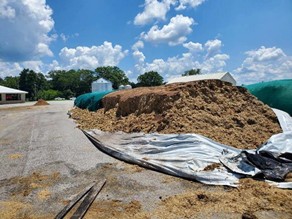 On July 10 the picture to the right was the image the guys from Feldun were welcomed with as they coming back across the farm a couple of hours post feeding. What we believe happened was a combination of two things; 1) the bag being cut from top to bottom as we work into the bag and 2) the protective covers. The protective covers draw additional heat to the bag as shown by a darker coloration in the silage around the edges of the silage. This is the cost of protecting a significantly larger amount of silage. We believe the plastic had more "stretch" too it from the covers given the time of year in combination with potentially how the bag is cut. It pretty acted like a zipper down 3/4 of a 200' bag. Nonetheless, Feldun was quick at getting it re-bagged with the use of two feed wagons to feed the silage back into the bagger. So far, silage appears stable as indicated by forage analysis. At the end of the day there are a number of "natural" disasters that could have led to bags splitting or being compromised and we would have been in a similar situation if not worse. We will learn something from this!
During the last 28-days we've had a couple cases of pinkeye, hoof cracks and foot rot. In each case, bulls all seem to have recovered.
If registration and weaning data has not been submitted to IBEP, please send this information as soon as possible. Double check bull registrations to confirm bulls are free of ALL lethal defects, this includes "population risk" bulls. Check registrations for status of genomic enhancement of EPDs and parent verification to sire and dam.
IBEP