

Overview
Healthy lawns provide aesthetic, recreational, and environmental benefits. Well maintained lawns and landscapes not only significantly increase property values, they can build a strong source of community
pride (Figure 1). Keeping a lawn healthy requires careful implementation of several key cultural management practices such as mowing and fertilization.
Authors
Cale A. Bigelow, Jim J. Camberato, Aaron J. Patton
Purdue Agronomy
* All photos by Cale Bigelow
What Kind of Grass Is in Your Lawn?
Why Should You Fertilize Your Lawn?
What Nutrients Does Your Turf Need?
How Do You Develop a Fertilizer Program?
What Fertilizer Should You Use?
What Else Should You Consider?
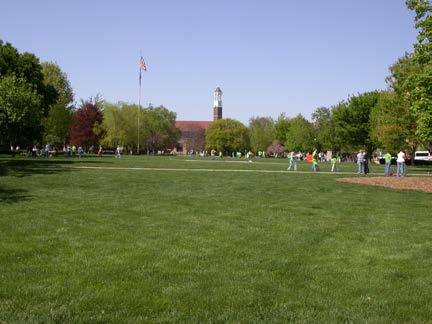
health and appearance.
Periodic fertilization of an established lawn is important because it keeps the lawn looking good and reduces how much you have to water and control weed, insect, and disease pests — that saves you money and is environmentally responsible. This publication answers questions about fertilizing cool-season lawns and provides tips for creating your own fertilization program.
What Kind of Grass Is in Your Lawn?
Most lawns in the Midwest contain cool-season grasses, which grow best in the cooler temperatures of spring and fall. During the hottest times of year, they may grow very slowly or even go dormant. Kentucky bluegrass, perennial ryegrass, tall fescue, and fineleaf fescue are common cool-season grasses.
By contrast, warm-season grasses perform best in warmer climates and are less common in the Midwest, except near the Ohio River valley. These grasses thrive and grow when many cool-season varieties go dormant. Zoysiagrass and bermudagrass are common warm-season species.
If you’re not sure what kind of grass you have, or what type of grass to plant, the turfgrass identification and lawn selector tools can help:
Why Should You Fertilize Your Lawn?
Fertilizing lawns maintains density and plant vigor, enhances green color, and encourages growth and recovery from turf damage and seasonal turf stresses (such as hot, dry periods). Unfertilized lawns will gradually lose density. When that happens, undesirable grasses (such as crabgrass) and broadleaf weeds (such as dandelion and clover) encroach and the risk for soil erosion increases. Properly fertilized lawns better tolerate stresses such as heat, drought, and cold. Applying the right fertilizer at the correct time helps turf plants accumulate and store the essential plant foods (sugars/carbohydrates) that are used for growth and development.
Malnourished turfgrasses are more prone to damage from diseases and insects — the damage is more noticeable and recovery takes longer (Figure 2). In short: dense, healthy, properly fertilized lawns require fewer pesticides to manage weeds, diseases, and insects. Lawns receiving periodic fertilization also help protect water quality by substantially reducing water runoff and potential soil losses.
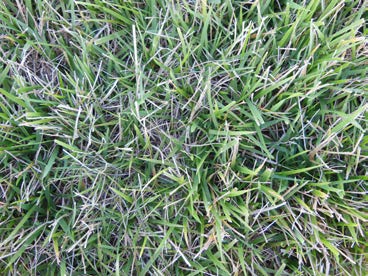 Figure 2. The turf on the left has not been fertilized for three years and is malnourished. The leaves are yellowing
(chlorotic) and the soil is becoming visible near the canopy base. The turf on the right has been regularly
fertilized. It has a pleasing green color and much higher shoot density to resist pests.
Figure 2. The turf on the left has not been fertilized for three years and is malnourished. The leaves are yellowing
(chlorotic) and the soil is becoming visible near the canopy base. The turf on the right has been regularly
fertilized. It has a pleasing green color and much higher shoot density to resist pests. 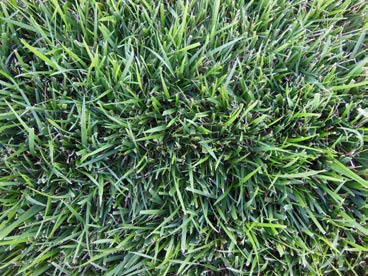
What Nutrients Does Your Turf Need?
You should only apply the nutrients your lawn needs. The nutrients plants need in the greatest quantity are nitrogen (N), phosphorus (P), and potassium (K). Of these, N has the most impact on established lawns. N promotes green color and overall growth, especially leaf growth. Plants need P and K for strong root and stem growth, which is most crucial when establishing a new lawn — for more information about establishing lawns see Establishing Turfgrass Areas from Seed (Purdue Extension publication AY-3-W) and Establishing a Lawn from Sod (AY-28-W), available from the Education Store.
Don’t guess the nutrient needs of your soil: you should test your soil to determine what nutrients it needs. Turfgrass plants accumulate 13 essential nutrients from the soil. You will not need to fertilize for most of these nutrients because they are already present in the soil.
Soil test results also indicate soil pH, which is the acidity or alkalinity of the soil. If the pH is too high or too low, it will limit nutrient availability and turf growth, and will reduce turf health. Poor soil pH must be corrected.
Find a certified soil-testing laboratory at ag.purdue.edu/agry/extension/Pages/soil_testing.aspx. Learn more in Soil Testing for Lawns (AY-18-W), available from the Education Store.
Some soils need to be tested more often than others. Test coarse-textured, sandy soils every year. Test fine-textured/heavy (that is, clayey) soils every two to three years.
Select an appropriate fertilizer source (Table 1, page 5) based on soil test results and your color and growth preferences. While soil tests recommend how much of nutrients like P and K that your soil needs, there is no reliable soil test to determine the N needs for lawns. N is applied to provide greening and growth. Individual needs will vary depending on personal color preferences, the turf ’s need to recover, and its ability to maintain itself (Table 2, page 6).
How Do You Develop a Fertilizer Program?
An annual fertilizer program generally consists of two to six individual fertilizer applications. Base your annual fertilizer program on a specific goal for maximizing turf health, not a color response. If you want the greenest, most actively growing lawn all year round, it is important to understand that you will likely need to apply more fertilizer more frequently (four to six times annually). Remember, where you apply more N, you will need to mow more often.
If your primary goal is a very dark green lawn, consider selecting and planting grass cultivars that are genetically more dark green (Figure 3). This may help reduce the amount you need to spend on fertilizer and decrease your mowing requirement.
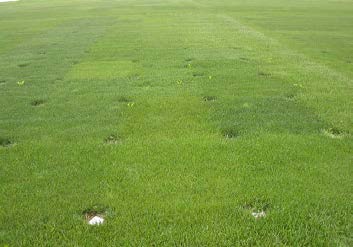
vary considerably. If you desire a dark green lawn,
choose darker green cultivars or varieties.
When Should You Fertilize?
The cool-season grasses (such as bluegrasses, fescues, and ryegrasses) will benefit most when you apply the majority of N fertilizer from late summer through autumn (Figure 4). This promotes summer recovery, enhances shoot density, maximizes green color, and prepares the turf for winter, all without a growth surge.
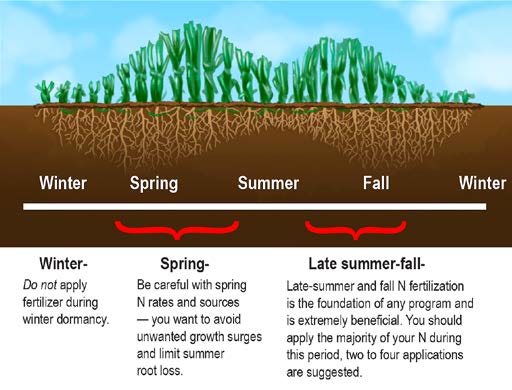
shoots and roots. Note the suggestions for when to apply N to promote maximum
turf health.
Apply less N during the spring growth flush, and then apply little to none during summer except where you frequently water and/or regularly remove clippings during mowing.
When you apply N fertilizer during the spring, use slow-release fertilizers to minimize excess growth. To promote maximum density during late summer and early fall (late August through early November), you should apply up to 1 pound of N per 1,000 square feet each month. From early October until early December, apply primarily water-soluble N fertilizers at slightly lower rates (such as 0.5 to 0.75 pound per 1,000 square feet) about every three weeks.
What Fertilizer Should You Use?
There are many commercially available fertilizer products. By law, all fertilizers list three numbers on their labels (for example, 16-4-8). These numbers indicate the guaranteed minimum percentage nutrient analysis or amount of N, P (as phosphate), and K (as potash). For example, a bag of 16-4-8 fertilizer contains 16 percent N, 4 percent P, and 8 percent K.
Consult your soil test report to determine your specific P and K needs. Many consumer publications suggest applying P and K in the fall to “put the lawn to bed.” However, if a soil test indicates your soil has sufficient P and K, applying more is unnecessary.
Ideally, you should use “lawn” fertilizers. Avoid “general-purpose” garden fertilizers (such as 12-12-12). Lawn fertilizers are specifically designed to provide the nutrients that mature lawns need. They also are formulated to minimize turf injury and often contain some portion of slow-release nutrients to provide long-term, steady feeding.
Calculating Granular Fertilizer Needs
To determine how much fertilizer you need to apply you need to know three important things:
- The size of the area you plan to treat
- The target application rate you want to apply (normally between 0.5 and 1.0 pound of actual N per 1,000 square feet)
- The percentage of the nutrient in the fertilizer product you will use
Let’s say you have a lawn that is 5,500 square feet, your target application rate is 0.5 pound of actual N per 1,000 square feet, and you are using an 18-0-10 fertilizer product.
Here’s how you determine how much actual fertilizer product you will need to apply to your lawn.
- Convert the percentage of the nutrient to a decimal. The 18-0-10 fertilizer product contains 18 percent N, so the decimal value is 0.18.
- Divide the target application rate (0.5 pound) by the decimal value from step 1.
0.5 ÷ 0.18 = 2.78
This is how many pounds of actual fertilizer product you will need per 1,000 square feet. - Divide the actual area of your lawn (5,500 square feet) by 1,000:
5,500 ÷ 1,000 = 5.5 - Multiply the results from Steps 2 and 3 to determine how much actual fertilizer you will need to apply to your lawn at the desired rate:
2.78 x 5.5 = 15.29
You will need to apply 15.29 pounds of 18-0-10 fertilizer product to your 5,500-square-foot lawn to achieve the target application rate of 0.5 pound of N per 1,000 square feet.
If you want to skip the math, the Purdue Turf Fertilizer Calculator can perform these calculations for you (Figure 5). Simply input the specific product analysis, target application rate, and size of the turf area you want to treat to determine your product needs.
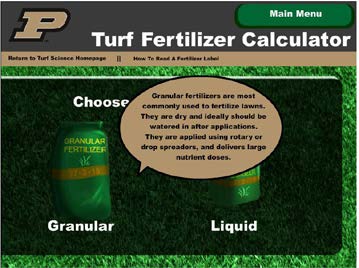
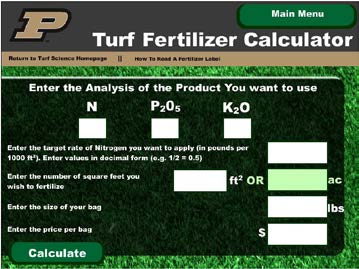
agry.purdue.edu/turf/fertilizerCalculator/index.html)
calculates granular and liquid fertilizer needs for
your lawn.
Two Kinds of N Fertilizers
N fertilizers are broadly classified into two categories:
- Quick-release products that are watersoluble and immediately available to plants
- Slow-release products that release N slowly over time
One type is not necessarily better than the other — what you apply often depends on your goals and when you plan to apply. Most lawn fertilizers combine quick- and slow-release N sources. Fertilizer labels will describe the specific proportions of each type the product contains.
For established lawns, it is appropriate to apply fertilizers that contain 25 to 50 percent slow-release N. This combination promotes rapid greening and gradual feeding for several weeks. However, from early October through early December (or when the ground freezes) a product that contains nearly 100 percent water-soluble N is preferred.
How Much Should You Apply?
All lawns will benefit from some fertilizer. Fertilization, especially with N, helps maintain density, color, and vigor. But more fertilizer is not necessarily better and excess fertilizer will contaminate surface and ground water.
Annual N requirements vary considerably depending on turfgrass species, growing environment, appearance expectations, and traffic. When considering how much N to apply, you must answer two questions:
- How much overall fertilizer do you need to meet your expectations?
- How will this amount affect your ability to provide enough fertilizer to maintain the turf? For example, are you willing to provide the extra mowing that might be required?
In general, mature cool-season lawns may need between 1 and 5 pounds of actual N per 1,000 square feet per year, which depends on many factors (Table 2, page 6). Selecting the specific fertilizer, rate, and timing for each application also depends on many factors. Remember, your goal should be steady, sustained growth, not rapid growth flushes or greening.
A product’s maximum application rate depends primarily on the amount of water-soluble N it contains. Do not apply more than 1.0 pound of actual water-soluble N per 1,000 square feet in any single application. This helps minimize growth surges, potentially negative effects (such as leaf injury), and leaching and runoff loss.
If the fertilizer product contains more than 50 percent of its N from slow-release sources, you can apply the product at higher rates. For these products do not apply more than 2.0 pounds of actual N per 1,000 square feet in any single application.
In other words, if a product contains 50 percent slow-release N, applying the product at 2.0 pounds of actual N per 1,000 square feet supplies 1.0 pound per 1,000 square feet each of quick-release (water-soluble) N and slow-release N.
What Else Should You Consider?
Growing environments and management practices affect overall N needs. In the 12 to 18 months after you install a new lawn (seeded or sodded), the turf may require up to 50 percent more overall N and more frequent applications than well-established lawns. By contrast, you may have to adjust your annual fertilization program if your lawn is extremely mature, it is shaded, it receives regular supplemental irrigation, or if you remove the clippings during each mowing.
Mature Lawns
Lawns that are fully mature and have been regularly fertilized for more than 10 years don’t need as much N fertilizer. Over time, the soils in these lawns have accumulated organic N, which provides background nutrition. For mature lawns, consider omitting one or more applications or reducing application rates to meet your growth and color goals.
Lawns Where Clippings Are Regularly Collected
Returning clippings during mowing benefits the lawn because grass clippings contain valuable nutrients that can be recycled into the soil. If you must regularly remove clippings when you mow, you may need to increase the amount of N you apply each year by 25 to 50 percent to maintain growth and color.
Shaded Lawns
Shaded grasses grow more slowly, so they may require up to 50 percent less annual N than turf grown in full sun. The turfgrass species of choice for shaded areas are the fine-leaf fescues such as creeping red fescue. This grass will persist in moderate shade, but if you apply too much N, the stand’s quality and density will decline.
In general, do not apply more than 2.0 pounds of actual N per year to turf in shaded environments. You can apply fertilizer at the same times you would apply it to sunny lawns, but you should simply reduce the overall N application rates by half.
More Tips for Responsible Fertilization
Healthy lawns provide more than aesthetic beauty. A substantial amount of university research has demonstrated that properly maintained and fertilized lawns considerably reduce water runoff, soil sediment, and nutrient losses. The movement of sediment and nutrients like N and P from urban areas, agricultural fields, and turf has been implicated in poor water quality. For more information, see Turfgrass Management: Facts About Phosphorus and Lawns (AY-22-W), available from the Education Store.
Follow these suggestions to fertilize your lawn responsibly to maximize health and minimize nutrient loss.
- Mow as high as practically possible (2.5 inches or taller) and return clippings when possible.
- Apply lower rates of fertilizer more frequently (such as 0.5 pound of actual N per 1,000 square feet every 21 days). This practice may provide more consistent color and growth responses than less frequent applications at higher rates.
- Only apply fertilizers to actively growing turf. Do not apply fertilizer to dormant or severely drought-stressed turf. Do not apply fertilizer during the winter or when the soil is frozen. Use a rotary spreader when possible (Figure 6). Rotary spreaders may be less time-consuming, easier, and provide more uniform product coverage than drop-type spreaders.
- Clean up any fertilizer particles that end up on hard surfaces (sidewalks, driveways, roads, etc.). Return the particles to the turf using a broom or blower.
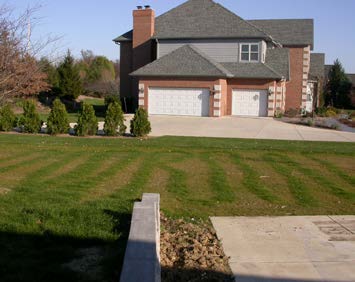
of implementing a healthy annual fertilizer program. Using
a narrow drop spreader to apply granular products across
large areas may prove difficult and result in misapplication
and poor turf nutrient utilization.
Find Out More
Find more publications in the Turfgrass Management series by visiting the Purdue Extension Education Store.
Some of the information presented in this guide, especially pesticide recommendations, may be specific to Indiana. Readers outside Indiana should check with their own cooperative extension services for state-specific information.
Reference in this publication to any specific commercial product, process, or service, or the use of any trade, firm, or corporation name is for general informational purposes only and does not constitute an endorsement, recommendation, or certification of any kind by Purdue University. Individuals using such products assume responsibility for their use in accordance with current directions of the manufacturer.
Table 1. General characteristics of common N fertilizer sources.
| Quick-release (readily available, water-soluble) | Slow-release (not immediately available, controlled release, water-insoluble) |
|---|---|
Examples
| Examples
|
Characteristics
| Characteristics
|
Table 2. General suggestions for developing a nitrogen (N) fertilization program for an established, mature, cool-season lawn (for example, Kentucky bluegrass, ryegrass, and/or fescues).
a Soil phosphorus (P) and potassium (K) needs should be based on demonstrated soil test needs.
b Avoid applications to dormant or severely drought-stressed turf. In general, no more than 1 pound of actual N should be applied in any one single application. Where the nitrogen fertilizer contains a high percentage (for example, > 50%) of slow/controlled release or water insoluble nitrogen higher application rates (for example 2 pounds of actual N) may be used.
c Higher application rates (for example, 2 pounds of actual N) should be divided into two or more individual applications.
| pounds of actual N/1,000 ft2a/b | ||||||
|---|---|---|---|---|---|---|
| Desired Maintenance Intensity: Visual appearance expectations, function and desired maintenance intensity | Total Annual N | Early Spring (mid-March through April) | Spring (May through mid-June) | Summer (mid-June through August) | Early Autumn (late August through September) | Autumn (October through early December) |
Lowest Maintenance Appearance: Consistent seasonal green color is not necessary. Function: Not suitable for intense traffic or use, density will decline. Management: Clippings returned during mowing, not irrigated. | 1-3 | 0-0.5 | 0-0.5 | 0 | 0.5-1 | 0-1 |
Moderate Maintenance Appearance: A dense, green lawn is desired but some seasonal color changes are tolerable. Function: Suitable for moderate traffic and use during nondrought periods. Management: Clippings returned during mowing, not irrigated | 2-4 | 0-0.75 | 0.5-0.75 | 0 | 0.5-1 | 1-2c |
Moderate Maintenance Plus Regular Supplemental Irrigation Appearance: A dense, green lawn is desired and minimal seasonal color changes are tolerable. Function: Suitable for moderate traffic and use during active growth. Management: Clippings returned during mowing, periodically irrigated to promote growth. | 2-4 | 0-0.5 | 0.5-1 | 0-0.75 | 0.5-1 | 1-2c |
Highest Maintenance Plus Regular Supplemental Irrigation Appearance: The darkest green color and densest turf is desired. Function: Will tolerate intense traffic and use during active growth. Management: Clippings are removed during mowing, regularly irrigated to prevent stress and promote growth. | 3-5 | 0-0.5 | 0.5-1 | 0.5-1 | 1-2c | 1-2c |