Turfgrass Science
A joint series from Purdue Extension and University of Illinois Extension
Purdue University Turf Science
Department of Horticulture and Landscape Architecture (formerly Department of Agronomy)
University of Illinois Turfgrass Program
Department of Natural Resources and Environmental Sciences
Introduction
Purchasing grass seed for your lawn can be a difficult task given the large selection of brands, vendors, and turfgrass types available. The first step before purchasing any seed is to determine what species of grass to plant. Factors to consider when selecting a grass for your lawn include (1) desired quality and the level of maintenance you are planning (consider mowing, watering, fertilization, cultivation and pest control); (2) site (shade or sun, wet or dry); and (3) use. Table 1 lists the species of turfgrasses that are recommended for homelawns in Indiana and Illinois. For specific cultivars of turfgrass species recommended in Indiana and Illinois, please refer to AY-5, Turfgrass Cultivars for Indiana.
Authors:
Zac Reicher, Professor and Turfgrass Extension Specialist, Purdue University Department of Agronomy
Cale Bigelow, Assistant Professor and Turfgrass Extension Specialist, Purdue University Department of Agronomy
Aaron Patton, Graduate Research Assistant, Purdue University Department of Agronomy
Tom Voigt, Associate Professor and Turfgrass Extension Specialist, University of Illinois Department of Natural Resources and Environmental Sciences
Table 1. Turfgrass species recommendations for selected sites in Indiana and Illinois.
| Sun | Condition | Species | Seed rate (lbs/1000 ft2) | Notes |
|---|---|---|---|---|
| Full | Medium-high maintenance (regular mowing, 3-4 pounds actual nitrogen per 1,000 ft2 per year fertilization, and irrigation) | 100% Kentucky bluegrass | 2 | - |
| Full | Medium-high maintenance (regular mowing, 3-4 pounds actual nitrogen per 1,000 ft2 per year fertilization, and irrigation) | Kentucky bluegrass + 10-15% perennial ryegrass | 3 - 4 | Limit perennial ryegrass wherever possible to limit future disease |
| Full | Medium-high maintenance (regular mowing, 3-4 pounds actual nitrogen per 1,000 ft2 per year fertilization, and irrigation) | 100% turf-type tall fescue | 6 - 9 | - |
| Full | Low maintenance (limited irrigation, 1-2 pounds actual nitrogen per 1,000 ft2 per year infrequent fertilization, mowing) | 100% turf-type tall fescue | 5 - 9 | - |
| Full | Low maintenance (limited irrigation, 1-2 pounds actual nitrogen per 1,000 ft2 per year infrequent fertilization, mowing) | 100% Kentucky bluegrass | 2 | Use a common Kentucky bluegrass cultivar like Ram1, Parks, etc. |
| Partial shade | Dry area (limited irrigation, proper drainage) | 100% turf-type tall fescue | 6 - 8 | Shade loving ornamentals will perform better than turfgrass |
| Partial shade | Dry area (limited irrigation, proper drainage) | 100% turf-type tall fescue | 6 - 8 | Shade loving ornamentals will perform better than turfgrass |
| Partial shade | Damp area (irrigation and/or poor drainage) | 100% turf-type tall fescue | 6 - 8 | Shade loving ornamentals will perform better than turfgrass |
| Partial shade | Damp area (irrigation and/or poor drainage) | 100% shade-tolerant Kentucky bluegrass | 2 | Shade loving ornamentals will perform better than turfgrass |
| Full | Temporary cover needed | 100% annual ryegrass | 4-5 | Plan on reseeding in the next 12 months |
| Full | Roadside, parking areas, low maintenance | 100% tall fescue (KY31) | 8-10 | - |
Table 2. Preferred ranges for items on the label of a good quality seed lot.
| Label Property | Definition | Preferred Range |
|---|---|---|
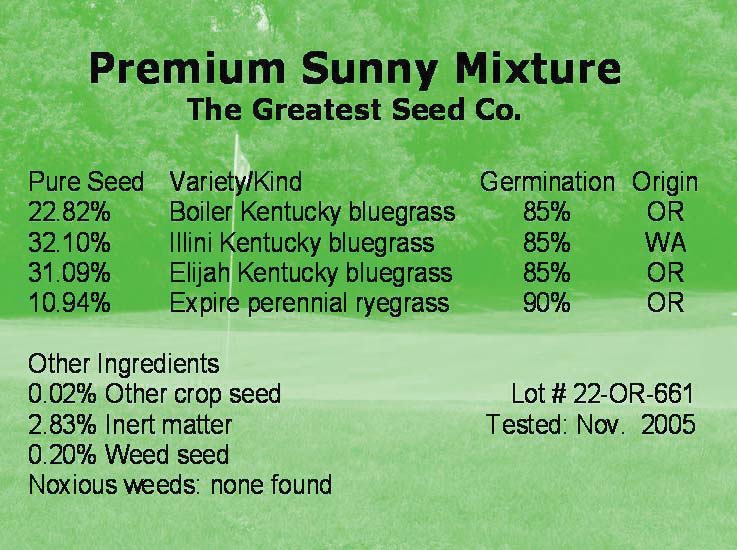
| Purity | Purity is the percent, by weight, of pure seed of each component in the mixture. Not all the pure seed is live seed. The purity for ‘Boiler’ Kentucky bluegrass in the sample seed label is 22.82%. | > 90% |
| Variety/kind | Variety/kind is the cultivar (variety) and the specific turfgrass species (kind.) Compare the variety with a list of cultivars well adapted to the Midwest to make sure that is a desirable cultivar. Do not buy seed that does not list the variety. Variety not stated (VNS) seed lots often include older cultivars not well adapted to lawns. | - |
| Germination | Germination is the percent of pure seed that has been tested under laboratory conditions for germination and should grow when seeded. The germination for Boiler Kentucky bluegrass in the sample seed label is 85%. | > 85 % |
| Other Crop | Other Crop is the percent, by weight, of seeds in a package that are grown as a cash crop. Examples of crop may include orchardgrass, timothy, redtop, clover, and bentgrass, which are considered weeds in turf. | < 0.5 % |
| Weed Seed | Weed Seed is the percent, by weight, of weed seeds in the package. A weed is any seed that has not been included in pure seed or crop. | < 0.3 % |
| Noxious Weeds | Noxious Weeds are the number per pound or ounce of weed seeds considered legally undesirable. Most of those listed for Indiana are not problems in turf areas. | None |
| Inert Matter | Inert Matter is the percent, by weight, of material in the container that will not grow. This includes pieces of seed stalks and chaff. | < 8 % |
| Date Tested | Date Tested is the date that the germination test was completed. | Within the last 9 months |
| Seed Lot | Seed Lot is a number that provides a way for the seed company to trace the history of that seed in case a problem should arise. | - |
Interpreting Turfgrass Seed Labels
The ability to understand seed labels is critical for selecting good seed. The information on the seed label will help you determine if the seed is of high quality. Table 2 lists the preferred ranges of items found on the seed label and their definitions.
Cost Comparisons
Just because a seed lot is cheaper per pound does not mean that it is also cheaper to establish. This is a common misconception. Seeding rate and cost/ pound both influence the establishment cost of a new lawn. For example, let’s examine two different scenarios: Scenario 1 is to establish the lawn with Kentucky bluegrass and scenario 2 is to establish the lawn with turf-type tall fescue. Superficially it appears that it is cheaper to establish a lawn with turf-type tall fescue because the cost of seed per pound is less expensive, but it is actually cheaper to establish a lawn with Kentucky bluegrass.
Scenario 1 - Kentucky bluegrass
(Kentucky bluegrass sold at $3.50 per lb):
Seeding rate: 2 pounds/1000 ft2
Therefore, the cost to establish 1000 ft2 is $7.00.
Scenario 2 - Turf-type tall fescue
(Turf-type tall fescue sold at $2.00 per lb):
Seeding rate: 6 to 9 pounds/1000 ft2
Therefore, the cost to establish 1000 ft2 is $12.00 to $18.00.
Final Thoughts
Avoid the following when purchasing seed:- Buying out of bulk bins
- Seed from the weekend newspaper circulars
- Seed mixes that contain 'Linn' perennial ryegrass, ‘Kenblue’ Kentucky bluegrass and ‘KY31’ tall fescue
- Seed mixes that contain annual ryegrass
- Seed mixes where the varieties are not stated
- Seed cost is not the only factor in determining establishment cost
Some other points to consider:
- The optimum time to seed cool-season turfgrass species is August 15 to September 15, but in some cases it may be necessary to seed outside this window. For more information, refer to AY-3, Establishing Lawn Areas from Seed.
- If you have heavy shade in your lawn, it may be advantageous to plant shade-loving ground covers rather than turfgrass. For more information, refer to AY-14, Improving Lawns in the Shade.
The best bet on getting good quality seed is to buy name brands from a reputable seed house or garden shop. Generally, the more expensive the seed, the better quality it is. Paying a few extra cents per pound for good quality seed is insignificant when compared to the added expense of trying to maintain an attractive lawn that was from poor quality seed.