

Turfgrass Science
A joint series from Purdue Extension and University of Illinois Extension
Purdue University Turf Science
Department of Horticulture and Landscape Architecture (formerly Department of Agronomy)
University of Illinois Turfgrass Program
Department of Natural Resources and Environmental Sciences
Authors:
Zac Reicher, Professor and Turfgrass Extension Specialist, Purdue University Department of Agronomy
Cale Bigelow, Assistant Professor and Turfgrass Extension Specialist, Purdue University Department of Agronomy
Aaron Patton, Graduate Research Assistant, Purdue University Department of Agronomy
Tom Voigt, Associate Professor and Turfgrass Extension Specialist, University of Illinois Department of Natural Resources and Environmental Sciences
Turf quality on municipal athletic fields is typically poor due to excessive traffic from soccer and football. These heavily trafficked fields often have compacted soils that reduce turf density. Aside from poor playability and poor turf quality, heavily trafficked sports fields provide less cushion and increase the risk of athlete injury.
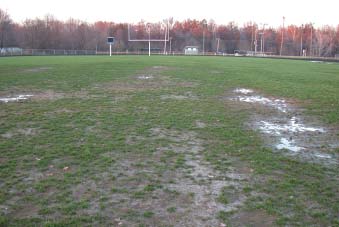
To counter traffic damage, athletic field managers are forced to overseed worn areas after the football and/or soccer season. This usually occurs in late spring or late fall, neither of which are ideal seeding periods for commonly used cool-season grasses such as perennial ryegrass or Kentucky bluegrass. Additionally, perennial ryegrass and Kentucky bluegrass are not well-adapted to warm, humid summers of southern Indiana and southern Illinois. Even if well-established, they are often weak and easily damaged during the summer months.
Bermudagrass is a warm-season turfgrass that may offer a potential solution. Perennial ryegrass and Kentucky bluegrass often go dormant during the summer and need time to recuperate in early fall. Conversely, bermudagrass performs well in the summer months and enters the fall playing season healthy and vigorous. Bermudagrass is well-adapted to athletic fields because it has excellent wear tolerance and recuperative ability. In fact, bermudagrass is considered to be the premier turfgrass for athletic fields in the southern United States. Bermudagrass can produce a higher quality athletic turf that has a lower irrigation requirement, more vigorous summer growth, and fewer insect and disease problems than cool-season turfgrasses. Seeding or sprigging bermudagrass in late May or early June instead of seeding a cool-season grass is an alternative for athletic turf. Improvements in the cold-tolerance of seeded and vegetative bermudagrass varieties now allow this turfgrass to be used in southern Indiana and southern Illinois (Table 1).
Table 1. Bermudagrass varieties best adapted for southern Indiana and southern Illinois athletic fields
| Vegetative | Seeded |
|---|---|
|
|
However, the major disadvantages of bermudagrass are poor winter tolerance and a straw-colored appearance after the first hard frost. Vegetative varieties of bermudagrass established by sprigs are not well-adapted to Indiana or Illinois and may die in severe winters. In the worst case, all or parts of bermudagrass fields may require reestablishment in the spring after winterkill. Some seeded varieties of bermudagrass are tolerant of Indiana and Illinois winters. “Riviera” is a new seeded cultivar that has survived winters in West Lafayette, IN. Although there are other cold-hardy seeded cultivars of bermudagrass available, preliminary research shows that “Riviera” also has good traffic tolerance. Overseeding perennial ryegrass in late August before the first frost will combat the problem of straw-colored turf, but doing so may also add to the risk of winterkill and slow spring green-up.
Establishing Bermudagrass Athletic Fields
Step 1
Grade the field to correct any surface drainage problems such as insufficient crown or low spots. Control existing vegetation with a non-slective herbicide such as glyphosate. Seed or sprig athletic fields with bermudagrass in late May or early June.
Step 2
Overseed bermudagrass turf with perennial ryegrass in late-August to mid-September if a green fi eld is desired and/or play will occur well into October and November. Remember that overseeding increases the risk of winterkill, so control the overseeded ryegrass with glyphosate immediately after the season in November or December.
Step 3
Repeat these steps the following year if there is winterkill or serious damage from the previous season. Only repeat step two if there is no winterkill or serious damage. The following section describes the establishment process in more detail.
Preparing Soil for Seeding/Sprigging
Research shows that seeding or sprigging bermudagrass into existing turf is not effective. Therefore, it is best to kill the entire fi eld with glyphosate and lightly rotary till the field prior to the initial seeding, sprigging or sodding. If the field is very thin or bare from the previous season, use a vertical slicer, power rake or other cultivation equipment to prepare the soil to a depth of 0.25 to 1.0 inch. Make sure to evaluate the surface drainage prior to seeding or sprigging. Proper surface drainage is essential to the success of all athletic fields. If sprigging bermudagrass, lightly disk or rotary till the area to a slightly deeper depth. This disruption of the soil will allow for proper sprig-to-soil contact which is necessary for proper establishment. Next, apply a starter fertilizer high in phosphorus at 1.0 to 1.5 lbs. P2O5/1000 ft2 to enhance growth and development. For more information on starter fertilizers, refer to AY3, Establishing Turfgrass Areas From Seed.
Time of Seeding/Sprigging
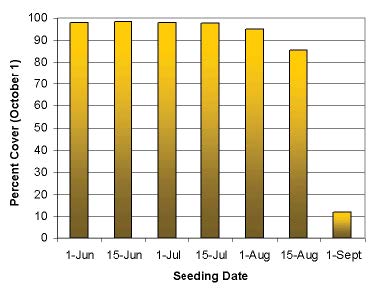
The best time to seed or sprig bermudagrass is late spring to early summer. Purdue research shows that the optimum time for seeding or sprigging in the southern half of Indiana is between May 15 and June 15 (Figure 2). Although coverage can be obtained with later seeding dates, it is preferable to seed early to enhance the winter survival and traffic tolerance. Germination should occur within 7 to 14 days depending on soil temperature and moisture (Figure 3). Ninety percent coverage usually occurs within five to eight weeks after seeding or sprigging.
‘Mirage’ bermudagrass
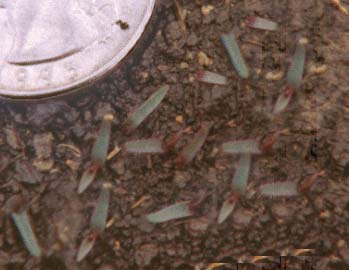
Seeding
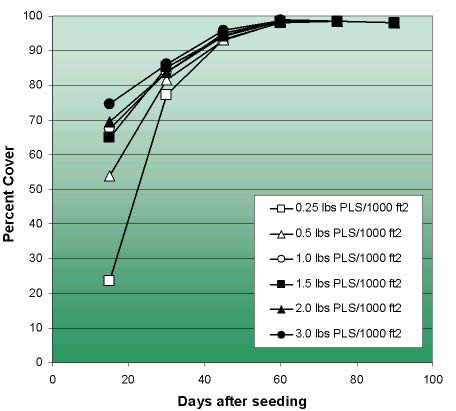
Seed bermudagrass at a rate of 0.5 to 1.0 lb. PLS/1000 ft2 using a drop spreader (PLS = Pure Live Seed = weight/(purity x germination)). Although these rates are lower than those used with other species, Purdue research shows that after only one month there is no benefit to seeding bermudagrass at rates higher than 1.0 lbs. PLS/1000 ft2 (Figure 4). Sow one half of the seed in one direction, and then sow the other half at right angles to the fi rst direction. For information on calibrating a drop spreader, refer to AY-22, Fertilizing Established Lawns. After the starter fertilizer and seed are applied, a light raking followed by a light rolling is recommended to insure good seed-soil contact. A roller designed to be filled with water, but left empty, is perfect for this task. It is critical to maximize the seed-soil contact for quick germination and establishment.
bermudagrass over two years in Indiana.
Sprigging
Sprigging is the process of removing a stem, stolon or rhizome, from a mature plant and replanting it in a different location. Sprigs are usually a few inches long and contain three or four nodes, from which new roots and shoots will develop. Sprigs start as sod that has been shredded, verticut, dethatched or by using a mechanical sprig harvester. Most sod companies that grow bermudagrass also sell bermudagrass sprigs. It is possible to harvest your own sprigs after an aggressive dethatching of a healthy bermudagrass area (e.g., an end-zone). To establish an area with sprigs; 1) prepare the soil by lightly tilling, 2) harvest sprigs from a healthy area, 3) broadcast sprigs over bare soil, 4) knife in or lightly topdress with soil, 5) apply Ronstar (oxadiazon) at the recommended rate to control annual grassy weeds, 6) apply a starter fertilizer at 1.5 lbs. P2O5 / 1000 ft2, and 7) irrigate frequently to promote regrowth. After about a week, new growth will begin to emerge, and the stand will fill in rapidly.
Post Seeding/Sprigging Care
Irrigation
A newly-seeded field may need to be irrigated one to three times daily depending on the weather. Apply enough water to moisten the top 1/2 to 1 inch of the soil profile, but avoid over-watering and saturating the area. Once the seedlings are one to two inches tall, gradually reduce the frequency of irrigation and water more deeply. After two or three mowings, bermudagrass will require little or no supplemental irrigation except in severe droughts. However, moderate irrigation will improve coverage.
Irrigation on a newly-sprigged area should take place as soon as sprigging is complete. Irrigate until the soil is nearly saturated, and then irrigate several times daily to keep the area moist. Despite all of this irrigation, sprigs may remain brown for one or two weeks before green up and growth begins. Reduce irrigation gradually once the plant begins to establish a root system.
Mowing
Mowing bermudagrass early will encourage the turf to fill in quickly. Mowing should begin when the first few seedlings are 1.0 inch tall. Mowing may only affect 10% of the plants in the first mowing, 20-30% of the plants in the second mowing, and so on. Be careful of wet surfaces during the first few mowings as scalping or tire rutting may occur. Bermudagrass should be ideally mown at 1.0 to 1.5 inches using a reel-type mower. Bermudagrass grows more quickly in the summer than cool-season grasses. Due to the higher growth rate, mowing may be required almost daily to avoid removing more than one-third of the leaf blade.
Fertilizing
New seedlings have poorly developed root systems and cannot effectively absorb nutrients from the soil. Therefore, fertilizer is important to encourage establishment. In addition to the starter fertilizer at seeding, apply 1.0 lb. N/1000 ft2 to bermudagrass two and four weeks after planting. This encourages growth and increases plant density. Since bermudagrass is a warm-season grass, you can use quick-release fertilizers such as urea, ammonium sulfate or ammonium nitrate for these summer fertilizer applications. Apply 1.0 lb. N/1000 ft2 every four weeks until mid-August. Fertilizing bermudagrass after mid-August may increase the likelihood of winterkill. Be sure to test soil for phosphorus and potassium levels, and make supplemental applications if necessary.
Weed Control
Bermudagrass is quick to germinate and fill in, but competition from annual grasses and broadleaf weeds may hinder establishment. Therefore, it may be necessary to use a herbicide for their control. Avoid using herbicides other than glyphosate prior to seeding to limit germination complications. For preemergence and postemergence control of annual grasses such as crabgrass, Dimension (dithiopyr) is safe to use on bermudagrass from seed after two mowings. Ronstar (oxadiazon) is safe for annual grassy weed control before sprigging bermudagrass. Since Ronstar is absorbed through the foliage instead of the roots, it will not harm the root development of sprigs. For postemergence grassy weed control, MSMA is effective when applied after three mowings. Avoid Acclaim (fenoxaprop-ethyl) for grassy weed control because bermudagrass is sensitive to this herbicide. For control of broadleaf and annual grassy weeds, Drive (quinclorac) is safe to use either before, during or after seeding of bermudagrass. Refer to all label directions for specific instructions.
Ongoing Maintenance
Fall Overseeding
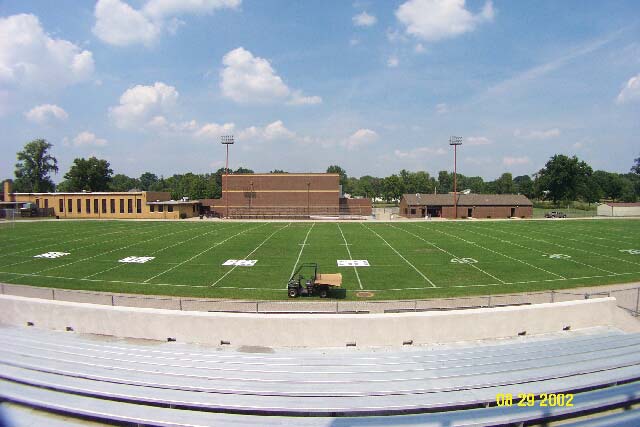
It may be desirable to overseed bermudagrass athletic fields with perennial ryegrass if fall sports are played (Figure 5). Overseeding with perennial ryegrass should be done in late-August to mid-September, before the first frost or about four weeks before the first fall athletic event. Common seeding rates for perennial ryegrass overseeding are 10 to 15 lbs./1000 ft2, so it can be costly. Table 2 provides a comprehensive management calendar for low, medium and high maintenance fields.
(Photo courtesy Steve Beckman)
Bermudagrass has several advantages over perennial ryegrass and Kentucky bluegrass for use in athletic fields, including aggressive summer growth and better disease tolerance. Although bermudagrass might not be appropriate for every field, it will provide cover on overused summer and fall-use fields. Using bermudagrass in southern Indiana and southern Illinois can improve safety, playability and aesthetics of athletic fields.
Table 2. Management calendar for Indiana athletic fields containing bermudagrass (From AY-31, Building and Maintaining Soccer Fields in Indiana)
| Maintenance Level | ||||
|---|---|---|---|---|
| Month | Low | Medium | High | Notes |
| April | Keep all traffic off field until bermudagrass greens-up and begins growing actively | Keep all traffic off field until bermudagrass greens-up and begins growing actively | Overseed if unable to fall or Keep all traffic off field until bermudagrass greens-up and begins growing actively seed | - |
| May | Apply 1.5 lbs N/1000 ft2 after bermudagrass has greened-up | Apply 1.5 lbs N/1000 ft2 after bermudagrass has greened-up | Apply 1.5 lbs N/1000 ft2 after bermudagrass has greened-up | Use urea (46-0-0) |
| June |
|
|
|
|
| July | - | Irrigate as needed |
| - |
| August | - | Irrigate as needed | Irrigate as needed | - |
| September | - | - | Apply 2.0 lb K2O/1000 ft2 | Use muriate of potash (0-0-60) |
| October - April | Keep all traffic off field after Bermudagrass goes into dormancy | Keep all traffic off field after Bermudagrass goes into dormancy | Keep all traffic off field after Bermudagrass goes into dormancy | - |
| December - February | Consider an application of glyphosate to control weeds | Consider an application of glyphosate to control weeds | Consider an application of glyphosate to control weeds | Bermudagrass must be absolutely dormant |