

Turfgrass Science
A joint series from Purdue Extension and University of Illinois Extension
Purdue University Turf Science
Department of Horticulture and Landscape Architecture (formerly Department of Agronomy)
University of Illinois Turfgrass Program
Department of Natural Resources and Environmental Sciences
Authors:
Cale Bigelow, Assistant Professor and Turfgrass Extension Specialist, Purdue University Department of Agronomy
Nolie Parnell, Small Animal Clinical Veterinarian, Purdue University School of Veterinary Medicine
Zac Reicher, Professor and Turfgrass Extension Specialist, Purdue University Department of Agronomy
Tom Voigt, Associate Professor and Turfgrass Extension Specialist, University of Illinois Department of Natural Resources and Environmental Sciences
Animal urine can aggravate anyone attempting to maintain a uniformly green, aesthetically pleasing lawn. Concentrated urine from wildlife such as foxes, deer, and geese can discolor, injure, or severely damage turf. But for homeowners, pets (particularly dogs) are the most frequent cause of patches of darker green and/or brown turf, that are often concentrated in a particular part of the lawn.
The exact mechanism of urine injury is not completely understood. However, concentrated salt-based fertilizer spills cause turfgrass damage similar to animal urine. This has lead many to believe that animal urine contains highly concentrated salts that dehydrate the turf.
Symptoms of Urine Damage
Animal urine can damage any turfgrass species in any climate. The most severe damage seems to occur where soil moisture is low and turf is poorly hydrated. Prolonged dry, hot weather may exacerbate the damage, especially for cool-season turfgrasses (Kentucky bluegrass, perennial ryegrasses, and tall and fine-leaf fescues). In severe cases of urine damage, turf receiving the highest concentration of urine typically takes on a gray-green, wilted appearance, which rapidly turns straw brown (Figure 1). Turf death may occur in 24 hours or less in hot, dry conditions. Dead patches of turf do not always appear, but when they do, there is a central crater of brown turf, 3-6 inches in diameter, surrounded by a dark green ring, 6-12 inches in diameter (Figure 2).
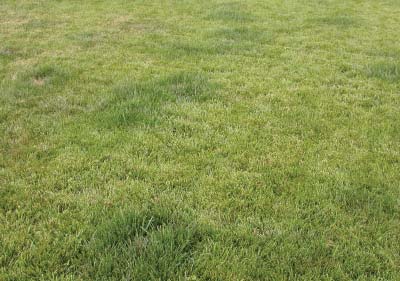
turf are caused by animal urine.
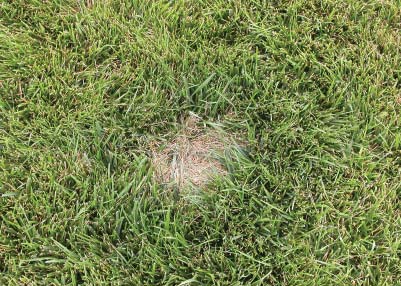
a dark green turf ring characterizes classic urine
damage.
This combination of very green and dead brown patches may persist for several weeks depending on the vigor of the surrounding turf and its capacity to recover and fill in. The greening effects are most noticeable in malnourished turf because the turf responds quickly to the urine’s readily available nitrogen. Greening may also occur in well-fertilized turf areas. For cool-season turfgrasses this is particularly evident during the early spring (March), midsummer, and late fall (November and December) when the turf is not actively growing (Figure 4).
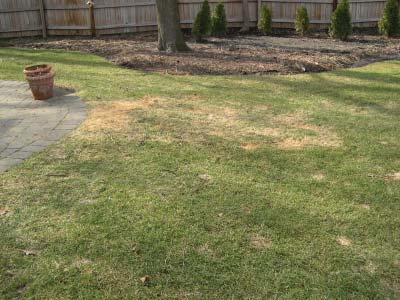
Figure 4. Concentrated dog urine can be particularly
damaging in months when the turf is not actively growing,
such as early spring.
Several common turfgrass diseases (such as dollar spot, summer patch, and necrotic ring spot) may be confused with animal urine damage because they affect turf during the warmer months and form similar patches and craters. For more on these and other turfgrass diseases, visit the Purdue Turfgrass Program publications Web site: http://www.agry.purdue.edu/turf/publicat.htm#BP. Animal urine turf damage can be distinguished from these diseases because there is no cottony mycelium present during the early morning and dying leaf blades do not appear water-soaked or mat down like those affected by fungal infections. Furthermore, urine damage almost always has a dark green, actively growing perimeter.
Behavior May Contribute to Damage
Of the common household pets, dogs tend to damage turf most. Cats are generally not a problem since they prefer gravel or sand-like substrates to void rather than lawns. Among dogs, females are more of a problem than males, due to differences in voiding behavior. Females typically squat when they urinate and male dogs lift their legs (Figure 3). However, young dogs of both sexes normally squat to urinate and the typical leg lifting and marking behaviors of male dogs do not become prevalent until dogs are about 1 year old.
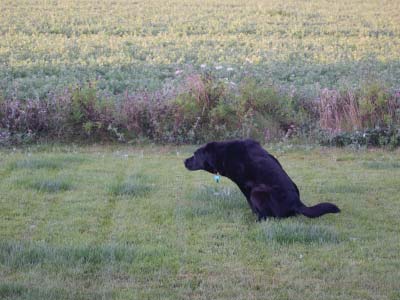
concentrating urine in one location.
In addition to squatting, female dogs are less discriminating about where they void and typically release all of their urine in one concentrated location.
Speculation abounds among pet owners regarding how the constituents of female dog urine damage turf. Some suggest that the urine’s pH, or that the hormone content of spayed vs. non-spayed dogs’ urine may influence the problem. To date, however, none of these factors has been thoroughly tested or proven to contribute to turf damage. Thus, the more important role is probably the voiding behavior of female dogs.
Practices That Help Minimize Damage
The only way to ensure animal urine does not damage turf is to completely remove the pet from the lawn, which for most pet owners is simply not practical, so consider the following management practices:
- Keep the pet off the most visible parts of the lawn and/or train the dog to use one designated low-visibility area.
- Water the portion of the lawn where the dog has voided with a watering can. This helps minimize serious damage but may not completely eliminate a greening response.
- Walk your pet in a neighborhood common area, dog park, or other, less aesthetically important turf area.
- Maintain healthy, vigorous turf that can easily recover from damage. Some of these maintenance practices include:
- Mow the lawn as high as practically possible; 2 to 3 inches is appropriate for most lawn turfgrass species.
- Follow an environmentally responsible, properly timed nitrogen fertilizer program (nitrogen is the nutrient most responsible for green leaves). This will help keep the area affected by urine from being dramatically different in color from the rest of the lawn. Although the turf affected by pet urine may respond to urine nitrogen, this does not necessarily mean that the lawn requires fertilization. Modest nitrogen additions may mask urine symptoms but nitrogen should only be applied when it will benefit the turf, and not during times when the turf is dormant and nutrients will be lost to the environment. For more detailed information, refer to Purdue Extension publication, AY-22, Fertilizing Established Lawns (http://www.agry. purdue.edu/turf/pubs/ay22.htm).
- During times of drought, follow a deep and infrequent lawn irrigation schedule. Maintain adequate soil moisture and keep the turf hydrated to minimize damage and encourage damage recovery.
Other Remedies Probably Ineffective
Some commercially available products claim they can repel animals from urinating on particular areas. However, these products have not been proven to be effective.
Also, a number of self-proclaimed pet authorities suggest a variety of dietary modifications (usually in pill form) to manage animal urine turf damage. Some products purportedly manipulate urine’s nitrogen content or affect the animal’s liquid consumption. Most of these products simply cause the pet to drink more water, thereby diluting the urine’s nitrogen content. An added side effect is that the animal will need to urinate more frequently, increasing the potential for “accidents.” Furthermore, using these products is potentially dangerous, and you should consult a qualified veterinarian before initiating such a remedy.
To see other Purdue Extension turf management information and publications, visit: www.agry.purdue.edu/turf.