

Facts About Phosphorus and Lawns
Authors
Cale A. Bigelow, William T. Tudor, and Jared R. Nemitz
Purdue Agronomy-Turf Science
All photos by C.A. Bigelow. All illustrations by J. Jones.
Phosphorus: Why the Concern?
Phosphorus is an essential nutrient that all plants need to grow and survive. Several environmental studies, however, have documented that excess phosphorus and nitrogen are partly responsible for declining surface water quality. These nutrients have been linked to eutrophication, a biological process in ponds, lakes, and streams where excessive seasonal algal growth occurs (Figure 1). These blooms can make the water smell and taste bad and decrease its recreational value. In severe cases, the algae deplete oxygen levels, which may kill fish.
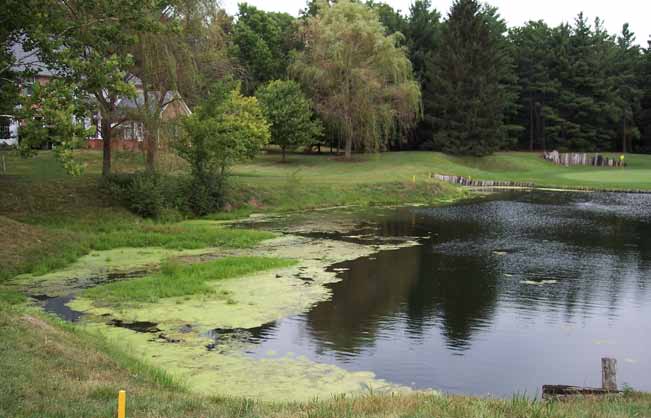
This publication examines the role that phosphorus plays in turfgrass growth, explains how to determine the needs of specific turf stands, and provides suggestions for proper application to reduce the risk of contaminating surface waters.
An Essential Plant Nutrient
Phosphorus is an essential macronutrient, a group that also includes nitrogen, potassium, calcium, magnesium, and sulfur. Plants also need micronutrients like iron, zinc, and copper but in smaller amounts than macronutrients. A nutrient is called essential because if it is not sufficiently available in the growing media or supplied as fertilizer, the plant will lack vigor and, when severely deficient, die. Additionally, severely malnourished plants are more prone to environmental stress (such as drought) and weed, insect, and disease pest problems.
Phosphorus is often associated with healthy root development but in truth, plants use it for many important growth processes. It is found inside plant cells as energy-rich phosphate bonds that are used to fuel the “metabolic machinery” and ultimately growth. Without phosphorus, leaf, root, and stem growth slows dramatically.
The first sign of a phosphorus deficiency is reduced vigor or slowed growth. Visually, the turf may appear somewhat dark green but the area will not seem to be growing as vigorously as expected. As the severity of the deficiency worsens, the appearance may continue to darken and the color of individual leaves may gradually change from dark green to purple as reddish pigments accumulate. If the deficiency is not corrected then portions of the turf stand will thin and lose density. This may result in undesirable weed
encroachment and soil erosion.
Phosphorus Sources and Where It Goes
Excess phosphorus can enter surface waters from a number of sources including atmospheric deposition, faulty or improperly installed septic systems, fertilizer runoff from turfgrass and agricultural fields, sediment, decaying plant debris, pollen, and pet or animal wastes. Although it is unclear how much each of these factors contributes to eutrophication, improper or excessive lawn fertilization is one factor that can be controlled.
Several things can happen when fertilizer with phosphorus is applied to turf (Figure 2). Ideally, it is taken up by the root system and used inside the plant. Alternatively, phosphorus may be bound or fixed to soil particles. When soil erodes from poorly vegetated sites, the soil and the nutrients it contains can contribute to surface water nutrient enrichment.
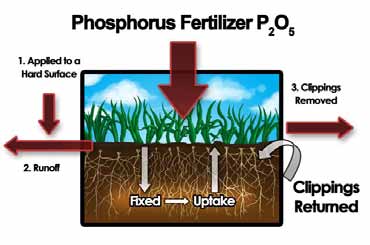
roots; bound to soil particles; subject to runoff on compacted,
bare, or frozen soil; and recycled or removed during mowing.
If fertilizer is inadvertently applied to hard surfaces (like driveways, frozen or nonvegetated ground) and not swept or blown back onto the turf, it can run off into surface waters and contribute to nutrient enrichment. When turfgrass clippings are regularly recycled during mowing, phosphorus is recycled on-site and the need for applying phosphorus fertilizer may decrease slightly over time. By contrast, when clippings are regularly removed these areas, then the turf can become phosphorus deficient and require supplemental phosphorus fertilizer.
Phosphorus Levels in Urban Lawn Soils
Throughout much of the Midwest the top layer of soil, or topsoil, is inherently rich in organic matter and nutrients. Unfortunately, many lawns are established on soils that have been severely disturbed during construction. Often, the topsoil is buried by less productive subsoil. This subsoil is normally high in clay and easily compacts (Figure 3). Soil compaction restricts rooting in new plantings, which makes the plant less able to explore the soil and acquire nutrients or water.
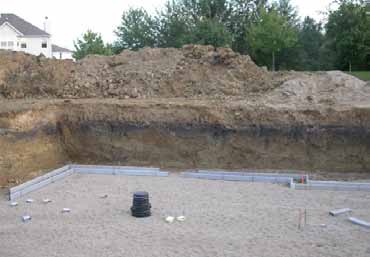
upper and lower light-colored layers) is often brought to the
surface and buries the nutrient-rich topsoil (the darker layer).
Subsoil frequently lacks sufficient inherent phosphorus to rapidly establish a dense turf from seed or promote vigorous mature turf growth. Furthermore, the alkaline pH and high calcium carbonate content of many subsoils binds phosphorus fertilizer to the soil. This reduces the effectiveness of fertilizers and may increase phosphorus needs. Therefore, higher phosphorus fertilizers rates are often recommended for shallow-rooted, immature turf than for deeply rooted, mature turf (Figure 4).
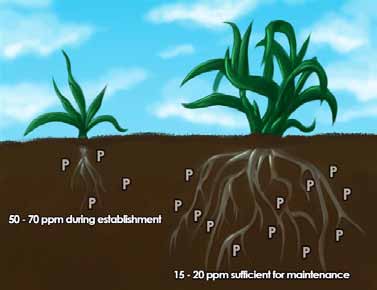
suggest slightly higher initial fertilizer rates for new lawns
(from seed or sod) because the immature, less-developed root
systems of newly planted turf are less able to explore the soil
for nutrients.
Select the Right Turf Fertilizer
Garden centers and professional distributors offer a wide range of fertilizer products. Fertilizer labels display three large numbers like 12-12-12, 18-4-12, or 27-3-10. These numbers are the guaranteed percentage by weight for three important macronutrients: nitrogen, phosphorus (expressed as phosphate), and potassium (expressed as potash). These numbers are sometimes referred to as the N-P-K content of the fertilizer.
Fertilizers should be carefully selected based on the turf ’s specific needs. For example, new lawn plantings generally benefit from a starter fertilizer that contains a higher percentage of phosphorus compared to nitrogen. Starter fertilizers promote healthy root development while minimizing unwanted growth surges. An example of a starter fertilizer analysis is 18-24-12 (Figure 5A).
In mature lawns, unless a soil test indicates that the turf needs supplemental phosphorus, it is best to apply lawn maintenance fertilizers. These products contain low (such as < 3%) phosphate levels. An example of a low-phosphate fertilizer analysis is 27-3-10 (Figure 5B).
If a soil test indicates sufficient to high phosphorus levels, then a zero phosphorus analysis such as 27-0-10 is appropriate (Figure 5C).
Healthy, mature turf leaf tissue generally contains a rather consistent ratio of about 4-1-2 for N-P-K. Thus, repeated applications of general purpose fertilizers like 12-12-12 should be avoided since excess phosphorus might be applied and accumulate in the soil (Figure 5D).
Interest in “natural organic” approaches to lawn fertilization continues to increase. These programs use only natural products or composts as fertilizer. If this option is pursued, carefully evaluate the N-P-K ratio of the fertilizer. Many products contain more phosphorus than your turf may need. When applied repeatedly over several years they will supply excess phosphorus similar to a general purpose fertilizer.
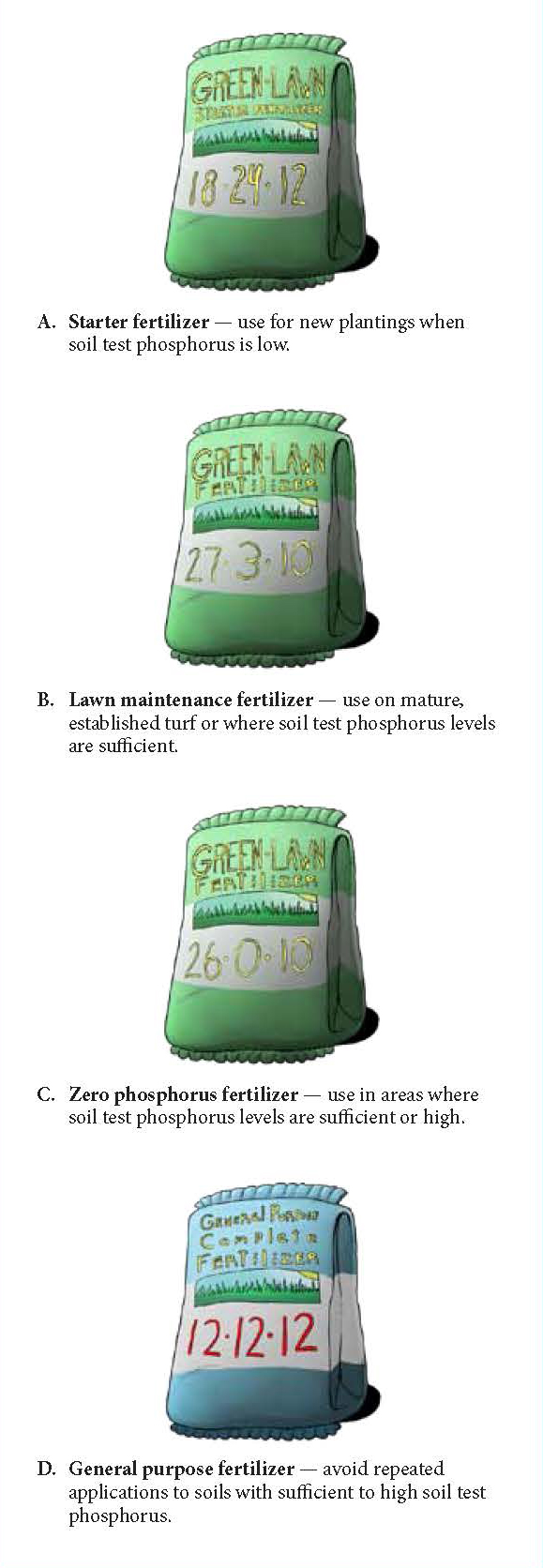
nutrients and individual products should be targeted for
specific turfgrass needs.
Apply Fertilizers Correctly
Many problems associated with phosphorus fertilizer and water quality can be linked to misapplication. When applying fertilizers (especially those that contain phosphorus), be sure to follow these best practices:
- Do not apply unnecessary nutrients to the turf stand. Get a soil test to know how much phosphorus to apply. A list of regional soil testing laboratories is available at www.ag.purdue.edu/agry/extension/Pages/soil-testing-labs.aspx.
- Determine the specific annual nutrient needs for your turf area and properly calculate how much to apply. The Web-based, Purdue Turf Fertilizer Calculator can help: www.agry.purdue.edu/turf/fertilizerCalculator.
- Never apply nutrients to drought stressed, dormant, or frozen turf. It may run off.
- Keep fertilizer on the turf. If granular fertilizer particles land on hardscapes (such as sidewalks, driveways, and patios), sweep or use a landscape blower to move them back into the turf where the plants can use them (Figure 6).
- Return lawn clippings back to the turf during mowing — do not bag them. This recycles nutrients like nitrogen and phosphorus back to the soil and can reduce overall annual fertilizer needs.
- Maintain a vegetative buffer strip of about 10 feet around all surface waters (ponds, lakes, streams). Avoid direct fertilizer applications to these areas.
- Keep lawn clippings, and other lawn and garden debris (such as tree leaves and vegetable waste) out of drainage ditches, gutters, storm sewers, streets, and any surface waters.
- Pick up pet waste promptly. Pet and animal waste contains nutrients as well as harmful bacteria.
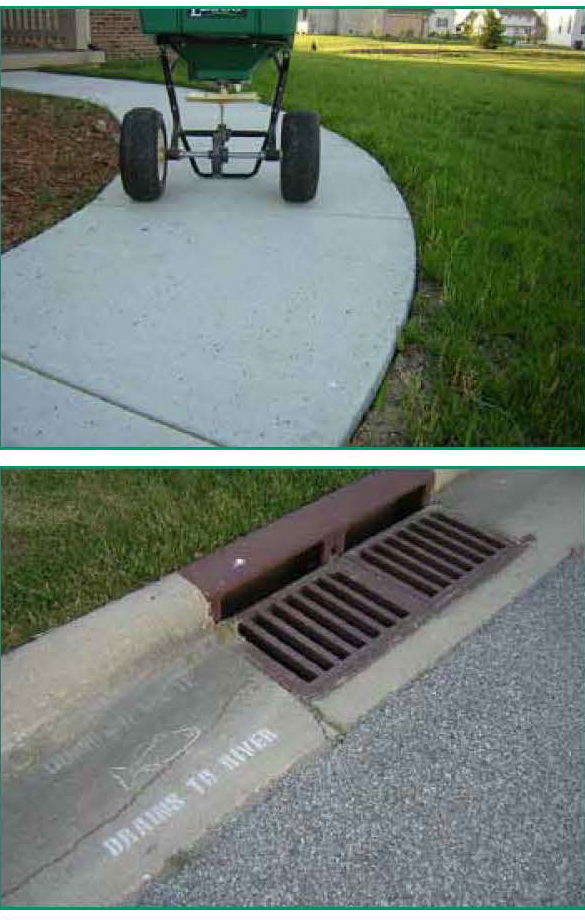
fertilizer to hard surfaces) reduces the potential for water
contamination.
Take-home Points
Fertilizers are important and essential tools for turf managers. Like any tool, specific fertilizers are only appropriate for specific uses. An environmentally responsible lawn fertilizer program will consider the desired appearance, turf maturity, intended use, and growing conditions. Assess seasonal needs and current nutrient requirements through a soil test and select the appropriate fertilizer products. Apply fertilizer using proper application rates, timings, and techniques. By following these suggestions you will be able to supply the correct amount of the necessary nutrients to promote consistent sustained growth and ultimately a dense, healthy, persistent turf without risking water quality impairment.
Find Out More
Find more publications in the Turfgrass Management series by visiting the Purdue Extension Education Store: www.the-education-store.com.
Reference in this publication to any commercial product, process, or service, or the use of any trade, firm, or corporation name is for illustrative purposes only and does not constitute an endorsement, recommendation, or certification of any kind by Purdue Extension.
Individuals using such products assume responsibility for their use in accordance with current directions of the manufacturer.