Turfgrass Science
A joint series from Purdue Extension and University of Illinois Extension
Purdue University Turf Science
Department of Horticulture and Landscape Architecture (formerly Department of Agronomy)
University of Illinois Turfgrass Program
Department of Natural Resources and Environmental Sciences
Introduction
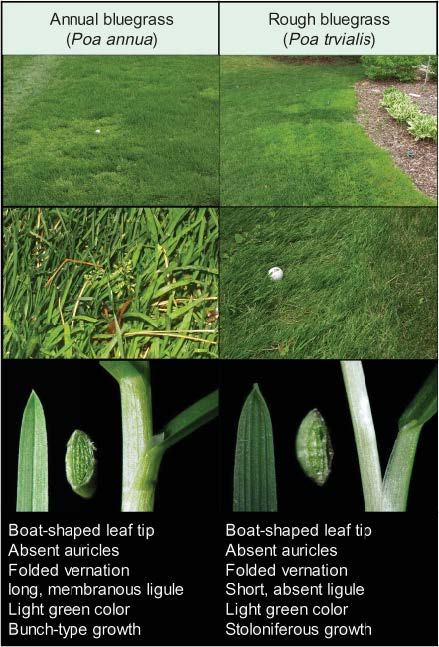
Annual bluegrass (Poa annua) and rough bluegrass (Poa trivialis) are common weeds on golf courses, but are now becoming a problem on highly maintained lawns and athletic fields. Both of these grasses are considered weeds because they are lighter colored than Kentucky bluegrass and perennial ryegrass. Moreover, they both tend to thin and die during the heat and drought of August in Illinois and Indiana. Poa annua is especially noticeable in May and June because of it’s prolific seedhead production. Poa trivialis, on the other hand, rarely produces a seedhead when mowed. Control of Poa annua and Poa trivialis in lawns is difficult, and relies on both cultural and chemical control. However, control might not be economically feasible or practical and it might be better to attempt to manage these weeds to keep them alive during the summer.
Authors:
Zac Reicher, Professor and Turfgrass Extension Specialist, Purdue University Department of Agronomy
Aaron Patton, Graduate Research Assistant, Purdue University Department of Agronomy
Cale Bigelow, Assistant Professor and Turfgrass Extension Specialist, Purdue University Department of Agronomy
Tom Voigt, Associate Professor and Turfgrass Extension Specialist, University of Illinois Department of Natural Resources and Environmental Sciences
Poa annua Biology
Poa annua is a winter annual that germinates in the late summer/early fall once soil temperatures fall below 70o F. Seedlings mature in the fall, overwinter in a vegetative state, and flower and produce seed in late spring and early summer. Annual bluegrass is a prolific seed producer, and flowering and seed production can occur at any mowing height. An individual plant is capable of producing more than 360 viable seeds. The seed may lie dormant in the soil for many years before germinating. Poa grows well under short days and cool conditions, and it will out-compete all other turf species during late fall and early spring. Poa often dies in the heat of the summer (but may survive the stress). However, we now know there are also perennial types of Poa annua that will live through the stress of the summer, primarily in northern Illinois and Indiana.
Chemical Control
Chemical control of annual bluegrass can be attempted with either preemergence and/or postemergence herbicides. Most preemergence herbicides, such as dithiopyr or prodiamine, on the market can be used in Poa control programs. Application timing is very important, so herbicides must be applied in early fall (early-September) prior to Poa germination. a second application will be needed in November or March to control spring germinating Poa annua. This technique may take many years to reduce the Poa annua populations and it will not be effective on the perennial type of Poa annua.
A postemergence herbicide, ethofumesate (Prograss) exhibits some residual preemergence control. Ethofumesate can be applied to Kentucky bluegrass and perennial ryegrass lawns, but it must only be applied by professionals. Two or three applications of ethofumesate applied between September and December are recommended per year. The applications should be approximately four weeks apart. Results are rarely seen that autumn; but are usually observed the following spring. Bispyribac-sodium (Velocity) is a newly labeled herbicide for control of annual bluegrass in creeping bentgrass and perennial ryegrass fairways. Multiple applications at low rates provide effective control of annual bluegrass. Refer to label recommendations for specific instructions. There are a number of herbicides currently (May 2006) under investigation for controlling Poa annua, but no others are available yet. Also, growth regulators are sometimes considered for Poa annua control, but these have not proven effective in home lawns or athletic fields.
The most effective combination of treatments is to let the lawn go dormant from drought, followed immediately by application of a preemergence herbicide. The drought will kill the annual bluegrass and the preemergence herbicide will prevent it from regerminating, but it will not prevent the desired turf from greening up again. This is most effective in lawns with less than 10% annual bluegrass
Summary of practices that will encourage or discourage Poa annua.
| Maintenance Practice | To encourage Poa annua | To discourage Poa annua |
|---|---|---|
| Irrigation | Light and frequent | Deep and infrequent |
| Mowing Height | 2 inches or below | 3 inches or above |
| Fertility | Spring N applications; high N and P when Poa is germinating | Fall N; low N and P |
| Aerification | Avoid, soil compaction favors Poa annua | Aerify as often as possible when desirable turf is actively growing |
Poa trivialis Biology
Poa trivialis is a perennial grass that spreads by stolons (creeping, above-ground stems) forming light green patches in turf. It is best adapted to shady, moist, or over-watered sites, and because of this, it often appears in mixtures with Kentucky bluegrass and perennial ryegrass recommended for shady areas. Two theories persist about how Poa trivialis is introduced to a turf stand. Some believe that Poa trivialis grows naturally over most of the world and Poa trivialis seeds or stolons can germinate after lying dormant for many years, thus contaminating a turf stand. Most believe that it is introduced as a contaminant in turf seed and seed producers have since self-imposed Poa trivialis growing and shipping restrictions to help prevent this.
Control
Currently, nonselective control with glyphosate followed by reseeding may offer the best chance of control of Poa trivialis. A herbicide called sulfosuron is now available for use by professionals. Additionally, bispyribac-sodium (Velocity) is labeled for Poa trivialis control, but we are still trying to determine its effectiveness at various rates and timings. There is no perfect product available for the selective control of Poa trivialis as of May 2006.
Summary of practices that will encourage or discourage Poa trivialis.
| Maintenance Practice | To encourage Poa trivialis | To discourage Poa trivialis |
|---|---|---|
| Irrigation | Light and frequent | Deep and infrequent |
| Mowing Height | 2 inches or below | 3 inches or above |
| Drainage | Poor drainage | Good drainage |
| Traffic | Limit all traffic | Poa trivialis cannot withstand traffic |