

Turfgrass Science
A joint series from Purdue Extension and University of Illinois Extension
Purdue University Turf Science
Department of Horticulture and Landscape Architecture (formerly Department of Agronomy)
University of Illinois Turfgrass Program
Department of Natural Resources and Environmental Sciences
Introduction
Creating and maintaining quality turfgrass involves more than irrigation, fertilization, and pesticide applications. A dense, healthy turf demands proper mowing techniques, occasional dethatching, and aerification in addition to fertilization and pest control. Knowing when and how to conduct these cultural practices will help enable one to have a thick, vigorous turf.
Authors:
Zac Reicher, Professor and Turfgrass Extension Specialist, Purdue University Department of Agronomy
Aaron Patton, Graduate Research Assistant, Purdue University Department of Agronomy
Cale Bigelow, Assistant Professor and Turfgrass Extension Specialist, Purdue University Department of Agronomy
Tom Voigt, Associate Professor and Turfgrass Extension Specialist, University of Illinois Department of Natural Resources and Environmental Sciences
Mowing
Improper mowing causes more problems on lawns than any other maintenance practice. Many lawns are mowed too short, not often enough, and/or with a dull mower blade.
Mowing height depends on the grass species (Table 1). Mowing below the optimum height restricts root growth and increases susceptibility to damage from insects, disease, drought, and traffic. Low mowing also favors weed infestations. Shaded lawns should be mowed 0.5 to 1.0 inch higher than optimum. Do not vary the mowing height during the year.
Table 1. Optimum mowing heights for lawns.
| Lawn species | Mowing height (in) |
|---|---|
| Kentucky bluegrass | 2.0 to 3.5 |
| perennial ryegrass | 2.0 to 3.5 |
| fine fescue | 2.0 to 3.5 |
| tall fescue | 2.5 to 4.0 |
| zoysiagrass | 1.0 to 2.0 |
Mowing frequency depends on how fast the grass grows. Some lawns may need mowing twice a week during spring and fall and only once every 2 weeks during summer. Mow frequently enough so as not to remove more than 1/3 of the leaf blade at a single mowing. For instance, if you are mowing at 3 inches, mow when the grass reaches 4 inches. If the grass has grown too tall, raise the mowing height and gradually lower it back to the original height over a few mowings. Avoid mowing during midday when temperatures are above 90o and the soil is dry because you may damage the turf. If you must mow during a hot and dry period, wait until temperatures moderate in the early morning or early evening.
The mower blades must be sharp and may need sharpening four to six times a year. A sharp blade results in a cleaner and healthier cut, leaving a more attractive lawn (Figures 1 and 2). Reel-type mowers often give a better cut, especially at height less than 1”, but they are more difficult to maintain.
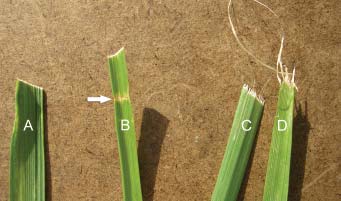 Figure 1. Leaf blade A demonstrates what a leaf blade should look like after mowing. Leaf blade B demonstrates a leaf blade that was injured by a dull mower blade. Leaf blade C was cut by the mower but indicates that the mower blade is not sharp enough. The shredded white tissue protruding from the leaf blades C and D is the
vascular tissue of the plant. Leaf blade D has been mown for quite some time with a dull mower blade (A. Patton).
Figure 1. Leaf blade A demonstrates what a leaf blade should look like after mowing. Leaf blade B demonstrates a leaf blade that was injured by a dull mower blade. Leaf blade C was cut by the mower but indicates that the mower blade is not sharp enough. The shredded white tissue protruding from the leaf blades C and D is the
vascular tissue of the plant. Leaf blade D has been mown for quite some time with a dull mower blade (A. Patton). 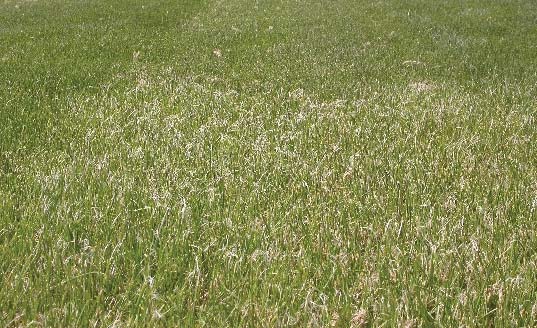 Figure 2. A lawn with a whitish cast resulting from mowing with a dull blade (C. Bigelow).
 Clipping removal is generally not recommended on most turfgrass areas. Clippings do not contribute to thatch because they are primarily water and break down quickly. Furthermore, returning clippings will recycle valuable nutrients to the soil thereby reducing fertilizer requirements. Clippings are not harmful if your mower spreads them evenly and if they are not thick enough to shade the grass below. Mulching mowers are recommended, but research suggests that mulching mowers increase clipping breakdown only slightly faster than conventional side-discharge mowers when used on cool-season turfgrasses. Catching clippings is labor and time intensive and should only be done if the clippings are used for mulch or compost.
Thatch Control
Thatch is a tightly intermingled organic layer of dead and living shoots, stems, and roots that accumulate just above the soil surface (Figure 3). Thatch accumulation is due to either over-fertilization, over-watering, and/or soil compaction. A small amount of thatch is desirable because it moderates soil temperature fluctuations and provides a cushion on the soil surface. Too much thatch interferes with water and air movement, reduces fertilizer and pesticide response, and increases disease and insect activity. Eventually, roots may start growing in the thatch, and since thatch does not hold much water, the turf then becomes very susceptible to cold, heat and drought stresses.
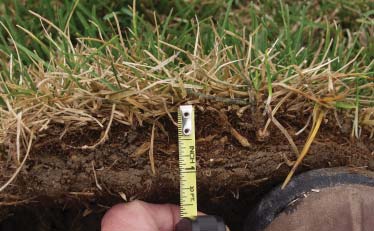 , opens larger image Figure 3. Dethatching a lawn helps reduce thatch and increase water movement (Z. Reicher).
 Dethatching machines are power rakes with blades that cut through the thatch down to the soil surface. As the blades revolve, dead and live organic material is torn loose and brought to the surface. Dethatching machines that cut with knives or blades are preferred for their effectiveness. Avoid machines with flexible rake-type tines and dethatchers that attach to your rotary mower blade. Dethatching machines can be rented, or dethatching can be done by a professional lawn care company. The organic material removed by the dethatcher must be raked, removed, and used as a mulch or in a compost pile. Regular core aerification can be used to reduce thatch levels and is less destructive than using a dethathcing machine. Annual core aerification, along with improved water and fertilizer management, may require, however, several years to reduce thatch levels to less than 0.5 inch.
If the thatch layer is 0.5 inch or more thick, a number of passes in different directions with the dethatcher will be necessary. Several passes will produce large quantities of refuse, and the lawn will look very ragged for some time. Reseeding may be necessary after dethatching lawns with 0.5 inches or more of thatch. Thatch thicker than 1.0 inch is most easily removed with a sod cutter. A sod cutter set at the soil surface removes the sod easily in light and manageable strips. The lawn must then be reestablished. Although reestablishment is hard work, it is better in the long run. Refer to AY-13, “Turfgrass Renovation” for more information.
Kentucky bluegrass should be dethatched in the spring (April) or fall (Sept.) when it is actively growing and never in the summer. Zoysiagrass, on the other hand, should be dethatched in the summer when it is actively growing. Tall fescue and perennial ryegrass rarely develop a thatch problem because of their bunch-type growth habit.
Aerification
Aerification is the mechanical removal of soil cores (Figure 4). Aerification relieves soil compaction, improves water and air movement into the soil, increases rooting, and can greatly improve turfgrass health. Additionally, aerification can also reduce thatch. Aerification is needed in compacted areas such as sport fields, heavily trafficked areas next to sidewalks, and areas with intense foot or pet traffic.
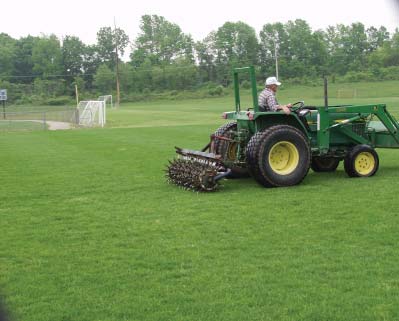 , opens larger image Figure 4. Aerifying a lawn helps reduce thatch and increase water movement when tine size and spacing is adequate (Z. Reicher).
 Table 2. Number of holes per square foot and percent surface area affected based on tine size and spacing
| Internal tine diameter (in.) | Tine spacing | Number of holes/ft2 | Percent surface area affected |
|---|---|---|---|
| 0.50 | 3” x 3” | 16 | 2.2 |
| 0.50 | 2” x 2” | 36 | 4.9 |
| 0.75 | 3” x 3” | 16 | 4.9 |
| 0.75 | 2” x 2” | 36 | 11.0 |
| 1.00 | 3” x 3” | 16 | 8.7 |
| 1.00 | 2” x 2” | 36 | 19.6 |
Aerification of Kentucky bluegrass, perennial ryegrass, fine fescue, and tall fescue should be done in the fall (Sept.) or spring (April) when the turf is actively growing. Zoysiagrass should be aerified in early to mid-summer.
Rolling
Rolling is not considered a necessary turf maintenance practice. Turf specialist generally do not recommend heavy rolling of saturated or clay soils in spring because it can cause soil compaction and increase soil moisture stress in summer. However, rollers do have some usefulness in turf. Light rolling is effective immediately following seeding to insure good seed-soil contact. Rolling can also insure good sod-soil contact after installing sod. Rolling may also help in other isolated occurrences such as severe mole damage or frost heaving. Rolling should never be used to correct surface undulations caused by improper grading.