

Introduction
Introduction
Dried or preserved plant materials complement any home decor in both formal and informal arrangements. They will last almost indefinitely if carefully done and require very little care. Flower arrangements, wreaths, pressed pictures, potpourri and wall hangings are just some of the creative possibilities with preserved plant materials.
Authors
Michael N. Dana and B. Rosie Lerner
The best time to gather materials for drying depends on the individual species. As a general rule, collect twice as much material as you expect to use, since some will be damaged in the preserving process.
Drying Methods
Naturally Dried Material
Materials such as dry grasses, reeds, pine cones, and most seed heads should be harvested in the fall at the end of their growing season but before they become withered in appearance. Pick cattails when they first turn brown and flowers are still visible at the top of the spike.
Simple grooming is usually all that is necessary for preserving these materials. To prevent shattering of fragile seed heads such as pampas grass and cattails spray with hair spray or an aerosol lacquer. Sprayed fruits and cones take on a shiny, decorative look. Pine cone seeds should be removed to prevent shedding as they age.
Artificial Drying Methods
Removal of moisture while retaining the original shape, color, and texture is the goal of plant material drying techniques.
Pick flowers before they reach full bloom because they will open further as they dry. Start with flowers of a lighter color because most flowers tend to darken as they dry. Foliage should be collected at the peak of its growing season. Generally, the best time to gather the materials is at midday, when they are not overly wet yet have not begun to wilt under the sun’s heat. Treat materials soon after picking.
Flower stems dry very slowly and add unwanted bulk. It is best to remove them, leaving only an inch or two to which a wire may be fastened. A false stem can be easily attached with a florist’s peg.
Air Drying
This simple method of drying works well with plants having semi-dry flowers and stems that do not readily wilt.
Remove all foliage from stems and tie in loose bundles with rubber bands, string, or twist ties. Hang the bundles upside down in a cool, dark place for about 3 weeks. Be sure to supply good air circulation to speed drying prevent mold.
Drying with Desiccants
Plant materials which wilt readily must be dried in a supportive material. The two most satisfactory are a sand-borax mix and silica-gel. Others, such as kitty litter, perlite, sawdust, cornstarch and cornmeal, can be used but are not as reliable.
Borax-sand: A mixture of 2 parts borax with 1 part fine sand is an inexpensive, yet effective desiccant medium. Drying by this method takes 4-14 days, depending on the material being dried. Adding 3 tablespoons of uniodized salt to each quart of this mixture will help flowers retain their original color. The material is lightweight and faster than using only sand. Do not use borax alone, as it may cause bleaching.
Silica-gel: Silica-gel is especially effective for drying delicate flowers. It is lighter than borax-sand and is the fastest drying agent available. (A quicker drying time usually means a truer blossom color.) Drying usually takes 2-7 days. It may be purchased from florists or garden centers as well as hobby and craft shops. Silica-gel crystals are expensive but may be used indefinitely. As the crystals absorb moisture, they turn from bright blue to pinkish gray. To reuse, they must be dried by placing in a shallow pan in a warm oven (250-275° F) for several hours. A microwave oven takes only a few minutes. The crystals should return to their original blue color when dry. Store in an airtight container.
How to use desiccants. Choose containers such as boxes and cans that will allow the material to be dried without overlapping or crowding. Pour 1/2 inch of desiccant into the bottom of the container. Place the first layer of flowers on top. Flat-faced flowers such as daisies may be placed face down; all others should be arranged face up. Gently place the drying agent around and over the flowers. Be careful to retain form and keep petals in their natural position. Add desiccant until the flower heads are covered.
It is a good idea to have a test flower conveniently located in the container to permit a check on the dryness without disturbing the entire contents. Cover the container and do not disturb.
Drying is complete when flowers are crisp and dry but not brittle. The thickest parts are slowest to dry. If only the petals are completely dry, the flower may be removed and air dried to complete the process.
To remove dried flowers, gently pour off desiccant. Wisk away any remaining drying medium with a soft brush. After drying, white or clear glue may be placed at the base of some flower petals to prevent shattering.
Microwave Oven Drying
Microwave drying takes only a few minutes and provides material that looks fresher and more colorful than that obtained by other methods. Use a desiccant such as silica-gel to support the flowers in a glass or special microwave container. Do not cover the container. Always place a cup of water in the oven before starting to prevent excessive drying.
Drying times vary (see Table 1). A standing period following drying is necessary to allow cooling and complete drying.
Table 1. Microwave Oven Flower Drying Times
| Flower | Heating Time (minutes) | Standing Time (hours) |
|---|---|---|
| African Daisy | 3 | 10 |
| Aster | 2-1/2 | 10 |
| Calendula | 2-1/2 | 10 |
| Carnations | 1 | 10 |
| Clematis | 3 | 10 |
| Chrysanthemum | 3 | 10 |
| Daffodil | 2-1/2 | 10 |
| Dahlia | 5 to 7 | 36 |
| Delphinium (Larkspur) | 4 to 5 | 10 |
| Dianthus | 3 | 10 |
| Dogwood | 2-1/2 | 24 |
| Marigold | 3 | 10 |
| Orchid | 1-1/2 to 2-1/2 | 24 |
| Pansy | 2-1/2 to 3 | 24 |
| Peony | 3 to 4 | 36 |
| Poppy | 2-1/2 to 3 | 24 |
| Rose | 1-1/2 | 10 |
| Salvia | 3 | 24 |
| Scilla | 2-1/2 | 10 |
| Tithonia (Mexican Sunflower) | 5 to 6 | 10 |
| Tulip | 3 | 24 |
| Violet and Viola | 2-1/2 to 3 | 10 |
| Zinnia | 4 to 5 | 10 |
Pressing Method
Pressing is a useful plant material drying technique when the original form is essentially flat. Place the flowers or leaves between several layers of newspapers or pages of an old phone book. Weight them down with a heavy, flat object. Drying takes about 3 weeks. This method is popular for small flowers, ferns, and autumn leaves.
Special Preservation Techniques
Glycerine: This method is best for preserving small, leafy tree branches. Crush the lower 2 inches of the branch and place in a jar containing 1 part glycerine to 2 parts water. As the glycerine solution is depleted, supplement with a solution of 1 part glycerine to 4 parts water. Glycerine will enter the leaves and turn them brown. The average time for this treatment is 2-3 weeks. For best results, use this method during the summer months when absorption is most rapid. Some plant material, particularly leaves that are thick and waxy, can be immersed in glycerine solution. Within 2-6 days, the leaves will be soft and pliable.
Skeletonizing: This treatment eliminates all tissue but the veins or “skeleton” of the leaf. Heavy-textured leaves are the best choices for this method of preservation.
Boil leaves for 40 minutes in a solution of 1 teaspoonful of baking soda or lye per quart of water. Rinse in cold water and spread the leaves on newspaper. Carefully scrape off the fleshy green pulp on both sides with a dull knife. If a lighter color is desired, immerse in 1 quart of water with 2 tablespoons of household bleach for 2 hours. Rinse thoroughly and gently wipe with a clean cloth. Finally, place between sheets of absorbent paper and press for 2 hours.
Dyeing and Coloring
Several methods are used to intensify natural color or introduce artificial color to plant material. Fragile flowers should be dyed before drying, especially if dried with a desiccant. Materials which are easily redried, such as grasses and seed heads, can be colored after drying.
Dip Dyeing
Mix ink or fabric dye with water to desired strength. Add 1 tablespoon alum to each gallon of solution. Mix floral dip dyes as directed.
Dip materials into the solution until desired color is obtained. Rinsing in clear water will usually lighten a color that has become too intense. Colors will also lighten in the drying process.
Spray Dyeing
Use commercial floral sprays as directed on even the most delicate material. These are not harmful and come in many colors.
Ordinary spray paint should only be used on heavy-textured material like branches, thick or large leaves, seed pods, or cones.
Absorption Dyeing
This technique is suitable for fresh material only. Prepare florist absorption dyes as directed. Ink, fabric dye, and food coloring should be mixed to a solution stronger than that prepared for dip dyeing. Place stems in solution and let stand until desired color is obtained.
Water soluble (absorption) dyes and glycerine are sometimes mixed so that glycerine and dye are taken up at the same time.
Using Preserved Plant Materials
You will find preserved flowers and leaves especially useful during the winter, as well as other seasons. Choose browns for refreshing summer arrangements. Add colored leaves and berries or candles for a special holiday effect. Or combine with fresh flowers, evergreens, statuary, or driftwood any time of the year.
Before using dried flowers, reinforce and lengthen stems with florist’s sticks and wire. Cover the wire with green or brown tape. A needlepoint holder anchors dried flowers in low containers; sand holds them in upright containers. Caution: dried flowers fade quickly in a bright or sunny room. Store dried flowers in tightly-capped jars containing silica-gel when you are not using them.
Pressed flower pictures: Cover a piece of cardboard with fabric or paper. Sketch a design lightly on the front; glue on the pressed flowers; cover with glass, then frame. Do the same for flowered trays or table tops. Make shadow boxes the same way, but plan for depth, and do not cover with glass.
Wood panels: Either paint plywood or rub it with equal parts of turpentine and linseed oil. Sketch your design on the wood, then cement on seeds, pods, dried branches, etc. Finally, cover the surface with a coat of clear shellac. make centerpieces the same way.
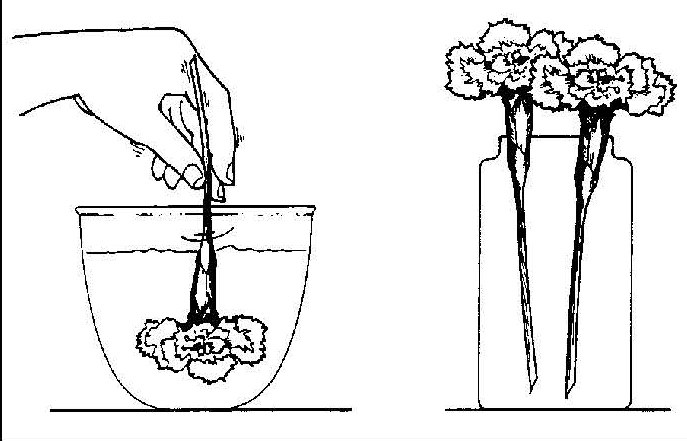
Left: Dip dye flowers by immersion of the bloom in the dye solution. Follow by rinsing. Colors will usually lighten as they dry.
Right: Absorption dyeing uses the plant's natural system of liquid movement into the flower. Success depends on vigor of flowers at time of cutting and veination of petals. Solutions should be stronger than for dip dyeing.
Table 2. Suggested Methods for Preserving Plant Materials
Fruit, Seed Pods (all may be air dried)
Grasses (all may be air dried)
| Common Name | Latin Name | Method |
|---|---|---|
| Flowers | No data | No data |
| African Violet | Saintpaulia sp. | Desiccate |
| Amaranthus | Amaranthus sp. | Air, natural dry |
| Anemone | Anemone sp. | Desiccate |
| Anthurium | Anthurium sp. | Air, desiccate |
| Aster | Aster sp., Callistephus sp. | Desiccate |
| Astilbe | Astilbe sp. | Air |
| Baby’s Breath | Gypsophila sp. | Air (slowly dried), natural dry, press |
| Balsam | Impatiens sp. | Desiccate |
| Bee-Balm | Monarda sp. | Air |
| Bells of Ireland | Moluccella sp. | Air, desiccate |
| Blazing Star | Liatris sp. | Air, desiccate |
| Buttercup | Ranunculus sp. | Desiccate |
| Calendula | Calendula officinalis | Desiccate |
| Camellia | Camellia japonica | Desiccate |
| Candytuft | Iberis sp. | Desiccate |
| Canterbury Bells | Campanula medium | Desiccate |
| Cape-Marigold | Dimorphotheca sp. | Desiccate |
| Carnation | Dianthus caryophyllus | Desiccate |
| Chinese Lantern | Physalis alkekengi | Air |
| Chrysanthemum | Chrysanthemum sp. | Air, desiccate, natural dry, press |
| Clematis | Clematis sp. | Desiccate, press |
| Cockscomb | Celosia sp. | Air, desiccate |
| Columbine | Aquilegia sp. | Desiccate |
| Coneflower | Echinaceae sp., Rudbeckia sp. | Air, desiccate |
| Coreopsis | Coreopsis sp. | Air |
| Cornflower | Centaurea cyanus | Desiccate |
| Daffodil | Narcissus sp. | Desiccate |
| Dahlia | Dahlia sp. | Desiccate |
| Daylily | Hemerocallis sp. | Desiccate |
| Delphinium | Delphinium sp. | Desiccate |
| English Daisy | Bellis perennis | Air, desiccate |
| Everlasting | Helipterum sp. | Air |
| False Dragonhead | Physostegia virginiana | Air |
| Foxglove | Digitalis sp. | Desiccate |
| Gaillardia | Gaillardia sp. | Desiccate, press |
| Gas Plant | Dictamnus albus | Air |
| Gladiolus | Gladiolus sp. | Desiccate |
| Globe Amaranth | Gomphrena globosa | Air, natural dry |
| Globe Thistle | Echinops sp. | Desiccate, press |
| Goldenrod | Solidago sp. | Air, natural dry |
| Heather | Calluna vulgaris | Air |
| Heliopsis | Heliopsis sp. | Air |
| Hollyhock | Alcea rosea | Air, desiccate |
| Iris | Iris sp. | Desiccate |
| Ironweed | Veronia sp. | Air, desiccate |
| Joe-Pye Weed | Eupatorium purpureum | Air, press |
| Lantana | Lantana camara | Desiccate |
| Lavender | Lavandula sp. | Air |
| Lily | Lilium sp. | Desiccate |
| Loosestrife, Gooseneck | Lysimachia clethroides | Desiccate |
| Lupine | Lupinus sp. | Desiccate |
| Marguerite Daisy | Chrysanthemum leucanthemum | Air, desiccate, natural dry, press |
| Marigold | Tagetes sp. | Air, desiccate, press |
| Meadow-Rue | Thalictrum sp. | Air |
| Milkweed | Asclepias sp. | Desiccate |
| Montebretia | Crocosmia sp. | Desiccate, press |
| Oregon Grape Holly | Mahonia aquifolium | Desiccate |
| Painted Daisy | Tanacatum coccineum | Air, desiccate, natural dry, press |
| Pansy | Viola x wittrockiana | Desiccate, press |
| Peony | Paeonia sp. | Desiccate |
| Pincushion flower | Scabiosa sp. | Air |
| Plantain Lily | Hosta sp. | Air |
| Plum | Prunus sp. | Desiccate |
| Poker Plant | Kniphofia sp. | Desiccate |
| Primrose | Primula sp. | Desiccate |
| Pussy Toes | Antennaria sp. | Air |
| Queen Anne’s Lace | Daucus carota | Desiccate |
| Rose | Rosa sp. | Desiccate, press |
| Scarlet Sage | Salvia splendens | Air, desiccate |
| Sedum | Sedum sp. | Air |
| Snapdragon | Antirrhinum majus | Desiccate |
| Star-of-Bethlehem | Ornithogalum sp. | Desiccate |
| Statice | Limonium sinuatum | Air, natural dry |
| Stock | Matthiola sp. | Desiccate |
| Strawflower | Helichrysum bracteatum | Air, natural dry |
| Sunflower | Helianthus sp. | Desiccate |
| Sweet Sultan | Amberboa moschata | Air |
| Tansy | Tanacetum sp. | Air |
| Teasel | Dipsacus sp. | Air |
| Tulip | Tulipa sp. | Desiccate |
| Violet | Viola sp. | Air, press |
| Yucca | Yucca sp. | Air |
| Zinnia | Zinnia sp. | Desiccate |
| Foliage | No data | No data |
| Autumn Leaves | several genera | Air, shellac |
| Barberry | Berberis sp. | Glycerine |
| Birch | Betula sp. | Glycerine |
| Bowstring Hemp | Sansevieria sp. | Air |
| Boxwood | Buxus sp. | Air (with stems in water) |
| Bush Clover | Lespedeza sp. | Air |
| Camellia | Camellia sp. | Desiccate |
| Coleus | Coleus x hybridus | Air |
| Dracaena | Dracaena sp. | Glycerine |
| Dusty Miller | Artemisia sp., Senecio sp. | Air |
| English Ivy | Hedera helix | Glycerine, air, press |
| Euonymus | Euonymus sp | Desiccate |
| Fennel | Foeniculum vulgare | Air |
| Fern | several genera | Air |
| Hen-and-Chickens | Sempervivum tectorum | Air |
| Holly | Ilex sp. | Air |
| Lemon Leaf (Salal) | Gaultheria shallon | Air |
| Magnolia | Magnolia sp. | Air, glycerine, skeletonize |
| Mint | Mentha sp. | Air |
| Mountain Laurel | Kalmia latifolia | Glycerine |
| Oak | Quercus sp. | Glycerine, skeletonize |
| Perilla | Perilla sp. | Air |
| Pittosporum, Japanese | Pittosporum tobira | Glycerine |
| Ruscus | Ruscus sp. | Air |
| Scotch Broom | Cytisus scoparius | Air |
| Snow-on-the-Mountain | Euphorbia marginata | Desiccate |
| Spindle Tree | Euonymus sp. | Desiccate |
| Ti | Cordyline terminalis | Air, glycerine |
| Yucca | Yucca sp | Glycerine |