

Introduction
Narcissi are spring-flowering bulbs which add bright color and interest to midwestern landscapes. These plants require very little care and flower reliably year after year. They are one of the best choices for the novice and accomplished gardener alike.
Author
Michael N. Dana and B. Rosie Lerner
The most important aspect of narcissus culture is proper selection. By careful planning, you can have narcissi in flower from late March through early May.
Narcissi are well-suited to many landscape design uses, including in front of shrubbery, under large trees, and in rock or perennial gardens. They should not be planted too close to building foundations or under extended eaves, where it may be too dry.
Narcissi are pleasing in areas where they can naturalize, such as woodlands and meadows. They are best if planted in informal groups rather than in rows or formal beds. When planting for naturalizing, take a handful of bulbs and give them a gentle toss. Then plant each bulb wherever it falls.
Types of Narcissus
There are many types of narcissus. Classifications are based on the flower and plant forms. Most gardeners are familiar with the trumpet class, but fewer people are acquainted with the miniatures, the multi-flowered forms, or those that resemble wild species, such as the poeticus or triandrus types. Figure 1 illustrates the parts of the typical narcissus flower. Table 1 lists and briefly describes the various narcissus types as classified by the American Daffodil Society (www.daffodilusa.org) and cites some example cultivars.
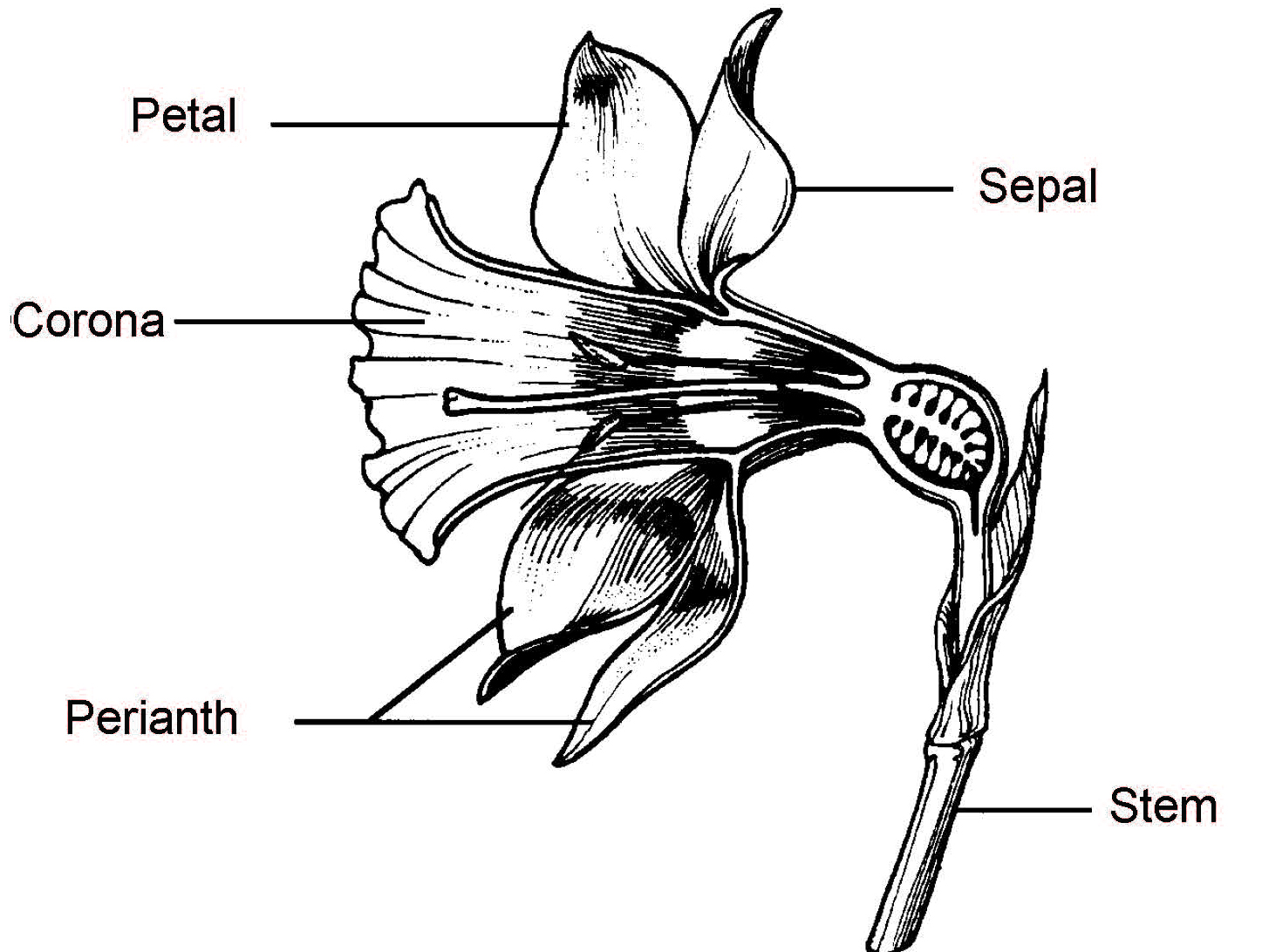
A point of confusion often arises over the use of the common names “narcissus”, “daffodil”, and” jonquil”. Narcissusis the only correct scientific name for this genus of plants. “Narcissus” as a common name is often used. “Daffodil” is a popular common name for the entire genus, too, but it is most often applied to the large, trumpet flower forms. “Jonquil”, sometimes used in reference to the entire genus, is correctly applied only to the species Narcissus jonquillaand its closely related hybrids.
When, Where, and How To Order Bulbs
Before placing an order for bulbs, study your needs, and know what types and cultivars are best suited for your conditions. Public gardens and spring flower shows are good places to see and learn about narcissi. Buy from a reputable local garden center or from a bulb catalog supplier.
If you select from local sources, buy your bulbs early in the fall when they are first put out for sale. Select the largest bulbs for the type, ones without spots, blemishes, or shrunken areas.
When ordering from a catalog, place your order early, usually in late spring as soon as the catalog arrives. Early ordering helps insure you will receive the cultivars you desire at the appropriate time for planting.
Culture of Narcissus
Soil Preparation
Narcissi grow adequately in many soil types. A well-drained, deep, fertile soil containing abundant organic matter, however, results in the best performance.
If natural drainage is poor, break the subsoil with a pickax. If the site is low, create a raised bed several inches above the surrounding soil level. Incorporate large amounts of coarse organic matter (2 inches or more) to loosen very heavy clay soil.
Good sources of organic matter are well-rotted manure, undecomposed peat moss, or compost. Narcissi, like most bulbous plants, thrive in slightly acid soils (pH 6.0 6.5). Do not add any limestone unless you have your soil tested.
The soil should be of average fertility. High fertility, particularly in nitrogen, promotes excessive leaf growth at the expense of high-quality flower production, as well as the excessive splitting of bulbs. Color and size of foliage are good indicators of fertility level. Large and bluish-green leaves indicate an abundance of nitrogen, whereas small and light green leaves indicate a shortage.
Commonly available “bulb food” or “bulb booster” fertilizers are useful when preparing soil for narcissus planting. These products are relatively low in nitrogen, but contain enough to support healthy plant growth. Apply 2 - 4 pounds of fertilizer per 100 square feet of bed.
Bonemeal is a traditional fertilizer for bulbous plants that releases phosphorus slowly, but it is usually too low in nitrogen to be used alone. An additional source of nitrogen must be used together with bonemeal. Wood ash is an alternative way to supply potassium. For average situations, apply 3 to 4 pounds of bonemeal and 5 to 6 pounds of wood ash to each 100 square feet of soil.
Mix the fertilizers thoroughly with the soil before planting. The nutrients need to be located in the soil in the vicinity of and just below the bulb for best uptake by the plant. Generally, a yearly application of fertilizer should be made immediately after flowering. Bulbs planted in sandy soils benefit from fertilization in the spring when new growth is developing and also after flowering. Do not allow the fertilizer to remain on the leaves. Wash it off quickly.
If narcissi are naturalized in open lawn areas which are regularly fertilized, the lawn fertilizer is adequate for the bulbs, too.
Time of Planting
Bulbs are shipped from catalog suppliers and also are available from garden centers in early fall. If the weather is extremely warm, it is better to hold the bulbs in storage and then plant them when the weather cools. October is generally best for bulb planting. This enables the bulbs to develop strong roots in the fall, which supports flowering in the spring.
Planting Depth
The proper depth to plant narcissus bulbs is governed by the size of the bulbs and the soil type. As a general rule, plant bulbs twice as deep as their greatest diameter in medium to heavy soils and about three times their depth in sandy soils.
Spacing
Spacing of bulbs will depend upon the size and type of bulb, and on how soon you want a dense planting. Minimum spacing will vary from 3 inches for small bulbs to 5 to 7 inches for large bulbs. Planting too close results in poor development of foliage and flowers. The closer the bulbs are planted together, the more massive the color display, but it will be necessary to dig the bulbs and divide them sooner to keep up flowering. Narcissi do multiply in time, so wider spacing will eventually result in a dense stand of plants.
Planting
Prepare the site, and place the bulbs in the exact spot where you wish to plant them. Plant the bulbs with the flattened base down. Small bulbs can be planted with either a dibble, trowel, or bulb planter. If you use a dibble, put a handful of screened soil or sand in the bottom of the pointed hole to avoid an air space underneath the bulb. This insures good contact between the bulb base and soil. A trowel or spade is better to use for large bulbs, owing to the size of the hole needed.
Cultivating and Mulching
There is little need for cultivating other than to control weeds. In fact, deep cultivation can be harmful. A 2-inch winter mulch of straw, peat moss, leaves, or similar materials is beneficial the first year after planting. It is particularly useful for bulbs planted late in the season or for bulbs planted in southern exposures, where the soil warms early and the growing tips may be damaged. The mulch provides insulation as well as prevents heaving during periods of freezing and thawing.
In the spring, after the danger of severe frost is over, gradually remove all but 1 inch of the mulch. The remaining layer then acts as a summer mulch to control weeds, to promote aeration, to add organic matter, and to preserve moisture.
Removal of Leaves and Flowers
Remove flowers as soon as they begin to fade. This not only makes the plants look better, but it also prevents undesirable seed development. Seed development results in smaller bulbs the next year.
Do not remove the green leaves of the plants until they begin to turn yellowish green. The length of time it takes the foliage to mature differs, depending on the type of plant and the overall cultural conditions. During this time, the bulbs gain most of their size and become mature. This is also when the flowers form for the next blooming season. This natural process of maturity and bulb development occurs only when leaves are allowed to manufacture plant food. At a minimum, leave foliage on for one month after flowering is ended. Gathering and tying together of foliage is not necessary, but if performed, you should only do it after the 1- month minimum period.
Digging and Dividing
The best flowers are generally produced the second, third, or fourth year. When the flowers gradually become smaller and fewer in number, usually due to crowding, it is a good idea to lift and replant the bulbs. Dig the bulbs as soon as the tops begin to die back. Digging before the tops have fully disappeared helps locate clumps and makes digging easier.
You may replant the bulbs immediately, or store them until a later time. The bulbs will either remain temporarily dormant, or they will start to grow new roots. Be sure to follow proper planting techniques as described above.
Storage
If you intend to store the bulbs, remove all yellow foliage as soon as you have dug the bulbs. Then place them in an airy location in the shade for several days. Store in a cool, shady, airy, and dry location. Keep them out of direct sunlight. The mother and daughter bulbs need not be kept together in storage; they may be divided (see below).
Propagation
Narcissi, like other bulbous plants, may be increased by two methods: division and seed. Bulbs multiply underground naturally by division. Division occurs as the “mother” bulb matures, thus creating a number of new “daughters.” Bulbs resulting from division always produce flowers identical to those of the “mother” plant.
Increase of narcissi by seed requires that pollinated and fertilized flowers be left on the plant so the seed capsules can ripen. Collected seed can be sown in the fall in a prepared seedbed for spring germination. Seedlings require several years to reach flowering size. Seedlings usually produce flowers which differ in character from those of the parent plants.
Table 1. Classifications of Narcissus with Cultivar Examples (in parentheses).
From the American Daffodil Society (www.daffodilusa.org)
Trumpet Narcissi. Corona is as long or longer than the perianth segments, with 1 flower per stem.
- Perianth colored, corona colored, not paler than perianth (King Alfred, Unsurpassable).
- Perianth white, corona colored (Trousseau, Music Hall).
- Perianth white, corona white, not paler than perianth (Mt. Hood, Beersheba).
- Any color combination not described above (Spellbinder).
Large-Cupped Narcissi. There is 1 flower per stem with the corona more than 1/3, but less than equal to the length of the perianth.
- Perianth colored, corona colored, not paler than perianth (Hyperion, Kissproof).
- Perianth white, corona colored (Duke of Windsor, Chinook).
- Perianth white, corona white, not paler than perianth (April Snow, Gypsy Moth).
- Any color combination not described above (Binkie, Gleeful).
Small-Cupped Narcissi. There is 1 flower per stem with the corona not more than 1/3 the length of the perianth.
- Perianth colored, corona colored, not paler than perianth (Alcida, Irish Coffee).
- Perianth white, corona colored (Aircastle, Lady Kesteven).
- Perianth white, corona white, not paler than perianth (April Clouds, Tern).
- Any color combination not described above (Reversa).
Double Narcissi. Some part of the flower (corona, perianth) is double (Cheerfulness, Golden Ducat).
Triandrus Narcissi. There is more than 1 flower per stem, often hanging down.
- Cup or corona not less than 2/3 the length of the perianth segments (Liberty Bells, Thalia).
- Cup or corona less than 2/3 the length of the perianth segments (April Tears, Hawera).
Cyclamineus Narcissi. There is 1 flower per stem with perianth reflexed resembling a cyclamen.
- Cup or corona not less than 2/3 the length of the perianth segments (February Gold, Tete-a-Tete).
- Cup or corona less than 2/3 the length of the perianth segments (Little Imp, Lofty).
Jonquilla Narcissi. The flowers are usually fragrant with more than 1 per stem. This is the true jonquil.
- Cup or corona not less than 2/3 the length of the perianth segments (Desert Song, Golden Guinea).
- Cup or corona less than 2/3 the length of the perianth segments (Finch, Suzy).
Tazetta Narcissi. The fragrant flowers borne in clusters on a stem, are early bloomers (Cragford, Geranium).
Poeticus Narcissi. The large white perianth backs up a small, usually red-edged corona. The flowers are fragrant and borne singly (Actaea, Andrew Marvel).
Species, Wild Forms, and Wild Hybrids.
Split Corona Narcissi. Corona split for at least 1/3 of its length (Lemon Beauty, Cassata).
Miscellaneous Narcissi. All narcissi not falling into any of the above divisions (Donna Bella, Elfhorn).