

Introduction
Daylilies are one of the easiest to grow garden perennials. They survive under a wide range of conditions, are practically trouble-free, and can remain undisturbed for many years.
Authors
Michael N. Dana
Botanically, daylilies are called Hemerocallis, derived from the Greek word meaning “beautiful for a day.” The name is somewhat misleading; even though individual flowers last only for a single day, new buds open daily, and the stalks bear flowers for several weeks.
Most people are familiar with the orange flowered clone “Europa,” which has become naturalized along roadsides, in old gardens, and in cemeteries. Our modern hybrid daylilies show vast improvements not only in size and flowering ability, but in color range, which now includes all but the truest blues.
Description and Use
Daylily foliage is bright green. The slender strap-like leaves grow 12-24 inches long and are visually effective from early summer until past first frost. The leaves arch from the crown of the plant, forming a graceful mound of foliage.
The flowers are borne on slender scapes (flower stalks) which arise from the center of the vegetative crown (Figure 1). The flower stalks may range in height from 1 foot to 6 feet. Usually much branched near the top, the showy, lily-like flowers open for 1 day only. Individual blooms vary from 1 inch to more than 8 inches in diameter and are composed of 3 sepals and 3 petals.
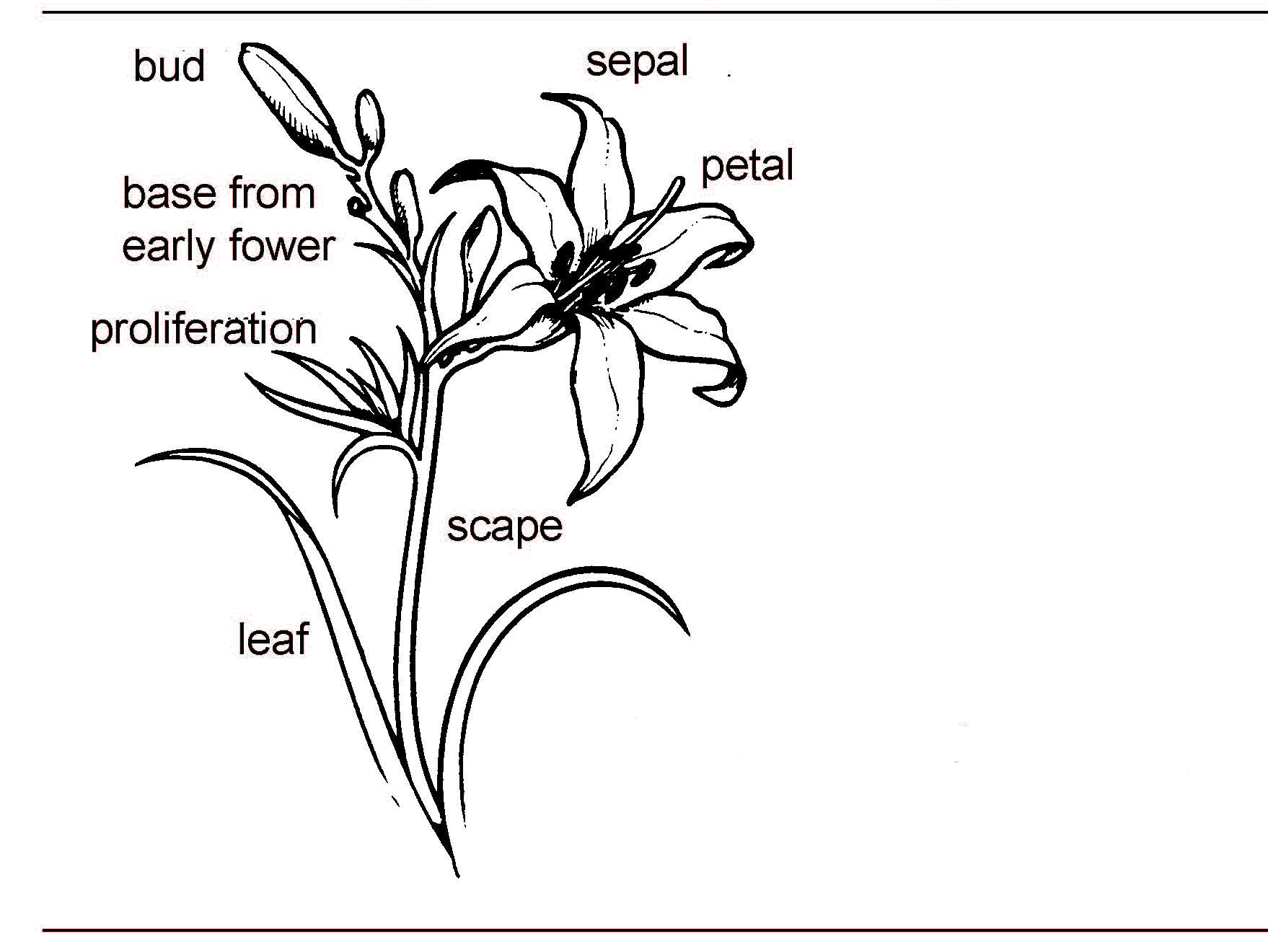
Flower shape will vary with the individual cultivar. Some flowers have wide and overlapping petals, while others have petals which bend backward. They may be crinkled, ruffled, or shaped like trumpets, cups, or bells. Some cultivars will automatically drop the spent bloom, thus giving the plant a neater appearance. These are known as “self-cleaners.”
Smaller types of daylilies are ideal border plants. Daylilies can also be effectively used with spring-flowering bulbs, since the daylily foliage will replace the empty areas when spring bulbs die down. Mass plantings are effective for landscape uses, adding both foliage and flower contrast to larger trees and shrubs. Types which spread rapidly are good for erosion control on steep banks. Daylily flower beds are even featured in oriental cuisine!
Classifications
There are several different types of daylilies, including those which are evergreen, semi-evergreen, and deciduous types. The deciduous types are known to grow well throughout Indiana. Although more properly suited for southern climates, the evergreen and semi-evergreen types are also being successfully grown by many Indiana gardeners. A mulch applied late in the season for several years helps these plants get established. Once established, they seem to be hardy.
Bloom time is variable. Some cultivars bloom in early June, while others may bloom as late as August. There are “rebloomer” types, as well, which flower over the entire summer season.
The most striking recent addition to daylily cultivars has been the development of tetraploid types. These plants have double the number of chromosomes in their cells as ordinary, diploid cultivars. The plants produce thicker scapes with larger flowers of much greater “substance.” Consider including some tetraploid cultivars in any daylily collection.
Daylilies which have been awarded prizes by the American Hemerocallis Society are excellent choices for the home landscape. Many other cultivars will also perform well, particularly those bred and selected in the Midwest. Catalog listings can be helpful in selecting cultivars.
Location
Although often noted for its thriftiness under conditions of neglect, the daylily does respond to good care. The plants should be located in full sun or partial shade. They prefer a loamy soil, but they will grow in a wide range of soil types. Deep soil preparation before planting is beneficial. Incorporation of organic matter on sandy soils may be helpful. Excessively rich soil may force foliage growth, resulting in sparse bloom.
Daylilies prefer good drainage and moderate moisture, but are able to grow under both wet and dry soil conditions. Water-logged sites, however, should be avoided.
Water and Nutrition
Natural rainfall usually provides ample moisture. However, excessive dryness does injure the plants and may cause some cultivars to drop their buds. During prolonged droughts, the soil should be thoroughly soaked to a depth of 10 or more inches and should not be watered again until it is dry. Daylilies respond favorably to abundant moisture before bloom.
Fertilizer should be used sparingly. On rich, loamy soil, little, if any, fertilizer is needed, and an excess of nitrogen may even be detrimental, since it may cause foliage to turn yellowish in early spring and become coarse and green later on. Bloom may also be reduced.
Generally the addition of moderate amounts of a complete dry fertilizer are beneficial. Analyses higher in phosphorus or potassium, such as 0-20-20 or 5-20-20, are suggested. One or 2 tablespoons should be applied around each plant in early spring.
Planting
In Indiana, the ideal planting time is from August 15 through September 30. During this period growth ceases, and there is a period of rapid root action and formation of next year’s flowers. Planting in the late summer or early fall gives the plants time to establish their root systems before cold weather. Spring planting is also acceptable, but it may decrease bloom the first season.
Before planting, prepare the entire planting area 1 foot deep. Space most daylily plants at least 2 feet apart. Dwarfs may be planted more closely. By planting in groups of at least three of the same variety, a massing effect can be achieved.
Dig each hole about 6 inches wider than the spread of the root mass, but leave a ridge in the center. Set the plant in place with the roots spread on each side of the ridge (Figure 2). Be sure the crown of the plant (the point where the roots and foliage meet) is set no deeper than 1 inch between the soil surface. Gently firm the soil around the roots and water in thoroughly. Deep planting will often cause browning of the foliage and a general lack of vigor.
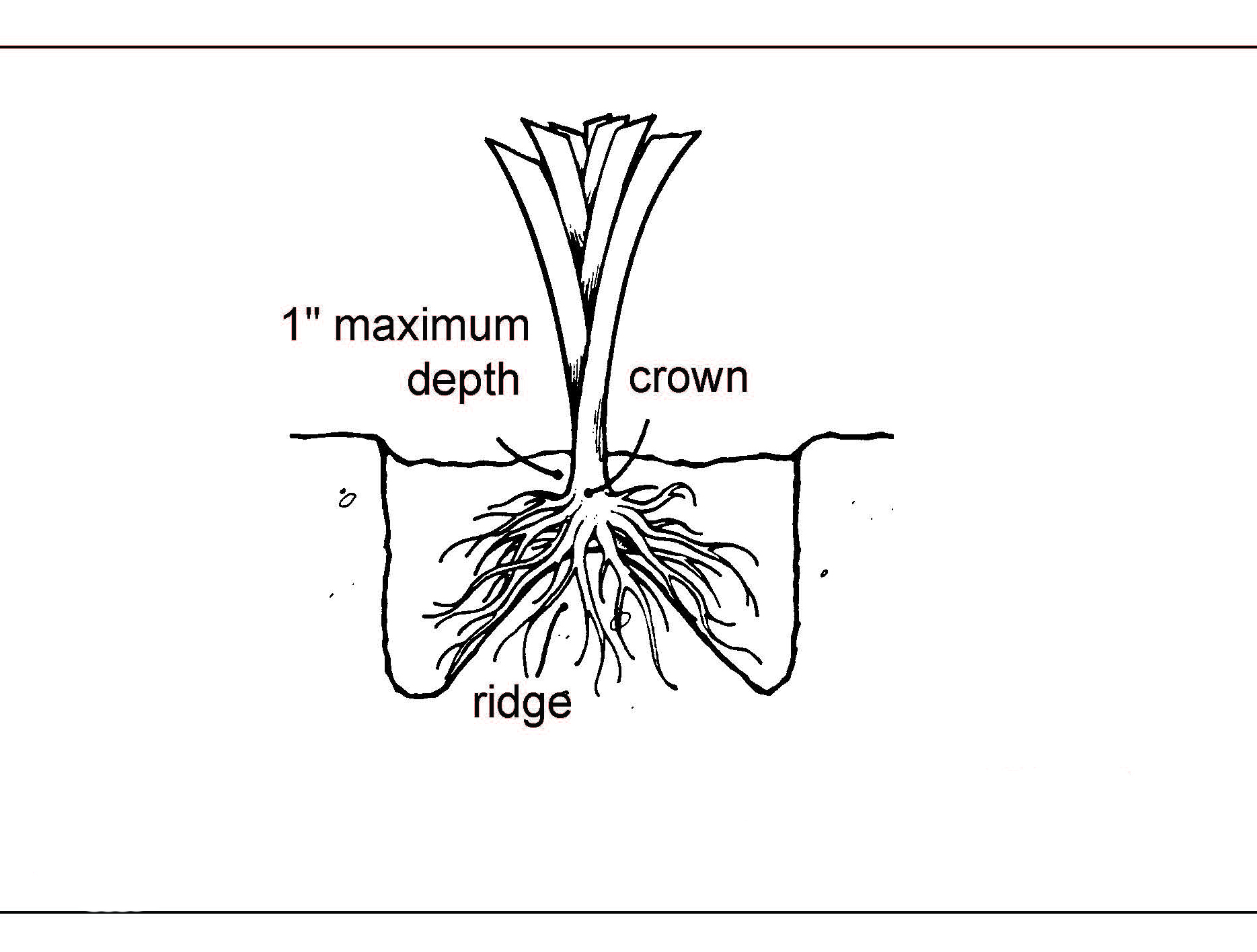
below the soil surface.
Summer Care
Mulches are beneficial but not essential for good daylily growth. Summer mulches reduce weeds and generally help condition the soil. In areas where heaving of the plants may be a problem, winter mulches are desirable. Light materials which do not pack around the crowns are preferred.
Remove damaged or diseased leaves when they appear. Cut the scapes a few inches above the ground after flowering.
Division
When flower production begins to decrease, divide older daylily clumps. Disturb only as often as necessary, usually not more than every 5-7 years. Most cultivars reach prime bloom the third season.
Cut around the entire clump with a sharp knife, and lift the entire mass. Wash off the excess soil, and cut into divisions (sections) with a sharp knife. Each division should include several strong fans or crowns. Cut the tops back to 8-10 inches, but trim only broken or decayed roots.
If you are removing certain clumps from a garden area, be sure to remove all the small plant parts and roots. Any remains might continue to grow and ultimately be out of place in the garden.
Hybridizing
Indiana has several amateurs who have been hybridizing daylilies for many years. The flowers are easy to emasculate and pollinate, and the results often are rewarding. For additional information, contact the American Hemerocallis Society (http://www.daylilies.org/).