

Introduction
Pollination is an important factor in growing fruits and nuts, since for most of these crops pollination is a prerequisite for fruit production. Pollination is the transfer of pollen from the stamen, or male part of a flower, to the pistil, or female part of a flower. Pollen is transferred by wind, splashing rain, moths, butterflies, birds, or honeybees, depending on the plant species. Most fruit trees are pollinated primarily by bees, while most nut trees are pollinated primarily by wind. The agent of pollen transfer (for example, a bee) is called the “pollinator” whereas the “pollinizer” is the source of pollen.
Authors
B. Rosie Lerner and Peter Hirst*
* This publication was previously authored by Juliann Chamberlain.
After pollination occurs, the pollen grain must germinate and grow into the ovary of the flower where the male pollen cell unites with the female egg cell in a process called fertilization. The success of pollination and fertilization depends upon the favorable environmental conditions as well as the right pollen grain reaching the pistil of the right flower, as pollen can only fertilize specific, compatible flowers. For example, pollen from a peach flower will not pollinate apple flowers.
Self and cross-pollination
Depending on the species, plants may be self- or cross-pollinated. The blossoms of self-pollinated (or self-fertile) plants can be fertilized by pollen from blossoms on the same tree or another tree of the same cultivar, as well as another cultivar of the same species. Therefore, a self-pollinated plant can provide its own pollen and doesn’t necessarily need another source to bear fruit. Even with a self-pollinated plant, bees are still necessary to transfer pollen. Examples of self-pollinated fruits are sour cherries,
apricots, and peaches.
Other species require cross-pollination, and can only set fruit by fertilization from another cultivar. Cross-pollination is the transfer of pollen from one cultivar to the flower of a different cultivar. Though in many cases their flowers have both male and female parts, the complex recognition factors in the flower prevent pollen from the same plant or cultivar from fertilizing its own flowers. For example, the pollen from one ‘Jonathan’ apple tree will not successfully fertilize flowers of another ‘Jonathan’ tree. Sweet cherries, pears, and most apples require the presence of two different compatible cultivars for pollination to result in fruit set.
In a few fruit species (e.g. kiwifruit and persimmon) male and female flowers are produced on different plants. Only female plants bear fruit, but a male plant must be present nearby to produce compatible pollen.
Check the individual listings under Pollen Requirements for the cross-pollination requirements for specific fruits and nuts. As well as having a source of compatible pollen nearby, attention must be paid to ensure the bloom time of the pollinizer overlaps with the tree to be pollinated.
Planting distance
Fruit trees that require two cultivars for pollination should be planted within 100-200 feet of each other. This will ensure that bees visit the trees often enough for adequate fruit set. Because nut trees are wind pollinated, plant them within 50 feet of each other.
Alternative pollen sources
If you do not have enough space to grow more than one fruit tree, there are a few alternatives even if your tree requires a second cultivar.
The easiest way to supply pollen is by cutting flower branches from a compatible cultivar and placing them in a bucket of water under your tree. Replace with fresh cut flower branches early each morning while the tree is in bloom.
If your neighbors have a compatible cultivar, plant your tree close enough to facilitate pollinator activity. Another possibility is to graft a branch of a compatible cultivar onto your tree. Although grafting is a rather complicated technique, the following sources of information will be helpful if you want to try this on your own.
http://www.extension.umn.edu/distribution/horticulture/DG0532.html
http://www.ext.nodak.edu/county/cass/horticulture/fruit/graft.htm
Or, check with your local nursery, garden center, or local garden club to find someone with experience who may be willing to graft your plant.
Pollination Requirements
Note: To avoid killing bees and other insect pollinators, do not apply insecticides while plants are in bloom.
Small fruits
Small fruits, including strawberries, raspberries, and blackberries, are primarily self-pollinating. Consequently, there is no need for a second cultivar. Blueberries require cross pollination, so select at least two cultivars with similar bloom times.
Tree fruits
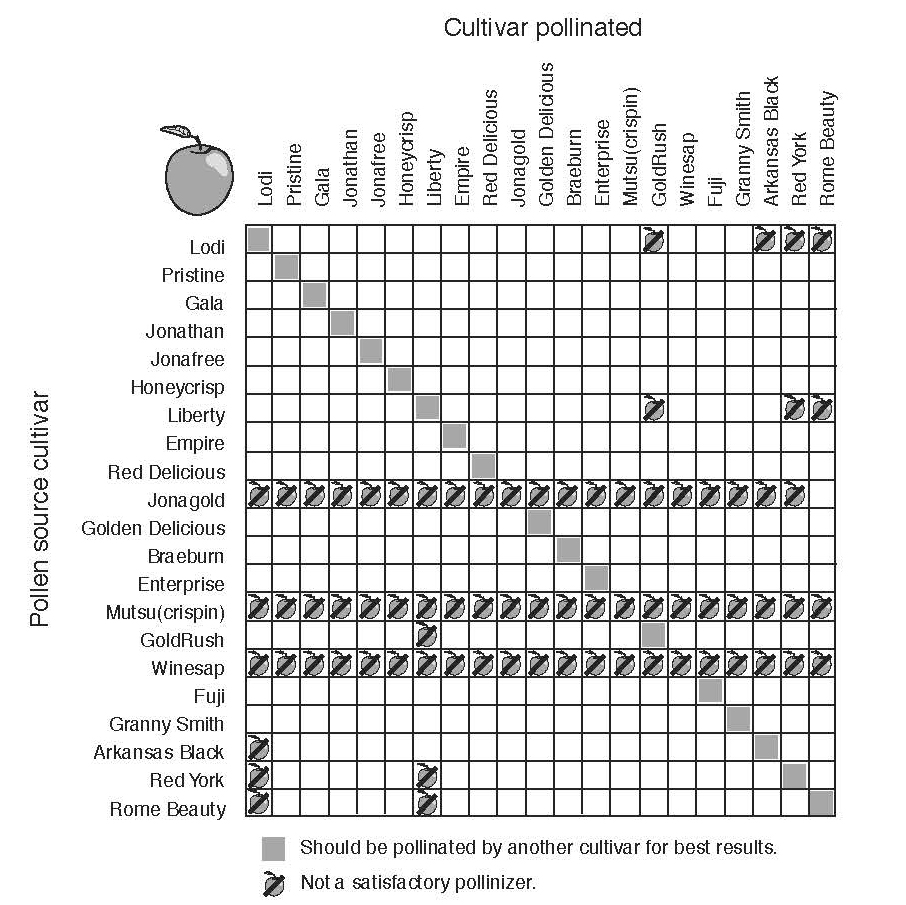
Apple—Apple trees require cross-pollination to produce fruit. It is important to choose compatible cultivars for maximum fruit production. Some apple cultivars such as ‘Sir Prize,’ ‘Turley,’ ‘Mutsu,’ ‘Stayman,’ the Winesap group and others are poor pollinizers and should not be used for a pollen source. Although ‘Golden Delicious’ is partially self-fruitful, it will produce better crops with cross-pollination. Many crab apple cultivars are excellent sources of pollen provided the bloom times overlap with other apple trees. See Chart A (on page 4 of this publication). Also refer to Purdue publication, HO-165 Apple Cultivars for Indiana.
Apricot—Most apricots are self-pollinated or self-fertile. However, in Indiana it is best to plant a second cultivar to encourage the heaviest fruit set possible. The cultivars ‘Perfection,’ ‘Riland,’ and ‘Rival’ require cross-pollination from any other cultivar. Apricots flower very early in the spring, posing a significant frost risk to flowers and young fruit.
Cherry, Sour—Sour cherries are self-pollinated or self-fertile so a second cultivar is unnecessary. Bee activity will help provide better pollen movement and thus provide better cropping.
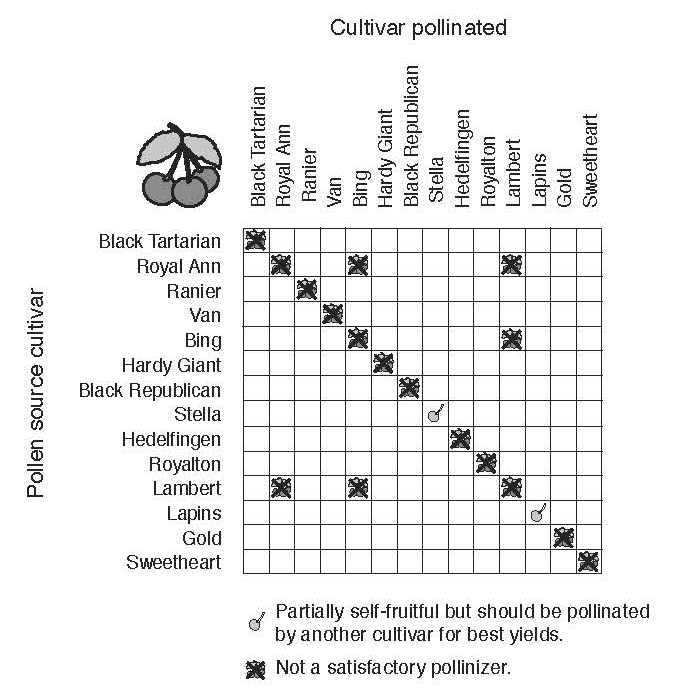
Cherry, Sweet—Sweet cherries (except for ‘Stella’ and ‘Lapins’) are self-incompatible, so two or, preferably, three cultivars must be planted together to insure adequate cross-pollination. Furthermore, some groups of cultivars are cross-incompatible. Thus, members of the same group will not cross-pollinate each other. For example, ‘Bing’ will not pollinate ‘Lambert’ or ‘Napoleon,’ etc. Select cultivars from at least two different groups or from outside these groups to be assured of cross-compatibility. Refer to Chart B (on page 4 of this publication).
The cross-incompatible groups include:
- ‘Bing, ’ ‘Lambert, ’ ‘Napoleon, ’ ‘Star, ’ and ‘Emperor Francis’
- ‘Windsor, ’ ‘Van, ’ and ‘Venus’
- ‘Viva, ’ ‘Hedelfingen, ’ and ‘Vista.’
Peach—Normally peaches are self–pollinated; however, a few cultivars such as ‘J.H. Hale’ need a pollinizer. Lack of pollination may be due to a lack of bees. If this is the case, hives placed near the trees during blossom time will aid pollination.
Pear—Most pear cultivars need a pollinizer and are compatible with any other cultivar with the following exceptions. ‘Magness’ cannot be used as a pollinizer for any other cultivar. ‘Bartlett’ and ‘Seckel’ will not cross-pollinate reliably. If you have these two cultivars, plant a third cultivar to provide pollen. Although ‘Duchess’ and ‘Kieffer’ are considered to be self-fruitful, a second cultivar is recommended for maximum fruit production.
Plum—European plums will not pollinate Japanese plums and vice versa due to the earlier bloom time of Japanese plums. American-Japanese hybrids may be able to serve as pollinizers for the Japanese cultivars, if their bloom seasons are compatible.
European plums have small fruits with dry, sweet flesh and require a second European type cultivar for pollination with the exception of ‘Damson,’ ‘Green Gage,’ and ‘Stanley’ which are self-fruitful. Other examples of European plums include ‘Blufre,’ ‘Earliblue,’ ‘Italian,’ ‘Mohawk,’ ‘President,’ ‘Seneca,’ ‘Shropshire,’ ‘Valor,’ ‘Verity,’ ‘Vision,’ and ‘Yellow Egg.’
Japanese plums are larger and less hardy than European types with soft, juicy, fruits. They require a second Japanese type for pollination. Japanese type cultivars include ‘Abundance,’ ‘Burbank,’ ‘Early Golden,’ ‘Elephant Heart,’ ‘Formosa,’ ‘Methley,’ ‘Santa Rosa,’ and ‘Shiro.’
Nut trees
Most nut trees are partially or completely self-unfruitful and require cross-pollination by another cultivar for adequate fruit set. Check the following list for pollination requirements.
Black Walnut—All cultivars are usually pollinated by native trees. Selected cultivars include ‘Beck,’ ‘Emmak,’ ‘Hare,’ ‘Oakes,’ ‘Snyder,’ ‘Sparrow,’ and ‘Thomas.’
Persian Walnut—’Hansen’ and ‘Colby’ are self-pollinated and do not require cross-pollination.
Chinese Chestnut—Plant any two cultivars of Chinese Chestnut for cross-pollination. Selected cultivars include ‘Abundance,’ ‘Crane,’ ‘Meiling,’ ‘Nanking,’ and ‘Orrin.’
Filbert (hazelnut)—’Winkler’ is reportedly self-fruitful. ‘Bixby’ and ‘Potomac’ are hybrids that should be planted together for cross-pollination.
Pecan—Plant at least one cultivar from each group for cross-pollination.
- ‘Giles,’ ‘Major,’ ‘Peruque’
- ‘Colby,’ ‘Posey’ ‘Green River’
Some nut growers recommend three different cultivars for maximum nut production on ‘Major.’ ‘Green River,’ and ‘Posey,’ are recommended to pollinate ‘Major.’ These cultivars provide a source of pollen over a long period of time. ‘Green River’ and ‘Posey’ are also good nut producers. If space is limited, plant ‘Major’ and ‘Posey’ for nut crops.
Hican (hickory-pecan hybrid)—Plant any two cultivars including ‘Bixby,’ ‘Burlington,’ ‘Country Club,’ ‘Dooley Burton,’ and ‘Hartmann’ to cross-pollinate. Native hickories and group A pecans will also pollinate hicans.
Hickory—Plant two cultivars of either hybrid or shagbark hickories for cross-pollination.
Definition of terms
Cultivar—A cultivated variety; a variation of a species that is somehow different from that species in a way that can be maintained when the plant is propagated.
Variety—A variation of a species.
Self-pollination—Transfer of pollen from the male part of one flower to the female flower part on the same flower, another flower on the same plant, or another plant of the same cultivar.
Cross-pollination—Occurring when the female flower part receives pollen from a different cultivar.
Pollinator—Bees, wind, moths, butterflies, other insects, animals, and humans, may act to physically transfer pollen from stamens to the stigma of the flower pistil.
Pollinizer—The source of pollen. Usually used when referring to cultivars planted for the purpose of cross-pollination.
Chart A. Apple Pollination.
Except where indicated, cultivars listed on the left can be used as reliable pollinizers for cross-pollination.*
| Cultivar pollinated | |||||||||||||||||||||
|---|---|---|---|---|---|---|---|---|---|---|---|---|---|---|---|---|---|---|---|---|---|
| Pollen Source Cultivar | Lodi | Pristine | Gala | Jonathan | Jonafree | Honeycrisp | Liberty | Empire | Red Delicious | Jonagold | Golden Delicious | Braeburn | Enterprise | Mutsu (crispin) | GoldRush | Winesap | Fuji | Granny Smith | Arkansas Black | Red York | Rome Beauty |
| Lodi | Should be pollinated by another variety for best results | Compatible | Compatible | Compatible | Compatible | Compatible | Compatible | Compatible | Compatible | Compatible | Compatible | Compatible | Compatible | Compatible | Not a satisfactory pollinizer. | Compatible | Compatible | Compatible | Not a satisfactory pollinizer. | Not a satisfactory pollinizer. | Not a satisfactory pollinizer. |
| Pristine | Compatible | Should be pollinated by another variety for best results | Compatible | Compatible | Compatible | Compatible | Compatible | Compatible | Compatible | Compatible | Compatible | Compatible | Compatible | Compatible | Compatible | Compatible | Compatible | Compatible | Compatible | Compatible | Compatible |
| Gala | Compatible | Compatible | Should be pollinated by another variety for best results | Compatible | Compatible | Compatible | Compatible | Compatible | Compatible | Compatible | Compatible | Compatible | Compatible | Compatible | Compatible | Compatible | Compatible | Compatible | Compatible | Compatible | Compatible |
| Jonathan | Compatible | Compatible | Compatible | Should be pollinated by another variety for best results | Not a satisfactory pollinizer. | Not a satisfactory pollinizer. | Not a satisfactory pollinizer. | Not a satisfactory pollinizer. | Not a satisfactory pollinizer. | Not a satisfactory pollinizer. | Not a satisfactory pollinizer. | Not a satisfactory pollinizer. | Not a satisfactory pollinizer. | Not a satisfactory pollinizer. | Not a satisfactory pollinizer. | Not a satisfactory pollinizer. | Not a satisfactory pollinizer. | Not a satisfactory pollinizer. | Not a satisfactory pollinizer. | Not a satisfactory pollinizer. | Not a satisfactory pollinizer. |
| Jonafree | Compatible | Compatible | Compatible | Compatible | Should be pollinated by another variety for best results | Compatible | Compatible | Compatible | Compatible | Compatible | Compatible | Compatible | Compatible | Compatible | Compatible | Compatible | Compatible | Compatible | Compatible | Compatible | Compatible |
| Honeycrisp | Compatible | Compatible | Compatible | Compatible | Compatible | Should be pollinated by another variety for best results | Compatible | Compatible | Compatible | Compatible | Compatible | Compatible | Compatible | Compatible | Compatible | Compatible | Compatible | Compatible | Compatible | Compatible | Compatible |
| Liberty | Compatible | Compatible | Compatible | Compatible | Compatible | Compatible | Should be pollinated by another variety for best results | Compatible | Compatible | Compatible | Compatible | Compatible | Compatible | Compatible | Not a satisfactory pollinizer. | Compatible | Compatible | Compatible | Compatible | Not a satisfactory pollinizer. | Not a satisfactory pollinizer. |
| Empire | Compatible | Compatible | Compatible | Compatible | Compatible | Compatible | Compatible | Should be pollinated by another variety for best results | Compatible | Compatible | Compatible | Compatible | Compatible | Compatible | Compatible | Compatible | Compatible | Compatible | Compatible | Compatible | Compatible |
| Red Delicious | Compatible | Compatible | Compatible | Compatible | Compatible | Compatible | Compatible | Compatible | Should be pollinated by another variety for best results | Compatible | Compatible | Compatible | Compatible | Compatible | Compatible | Compatible | Compatible | Compatible | Compatible | Compatible | Compatible |
| Jonagold | Not a satisfactory pollinizer. | Not a satisfactory pollinizer. | Not a satisfactory pollinizer. | Not a satisfactory pollinizer. | Not a satisfactory pollinizer. | Not a satisfactory pollinizer. | Not a satisfactory pollinizer. | Not a satisfactory pollinizer. | Not a satisfactory pollinizer. | Not a satisfactory pollinizer. | Not a satisfactory pollinizer. | Not a satisfactory pollinizer. | Not a satisfactory pollinizer. | Not a satisfactory pollinizer. | Not a satisfactory pollinizer. | Not a satisfactory pollinizer. | Not a satisfactory pollinizer. | Not a satisfactory pollinizer. | Not a satisfactory pollinizer. | Not a satisfactory pollinizer. | Compatible |
| Golden Delicious | Compatible | Compatible | Compatible | Compatible | Compatible | Compatible | Compatible | Compatible | Compatible | Compatible | Should be pollinated by another variety for best results | Compatible | Compatible | Compatible | Compatible | Compatible | Compatible | Compatible | Compatible | Compatible | Compatible |
| Braeburn | Compatible | Compatible | Compatible | Compatible | Compatible | Compatible | Compatible | Compatible | Compatible | Compatible | Compatible | Should be pollinated by another variety for best results | Compatible | Compatible | Compatible | Compatible | Compatible | Compatible | Compatible | Compatible | Compatible |
| Enterprise | Compatible | Compatible | Compatible | Compatible | Compatible | Compatible | Compatible | Compatible | Compatible | Compatible | Compatible | Compatible | Should be pollinated by another variety for best results | Compatible | Compatible | Compatible | Compatible | Compatible | Compatible | Compatible | Compatible |
| Mutsu (crispin) | Not a satisfactory pollinizer. | Not a satisfactory pollinizer. | Not a satisfactory pollinizer. | Not a satisfactory pollinizer. | Not a satisfactory pollinizer. | Not a satisfactory pollinizer. | Not a satisfactory pollinizer. | Not a satisfactory pollinizer. | Not a satisfactory pollinizer. | Not a satisfactory pollinizer. | Not a satisfactory pollinizer. | Not a satisfactory pollinizer. | Not a satisfactory pollinizer. | Not a satisfactory pollinizer. | Not a satisfactory pollinizer. | Not a satisfactory pollinizer. | Not a satisfactory pollinizer. | Not a satisfactory pollinizer. | Not a satisfactory pollinizer. | Not a satisfactory pollinizer. | Not a satisfactory pollinizer. |
| GoldRush | Compatible | Compatible | Compatible | Compatible | Compatible | Compatible | Not a satisfactory pollinizer. | Compatible | Compatible | Compatible | Compatible | Compatible | Compatible | Compatible | Should be pollinated by another variety for best results | Compatible | Compatible | Compatible | Compatible | Compatible | Compatible |
| Winesap | Not a satisfactory pollinizer. | Not a satisfactory pollinizer. | Not a satisfactory pollinizer. | Not a satisfactory pollinizer. | Not a satisfactory pollinizer. | Not a satisfactory pollinizer. | Not a satisfactory pollinizer. | Not a satisfactory pollinizer. | Not a satisfactory pollinizer. | Not a satisfactory pollinizer. | Not a satisfactory pollinizer. | Not a satisfactory pollinizer. | Not a satisfactory pollinizer. | Not a satisfactory pollinizer. | Not a satisfactory pollinizer. | Not a satisfactory pollinizer. | Not a satisfactory pollinizer. | Not a satisfactory pollinizer. | Not a satisfactory pollinizer. | Not a satisfactory pollinizer. | Not a satisfactory pollinizer. |
| Fuji | Compatible | Compatible | Compatible | Compatible | Compatible | Compatible | Compatible | Compatible | Compatible | Compatible | Compatible | Compatible | Compatible | Compatible | Compatible | Compatible | Should be pollinated by another variety for best results | Compatible | Compatible | Compatible | Compatible |
| Granny Smith | Compatible | Compatible | Compatible | Compatible | Compatible | Compatible | Compatible | Compatible | Compatible | Compatible | Compatible | Compatible | Compatible | Compatible | Compatible | Compatible | Compatible | Should be pollinated by another variety for best results | Compatible | Compatible | Compatible |
| Arkansas Black | Not a satisfactory pollinizer. | Compatible | Compatible | Compatible | Compatible | Compatible | Compatible | Compatible | Compatible | Compatible | Compatible | Compatible | Compatible | Compatible | Compatible | Compatible | Compatible | Compatible | Should be pollinated by another variety for best results | Compatible | Compatible |
| Red York | Not a satisfactory pollinizer. | Compatible | Compatible | Compatible | Compatible | Compatible | Not a satisfactory pollinizer. | Compatible | Compatible | Compatible | Compatible | Compatible | Compatible | Compatible | Compatible | Compatible | Compatible | Compatible | Compatible | Should be pollinated by another variety for best results | Compatible |
| Rome Beauty | Not a satisfactory pollinizer. | Compatible | Compatible | Compatible | Compatible | Compatible | Not a satisfactory pollinizer. | Compatible | Compatible | Compatible | Compatible | Compatible | Compatible | Compatible | Compatible | Compatible | Compatible | Compatible | Compatible | Compatible | Should be pollinated by another variety for best results |
Chart B. Cherry Pollination
Except where indicated, cultivars listed on the left can be used as reliable pollinizers for cross-pollination.**
| Cultivar pollinated | ||||||||||||||
|---|---|---|---|---|---|---|---|---|---|---|---|---|---|---|
| Pollen Source Cultivar | Black Tartarian | Royal Ann | Ranier | Van | Bing | Hardy Giant | Black Republican | Stella | Hedelfingen | Royalton | Lambert | Lapins | Gold | Sweetheart |
| Black Tartarian | Not a satisfactory pollinizer. | Compatible | Compatible | Compatible | Compatible | Compatible | Compatible | Compatible | Compatible | Compatible | Compatible | Compatible | Compatible | Compatible |
| Royal Ann | Compatible | Not a satisfactory pollinizer. | Compatible | Compatible | Not a satisfactory pollinizer. | Compatible | Compatible | Compatible | Compatible | Compatible | Not a satisfactory pollinizer. | Compatible | Compatible | Compatible |
| Ranier | Compatible | Compatible | Not a satisfactory pollinizer. | Compatible | Compatible | Compatible | Compatible | Compatible | Compatible | Compatible | Compatible | Compatible | Compatible | Compatible |
| Van | Compatible | Compatible | Compatible | Not a satisfactory pollinizer. | Compatible | Compatible | Compatible | Compatible | Compatible | Compatible | Compatible | Not a satisfactory pollinizer. | Compatible | Compatible |
| Bing | Compatible | Compatible | Compatible | Compatible | Not a satisfactory pollinizer. | Compatible | Compatible | Compatible | Compatible | Compatible | Not a satisfactory pollinizer. | Compatible | Compatible | Compatible |
| Hardy Giant | Compatible | Compatible | Compatible | Compatible | Compatible | Not a satisfactory pollinizer. | Compatible | Compatible | Compatible | Compatible | Compatible | Compatible | Compatible | Compatible |
| Black Republican | Compatible | Compatible | Compatible | Compatible | Compatible | Compatible | Not a satisfactory pollinizer. | Compatible | Compatible | Compatible | Compatible | Compatible | Compatible | Compatible |
| Stella | Compatible | Compatible | Compatible | Compatible | Compatible | Compatible | Compatible | Partially self-fruited but should be pollinated by another cultivar for best yields | Compatible | Compatible | Compatible | Compatible | Compatible | Compatible |
| Hedelfingen | Compatible | Compatible | Compatible | Compatible | Compatible | Compatible | Compatible | Compatible | Not a satisfactory pollinizer. | Compatible | Compatible | Compatible | Compatible | Compatible |
| Royalton | Compatible | Compatible | Compatible | Compatible | Compatible | Compatible | Compatible | Compatible | Compatible | Not a satisfactory pollinizer. | Compatible | Compatible | Compatible | Compatible |
| Lambert | Compatible | Not a satisfactory pollinizer. | Compatible | Compatible | Not a satisfactory pollinizer. | Compatible | Compatible | Compatible | Compatible | Compatible | Not a satisfactory pollinizer. | Compatible | Compatible | Compatible |
| Lapins | Compatible | Compatible | Compatible | Compatible | Compatible | Compatible | Compatible | Compatible | Compatible | Compatible | Compatible | Partially self-fruited but should be pollinated by another cultivar for best yields | Compatible | Compatible |
| Gold | Compatible | Compatible | Compatible | Compatible | Compatible | Compatible | Compatible | Compatible | Compatible | Compatible | Compatible | Compatible | Not a satisfactory pollinizer. | Compatible |
| Sweetheart | Compatible | Compatible | Compatible | Compatible | Compatible | Compatible | Compatible | Compatible | Compatible | Compatible | Compatible | Compatible | Compatible | Not a satisfactory pollinizer. |