

Introduction
Although it’s easy to identify poison ivy (Rhus radicans or Toxicodendron radicans) and most people have heard that they should avoid it, countless individuals experience a painful introduction to the species. A mere touch of poison ivy foliage can result in skin blotches and burning water blisters, which cause the flesh beneath to swell and throb with intense pain.
Individuals may experience these symptoms a short time after exposure, or they may not experience them until a few days later. Fortunately, these reactions leave no scars, and do not affect general health.
This publication describes how to identify poison ivy, provides treatment options for those who come in contact with the foliage, and offers control options.
Authors
B. Rosie Lerner, Purdue Horticulture and Landscape Architecture
Travis Legleiter, Purdue Botany and Plant Pathology
This publication was adapted with permission from Poison Ivy: Identification and Control (University of Missouri Extension publication MU Guide 4880).
All parts of the poison ivy plant, including the stem and roots, contain and secrete a nonvolatile oil (oleo resin), which affects the skin. This oil is insoluble in water. That means if you simply wash with water alone after coming into contact with poison ivy, you merely spread the oil to other areas and increase the discomfort.
However, washing with a strong alkali soap, such as yellow laundry or naptha, will relieve the discomfort. Alcohol will dissolve and remove the oily substance from the skin, and if you apply it soon enough, may prevent irritation.
Seek medical attention as needed.
If you ever remove poison ivy, you must be sure never to burn it (alone or with other brush). Burning poison ivy can be hazardous because the smoke may contain the oil and can cause the same symptoms. Inhaling the smoke can result in serious consequences.
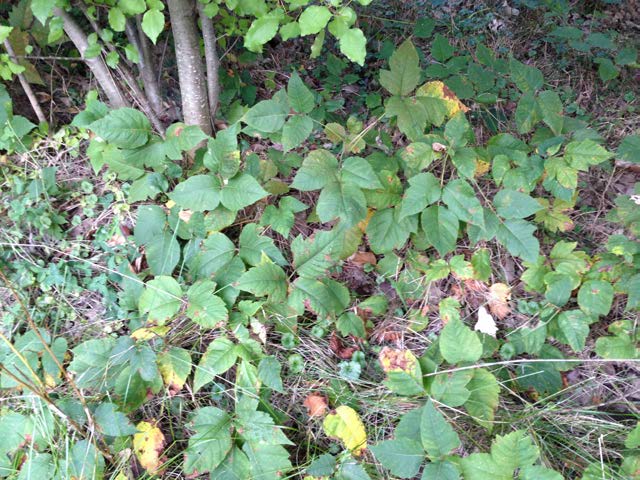 Figure 1. Poison ivy can show up virtually anywhere in the home landscape.
Photo by B. Rosie Lerner
Figure 1. Poison ivy can show up virtually anywhere in the home landscape.
Photo by B. Rosie Lerner Identification
Poison ivy can be a low-growing shrub or a vine that climbs to the top of the tallest tree. It has aerial rootlets that enable the vine to attach itself to whatever it may be growing on.
Poison ivy can be found almost anywhere (Figure 1). It usually grows along fencerows, roadside areas, and along the edges of wooded tracts. However, you may also find it around the home in shrubbery, flowerbeds, and along lot boundaries. Since it is inconspicuous during the growing season, homeowners may be unaware of its presence. However, its vivid fall color makes poison ivy a tempting addition to winter bouquets.
Poison ivy is most easy to identify by its leaves, which are compound and composed of three leaflets (Figure 2). The leaflets may have smooth, scalloped, or irregularly toothed margins. The two lower, opposite leaflets grow on a very short or absent stalk. The third or top leaflet will be extended on a long stalk. Leaf surfaces may or may not appear oily, waxy, or warty.
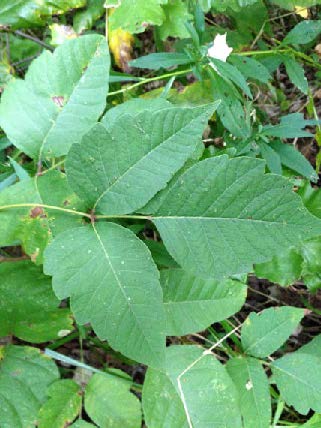 Figure 2. Poison ivy has a compound leaf made of three leaflets. The top leaflet has a long stalk. Photo by B. Rosie Lerner
 Another key identifying characteristic is that one side of a leaflet may have an irregularly toothed margin, while the opposite margin remains smooth or without serration.
Poison ivy produces greenish white, smooth berries that appear waxy (Figure 3). The berries grow in clusters about the size of currants. Each berry contains a single seed. Birds and other wildlife eat the berries and spread the seeds in their droppings.
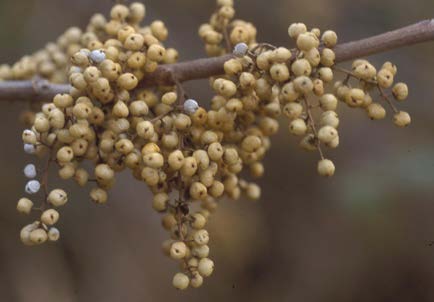 Figure 3. Poison ivy has greenish white, smooth berries. Photo by Ohio State Weed Lab, The Ohio State University, bugwood.org
 Similar Species
People often use the names “poison ivy” and “poison oak” interchangeably; this is incorrect. Poison ivy is the only species found throughout Indiana. Poison oak (Rhus toxicodendron), is a low-growing, non-climbing shrub, that is not known to occur in Indiana (Figure 4).
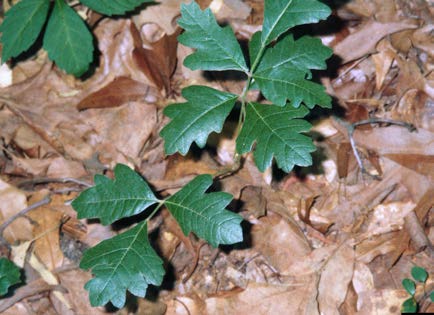 Figure 4. Poison oak is a low-growing, non-climbing shrub. Photo by David J. Moorhead, University of Georgia, bugwood.org
 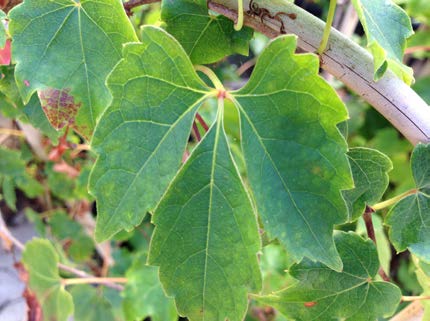 Figure 5. Young Boston ivy also has a compound leaf with three leaflets. Each leaf is attached by a stalk. Photo by B. Rosie Lerner
 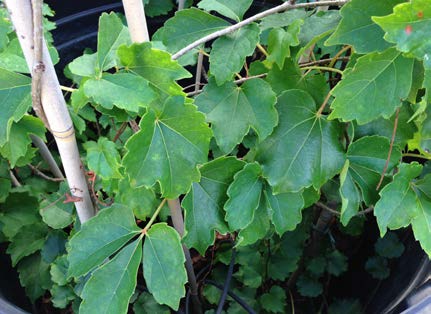 Figure 6. Mature Boston ivy leaves are three-lobed, but not separated. Photo by B. Rosie Lerner
 It’s also easy to confuse poison ivy with Virginia creeper (Parthenocissus quinquefolia), also called woodbine. Virginia creeper, found throughout Indiana, is an aggressive vine that will grow to the top of the tallest trees. It can be distinguished from poison ivy because its compound leaf has five leaflets (Figure 7). Both Boston ivy and Virginia creeper have dark blue fruit.
Fragrant sumac (Rhus aromatica) also has three leaflets and is commonly confused with poison ivy (Figure 8). However, none of the leaflets have stalks in fragrant sumac and the fruit are red and slightly fuzzy (Figure 9).
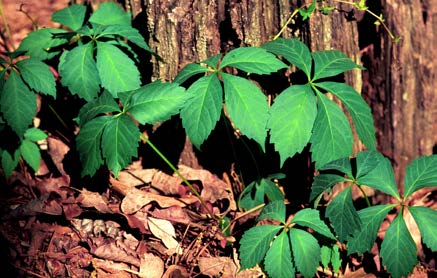 Figure 7. Virginia creeper has compound leaves with five leaflets; poison ivy has three leaflets. Photo by James H. Miller & Ted Bodner, Southern Weed Science Society, bugwood.org
 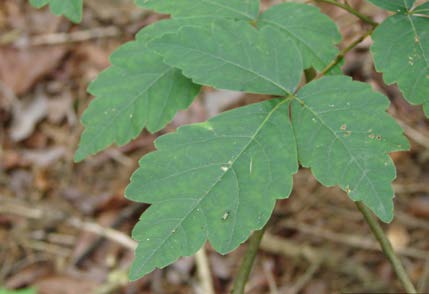 Figure 8. Fragrant sumac also has compound leaves, but none of the leaflets have stalks. Photo by Troy Evans, Great Smoky Mountains National Park, bugwood.org
 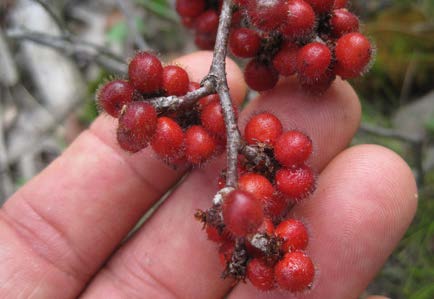 Figure 9. Fragrant sumac has red berries. Photo by Rob Routledge, Sault College, bugwood.org
 None of these lookalike plants — Boston ivy, Virginia creeper, and fragrant sumac — contain toxic substances that irritate the skin.
Control
Once established, the woodiness of the poison ivy plant makes it difficult to control. Repeatedly cutting the plant back to the ground may eventually starve the plant. However, each time you cut it, you expose yourself to the oil. You can dig up and discard small
plants. However, if you leave behind any portion of the root system, the plant will likely resprout.
Several herbicides are available for poison ivy control. However, keep in mind that any herbicide that will kill poison ivy will also kill any desirable plants. So if the poison ivy is growing among shrubs and trees, you must apply chemical controls directly to the poison ivy plant and not to any of the other plants. If the poison ivy growth is severe enough, it may be worth sacrificing some desirable plants to eliminate the poison ivy.
Herbicide products that contain the active ingredient triclopyr are the most effective at controlling poison ivy. You can find these products at retail stores or nurseries. The products are often touted as poison ivy or brush control and are most often mixed with glyphosate. When using these products, it is essential to thoroughly cover the vegetative parts of the plant. Be prepared to make repeated applications for complete control.
The herbicide glyphosate (Roundup®, Kleenup®) is also effective in eradicating the pest, but again, will require multiple applications. You may also use a combination of triclopyr and 2,4-D (Crossbow®) where herbicide drift is not a factor. However, you should never apply 2,4-D in locations where other sensitive species grow in close proximity to poison ivy.
Read and understand the instructions on any herbicide label before making applications. No matter what control method you use, be careful to avoid exposing your skin to the plant. Wear gloves, long pants, socks and shoes, and a long-sleeved shirt.
And remember: never burn poison ivy! The smoke from burning the plant contains particles that can seriously injure your eyes, skin, and respiratory system.
For more information about poison ivy, contact your Purdue Extension county office.
Reference to products in this publication is not intended to be an endorsement to the exclusion of others that may be similar. Individuals using such products assume responsibility for their use in accordance with current directions of the manufacturer.