

Plant Growth Regulators for Greenhouse Production Pocket Reference
 How Do Growth Regulators Work?
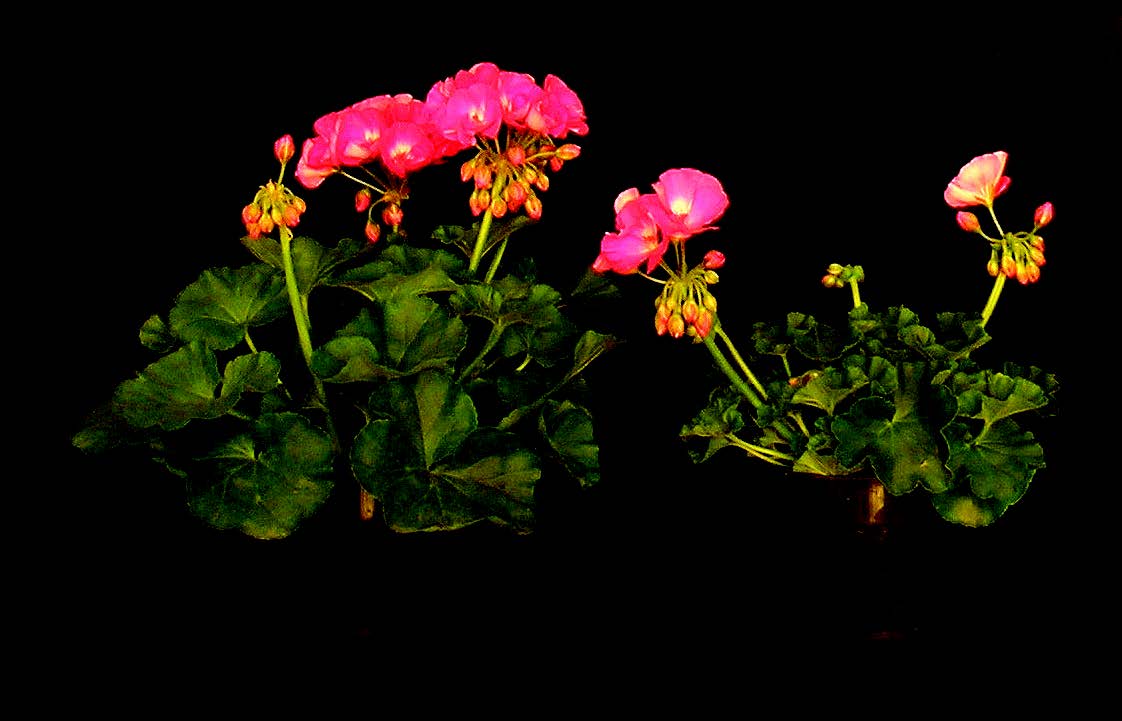
Many plant growth regulators (PGRs) reduce internode elongation, which decreases plant height. These growth-retarding products contain one of these active ingredients:
- ancymidol
- chlormequat chloride
- daminozide
- flurprimidol
- paclobutrazol
- uniconazole
In other growth regulators, the active ingredients are plant hormones such as benzyladenine (BA) or gibberellins (GA), which affect growth (cell elongation and division) and development (flowering). Dikegulac-sodium products reduce apical dominance and increase branching.
Additional Notes on Plant Growth Regulators
- ancymidol: Drench remains active (in plant) 3 - 4 weeks.
- benzyladenine: Stimulates but does not cause branching or flowering. Spray remains active 7 - 10 days.
- benzyladenine + gibberellins: Products can induce growth in “over-regulated” poinsettia.
- chlormequat chloride: Drench remains active 1 - 2 weeks. May see leaf margin yellowing in 3 - 5 days.
- daminozide: Apply foliar spray in early morning or late in the evening for best uptake. Do not tank mix or use with a copper-containing compound.
- dikegulac-sodium: Apply early in crop production schedule. Transient chlorosis and slowed growth for 1 - 2 weeks.
- ethephon: Remains active 6 - 8 weeks.
- flurprimidol: Not recommended for fibrous begonia. Do not apply on plugs of begonia, pansy, salvia, or annual vinca.
- gibberellins: Very active, start with lowest label rates.
- paclobutrazol: Drench rates approximately 10% of spray rates. Drench remains active 3 - 4 weeks. Do not apply on annual vinca. Begonia, geranium, and viola are very sensitive.
- uniconazole: Drench remains active 3 - 4 weeks. Can leach into groundwater.
Things to Remember
Use products only as labeled. The labels indicate:
- Any known intolerances.
- Application timing.
- Any phytotoxic effects.
General Recommendations
- Use higher concentrations of PGRs when plant growth rates are high (due to high temperature and light).
- Know that plant response varies with plant species and cultivar.
- Mix and apply PGRs the same day.
- Do not apply PGRs to stressed plants.
Sprays
- Repeat applications at lower rates may be beneficial (except dikegulac-sodium).
- Make sure foliage is dry before application.
- Apply 2 qts/100 ft2 spray volume (general recommendation) — chlormequat chloride and paclobutrazol may require 2–3 qts/100 ft2 for larger plants.
Drenches
- Make sure substrate is moist, not wet — water before application.
- Decrease rates for sub-irrigation — substrate should be as moist as after a normal watering.
- Remember that as the percentage of pine bark in substrate increases, the effectiveness of ancymidol,
flurprimidol, paclobutrazol, and uniconazole decreases. Test these products first with non-composted organic substrate components.
Container Sizes and Volumes for Drench Applications
| Drench Volume | ||
|---|---|---|
| Container Diameter (inches) | fl oz./container (1) | mL/container |
| 4 | 2 | 59 |
| 5 | 3 | 89 |
| 6 | 4 | 118 |
| 8 | 10 | 296 |
| 10 | 25 | 739 |
| 10-inch basket | 15 | 444 |
Plant Growth Regulators for Greenhouse Containerized Ornamentals
Notes:
1: Do not reuse containers or trays after application.
2: Agitate during application.
3: Do not apply through irrigation system.
4: Apply early in the morning or late in the evening because activity is related to temperature.
5: Avoid run-off when applying sprays.
6: Apply within 4 hours of mixing.
7: The ideal PGR solution pH is 5.
8: Best mixed with neutral or slightly acid water (pH < 8.5).
| Active Ingredient (A.I.) | Notes | Trade Names | % A.I. and Formulation | Relative Activity | Spray (S) or Dench (D) Concentration Range for Annuals (ppm) | Application Method and Target | Spreader Sticker w/ Sprays | Hours to Overhead Irrigation | REI (hrs.) |
|---|---|---|---|---|---|---|---|---|---|
| ancymidol | 1, 2 | A-Rest®, Abide® | 0.026 liquid | M | S: 6-66 D: 1-2 | spray, dip, drench leaves, roots | N | 0.5-1 | 12 |
| benzyladenine 6-BA | 3 | Configure® | 2.0 liquid | No data | S: 50-500 | spray leaves | Y | 6 | 12 |
| benzyladenine 6-BA +gibberellins GA4+7 | 3, 4, 5 | Fascination®, Fresco® | 1.8/1.8 liquid | H | S: 1-100 | spray leaves | Y | 12 | 4 |
| chlormequat chloride | 3, 4, 5 | Chlormequat E-Pro®, Citadel®, Cycocel® | 11.8 liquid | L | S: 800-1,500 D: 2,000-3,000 | spray, dip, drench leaves, roots | N | 6 | 12 |
| daminozide | 3, 4 | B-Nine®, Dazide® | 85.0 powder | L | S: 1,250-2,500 | spray leaves | N | 24 | 24 |
| dikegulac-sodium | 3, 4 | Augeo® | 18.5 liquid | M | S: 400-1,600 | spray leaves | N | 6 | 12 |
| ethephon | 3, 4, 5, 6, 7 | Florel® | 3.9 liquid | L | S: 100-500 | spray, dip leaves | Y | 12-16 | 48 |
| flurprimidol | 1, 2 | Topflor® | 0.38 liquid | H | S: 2.5-80 D: 0.25-4 | spray, dip, drench leaves, stems, roots | N | 0.5 | 12 |
| gibberellic acid GA3 | 3, 8 | Florgib®, ProGibb T&O®* | 4.0 liquid | H | S: 50-500 | spray leaves, stems | N | 2 | 4, 12* |
| paclobutrazol | 1, 2 | Bonzi®, Downsize®, Florazol®, Paczol®, Piccolo® | 0.4 liquid | H | S: 2.5-90 D: 1 | spray, dip, drench (Downsize® drench only) stems, roots | N | 0.5 | 12 |
| uniconazole | 3, 4, 6 | Concise®, Sumagic® | 0.055 liquid | H | S: 1-50 D: 0.1-2 | spray, dip, drench stems, roots | N | 0.5-1 | 12 |
More PGR information is available in Commercial Greenhouse and Nursery Production: Applying Plant Growth Retardants for Height Control, Purdue Extension publication HO-248-W. Available from the Purdue Extension Education Store.
We appreciate the insight of James Barrett, Brian Whipker, Joyce Latimer, Fine Americas, OHP Inc., SePRO, Syngenta, and Valent Biosciences.