

Introduction
Many commercial growing media include a starter dose of fertilizer. Usually, a growing medium quickly loses starter fertilizer because of top-down irrigation (such as from a hose or boom irrigation). Most of it leaches out of the containers within a few days of planting.
Author
Krishna Nemali
However, this fertilizer loss due to leaching does not occur with subirrigation. In sub-irrigation, the growing medium absorbs water bottom-up through the holes in the pot. Leaching from the growing medium is practically absent. Because of sub-irrigation, starter fertilizer can remain in the growing medium for a longer period and supply a substantial amount of nutrients to plants.
We set out to find out how much additional fertilizer a crop needs under sub-irrigation when the growing medium contains starter fertilizer or not. This publication summarizes that research.
Methods
We obtained plug seedlings of wax begonia ‘Cocktail Vodka’ from a commercial grower and transplanted them into 4-inch containers filled with soilless growth medium (Fafard 2P mix). Some containers had starter fertilizer and others did not. Starter fertilizer was removed from the medium by irrigating it several times to leach it out. We placed the seedlings on 4 x 8-foot ebb and flow bench (Figure 1) and sub-irrigated the seedlings every day with one of the four fertilizer solutions made from Peter’s 20-10-20 Peat Lite Special. The four fertilizer solutions had concentrations of 0, 50, 130, or 210 ppm of nitrogen (N); the solutions had electrical conductivity (EC) of 0.15, 0.33, 0.86 and 1.4 mS/cm.
After eight weeks of growth, we measured shoot dry weight, leaf area, and flower number.
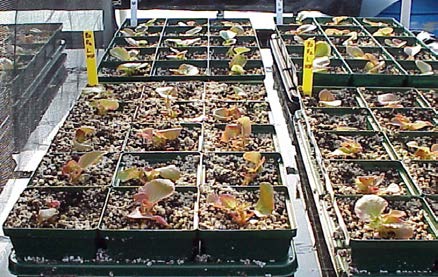 Figure 1. This picture shows wax begonias that were sub-irrigated with a fertilizer solution on ebb-flow benches. The plants were grown in 4-inch containers filled with Fafard 2P mix.
 What We Learned
When the growing medium contained starter fertilizer, adding more fertilizer to the growing medium did not increase shoot dry weight. However, when growing medium did not contain starter fertilizer, adding fertilizer during growth did increase shoot dry weight.
When the medium did not contain starter fertilizer, we found that maximum growth was obtained with fertilizer concentrations of 130 to 210 ppm N (EC of 0.86 to 1.4 dS/m) (Figures 2 and 3).
We also found that leaf area, plant height, and number of flowers per plant responded similarly to shoot dry weight (Figure 3). Based on these findings, we recommend fertilizing wax begonias with 130 to 210 ppm N if the growing medium does not contain a starter fertilizer. If the growing medium does contain a starter fertilizer, we recommend fertilizing with a lower concentration of about 50 ppm N.
0, 50, 130, and 210 ppm. We applied fertilizer solution to growing media that did and did not contain a starter fertilizer.
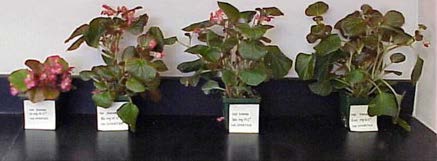
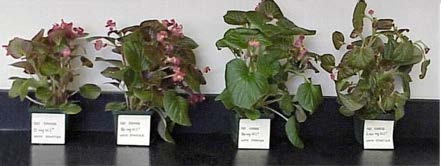
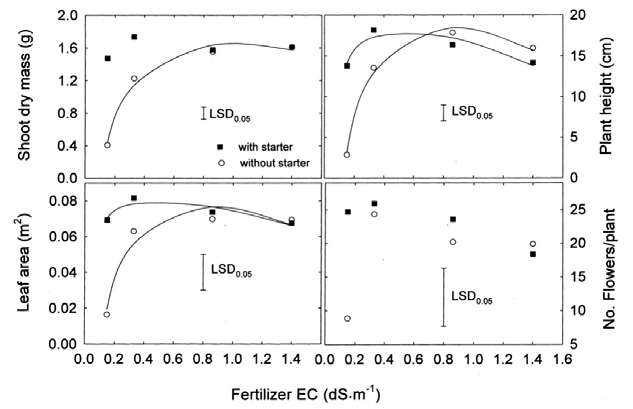 Figure. 3. These graphs illustrate the effects of sub-irrigating wax begonias on various growth factors with various fertilizer concentrations. In the graphics, filled squares indicate a growing medium that contained starter fertilizer; open squares indicate a growing medium that did not contain starter fertilizer.
 Conclusions
From this research, growers can produce subirrigated wax begonias with very little fertilizer if the growing medium contains a starter fertilizer. Adding more fertilizer did not improve plant quality. If the growing medium does not contain a starter fertilizer, growers should fertilize with concentrations of 130 to 210 ppm N.
Find Out More
For more publications in the Greenhouse and Indoor Production of Horticultural Crops, visit the Purdue Extension Education Store.
Reference in this publication to any specific commercial product, process, or service, or the use of any trade, firm, or corporation name is for general informational purposes only and does not constitute an endorsement, recommendation, or certification of any kind by Purdue Extension. Individuals using such products assume responsibility for their use in accordance with current directions of the manufacturer.
It is important to note that the results from this study specifically refer to wax begonias, which are slow-growing bedding plants, grown in 4-inch containers. Exercise caution when extrapolating these findings to other crops.