

Introduction
Greenhouse hydroponics allow for year-round production of lettuce and other leafy greens in colder climates. However, heating the greenhouse to an optimal 70°F is required for maximizing productivity during the winter. Heating costs for maintaining a 3000 square feet greenhouse at 70°F can vary from $90 to $110 per day, when outside air temperature is 32°F (average winter temperature in the U.S. Midwest). Thus, heating a greenhouse during the winter can be expensive and affect profits in hydroponic production. One way to reduce heating associated costs is to grow lettuce varieties that can tolerate low temperature conditions. A cold-tolerant variety can produce relatively more yield under cooler air temperature conditions than a cold sensitive variety.
Authors
Alexander Miller, Petrus Langenhoven, and Krishna Nemali
Department of Horticulture and Landscape Architecture, Purdue University
This means growers, using cold tolerant varieties, can maintain a lower air temperature in the greenhouse during the winter and reduce heating costs without a large impact on lettuce yield. There are many hydroponic lettuce varieties, but little information is available about the cold-tolerance level of varieties. This information can be quite valuable to hydroponic growers for maximizing profits during winter.
This study, conducted at Purdue University, West Lafayette, Indiana, tested the productivity of 24 lettuce varieties under mild and moderate levels of cold temperature stress using a constant flood table (CFT) production system (Figure 1). Varieties of lettuce belonging to leaf, romaine, butter head and oak leaf groups were grown in a growth chamber at a target temperature of 50°F (moderate cold temperature stress) and 60°F (mild cold temperature stress) for 28 days in a replicated trial. Electrical conductivity of the nutrient solution used was 1.8 dS/m or 1800 µS. Plants received a light intensity of 10.3 moles per square meter each day. Lettuce varieties were harvested at the end of the experiment to measure average fresh weight of each variety in both temperature stress treatments. Based on their fresh weight, lettuce varieties were ranked for their performance (1 = highest yield and 24 = lowest yield).
Our results indicated that lettuce varieties grown in the 50°F treatment did not reach marketable size after four weeks of growth (see Figure 1). Their fresh weights were quite low and ranged from 0.7 to 5.9 g/plant (Table 1). There was nearly a ten-fold increase in the fresh weight of the same lettuce varieties when grown under 60°F (see Figure 1 and Table 2). Fresh weight of different varieties ranged from 8.5 to 53.4 g/plant when grown in the 60°F treatment (Table 2). Some varieties were of marketable size (> 50 g/plant) after four weeks in the 60°F treatment (see Table 2).
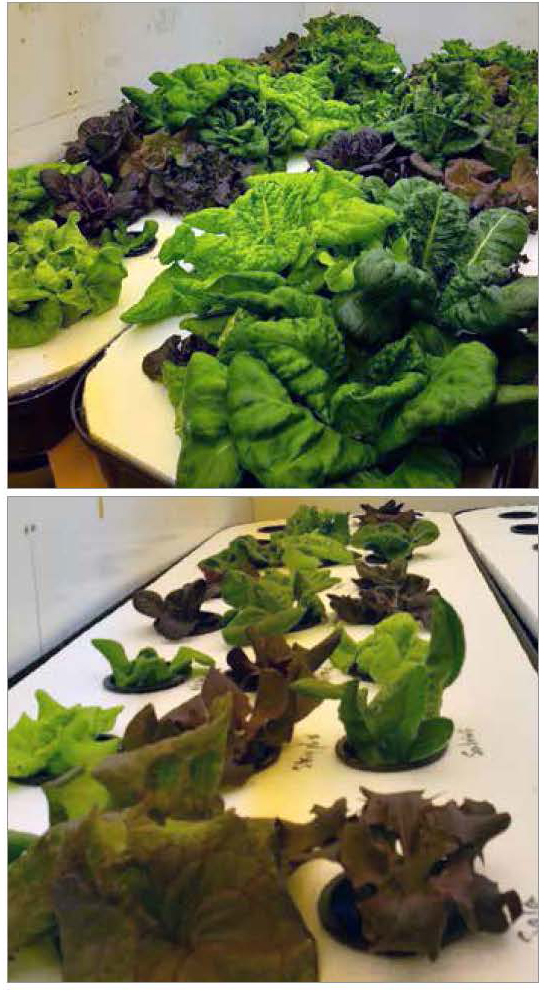
Table 1: Lettuce varieties ranked for their performance based on average fresh weight (g/plant) when grown under moderate cold temperature stress (50°F) in a constant flood table hydroponic production system.
| Rank | Variety | Group | Fresh Weight (g/plant) |
|---|---|---|---|
| 1 | Dragoon | Romaine | 5.9 |
| 2 | New Red Fire | Leaf | 5.5 |
| 3 | Adriana | Butterhead | 4.3 |
| 4 | Red Sails | Leaf | 4.3 |
| 5 | Cherokee | Leaf | 4 |
| 6 | Salvius | Romaine | 3.9 |
| 7 | Butter Crunch | Butterhead | 3.5 |
| 8 | Rex | Butterhead | 3.5 |
| 9 | Nevada | Leaf | 3.4 |
| 10 | Skyphos | Butterhead | 3.4 |
| 11 | Waldmann’s Dark Green | Leaf | 3.1 |
| 12 | Cedar | Oakleaf | 2.9 |
| 13 | Amadeus | Romaine | 2.7 |
| 14 | Navara | Oakleaf | 2.7 |
| 15 | Natalia | Butterhead | 2.5 |
| 16 | Red Salad Bowl | Oakleaf | 2.5 |
| 17 | Breen | Romaine | 2.5 |
| 18 | Intred | Romaine | 2.4 |
| 19 | Truchas | Romaine | 2.2 |
| 20 | Salanova Red Butter- head | Butterhead | 2.1 |
| 21 | Black Seeded Simpson | Leaf | 2 |
| 22 | Salanova Green Oakleaf | Oakleaf | 1.9 |
| 23 | Alkindus | Butterhead | 1.9 |
| 24 | Salanova Red Oakleaf | Oakleaf | 0.7 |
Table 2: Lettuce varieties ranked for their performance based on average fresh weight (g/plant) when grown under mild cold temperature stress (60°F) in a constant flood table hydroponic production system.
| Rank | Variety | Group | Fresh Weight (g/plant) |
|---|---|---|---|
| 1 | Red Sails | Leaf | 53.4 |
| 2 | Dragoon | Romaine | 53 |
| 3 | Adriana | Butterhead | 52.5 |
| 4 | Waldmann’s Dark Green | Leaf | 42.3 |
| 5 | Black Seeded Simpson | Leaf | 39.5 |
| 6 | Butter Crunch | Butterhead | 33.6 |
| 7 | Cedar | Oakleaf | 31.4 |
| 8 | Rex | Butterhead | 31.2 |
| 9 | Nevada | Leaf | 28.2 |
| 10 | Salvius | Romaine | 28.1 |
| 11 | New Red Fire | Leaf | 27.2 |
| 12 | Natalia | Butterhead | 26.7 |
| 13 | Alkindus | Butterhead | 20.2 |
| 14 | Breen | Romaine | 19.9 |
| 15 | Skyphos | Butterhead | 18 |
| 16 | Cherokee | Leaf | 17.5 |
| 17 | Red Salad Bowl | Oakleaf | 16.6 |
| 18 | Truchas | Romaine | 16.3 |
| 19 | Salanova Red Oakleaf | Oakleaf | 15.1 |
| 20 | Salanova Red Butterhead | Butterhead | 14.7 |
| 21 | Salanova Green Oakleaf | Oakleaf | 12.4 |
| 22 | Amadeus | Romaine | 11.6 |
| 23 | Navara | Oakleaf | 11.1 |
| 24 | Intred | Romaine | 8.5 |
Based on the results from this study, we recommend that hydroponic growers maintain air temperatures at or higher than 60°F to maximize profits during production. Achieving a marketable size crop is likely not possible in four weeks when air temperature is below 60°F. If operational costs of heating limit production, varieties that perform better under cooler air temperature may be used in production (i.e., Red Sails, Adriana and Dragoon).