

Introduction
Correct pruning is essential maintenance for keeping trees and shrubs healthy in the home landscape. However, the thought of pruning makes many homeowners apprehensive. But this doesn’t have to be. Pruning is not difficult if you understand the basics of why, when, and how to prune.
To prune successfully, you must know:
- Why you should prune — prune for the right reasons
- When to prune — prune at the right time
- How to prune — use the right techniques and tools
Authors
Rosie Lerner & Kyle Daniel, Department of Horticulture and Landscape Architecture
Lindsey Purcell, Department of Forestry and Natural Resources
A previous version of this publication was written by Michael Dana and Philip Carpenter.
Photo Credits: Figure 2 photo by Mary Welch-Keesey; Figures 8 and 11 provided by Jeff Harris, Arbor Rangers.
Contents
Review of General Pruning ProceduresToo often, homeowners ignore pruning for several years, which causes some trees and most shrubs to become overgrown — and often weak or even unsafe. When this happens, drastic pruning is necessary to bring the plant back to usefulness or to conform to the space. Regular pruning will help keep plants in bounds and keep their growth vigorous. You should examine trees and shrubs each year to determine whether you need to prune them.
Pruning Myths
Debunking the myths
There are a number of myths and misconceptions about pruning. We attempt to lay a number of these to rest in the boxes throughout this publication.
Pruning Tools
Before you prune any plants, make sure you have the proper tools. Your tools should be the highest quality you can afford, and they should be sharp.
Keep pruning tools (like all gardening tools) in good condition by regularly lubricating them, cleaning them to prevent rust, and using them only for their intended function. If you prune more than one plant, disinfect the pruning tools in between plants to avoid spreading disease — immerse tools in rubbing alcohol or household bleach to disinfect them.
Figure 1 provides examples of common pruning tools.
Figure 1. Examples of common pruning tools.

Hand pruners (“clippers,” for branches up to 1/4 to 1/2 inch in diameter). Both scissor and blade and anvil types are available in 6- to 9-inch sizes. Scissor types are preferred over blade and anvil types, which can crush plant tissue. It is worth investing in good quality pruners that fit your hand. You can purchase pruners designed for right or left hands, small pruners for petite hands, or pruners with rotating handles.

Lopping shears (“loppers,” for branches up to 1.5 inches diameter). Scissor (preferred — see hand pruners above) and blade and anvil types are available. Handles are 16 to 30 inches long. Strong but lightweight handles are critical.

Pruning saws (for branches more than 1 inch in diameter). Pruning saws are characterized by coarse teeth that prevent gumming. Most cut on the pull stroke for easier, safer use.

Pole pruners (for branches beyond arm’s reach). You can mount either a pruning head with rope action or a saw on a pole pruner. A “take apart” or telescoping handle makes storage easier. Pole pruners are not safe for use near utility lines.
These tools are not meant for pruning:

Hedge shears (for clipping new growth into formal shapes). Power and hand types are available in 6- to 18-inch blades. Do not use these shears to prune large branches or for any pruning intended to maintain a plant’s natural appearance. Use this tool only to shape hedges.

Chain saws. These tools are dangerous to use for pruning. They are best used for cutting up limbs already on the ground.
Pruning Myths
Myth: Pruning Is Difficult
Pruning is straightforward if you know a little about how the plant grows and what it should look like when the process is complete.
Why You Should Prune
There are several good reasons to prune your trees and shrubs. However, the right plant in the right place can minimize the need for most pruning. Here are some of the most common reasons to prune.
Maintain or Reduce Plant Size
Pruning can prevent a plant from overgrowing its space in the landscape and eliminate the need for you to drastically cut crowded, overgrown plants. Pruning also allows plants to grow under or adjacent to the pruned plant. Pruning reduces leaf area on newly planted trees and shrubs. This promotes survival through transplanting and consequent root loss.
Remove Undesirable Growth
Pruning can encourage plant vigor when you remove weak, overcrowded growth. Such thinning often improves the plant’s visual balance or symmetry.
Remove Dead, Diseased, or Broken Branches
Pruning will help maintain the plant’s shape, vigor, and health.
Stimulate Flowering and Fruiting
Remove the current year’s old, faded flowers and fruit clusters. Doing this will promote flower buds to grow the following season.
Rejuvenate and Restore Old Plants
Proper pruning can restore a youthful, natural growth habit in certain overgrown shrubs.
Prevent Damage to Life and Property
Pruning can help keep branches and limbs away from power lines and buildings. You also should prune to remove weak branches before strong winds can break limbs and fall on people or buildings. Good pruning also opens blocked sight lines, such as
when overhanging limbs block the views from driveways or street corners.
Shape Plants in Artificial Forms
You can prune and shear to shape plants as hedges or for rigidly formal espaliers or topiaries.
When You Should Prune
When you decide you should prune your trees and shrubs, you should consider many factors, including:
- The plant’s flowering, fruiting, or growth habits
- The plant’s tendency to “bleed”
- The fact that pruning usually stimulates a flush of regrowth
You can prune most plants at almost any time of year without jeopardizing their basic survival. However, it is better to prune specific plants at specific times of the year.
Pruning Myths
Myth: Plants Die if Pruned at the Wrong Time
If you don’t prune at the optimal time, you may injure plants. But seldom, if ever, will you kill a tree with a poorly timed pruning.
Prune According to Bloom Season
If you have a tree or shrub that was planted for its flowers, then time your pruning to maximize their flowering. If you prune these plants at the wrong time, it will not cause any long-term damage — it will simply mean you lose one season’s floral display.
If your trees and shrubs flower before the end of June, prune them immediately after flowering. Flower buds develop during the previous season’s growth, so the flowers that bloomed this year developed last year and overwintered in the bud. If you prune before spring flowering, you also remove the flower buds and will eliminate the flowering for that season.
Table 1 provides examples of plants you should prune after flowering.
Pruning Myths
Myth: Prune Only in Winter
Actually, it is best to prune many plants during the growing season to facilitate rapid sealing of the wound.
Table 1. Spring-flowering trees and shrubs that should be pruned after flowering.
| Scientific Name | Common Name |
|---|---|
| Amelanchier spp. | shadblow |
| Calycanthus spp. | sweetshrub |
| Caragana spp. | peashrub |
| Celastrus spp. | bittersweet |
| Cercis spp. | redbud |
| Chaenomeles spp. | flowering quince |
| Chionanthus spp. | fringetree |
| Cornus florida spp. | flowering dogwood |
| Cornus kousa | kousa dogwood |
| Cornus mas | cornelian cherry |
| Cotinus coggygria | smoketree |
| Cotoneaster spp. | cotoneaster |
| Crataegus spp. | hawthorn |
| Deutzia spp. | deutzia |
| Euonymus | winged spindle tree |
| Forsythia spp. | forsythia |
| Kalmia latifolia | mountain laurel |
| Kolkwitzia amabilis | beautybush |
| Laburnum spp. | laburnum |
| Ligustrum spp. | privet |
| Lindera spp. | spicebush |
| Magnolia spp | magnolia |
| Malus spp. | crabapple |
| Philadelphus spp. | mock orange |
| Pieris spp. | andromeda |
| Prunus spp. | flowering cherry and plum |
| Pyracantha spp. | firethorn |
| Rhododendron spp. | rhododendron and azalea |
| Rhodotypos scandens | black jetbead |
| Ribes spp. | currant |
| Rosa spp. | climbers and shrub roses |
| Sorbus spp. | mountain ash |
| Spiraea thunbergii | Thunberg spirea |
| Spiraea x vanhouttei | Vanhoutte spirea |
| Styrax japonica | Japanese snowball |
| Syringa spp. | lilac |
| Viburnum spp. | viburnum |
| Weigela spp. | weigela |
| Wisteria spp. | wisteria |
Pruning Myths
Myth: Anyone with a Pickup and a Chainsaw Is Qualified
Indiana has no licensure for tree pruners, so there are some individuals pruning trees who may not be knowledgeable or skilled in proper techniques. Never hire someone who stops and tells you that your plants need pruning and that he will do it right away.
The best recommendation is to consult with an International Society of Arboriculture Certified Arborist for best pruning and tree care practices. Obtain references, and see their work first! You can find a Certified Arborist in your area on the ISA website.
If your trees and shrubs flower after the end of June, prune them in winter or early spring before new growth starts. Plants that flower after June develop their flower buds during the spring of the flowering season.
Table 2 provides examples of flowering plants you should prune before spring growth begins.
Table 2. Summer-flowering trees and shrubs that should be pruned before spring growth begins.
| Scientific Name | Common Name |
|---|---|
| Abelia x grandiflora | glossy abelia |
| Acanthopanax spp. | aralia |
| Albizia julibrissin spp. | silk tree |
| Buddleia davidii | butterflybush |
| Callicarpa spp. | beautyberry |
| Hibiscus syriacus | shrub-althea |
| Hydrangea arborescens | smooth hydrangea |
| Hydrangea paniculata | panicle hydrangea |
| Hypericum spp. | St. Johnswort |
| Koelreuteria paniculata | goldenrain tree |
| Magnolia virginiana | sweet bay |
| Rhus spp. | sumac |
| Rosa cvs. | hybrid tea roses |
| Sorbaria spp. | false spirea |
| Stewartia spp. | stewartia |
| Symphoricarpos spp. | snowberry, coralberry |
Finally, there are certain plants you may lightly prune before and after flowering. Pruning these plants often increases flower and fruit production, and several may produce a second bloom during the year.
Table 3 provides examples of plants you can prune before and after bloom.
Table 3. Trees and shrubs that may be pruned both before and after bloom.
| Scientific Name | Common Name |
|---|---|
| Cornus sericea spp. | red-osier dogwood |
| Cotoneaster apiculatus | cranberry cotoneaster |
| Cotoneaster divaricatus | spreading cotoneaster |
| Cotoneaster multiflorus | many-flowered cotoneaster |
| Mahonia aquifolium | Oregon hollygrape |
| Spiraea x bumalda | Japanese spirea |
| Symphoricarpos albus | snowberry |
| Symphoricarpos x chenaultii | Chenault coralberry |
| Weigela spp. | weigela |
Pruning Myths
Myth: You Must Treat all Cut Surfaces with Tree Paint
We no longer recommend using tree paint. Wound dressings provide no benefit and may hinder natural wound closure.
Prune to Maximize Fruiting Display
If you prize your shrubs or trees for their fruit, then you should prune them after the fruit drops or wildlife eats it. Although these plants may flower early in the season, you should allow the fruit to develop. Prune only after the fruit has lost its appeal.
Examples of plants in this group are certain viburnums and hawthorns.
Prune to Avoid ‘Bleeders’
Some deciduous trees have an exceptionally heavy sap flow in the early spring. If you cut such trees, they will “bleed.” While this sap loss does not injure the tree, it can look unappealing and cause problems for pedestrians or vehicles that pass
underneath the dripping sap.
You can avoid “bleeding” by pruning these plants in midsummer or late fall. Examples of “bleeding” plants include maples, birches, dogwoods, elms, walnuts, and yellowwood.
Anticipate Growth After Pruning
Except for the cases already cited, the best time to prune is when the plant will recover fastest.
Save severe pruning until just before regrowth starts in the spring to maximize wound closure and allow new growth to camouflage the wounds. Avoid pruning in late summer because it stimulates succulent growth from axillary (lateral) buds that may not harden sufficiently to avoid winter dieback. Prune storm-damaged plants as soon as possible after the damage occurs.
When to Prune Needle (Coniferous) Evergreens
If you want a compact plant, you can prune coniferous evergreens in late spring as the new branches elongate, but before they become stiff.
If you don’t want a compact plant, you can prune coniferous evergreens and broadleaved evergreens whenever the wood is not frozen. However, coniferous plants generally will not develop new shoots on older wood. So avoid cutting back beyond the living foliage portion of the branches.
Keep in mind that tightly pruned coniferous evergreens are more susceptible to stress, disease, and insects, such as aphids.
Pruning Myths
Myth: You Only Need Hedge Shears to Prune Shrubs
Hedge shears are intended to prune hedges only! You will destroy the natural growth and beauty of your plants if you use hedge shears on shrubs or trees not intended as hedge plants.
How You Should Prune
When it comes to how you should prune, there are a few basics to remember.
This section:
- Provides basic safety rules
- Explains three basic pruning techniques
- Describes procedures for cutting specific types of trees and shrubs
Basic Safety Rules
Before pruning any tree and shrub, keep the following safety rules in mind.
- Call in a professional certified arborist for large trees or for jobs you don’t have the equipment for
- Keep all equipment sharp and in good repair
- Use equipment only for the job it was designed to do
- Be aware of electric lines at all times
- If a power line is touching a tree limb, call the power company fast and stay clear of the tree
- Never climb a tree without a safety rope (with or without a ladder)
- Keep your fingers clear when using hand clippers
- Wear eye protection both while pruning and while handling pruned limbs and brush
Three Basic Pruning Techniques
There are three relatively simple techniques basic to all pruning situations:
- Pinching
- Removal (thinning) cuts
- Reduction cuts (heading back)
Pinching is the process of removing the apical growing point at the tip of the stem. This is the point at the tip of a stem that is responsible for upward or outward growth. Typically, you remove this growing point by hand (Figure 2). It is a good way to control plant size.
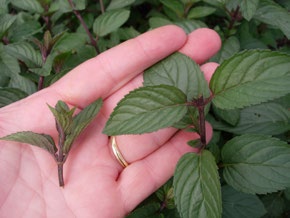
Pinching also stimulates branching and changes a plant’s overall shape. Unpinched plants will be taller and narrower, while pinched plants will be shorter but broader. Making removal (thinning) cuts completely removes some branches back to a main branch, trunk, or soil line (Figure 3).

Do not do not cut so near the trunk that you cut through the area at the base of the limb that is adjacent to the main trunk (this area is known as the branch collar). Such a cut allows infection to spread into the part of the plant you wish to keep. Cut only the branch that you want to remove. Make the cut 1/2 to 2 inches from the main trunk (depending on the tree’s age) (Figure 4).

(A) This cut leaves too much of a stub
(B) This is a correct cut
(C) This cut is too close to the trunk
Making reduction cuts (heading back) involves shortening branches back to a good bud or lateral branch (Figure 5). A proper heading cut should not leave a stub (Figures 6 and 7). Make your cut about 1/4 inch above an active bud or lateral branch.


from the branch, and be certain that the lateral branch is large enough to
assume the terminal role. Typically, prune branches back to laterals at
least one-third the diameter of the limbs being removed.
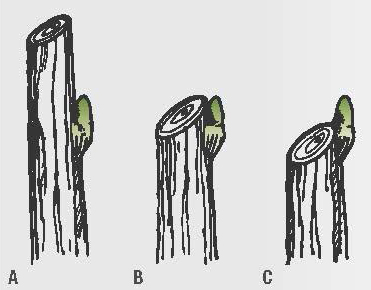
(A) Too much branch left as a stub
(B) Correct location of cut
(C) Cut too close to bud
Dress for Success
Is it necessary to apply tree paint after pruning?
We do not recommend wound dressing or tree paint, because recent research concludes that these products are not as advantageous as we once thought. It turns out that dressings may actually harbor disease organisms rather than exclude them. And wound dressings slow wound callusing (often called healing).
Procedures for Specific Trees and Shrubs
This section describes things you should consider for specific types of plants, including:
- Deciduous trees and shrubs
- Evergreen trees and shrubs
- Newly transplanted trees
- Large trees
- Old, overgrown shrubs
- Hedges, espaliers, and topiary
Deciduous Trees and Shrubs
Unless you desire a special effect (as with hedges or a formal garden), you should always allow a tree or shrub to develop its natural shape. Avoid topping trees (also called “rounding or heading” pruning), which involves drastically removing or cutting back large branches in a mature tree (Figure 8).

mature tree), the shoots that grow back are weaker and often unattractive.
Instead of topping trees or making perfectly shaped globes or squares, make thinning cuts on both trees and shrubs. Try to retain the plant’s natural shape by cutting the branches at different lengths — but always make your cut 1/4 inch above an active bud.
Pruning Myths
Myth: Topping Trees Prevents Damage to the Home
Topping a tree is drastically removing or cutting back large branches in a mature tree. After a tree has been topped, the shoots that grow are weaker than the original limbs. This new, weaker growth is more likely to split off and cause damage unless you remove them every few years. Also, topped trees are more susceptible to wood rots, which results in poorer tree health and a greater likelihood that limbs will break due to poor branch attachments.
If you want to reduce overcrowding, then remove twigs or branches selectively. You also should remove some stems at ground level. Reduce new shoots to 1/3 to 1/2 of their length, which induces side shoots to develop.
When you cut above a bud, it prevents the stem from dying back and encourages a new branch to develop from the bud. The haircut technique causes the ends of pruned branches to grow densely, which shades the rest of the plant and causes the plant to eventually develop a leggy appearance.
If a shrub develops a weak, dense growth, thin out many of the smaller branches and twigs. This promotes vigorous growth in the remaining branches. Also, remove branches that tend to rub against one another, which can open wounds that make the plant more susceptible to disease.
Remove dead, damaged, or diseased branches and limbs at any time of season. Remove dead flower branches, dead flowers, and old fruit stalks as soon as the flowers have wilted or the fruit has dropped. This stimulates new growth and helps make a stronger tree or shrub. It also encourages plants such as rhododendrons to produce more flower buds for next season.
Evergreen Trees and Shrubs
Avoid shearing evergreen shrubs into artificial shapes. If the evergreen plant has a soft, feathery appearance, do not cut it square or make a round shrub out of it. Instead, prune using the thinning technique, which keeps the evergreen’s natural shape.
The non-green portions of needle-leaved evergreen branches do not normally put out new branches. So, do not cut evergreen branches back to the old wood. Reduce new growth annually, and when removing the larger branches for thinning, cut close to the main trunk, leaving no stubs. Heavy thinning is needed only every few years.
Certain evergreens — such as yews (Taxus spp.) — experience a new flush of growth in the early fall. Head back these long shoots to keep the plants in shape.
Prune broadleaf and narrow-leaf evergreen shrubs in the same manner by thinning and heading back. It is preferable to lightly prune them every year, but it is acceptable to heavily prune them every three years.
Rhododendron species benefit from removing flower heads immediately after flowering. You can severely cut back most types (hollies, Pyracantha, azaleas, and Euonymus), but avoid cutting all the way to the ground.
You can thicken the new growth of coniferous trees such as pines, spruces, or firs by pinching them in the spring. Pinch out half of the new growth (called the candles) when it is approximately 2 inches long (Figure 9). Do not use shears, because they damage the needles that are around the candle, which cause the cut edges to turn brown and make the tree unsightly. Never top or remove the central leader.
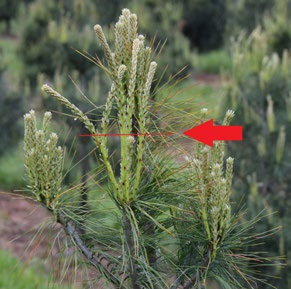
structure called a candle. The center structure shown here is the candle, the
surrounding structures are male pine cones. Pinch pine candles when new
growth is about 2 inches long. Remove 1/2 of the candle.
If the terminal (end) of a pine or spruce has been lost, you will need to help the plant grow a new terminal shoot. If you don’t do this, the plant will likely produce multiple leaders (or trunks).
To form a new terminal, bend one of the youngest lateral branches near the terminal into an upright position (Figure 10). Secure it to the dead terminal stub or insert a stake for rigidity. After a season, this branch will take over as a terminal shoot. Once it takes over, remove the stub or stake, and the plant will resume its characteristic growth habit.

(A) by tying a lateral branch in a vertical position
(B) and securing it to the stub of the dead terminal
(C). You also can secure the lateral branch with a stake.
Pruning Myths
Myth: Removing a Tree Is a Crime Against Nature.
If a plant is in the wrong place, from a functional or aesthetic viewpoint, it is by definition a weed and you can remove it with a clear conscience. This is especially true if you must mutilate a tree beyond recognition to eliminate the problem it is causing.
Newly Transplanted Trees
Not only is it acceptable to prune trees when you plant them, we encourage it to get trees off to a good start. In the past, experts discouraged pruning at planting, however, current research suggests light to moderate pruning will help to establish a well-developed tree. Focus on dead or damaged branches and minimize green tissue removal until the tree has established itself in its new home, typically after one year.
The primary advantage of early pruning is that you make smaller wounds (due to smaller branches), which will heal faster and reduce the chances for disease. Structural pruning on young trees prevents many problems that require extensive repair work in mature trees. By selectively removing and reducing stems and branches early in a tree’s life, you create a safer, stronger, more aesthetic structure as well. Of course, it is important to know the tree’s growth habit before proceeding. This procedure may not apply to clump-form trees or to creating specialized habits such as pollarding or topiary.
Reputable nurseries prune trees while they are young to develop acceptable architecture and follow standards that were developed to provide buyers and sellers of nursery stock with a common terminology and facilitate best practices in growing high-quality nursery stock.
If you must prune the nursery stock you purchase, one of your first steps should be to select a leader (trunk) in the top of the tree. There is often a codominant stem that contends with the top leader stem. Select the strongest, straightest stem and remove any competitors.
If you allow a codominant stem to grow, you will have a weak plant that is more susceptible to splitting with high winds, especially after it grows. After you choose the appropriate leader, the tree’s central stem will form a strong, stable configuration.
After planting, prune the young tree as needed. Continue to establish strong branch unions that have large aspect ratios (diameter of the branch relative to the diameter of the trunk) and to maintain a dominant central leader.
The next thing you want to do with a new planting is select the permanent lower branches. The branches on the lower portion of the crown will remain the lowest branches on the tree throughout its life. Remember to consider sight lines, clearance, and structures around the tree. Select strong lateral branches that have good radial placement (location of the branches) around the trunk. These permanent branches should be about half the size of the main stem or smaller.
If the tree is too young or small to select a permanent lower branch at the desired height, postpone pruning until the tree grows taller. Do not over-prune smaller trees to establish lower branch size too early. This could create a misshapen tree that is “top-heavy” and more prone to failure. Try to maintain a proportion of two-thirds canopy to one-third trunk for a good live crown ratio (the ratio of crown length to total tree length).
Large Trees
Proper pruning helps prevent injury (to people and plants) and property damage. To protect people and property, remove large branches or limbs that are weak or defective. Where tree limbs are near power lines, call the power company and ask them to remove them. Do not try to remove tree limbs from power lines yourself.
Low-hanging branches may injure people mowing the lawn or walking on the street. Branches sometimes rub against the house and roof and you should remove these branches, too.
If branches are more than 1 inch in diameter, use the ternary cut method (Figure 11). The method involves making three cuts instead of just one to keep the branch from tearing and splintering the trunk.

Use the ternary cut method to remove
large limbs and avoid trunk damage
and bark stripping.
As the name suggests, the ternary method involves making three cuts. The first step is to make a cut from the underside of the limb. Make this cut about 1 foot from the trunk, and cut about one-third of the way through the limb from the underside. The second step is to cut through the limb from the top. Make this cut about 2 to 3 inches farther away from the trunk than your first cut. For the third step, cut the stub, making sure not to cut into the collar. Cut through on the upper part of the limb.
Beware of so-called rejuvenation techniques people sometimes use on large, old trees. People sometimes “con” homeowners into having the tops of old trees completely cut back, leaving only the stubs. These stubs eventually decay. Also, since the tree is in such a weakened condition, it may die prematurely. If you need to remove large limbs, hire a professional certified arborist.
Old, Overgrown Shrubs
You can also prune declining old shrubs to renew them. Renewal pruning involves removing one-third of the old, mature stems over three growing seasons (Figure 12). Remove the large, old branches at the ground level and leave the young, vigorous branches.

Figure 12.
First year — (From left) (A) A large old shrub. (B) Remove one-third of the old
branches at ground level. (C) Growth at the end of the first season.
Second year — (From left) (D) Use thinning technique to remove one-third
of old branches and to cut back new growth. (E) Growth at the end of the second season.
Third year — (From left) (F) Use thinning technique to remove remaining
old branches and to cut back new growth. (G) Growth at the end of the third season (rejuvenated shrub).
At the beginning of the second and third growing seasons, you should also cut back the water sprouts or suckers that developed. Cut this new growth to different lengths and encourage them to develop into strong branches for the shrubs by thinning them.
Lilac wood often is more than three years old before it flowers. Therefore, you can gradually cut back large, overgrown lilac bushes over a period of years. Just don’t remove all the old flowering wood until the new growth begins to flower. Then the shrub will flower every year and will not have any barren years.
If you must immediately reduce the size of a shrub, rejuvenation pruning is appropriate for some species (Table 4 provides a list of plants you can prune in this way). Rejuvenation pruning involves cutting back the entire top of the plant to the ground line (Figure 13). Many new shoots will grow from the base, and they will require thinning. You should remove as much as three-quarters of the new growth, depending on the species.
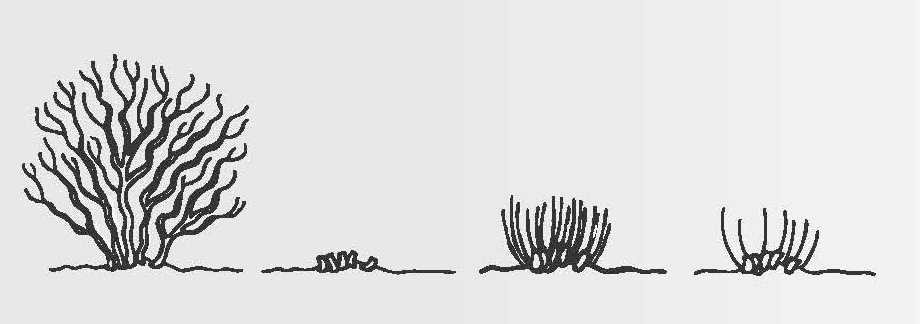
Rejuvenation pruning involves cutting back the top of a shrub to the ground.
Thin the new shoots as they begin to grow to prevent excessive crowding.
Table 4. Landscape plants that may be rejuvenation pruned (completely cut back to the ground).
| Scientific Name | Common Name |
|---|---|
| Buddleia davidii | butterflybush |
| Forsythia spp. | forsythia |
| Hibiscus syriacus | shrub-althea, rose of Sharon |
| Hydrangea arborescens | smooth hydrangea |
| Hydrangea quercifolia | oakleaf hydrangea |
| Ligustrum vulgare | privet |
| Spiraea spp. | spirea |
| Syringa spp. | lilac |
On some plants, all of the aboveground stems may die back. This happens because the plants are marginally cold hardy. You may safely rejuvenation prune these plants to produce rapid new growth. These plants are considered to be usefully winter hardy. You can use them for landscaping purposes similar to an herbaceous perennial, even though severe rejuvenation pruning often is necessary.
Pruning Myths
Myth: Most Trees Need Pruning
Mature trees seldom require pruning. Young trees usually benefit because pruning helps to establish the tree’s basic branch structure
Hedges, Espaliers, and Topiary
Plants are occasionally sheared to unnatural shapes. Barrier hedges are the most common example. However, hedges are often improperly pruned, with the top trimmed flat and the sides sloped inward so that the base is more narrow than the top. This shape shades the lower portion of the hedge, preventing dense leaf growth (Figure 14).

These improperly pruned hedges become leggy, the hedge becomes straggly, and the screening function is not achieved. To properly shear a hedge, shape the top narrower than the base. Doing this allows light to penetrate the lower portions of the plants, which maintains growth, and achieves a full appearance over the entire height of the hedge.
Espalier and topiary are two other methods that prune plants to unusual shapes. Both practices originated in European gardens and are very time consuming. An attractive plant requires both dedicated effort and constant attention. Not all landscape designs are appropriate for such plants. You should use these methods on a limited basis (as focal points) due to their highly unusual appearance.
Espaliering is the practice of training a tree or shrub to grow flat. Almost any tree or shrub can be trained flat by continually removing growing points that go in unwanted directions. Allow the rest of the growing points to develop in their own way.
Before locating a plant next to your house for espaliering, place an iron or wooden support a few inches away from the house. This prevents the plant from disfiguring the wall and allows for plant support and easy plant removal at a future date.
Topiary is a shearing technique occasionally done on boxwood (Buxus spp.), juniper (Juniperus spp.), firethorn (Pyracantha spp.), and yew (Taxus spp.). The idea is to shape the plants into ornamental shapes. Topiary takes many seasons and will require frequent maintenance.
Review of General Pruning Procedures
- Start pruning while plants are young to maintain their natural form and avoid the need for corrective pruning later.
- Know why you want to prune the plant and know your final goal before you start.
- Time your pruning properly for aesthetic and functional reasons.
- Immediately remove any dead, broken, injured, diseased, or insect-infested branches. When removing diseased wood, clean your tools after each cut by immersing cutting blades in rubbing alcohol or household bleach.
- Prune out undesirable branches such as those that cross over each other, upright sprouts from the trunk (watersprouts) or roots (suckers), or those branches that are too long or too low.
- Make proper cuts without leaving stubs, but don’t cut into the collar.
- Clean and oil metal parts of pruning tools when finished.
- Never let the situation exceed your skills. If you are unsure how to prune a tree properly or safely, get help for the safety of yourself and the health of the tree.