

Introduction
Authors
A Safe Houseplant
The poinsettia has long been veiled in an aura of folklore and has gained the reputation of being a deadly plant. A member of the spurge family, it is closely related to the dangerous Snow-on-the-Mountain. However, in university tests, rats showed no signs of toxicity or any apparent ill effects when given large doses of homogenates made from the leaves, bracts, or flowers of the poinsettia. The force-fed rats showed no changes in dietary intake or general behavior pattern. So it appears the poinsettia is not a dangerous plant as many people still believe. However, some individuals may be sensitive to the plant's milky sap as a skin irritant.
Purchasing
Poinsettias are priced according to the number of blooms, those with more blooms are more expensive. A bloom is composed of several true flowers with the colorful red, pink, or white bracts surrounding them. For the best buy, look for plants with bright green foliage all along the stem. Plants with healthy foliage should have good root systems and should last well in your home where growing conditions are usually not ideal for poinsettias.
Select plants with the least amount of pollen showing on the fresh, true flowers situated just above the colorful bracts. Plants with old flowers that have shed much of their pollen tend to drop their bracts sooner. Differences in varieties do occur, and many cultivars will hold their bracts for several weeks or even months after the true flowers have dropped.
Most plants are sold as three single-stem plants per pot. However, with new varieties, it is possible to have multi-stemmed plants. Each plant may have two to four branches and flowers. Flowering and bract development occur evenly, making multi-stemmed plants the equal of single-stemmed plants.
Avoid bruising or chilling the plant when you take it home from the florist. Sudden drops in temperature to 50°F or below can cause wilting followed by a dropping of the bracts.
Home Care
Proper care of poinsettias will keep your plant looking attractive for a long time. The conditions inside our northern homes often are not ideal for poinsettias, natives of the tropics. Under unfavorable conditions, the leaves will turn yellow and drop off; the bracts may also drop.
Since the poinsettia is greenhouse grown at temperatures of 60-70°F with high relative humidity and maximum sunlight, homeowners should try to simulate these conditions for best home care. Root-rot disease is more prevalent when the plants are kept below 60°F. Plants kept in rooms where the temperature is above 70°F will usually have a slightly shorter life.
Place the plant near a sunny window, but do not allow it to touch the cold glass. Avoid temperature fluctuations and drafts that can cause chilling and injury. Also, avoid heat outlets since warm, dry air can cause damage. If possible, move the plant to a cooler room at night (60°F).
Both over- and under-watering can cause problems. When the soil feels dry to the touch or appears lighter in color, water thoroughly. Always add enough water so that it drains from the pot (Figure 1). Pots that are wrapped with foil should have a hole punched through the foil to allow excess water to drain away. Do not allow the pot to stand in excess water; excess water deprives the roots of oxygen and causes the roots to die and eventually rot.
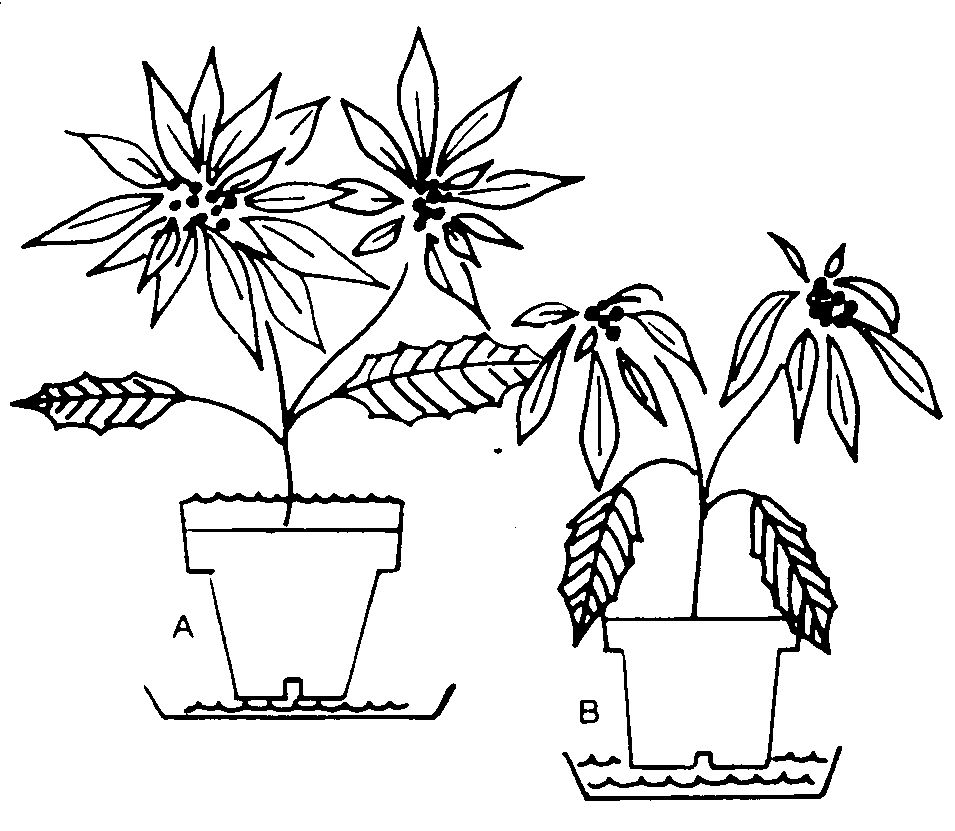
A wilted plant may drop its leaves prematurely. If wilting does occur, water the plant thoroughly to moisten the soil, then re-water again in 5 to 10 minutes, but never allow the plant to stand in excess water.
Display
Display your potted poinsettia to its best advantage. For example, it may be used with harmonizing statuary or candles as a focal point on a low table. Choose a pleasing background free of objects which will compete for attention.
Poinsettias are not easily handled as cut flowers; they may quite suddenly wilt even with proper care. However, they can be useful as cut flowers for short-term arrangements if cut and sealed properly. Cut the stem between the nodes. Stop the latex from exuding by dipping the cut end in boiling water for 30 seconds, or sear it with a flame. Be sure to protect the bloom and the rest of the stem from the heat while sealing the cut end. To extend flower life, recut the stem and reseal it periodically.
After Flowering
Quite often people desire to keep their poinsettia plant and reflower it the following year. Even though it is one of the most difficult plants to reflower successfully, it is probably the most often attempted. For those who are persistent enough to follow these directions, which include 2-1/2 months of daily attention to the plant, another Christmas flower show can be produced. Those who cannot provide proper conditions should not attempt to reflower their plants.
Leaves and bracts fall once the flowers pass maturity. After half of the leaves and bracts have fallen off, gradually decrease watering until the soil is completely dry. The plant is then in a dormant state and should be stored in a dark location at 50°F. Water only enough to keep the wood from shriveling, but not enough to promote growth. If other plants were added to the pot by the florist (usually to hide barren lower stems), remove them before inducing dormancy.
Spring and Summer Care
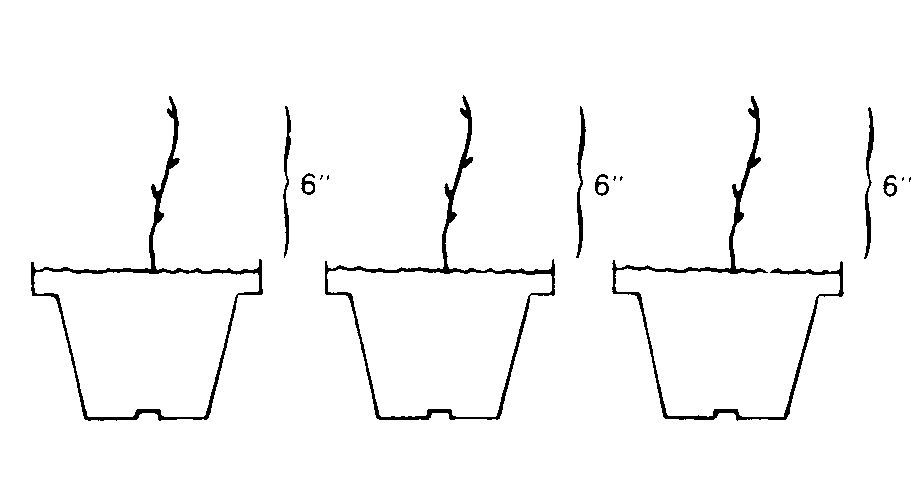
When new growth begins, about May 1, repot the plant. If several plants are in the same pot, it is best to repot each individually. Use a potting mixture of two parts soil, one part sphagnum peat moss, and one part perlite or sand. Cut the stems back to 6 inches above the soil (Figure 2) and water thoroughly. Then place the plant near a south-facing window. Keep the plant at a temperature of 70-75°F. Water only when the soil appears dry. After new growth appears, fertilize with a water soluble balanced analysis fertilizer such as 20-20-20 every two weeks (follow directions on the label for mixing).
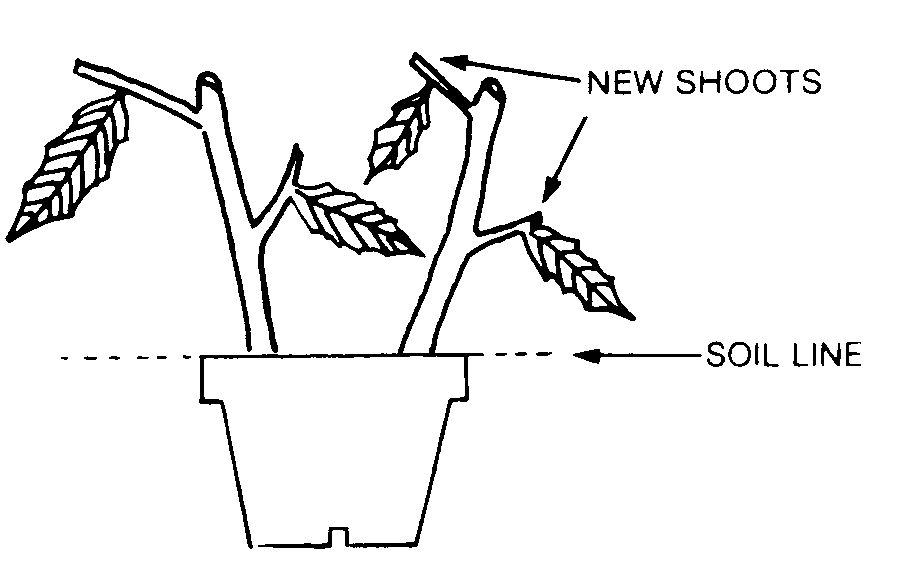
After the danger of frost has passed and night temperatures exceed 50°F, select a slightly shaded area, and sink the poinsettia pot to the rim in well-drained soil out-of-doors (Figure 3). Rotate the pot occasionally in order to prevent the roots from growing into the soil outside the pot. The plants may be transplanted into larger pots as the plants become rootbound. Poinsettia plants have brittle roots, so avoid any unnecessary rough handling.
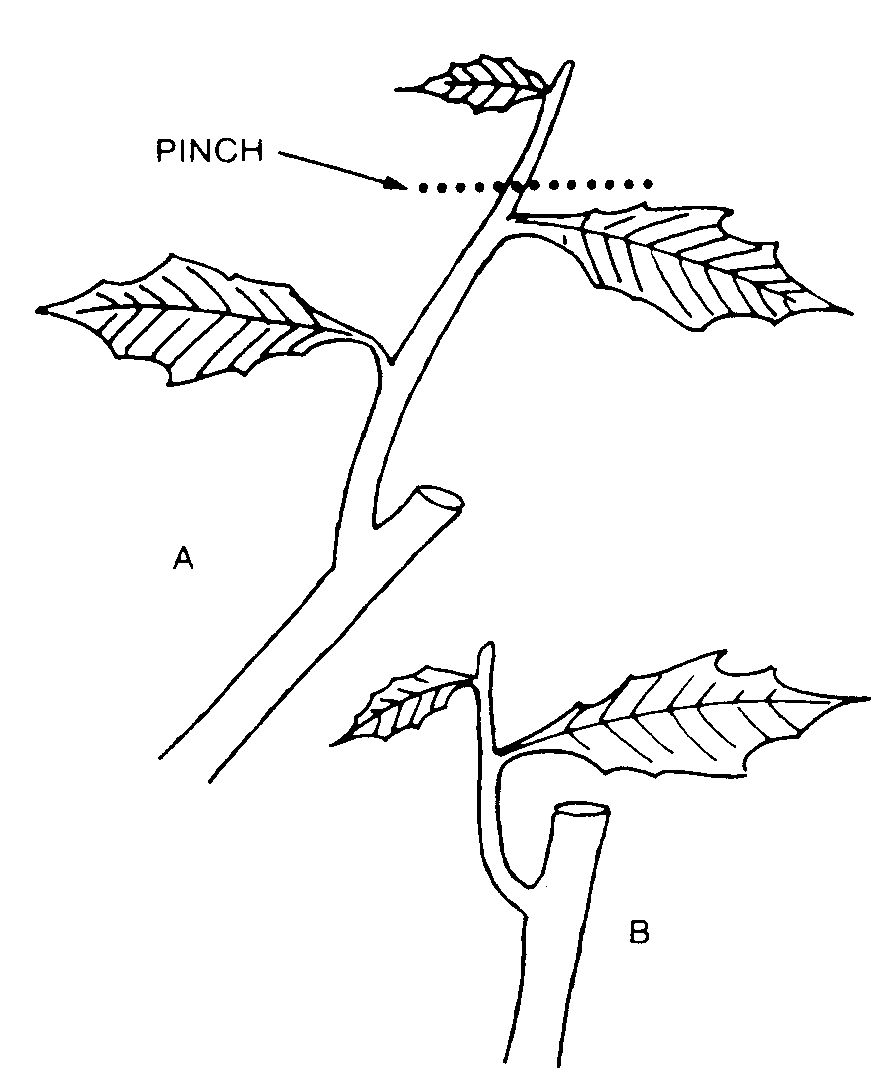
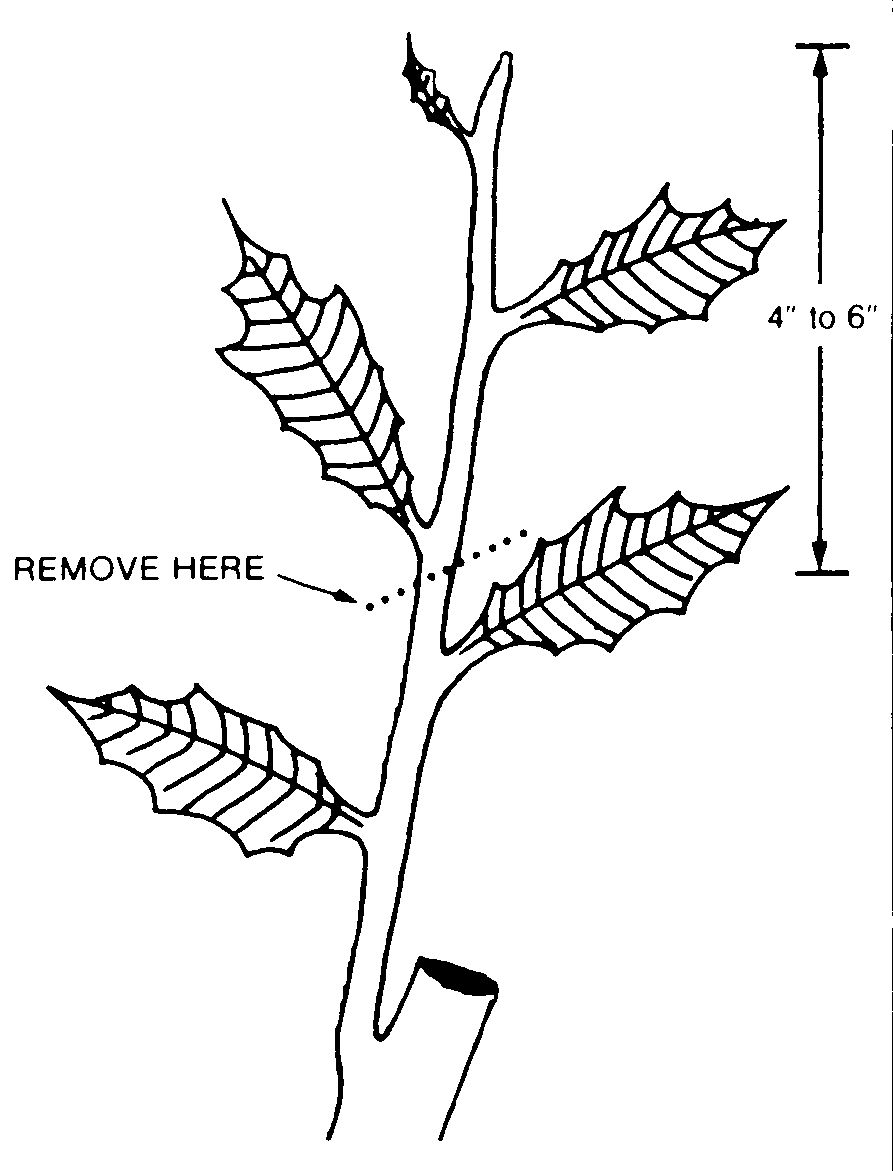
If a short plant is desired, pinch out the growing shoot tips when there are two fully expanded leaves on each shoot (Figure 4). Use a clean, sharp knife to remove the shoot tip. To produce a tall plant, avoid pinching completely, or pinch only once to obtain the desired shape. Do not pinch after mid-August. Continue to water and fertilize the plant weekly while it is out-of-doors.
Fall Care
The plant should be brought indoors before the end of August. A thorough spraying with malathion should eradicate all insect pests before bringing the plant indoors. Read the label carefully for mixing rate and precautions. Keep the plant in a sunny location at a temperature of 65-75°F and continue to water and fertilize as previously outlined.
Flowers on the poinsettia are photoperiodically induced. This means that flowers begin to form when days are a definite length, or more accurately, when the nights reach a definite length. The poinsettia is a long-night plant. It flowers about 10 weeks after the length of night is 13 hours or more. Thus, the plant must have complete darkness between 5 p.m. and 8 a.m. daily from October 1 to December 15. If the plant is exposed to any kind of light (street light, flashlight, etc.) during the dark hours, flowering will be delayed. A dark closet or opaque box may be used for the dark treatment. If growing conditions and long night conditions are accurate, the dark treatment can be omitted after December 1. However, it is best to continue the dark treatment until the bracts are almost fully expanded.
During the period of floral-induction with its long night treatment, keep night temperatures between 60-62°F. Day temperatures should be 10 to 14 degrees warmer. Provide the brightest possible light during the daytime. Continue fertilization until mid-December, but reduce to every second week since growth is slower inside the house.
Propagation of Additional Plants
Poinsettias may be propagated by cuttings taken during July through August. When new shoots are 8 to 10 inches long, cut the stem 4 to 6 inches from the tip (Figure 5). Use a sharp knife to remove the cuttings. Remove the basal leaves and apply a rooting hormone. Place the cuttings in a moistened rooting medium of clean, coarse sand, or a mixture of sand and peat moss. Cover the cuttings with a glass jar or a plastic bag to conserve the moisture. Place in a shaded location. Poinsettia cuttings are extremely succulent and wilt easily. Often it is better to take cuttings during the early morning hours before the sun gets too warm. When the cuttings root in 3 to 4 weeks, transfer them to small pots. Poinsettias have brittle roots, so take extra care in the potting process. After the cuttings grow, they may be transferred to larger pots, with several cuttings per pot.