

Turning Trash To Treasure
Yard waste materials such as grass clippings, leaves, and yard trimmings make up approximately 10% (by volume) of the municipal waste stream, according to Indiana’s Department of Environmental Management. Yard waste can account for 50% or more of residential solid waste during the active growing season. Although this waste is biodegradable, landfills do not get the oxygen and water needed for breakdown. Landfills are constructed to prevent movement of air and moisture in order to protect the surrounding environment. These materials can be better put to use enhancing our gardens and landscapes. Some communities have established municipal composting facilities to efficiently manage large quantities of yard wastes. But by reducing the amount of yard waste generated and recycling the rest, gardeners can have a great impact, both economically and ecologically.
Author
B. Rosie Lerner
Department of Horticulture and Landscape Architecture
Reducing Yard Wastes
Leaving grass clippings on the lawn rather than bagging for disposal is an excellent way to dramatically reduce yard waste. The amount of grass clippings generated from a given lawn varies, depending on the grass species, weather, fertilization program, and yard size. One estimate indicates that 5,000 square feet of lawn generates about 1 ton of clippings per year! Grass clippings left on the lawn are not harmful to the turf if it is mowed at the proper height and frequency. In fact, the clippings will return some nutrients back to the soil, reducing fertilizer requirements. Contrary to popular belief, grass clippings do not contribute to thatch buildup because they break down quite rapidly. Thatch is composed of dead, decomposing roots, and underground stems. Maintain the lawn at a height of about 3 inches, removing no more than 1/3 or the grass plant each time. This will likely mean mowing more often than once a week, but mowing time is greatly reduced when clippings are not collected. Mow only when the lawn is dry to prevent clippings from matting down. If the lawn is excessively tall when mowed, you should remove the clippings and either use as a mulch or add to a compost pile.
Recycling Yard Wastes
Composting is a naturally occurring process that breaks down organic materials into a soil-like material. Finished compost is an excellent soil amendment that improves soil structure as well as adds some nutrients. All organic materials will break down eventually, if given the proper environmental conditions. Gardeners can speed up the composting process with proper management of the materials and environment of the compost system.
Ingredients of Compost
The basic ingredients for successful composting include organic materials, microorganisms, and the proper balance of carbon to nitrogen, water, and oxygen. Let’s look at each of these more closely.
Organic materials for composting include discarded garden plants, grass clippings, tree leaves, and plant trimmings. The smaller the particle size, the faster the organic materials will break down. Materials which have been chopped or shredded will compost more quickly. Kitchen wastes such as vegetable and fruit scraps, egg shells, and coffee or tea grounds can also be added. These materials should be buried in the center of the compost pile to avoid attracting insects, rodents, and neighborhood pets.
Some organic materials are best left out of the compost pile because of possible health hazards or attractiveness to pests. Because of the danger of disease transmission, human and pet feces should not be composted. Meat scraps, bones, and fats will likely attract rodents and other unwanted visitors. Less experienced composters should avoid materials heavily infested with weed seeds, insects, and disease organisms. Although a properly managed compost pile should generate enough heat in the center to kill most of these pests, ensuring uniform heat may be difficult, particularly in a small compost pile.
Microorganisms (microbes) such as bacteria and fungi are responsible for breaking down the organic materials in yard waste. Although commercially packaged compost starter is available, adding a little soil or finished compost will supply all the microbes you need for composting. Microorganisms require a proper environment to work efficiently. Any factor which affects the microbial population will also affect the rate of decomposition.
Nitrogen is needed by the microbes in order to break down and use the carbon found in organic materials. The ratio of carbon to nitrogen in the compost pile will affect the rate of decomposition. If the carbon content is too high, decomposition will be slow. If the nitrogen content is too high, ammonia gas can be given off, creating foul odors.
The ideal ratio of carbon to nitrogen is approximately 30:1. Table 1 shows the carbon to nitrogen ratios of various organic materials. Sawdust has a high C:N ratio, while animal manures have a low C:N ratio. The ideal ratio for composting can be achieved by combining high and low carbon materials, such as dry tree leaves and fresh grass clippings. Another method is adding a nitrogen source such as livestock manures or commercially packaged fertilizer to high carbon materials.
Table 1. Approximate carbon to nitrogen (C:N) ratio of various materials used in municipal and backyard composts.*
*Adapted from Composting and Mulching: A Guide to Managing Organic Yard Wastes. University of Minnesota Extension Service Bulletin BU03296.
| Material | C:N Ratio |
|---|---|
| Livestock manure | 10 to 30:1 |
| Table scraps | 11 to 15:1 |
| Alfalfa | 12 to 19:1 |
| Grass Clippings | 15 to 25:1 |
| Fruit wastes | 25 to 45:1 |
| Sugarbeet | 30 to 40:1 |
| Leaves | 40 to 80:1 |
| Paper | 200 to 800:1 |
| Sawdust | 100 to 750:1 |
| Wood | 200 to 1300:1 |
Water is also needed for efficient microbial action and uniform heating of the compost. Apply water as needed if rainfall is lacking. Compost with optimum moisture content should resemble that of a moistened sponge that has the excess water squeezed out.
Oxygen is required for efficient decomposition and to prevent foul odors. Breakdown occurs more slowly when oxygen is lacking, and foul odors from fermentation will result. Turning and mixing the pile at least once or twice a month will add oxygen from the air into the center of the pile. Mixing the compost also helps bring the outer materials to the center for heating and faster decomposition.
Lime is generally not needed in most compost piles. Although lime is recommended by some gardening books to “sweeten” (make alkaline) the compost pile, several studies indicate that finished compost is already slightly alkaline. Adding lime may lead to production of ammonia gas, which allows nitrogen to escape from the pile and causes foul odors. Wood ashes are very highly alkaline and should only be added in very small quantities, if at all.
Containing Compost
Compost can be constructed in open piles, but it is probably more easily managed in some type of structure. Many types of containing materials can be found around the home or at a hardware supplier. Examples include wooden pallets, metal mesh wire, and cinder blocks. Molded plastic bins such as those with a turning crank and aeration holes are also available for relatively small composting operations.
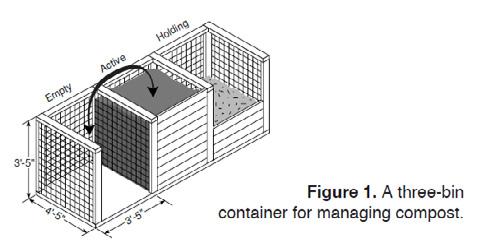
A three-bin container is ideal for managing compost (Figure 1). One bin is for actively composting materials. One bin remains empty to allow the compost to be turned over more easily. The third bin is used for holding plant materials until the current compost is finished. Locate the compost pile close enough to the house so it is readily accessible but out of the way of other activities. Choose a shady spot with protection from the wind to avoid excessive heating and drying.
Managing Compost
To achieve a good balance of materials, construct compost piles in layers, alternating yard wastes; a nitrogen source, if needed; and soil (or finished compost) (Figure 2). The base layer should consist of 6-10 inches of organic materials, with coarser, dry materials on the bottom. If needed, follow with a nitrogen source such as 1-2 inches of animal manure or approximately 1 cup of a balanced, low-analysis fertilizer (such as 12-12-12), per 25 square feet of compost surface area. The next layer should be approximately 1 inch of soil or finished compost. Repeat layers as organic materials are added. Water each layer as it is needed, and check the pile occasionally for watering needs.

The center of a properly managed compost pile will generate heat as the microorganisms break down the organic matter. A good-sized compost heap, approximately 4-5 feet in diameter and 4-5 feet deep, should reach 130 to 160 F in the center.
Turn the pile with a pitchfork or shovel at least once or twice a month to keep the materials supplied with oxygen and to bring outer contents to the center for heating. Small amounts of organic materials can be added to actively composting piles, but it’s best to start a new pile when compost becomes too tall to work by hand.
Using Finished Compost
Compost can be ready to use in as soon as a month or as long as a year, depending on how well the pile is constructed and tended. Finished compost should look much like a uniform potting soil, with no indication remaining of what materials originally went into the pile.
Compost can be used as a soil amendment in the garden to add some nutrients, but its primary advantage is that of improving soil structure. Adding compost increases water-holding capacity, aeration, and nutrient exchange sites in the soil.
Compost can also be used as an organic media in potting soil or for starting seeds of garden plants. Finished compost is free of pests and weed seeds only if it has been properly mixed and uniformly heated. To be sure your compost is free of pests, pasteurize it by heating in a conventional oven to 180 F for 30 minutes. Be sure the compost is slightly moist to ensure uniform heating.
Compost is also useful as a garden mulch to conserve soil moisture, cool the soil, and discourage weeds. And it can be used to cover seeds as they are planted, to prevent crusting in heavy soils.
Compost is an inexpensive and ecologically sound method of managing yard waste and producing an excellent gardening tool. Composting will help you recycle your garden wastes, improve your soil, and reduce disposal costs.
“Don’t Bag It” Lawn Care Plan, Texas A&M Extension Service
Because of possible injury to desirable plants, clippings from lawns treated with weed killer should not be used as mulch for at least 8 weeks after the herbicide is applied. Most commonly used lawn herbicides will break down in that time, but some do take several more months to a year to degrade. Leaving these clippings on the lawn is the best method of disposal.Pesticides are biodegradable and are dependent on the same environmental factors as composting yard wastes: microorganisms, temperature, water, and oxygen. But some pesticides may take longer to degrade.A citizen education program called “Don’t Bag It” was piloted in Ft. Worth, Texas to encourage citizens to reduce yard waste. The 184 residents participating saved the city $60,000 in garbage collection costs and saved themselves a total of $22,000 by purchasing fewer plastic bags for disposal. Participants reduced the average time for mowing by more than 30 percent, although they did mow more frequently. And, of course, the local landfill saved considerable waste space.