

Introduction
Five fine fescue taxa (strong creeping red fescue, slender creeping red fescue, Chewings fescue, hard fescue, and sheep fescue) are often grouped together and called “fine fescues.” This publication provides information on optimum time periods for various maintenance practices required to manage a fine fescue lawn.
Authors
Aaron Patton, Purdue University
Ross Braun, Purdue University
Fine fescues (Festuca L. spp.) are comprised of a group of five cool-season turfgrasses that are used in lawn areas:
- Strong creeping red fescue (Festuca rubra ssp. rubra)
- Slender creeping red fescue (Festuca rubra ssp. littoralis)
- Chewings fescue (Festuca rubra ssp. commutata; synonym = Festuca rubra ssp. fallax)
- Sheep fescue (Festuca ovina; synonym = Festuca ovina ssp. hirtula)
- Hard fescue (Festuca brevipila)
Fine fescues are recommended for use in full sun to shaded site conditions for the northern half of Indiana. Recommendations include planting fine fescues alone or in a mixture with Kentucky bluegrass (Poa pratensis) and/or perennial ryegrass (Lolium perenne) in home lawns. In southern Indiana, fine fescues are recommended for moderately dense shaded areas only. This is due to the more extreme summer stress conditions of southern Indiana.
Fine fescues also have excellent cold hardiness but only fair heat tolerance. Full sun in these growing conditions will reduce fine fescue quality and result in thinning. Considering this, tall fescue (Festuca arundinacea, synonym Schedonorus arundinaceus) may be a better option than fine fescue in the sunny areas of southern Indiana.
As the name suggests, fine fescues have extremely fine (narrow) leaves, which almost resemble pine needles (Fig. 1). Leaf color ranges from medium to dark green (creeping red fescues and Chewings) to gray-green (hard) or bluish-green (hard and sheep)
(Fig. 2). Fine fescues are relatively quick to germinate, generally requiring five to 12 days to germinate after seeding. One key characteristic of this species is its excellent shade tolerance, potentially the best shade tolerance among cool-season turfgrass species.
Fine fescues can be grown on a wide variety of soil conditions (fertile to infertile) and in many site conditions (full sun to moderately dense shade) (Figs. 3 and 4).
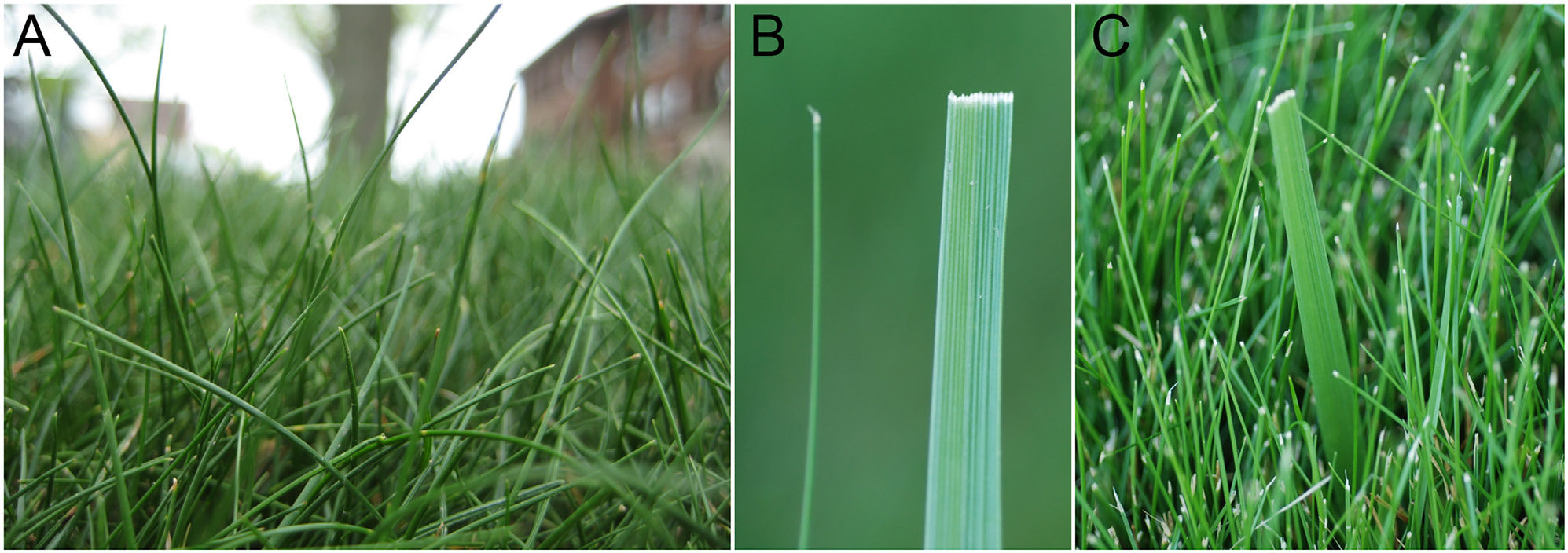
fescue (left) vs. coarse, tall fescue (right) (B), and tall fescue leaf (middle) in a stand of fine fescue (C).
Photos by Ross Braun and Aaron Patton.
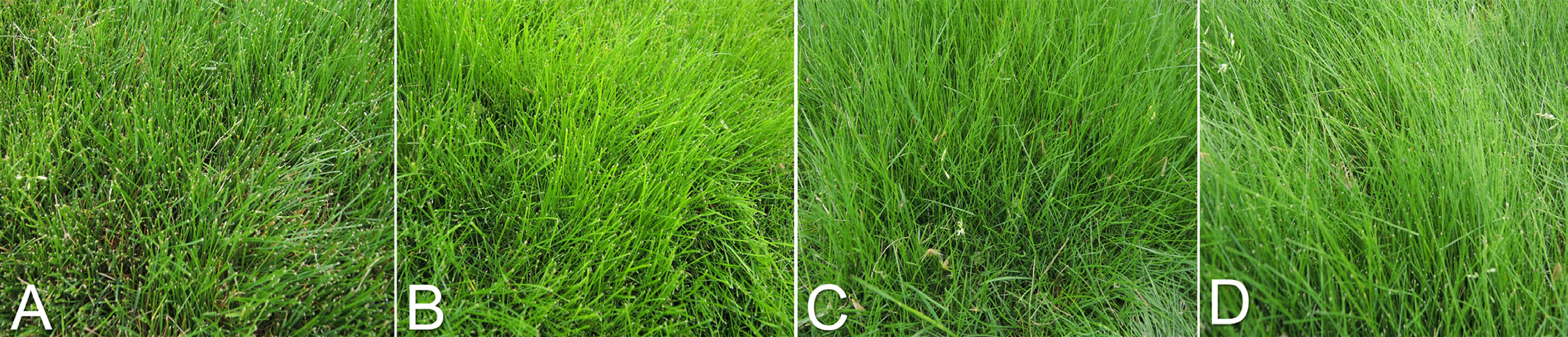
Figure 2. Photographs taken under same light intensity to capture genetic color differences of the fine fescues
(A) strong creeping red fescue; (B) slender creeping red fescue; (C) Chewings fescue;
and (D) hard fescue. Photo by Ross Braun.
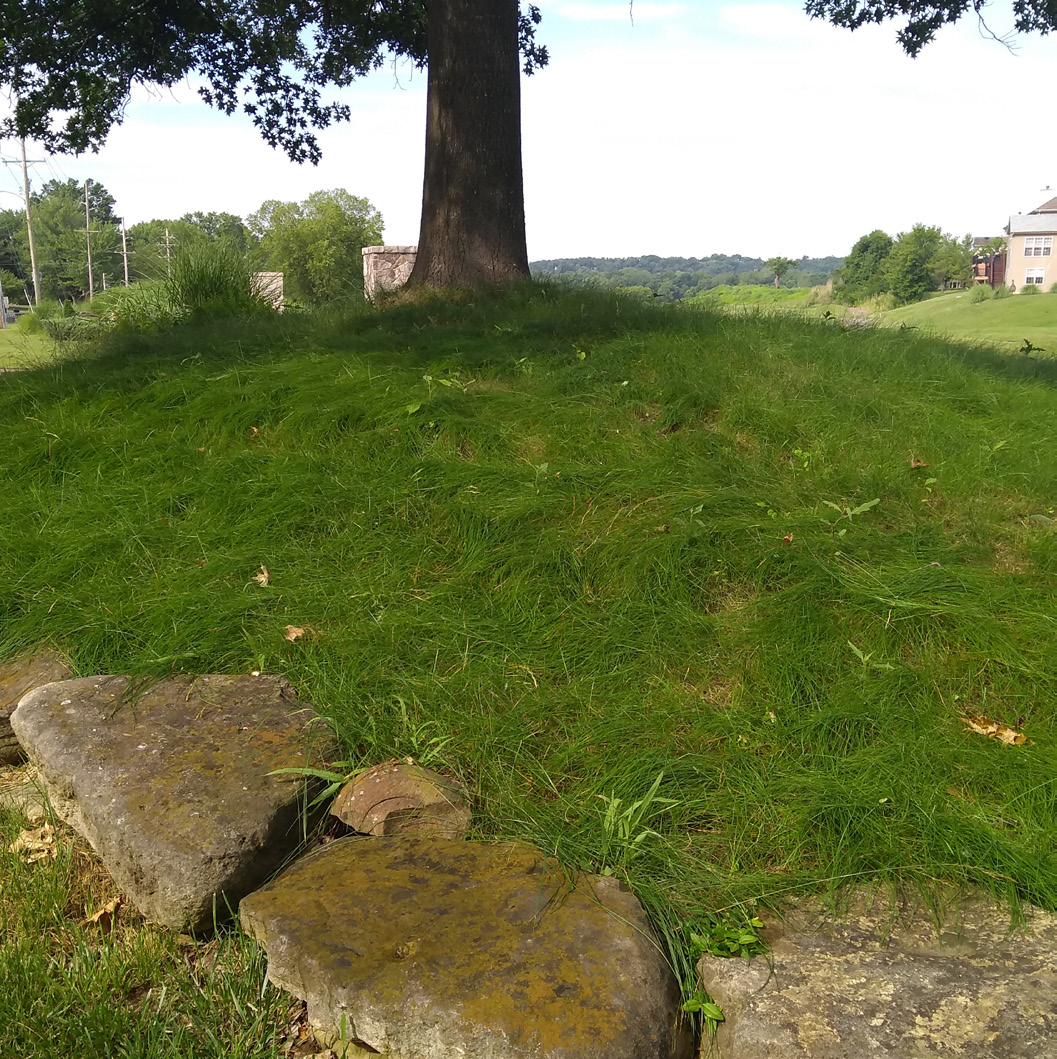
and hard fescue being maintained as a “minimal-to-no mow” turf
site under moderate shade in St. Louis, MO. Photo by Ross Braun.
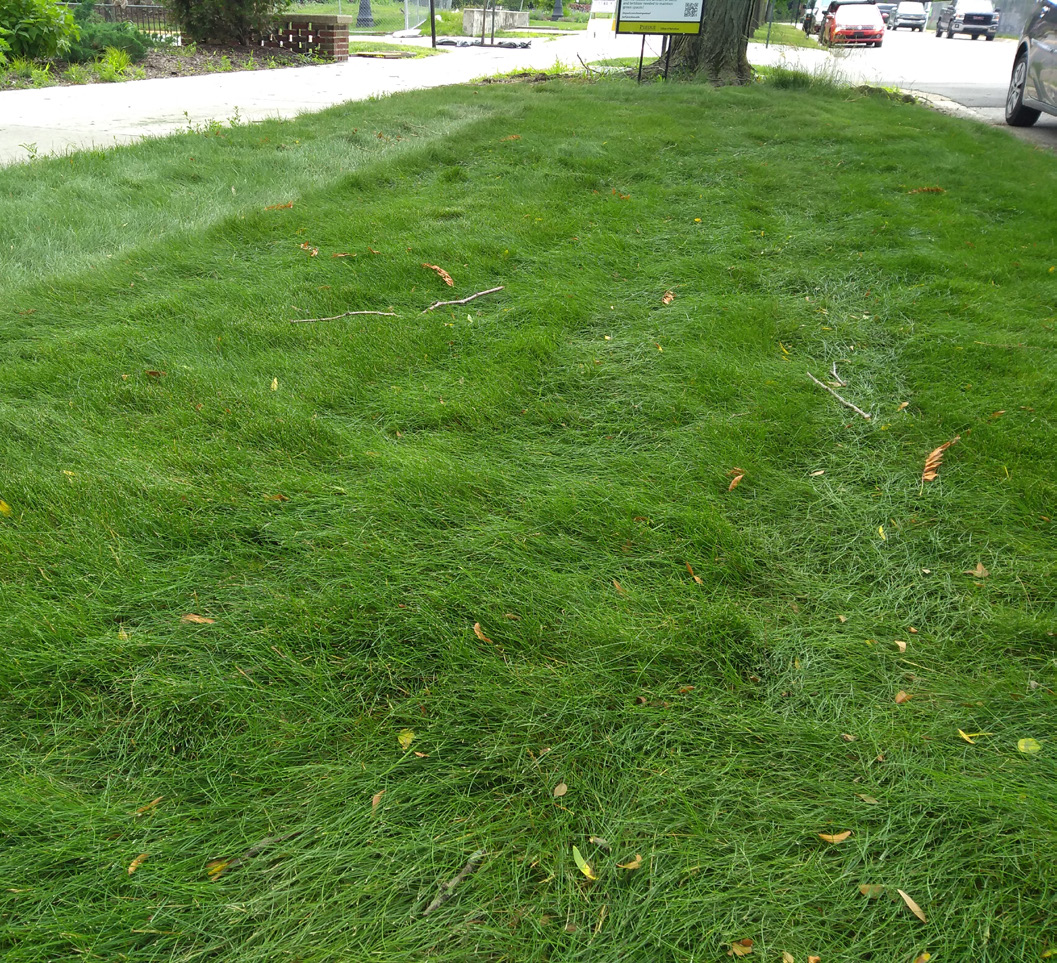
slender creeping red fescue, 25% Chewings fescue, and 25% hard
fescue on a shaded demonstration site on the campus of Purdue
University in West Lafayette, IN, being mowed weekly at 3 inches.
Photo by Ross Braun.
However, there are several variations between the various species. Chewings, hard, and sheep fescue have a bunch-type growth habit; strong creeping red fescue and slender creeping red fescues produce rhizomes. Strong creeping red fescue, slender creeping red fescue, and Chewings fescue prefer welldrained, droughty, infertile soils, and better tolerate close mowing (<1 inch). Hard and sheep fescues prefer well-drained, droughty, sandy, infertile soils, with very low nitrogen requirements and generally have better drought tolerance.
Fine fescues are generally regarded as low-input turfgrass options because they have the following characteristics: low nitrogen fertilization requirements (less fertilization), low water use (less irrigation), good resistance to weed invasion (fewer herbicide
applications), and slow growth (less mowing for some species). Fine fescues can be managed at a 2.5 to 4.0-inch lawn height, or not mown at all and maintain acceptable quality with very few inputs, especially in northern Indiana and/or under moderately dense
shade conditions.
Once established, nitrogen fertilization should be limited to 1 to 2 applications per year, supplying a total of 0.5 to 2 pounds of nitrogen per 1,000 square feet throughout the growing season. Nitrogen fertilization rates should not exceed 2 pounds of N per 1,000
square feet throughout the growing season. The best time to fertilize fine fescues is in the fall (September-October). Fine fescues will respond to supplemental irrigation (1” of water per week during summer), but fine fescues will not thrive under persistently wet
soil and generally prefer drier soil conditions. It is important to reduce or avoid traffic on fine fescue when turf is drought-stressed, particularly during summer heat, or damage will occur (Fig. 5).
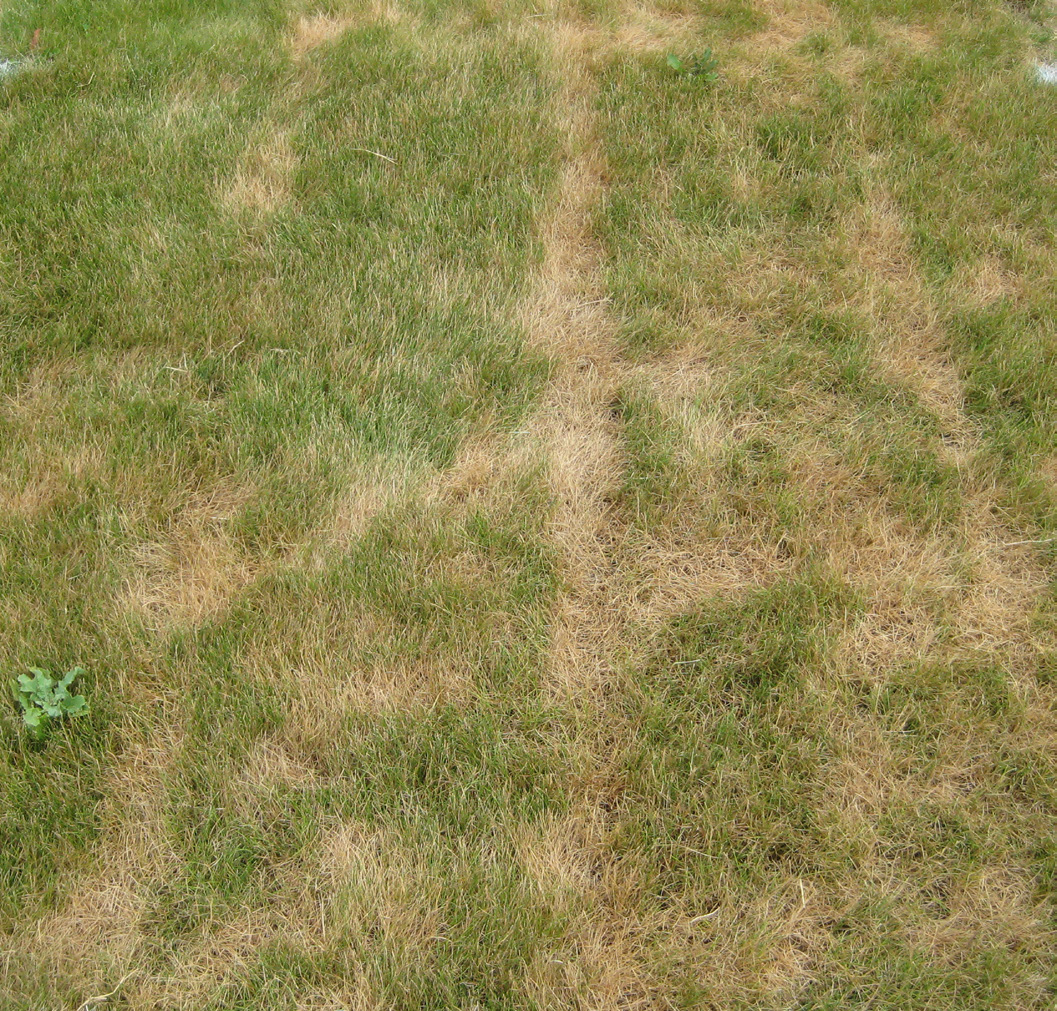
damage on strong creeping red fescue from mower traffic during
hot summer drought conditions in late July. Photo by Ross Braun.
When developing an irrigation program, it is important to know the type of soil at your site. For example, due to the construction process, recent construction sites and newer lawns are likely to have little topsoil, higher clay content and compacted soil at the surface. If the soil has a very high clay content or is compacted, it will poorly drain after rainfall or irrigation, which will likely cause a decline in fine fescue turfgrass quality and turf cover, especially during hot summer conditions. Soils with a high clay content should be amended prior to establishing a new lawn.
Like tall fescue, the fine fescues have only a few insect pest and disease problems. Bluegrass billbugs and chinch bugs are the main insect concern for fine fescues, but white grubs can become problematic if an excessive thatch layer develops. Some cultivars
of fine fescues are “endophyte enhanced,” meaning a mutualistic beneficial fungal association exists in the plant that improves environmental stress tolerance and limits surface feeding insect problems. Endophytes can be found in the seed of some cultivars; however, endophyte viability can decrease during storage conditions. Viability of the endophyte will be lost quickly if the seed is not stored under cool, dry conditions. Similar to other turfgrass species, some turf diseases, such as snow molds, red thread, dollar spot, and summer patch, can occur in fine fescues. However, most outbreaks of foliar diseases are short-lived and can be minimized with correct fertilization and irrigation management practices. Root diseases (summer patch and necrotic ring spot) are more challenging to suppress; hard and sheep fescues should not be used in sites known to have root diseases.
Persistence and proper timing of management practices is important in maintaining a high-quality fine fescue lawn or a lawn mixture containing fine fescue and Kentucky bluegrass. The following suggestions for lawn care throughout the year in the northern half of Indiana covers both a fine fescue lawn and a lawn containing a fine fescue and Kentucky bluegrass mixture. However, every site is different due to variations in location, soil conditions, and previous lawn care practices; therefore, you may need to adjust these practices and dates to suit your home lawn.
Fine Fescue Maintenance Calendar
Table 1 below shows the optimum time periods for various maintenance practices required to manage a fine fescue lawn or a fine fescue + Kentucky bluegrass lawn mixture based on typical central Indiana weather conditions. The optimum lawn maintenance period may occur earlier or later based on variations in annual weather conditions and/or locations within Indiana. For example, the optimum time periods during spring are commonly 1-2 weeks earlier for southern Indiana and about 1-2 weeks later for northern Indiana; the optimum time periods in the fall are commonly 1-2 weeks earlier for northern Indiana and about 1-2 weeks later for southern Indiana.
Table 1. Fine fescue maintenance calendar and pest timelines: Maintenance
† Gold shaded-cells (Go) represent the best recommended months for each maintenance practice, and light tan-shaded cells (LT) represent possible/marginal recommended months for each practice. Reminder: recommendations are based on typical central Indiana weather conditions for the time of year.
‡ Avoid fertilization when temperatures exceed 85°F in summer months. Although August is not shaded, you may start fertilizing in late-August if daytime high temperatures are less than 85°F.
| Maintenance† | Jan | Feb | Mar | Apr | May | Jun | Jul | Aug | Sep | Oct | Nov | Dec |
|---|---|---|---|---|---|---|---|---|---|---|---|---|
| Watering | - | - | - | - | LT | Go | Go | Go | LT | - | - | - |
| Mowing | - | - | - | Go | Go | Go | Go | Go | Go | Go | - | - |
| Fertilization‡ | - | - | - | LT | LT | - | - | - | Go | Go | - | - |
| Aerification (aeration) | - | - | - | LT | LT | - | - | - | GO | - | - | - |
| New seeding | - | - | LT | LT | - | - | - | Go | Go | LT | - | - |
| Overseeding | - | - | - | - | - | - | - | Go | Go | LT | - | - |
| Sodding | - | - | LT | LT | LT | LT | - | - | Go | Go | - | - |
Table 1. Fine fescue maintenance calendar and pest timelines: Weed Control
† Gold shaded-cells (Go) represent the best recommended months for each maintenance practice, and light tan-shaded cells (LT) represent possible/marginal recommended months for each practice. Reminder: recommendations are based on typical central Indiana weather conditions for the time of year.
₧ For effective preemergence crabgrass control in May, use a product with dithiopyr as the active ingredient. Product recommendation may vary for new establishing sites vs. mature turfgrass areas.
| Weed Control†₧ | Jan | Feb | Mar | Apr | May | Jun | Jul | Aug | Sep | Oct | Nov | Dec |
|---|---|---|---|---|---|---|---|---|---|---|---|---|
| Preemergence-crabgrass₧ & summer annuals | - | LT | Go | Go | - | - | - | - | - | - | - | - |
| Postemergence-broadleaf weeds | - | - | - | LT | LT | - | - | - | LT | Go | LT | - |
| Postemergence-crabgrass | - | - | - | - | LT | Go | Go | Go | - | - | - | - |
| Postemergence-sedges | - | - | - | - | LT | Go | Go | LT | - | - | - | - |
Table 1. Fine fescue maintenance calendar and pest timelines: Insect Occurrence
§ Dark grey shaded cells (DG) indicate greatest potential of occurrence for each insect or disease pest based on life cycle of the specific pest and typical weather conditions for central Indiana. More information and recommended Extension publications on each pest is mentioned in the guidelines below.
| Insect Occurrence§ | Jan | Feb | Mar | Apr | May | Jun | Jul | Aug | Sep | Oct | Nov | Dec |
|---|---|---|---|---|---|---|---|---|---|---|---|---|
| Billbug adult | - | - | - | LG | DG | - | - | - | - | - | - | - |
| Billbug larvae | - | - | - | LG | DG | DG | - | - | - | - | - | - |
| Chinch bugs | - | - | - | LG | DG | DG | LG | - | - | - | - | - |
| White grubs | - | - | - | - | - | LG | DG | DG | DG | - | - | - |
Table 1. Fine fescue maintenance calendar and pest timelines: Disease Occurrence
§ Dark grey shaded cells (DG) indicate greatest potential of occurrence for each insect or disease pest based on life cycle of the specific pest and typical weather conditions for central Indiana. More information and recommended Extension publications on each pest is mentioned in the guidelines below.
| Disease Occurrence§ | Jan | Feb | Mar | Apr | May | Jun | Jul | Aug | Sep | Oct | Nov | Dec |
|---|---|---|---|---|---|---|---|---|---|---|---|---|
| Snow molds | DG | DG | DG | LG | - | - | - | - | - | - | - | - |
| Red thread, pink patch, spring/fall leaf spot | - | - | - | DG | DG | DG | - | - | DG | DG | - | - |
| Dollar spot | - | - | - | LG | LG | DG | DG | DG | DG | LG | - | - |
| Brown patch | - | - | - | - | - | DG | DG | DG | LG | - | - | - |
| Summer patch, necrotic ring spot | - | - | - | - | LG | DG | DG | DG | DG | - | - | - |
Guidelines for Fine Fescue Lawn Maintenance: March through May
| - | March through May |
|---|---|
| Mowing | Begin mowing the fine fescue after green-up in spring. It should be mown at 2.5 to 3.5 inches tall as often as needed without removing more than 1/3 of the leaf blade. The mowing frequency will be once a week in the months of April and May. Let the clippings return to the turf surface to supply/recycle nutrients to the soil. Avoid excessive clipping buildup on the lawn surface by following the 1/3 rule and using a mulching mower. Perform routine maintenance on your mower and sharpen the blades based on the amount of usage or at least twice a year. Sharp mower blades provide a clean cut, while dull worn blades will tear the grass which results in greater water loss from the plant and poor health. For more information about mowing see Mowing Your Lawn Extension publication. |
| Fertilizing | The best time to fertilize is in the fall (see below). If you must fertilize in the spring, then apply 0.5 to 1.0 pound of nitrogen per 1,000 square feet in mid-April or early May. Do not apply more than 1 pound of nitrogen per 1,000 square feet in the spring or excessive growth will occur. Use a nitrogen fertilizer product that contains mostly slow-release nitrogen, such as sulfur- or polymer-coated urea, or a natural organic source. Submit a soil sample to also determine phosphorus and potassium requirements (contact your county Extension Office). Submit soil samples for analysis every 2-3 years to determine your lawn’s nutrient requirements. For more information about fertilization see Fertilizing Your Lawn Extension publication. For more information about soil testing in lawns see Soil Testing For Lawns Extension publication. For more information on calculating the amount of fertilizer you need to apply see Fertilizing Your Lawn Extension publication. |
| Watering | Irrigation is seldom needed during the spring except for newly seeded or sodded areas, which need frequent irrigation in the absence of rain until all seed germinates or rooting of sod is successful. Additional irrigation may only be required for established turf if dry, warm conditions occur for an extended period. A dark, bluish gray color, foot-printing, and wilted, or curled leaves indicate that it is time to water. |
| Disease Control | Common diseases that occur during the spring are pink snow mold, red thread, pink patch, powdery mildew, dollar spot and leaf spot. If snow mold is present during spring green-up, promptly hand-rake and remove debris from damaged areas to encourage recovery. Reseed damaged areas after raking and when turf growth resumes. Fungicides are rarely necessary in home lawns for most spring diseases, including red thread/pink patch and leaf spot. Proper management of cultural practices will typically help prevent or control most of these diseases (see June through August guidelines). Detailed Extension publications on Gray Snow Mold, Pink Snow Mold, Red Thread, and Leaf Spot/Melting Out are available. |
| Weed Control | Apply preemergence herbicides if crabgrass has been a problem in the past. Apply from late-March to mid-April. See Crabgrass Control and Other Summer Annual Grasses Extension publication for more weed control information. For dandelion and other perennial broadleaf control, applications in the fall (October) will provide safer and more efficient dandelion control than an application in the spring. See Broadleaf Weed Control Extension publication for more weed control information. |
| Insect Control | Insect control is rarely required in spring. Although rare, the most likely culprit would be white grub damage from the European chafer larvae (grubs). Damage from this pest is usually limited to the northeastern part of the state. Scout for insect pests in the spring, particularly where there is a history of insect problems, and determine if a curative or preventive treatment is required. May is a good time to scout for billbug adults as they can be controlled before they lay eggs. |
| Cultivation | Due to the bunch-type growth habit, there is less potential for Chewings, hard, and sheep fescue to develop excessive thatch problems. If the lawn contains a creeping red fescue, or a fine fescue + Kentucky bluegrass mixture, then thatch removal may be required once every 2-4 years. Thatch removal should be performed when the grass is actively growing. Thatch removal can be conducted in April or May, but the best time of the year is to complete this task is September. Between April and May, thatch removal can be accomplished by core aerification (see below). Core aerification, removes organic matter and alleviates soil compaction making it the preferred thatch removal process. Power raking is an alternative but a less preferred practice because it is more damaging to the turf and does not alleviate soil compaction. |
Guidelines for Fine Fescue Lawn Maintenance: June through August
| - | June through August |
|---|---|
| Mowing | Fine fescue should be mowed every 7 to 14 days during the summer months or less often when the lawn is drought-stressed or slowly growing. During periods of drought stress, mowing should be delayed to prevent traffic associated damage. Set your mower at 3.0 inches or higher during the summer to help reduce stress. Fine fescue on shaded sites should be mowed slightly higher (0.5 to 1.0 inch higher) and less often than a lawn in full sun. Perform routine maintenance on your mower and sharpen the blades based on the amount of usage. |
| Fertilizing | Do not fertilize during summer as fertilization during these months increases the likelihood of intensifying drought stress and damaging diseases. |
| Watering | During the summer, water as needed to prevent drought or allow the lawn to go dormant. If you are irrigating to prevent summer dormancy, a dark bluish-gray color, foot printing, wilting, folded leaves, or curled leaves indicate that it is time to water. For established turfgrass, occasional lawn wilting helps promote deeper rooting of the turfgrass; therefore, water infrequently but deeply during the early morning hours when wilt occurs. During drought periods in the summer, it is OK to let your lawn go dormant (turn brown). It will usually recover with increased rainfall or irrigation and cooler temperatures in the fall. If the drought period continues for an extended time, it is recommended you do not completely discontinue irrigation in midsummer. Water dormant lawns every three weeks if an adequate (0.75 to 1 inch) rainfall event does not occur during this period. About 1 inch of water from rainfall or irrigation each week is adequate for lawns. Sandy soils often require more moisture as they are well-drained and do not store as much water. Probe with a screwdriver to help determine the irrigation need, the lawn needs watered when the screwdriver will not penetrate more than 1 to 2 inches. When watering, it may be necessary to irrigate an area for more than 1 hour to apply 1 inch of water (1 inch of water to the lawn typically will moisten the top 4 to 6 inches of soil). For example, it requires 620 gallons of water to deliver 1 inch of water per 1,000 square feet. You can use catch cans (trays) to assess the amount of water applied when you use your irrigation system. Because clay or compacted soils accept water slowly, irrigate just until runoff is about to occur, wait 30 minutes until the water has been absorbed, and then continue irrigating until the desired depth or amount is obtained. For fine fescue lawns, it is important to reduce traffic when the turf is drought stressed, especially during hot weather. Minimize equipment and mowing events as well as reduce foot traffic when drought-stressed or damage will occur (Fig 5). |
| Disease Control | Common diseases that can damage fine fescue turf in the summer include Rhizoctonia brown patch, summer patch, necrotic ring spot, and dollar spot. Fungicide use to control these diseases is rarely necessary for home lawns, and proper cultural practices will typically prevent or reduce disease damage. These cultural practices include mowing at a higher height of cut, 3 inches or higher, irrigate after dew formation at night or early in the morning, avoid excessive summer fertilizer applications, and maintain a moderate to low amount of thatch. Ultimately, cultural practices that favor deep rooting are the best defense against many of these summer diseases. For more information see Rhizoctonia Brown Patch, Summer Patch, Necrotic Ring Spot, and Dollar Spot Extension publications If turfgrass diseases are present, contact the Purdue University Plant and Pest Diagnostic Laboratory (www.ppdl.purdue.edu) for assistance with identification. Contact a professional lawn care company for assistance with control. See Should I Hire a Professional Lawn Care Service? for more information. |
| Weed Control | f a preemergence herbicide was not applied in the spring, crabgrass plants may be controlled with a postemergence herbicide in June. Avoid applications when temperatures are over 85°F. Chose postemergence herbicides with fluazifop, sethoxydim, or topramezone as the key ingredient; these are effective on crabgrass and safe on 100% fine fescue lawns. If a mixture of fine fescue and Kentucky bluegrass is present, then use products with quinclorac or topramezone. Sedges and some summer annual broadleaf weeds may also be problematic in the summer. See Yellow Nutsedge Control and Control of Broadleaf Weeds in Home Lawns for more information |
| Insect Control | Start scouting for white grubs and billbug larvae in early July. If the lawn has a history of white grub or billbug damage, an insecticide may need to be applied as a preventive in early July. Or you can wait until later in the summer; if insect damage does occur, apply a curative treatment. Chinch bug damage typically appears during hot and dry periods during July or August. The insecticide application should be handled by a professional lawn care company. For more information see Integrated Management of Turfgrass Insects: Managing White Grubs in Turfgrass, and Managing Billbugs in Turfgrass Extension publications. |
| Cultivation | Renovation, dethatching, and aerification practices should not be conducted during the summer due to summer heat stress and competition with weeds. |
Guidelines for Fine Fescue Lawn Maintenance: September through November
| - | September through November |
|---|---|
| Mowing | Mow the lawn about once a week or as needed based on growth rate of the turfgrass to avoid removing more than 1/3 of the leaf blade with each mowing event. Let the clippings return to the turf surface. If you raised your mowing height during the summer, you may gradually lower the mower back to the desired height between 2.5 to 3.5 inches over two or three mowing events. Perform routine maintenance on your mower and sharpen the blades. |
| Fertilizing | This is the best time to fertilize fine fescue. Fertilize with nitrogen at 0.5 to 1.0 pounds of nitrogen per 1,000 square feet in early- to mid- September. Use a slow-release fertilizer when applying nitrogen at more than 0.5 lb. per 1,000 square feet. A second application at 0.5 pounds of nitrogen per 1,000 square feet may be beneficial from late September to early October if recovery from summer stress damage is not complete. |
| Watering | Supplemental irrigation is seldom needed during the fall on established lawns. The exception is newly seeded or sodded areas, which will likely need irrigation to promote establishment. If dry, hot, windy conditions occur in September on newly established lawns, then irrigate as needed by following the June through August guidelines. |
| Disease Control | The same turf diseases that occur in the spring can also occur during the fall (see March through May guidelines). If dollar spot is present, it may be an indication of low nitrogen; therefore promptly apply nitrogen fertilizer to alleviate symptoms. If you have a fine fescue + Kentucky bluegrass mixture, powdery mildew may appear as a white to light-gray powder on the leaf surface. This may be an indication of poor air circulation, excessive shade, and low fertility problems. Overseed shaded areas with fine fescues. Improve light penetration and air circulation by pruning trees, shrubs, or bushes. A light (<0.25 pound of N per 1,000 square feet) fertilizer application should also help reduce powdery mildew. Fungicide use on fine fescue home lawns should not be necessary to control most diseases, including powdery mildew. For more information see Powdery Mildew Extension publication. |
| Weed Control | If needed, this is the best time to apply herbicides for effective control of perennial broadleaf weeds, such as dandelion. Apply postemergence broadleaf herbicides containing 2,4-D, dicamba, or mecoprop. Follow label directions. See Control of Broadleaf Weeds in Home Lawns and Controlling Tough Broadleaves in Lawns for more information. |
| Insect Control | If white grub damage is found in early September, consult the "Managing White Grubs in Turfgrass" Extension publication. |
| Renovation | Overseed thin, bare areas as the turfgrass begins to respond to cooler temperatures in September and early October. Early fall seeding will establish more quickly than when seeding in late fall. Use a blend of new and improved fine fescue cultivars at 4 to 6 pounds per 1,000 square feet. If soil tests indicate, apply a starter-type (high phosphorus) fertilizer at time of seeding. In the absence of rain, keep the seedbed moist with light, frequent watering several times a day to ensure good germination and emergence of seedlings. |
| Aerification | If core aerification is needed to alleviate soil compaction and/or thatch removal, then early September is the best time of year to complete this task. |
| Tree leaf removal | Leaf removal is key to turf maintenance. Remove, or mulch fallen leaves with your mower to decrease shade on growing turfgrass. Installing a mulching blade on your mower will help to thoroughly chop up fallen leaves and return them to the soil, which provide additional fertilizer. Do this promptly to avoid shading/smothering the turf. |
Guidelines for Fine Fescue Lawn Maintenance: December through February
| - | December through February |
|---|---|
| Mowing | Mowing is likely not required. |
| Fertilizing | Do not fertilize. |
| Watering | Irrigation not required except newly laid sod when temperatures are above freezing and soils are dry. Winterize your irrigation system and hoses prior to freezing temperatures. |
| Weed Control | It is often too late to apply postemergence broadleaf herbicides. If early December is mild, postemergence applications for control of chickweed, henbit, or other weeds can be made. |
| Tree leaf removal | Leaf removal is key to turfgrass health. Promptly remove or mulch fallen leaves from trees to decrease shade and smothering of the turfgrass lawn. |
Additional Information
Additional fact sheets available at: https://mdc.itap.purdue.edu/default.asp
Additional information about turfgrass management available at: www.turf.purdue.edu
This publication was developed with funding support by the National Institute of Food and Agriculture, U.S. Department of Agriculture, Specialty Crop Research Initiative under award number 2017-51181-27222.