

Introduction
Yellow nutsedge (Cyperus esculentus) is a troublesome, difficult-to-control weed that is often found in turf areas (Figure 1). It is important to remember that yellow nutsedge is not a grass or broadleaf weed, but a sedge. While there are many sedge species in Indiana, yellow nutsedge is the most problematic. Sedge control requires different herbicides and application timings than most grasses and broadleaves, so understanding the biology of sedges is important.
This publication describes the life cycle and identification of yellow nutsedge, and recommends cultural and chemical management options in cool- and warm-season turf for professional turf managers. This publication also addresses other problem sedges found in the Midwest.
Author
Aaron Patton
Turfgrass Extension Specialist
Department of Horticulture and Landscape Architecture
Purdue University
Contents
Site History and Cultural Control Methods
Table 1. Sedge control and turfgrass tolerance ratings for professional products.
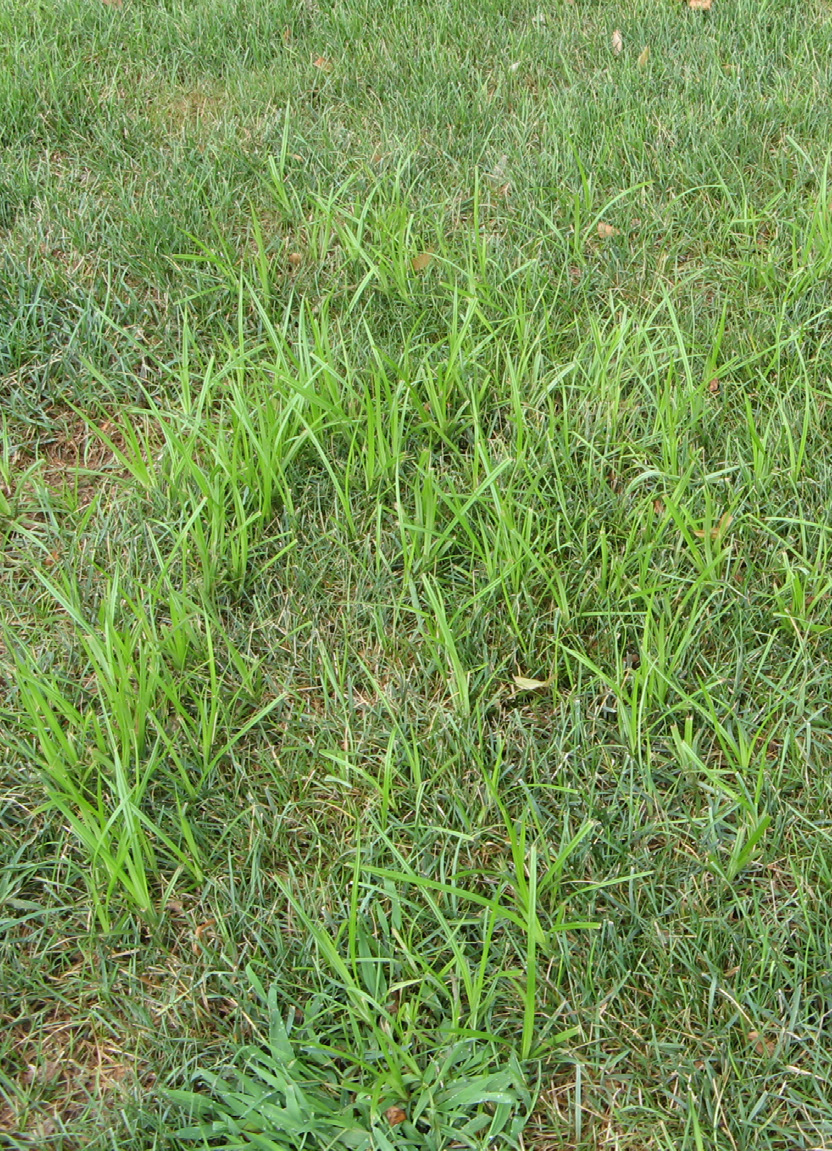
turf weed that is difficult to control.
Life Cycle and Identification
Yellow nutsedge is a perennial plant that reproduces primarily by small underground tubers — called nutlets — that form at the end of underground stems — called rhizomes (Figure 2). A single plant can produce several hundred of these tubers during the summer. Yellow nutsedge can also spread by rhizomes (Figure 3). Yellow nutsedge produces a seedhead when unmown, but these seeds rarely germinate.
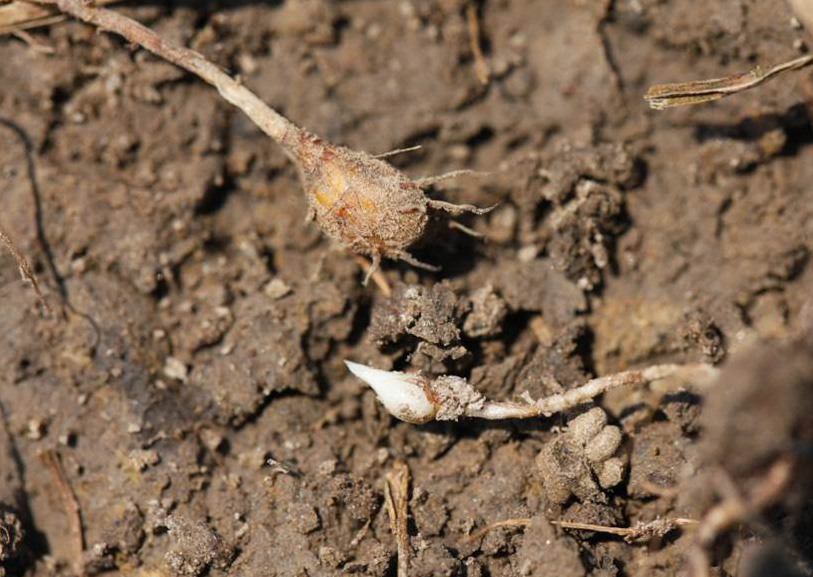
tuber (the brown structure shown on top) and a yellow
nutsedge tuber forming on the tip of a rhizome (white,
tear-shaped structure shown on the bottom). Photo by
Corey Gerber, Purdue Extension.
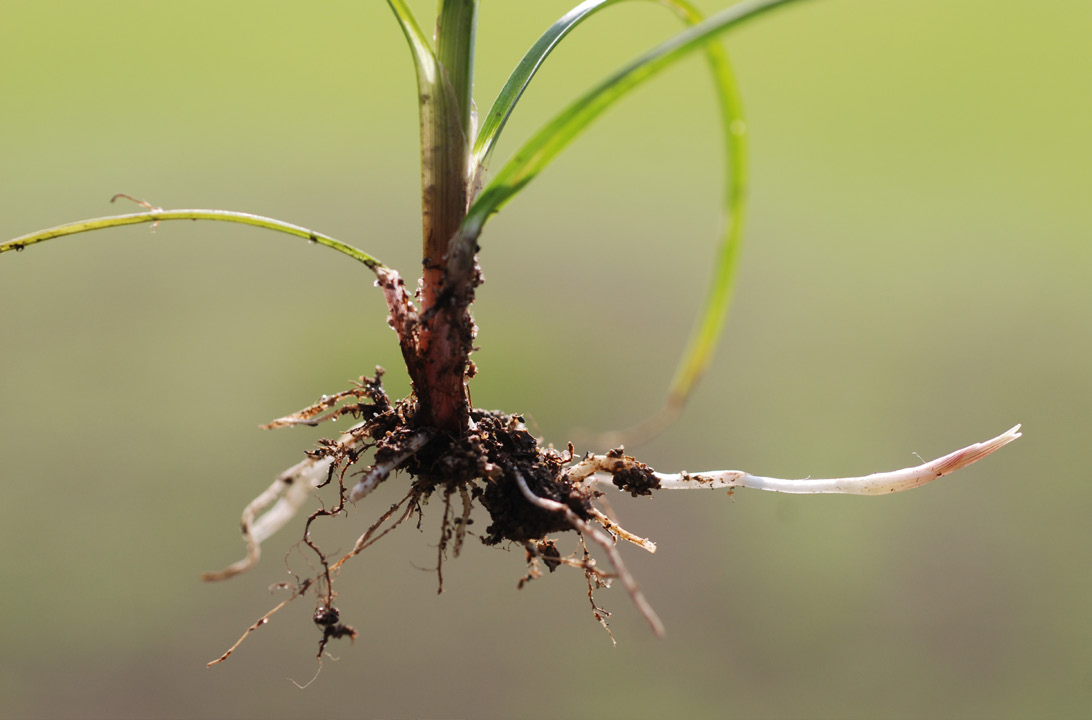
of image) and tubers.
Yellow nutsedge actively grows during the heat of the summer when cool-season turf grows more slowly. In the Midwest, yellow nutsedge typically emerges (germinates from tubers) in late April or May (a few weeks after crabgrass germinates) and grows actively until the first frost in autumn (Figure 4). A frost will kill the plant’s aboveground portion, but the tubers will survive and overwinter in the soil. Dormant tubers can germinate and emerge throughout the following season and survive in the soil for more than three years.
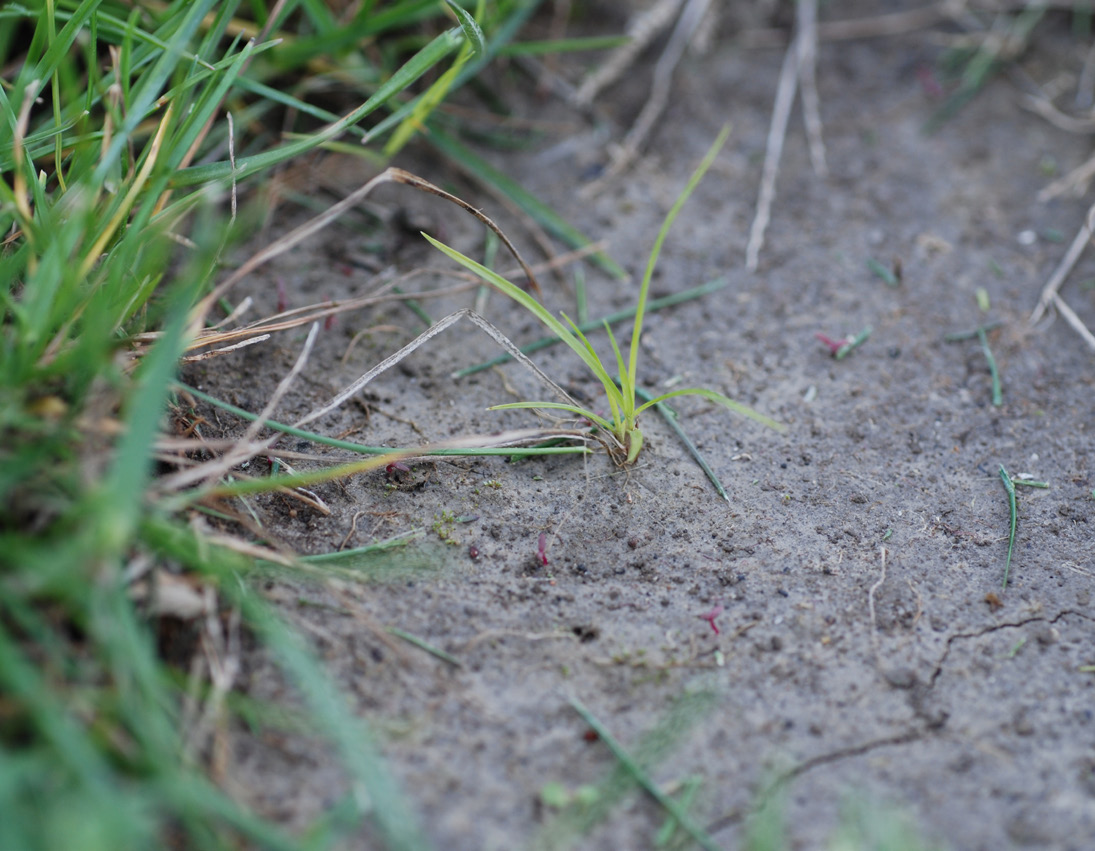
shortly after emerging in a bare soil area.
Yellow nutsedge is most noticeable in summer because its leaves grow more rapidly than the turf during the hottest summer months (Figure 5). During spring and fall (when temperatures are cooler) nutsedge growth is slower and not as easily spotted in turf.
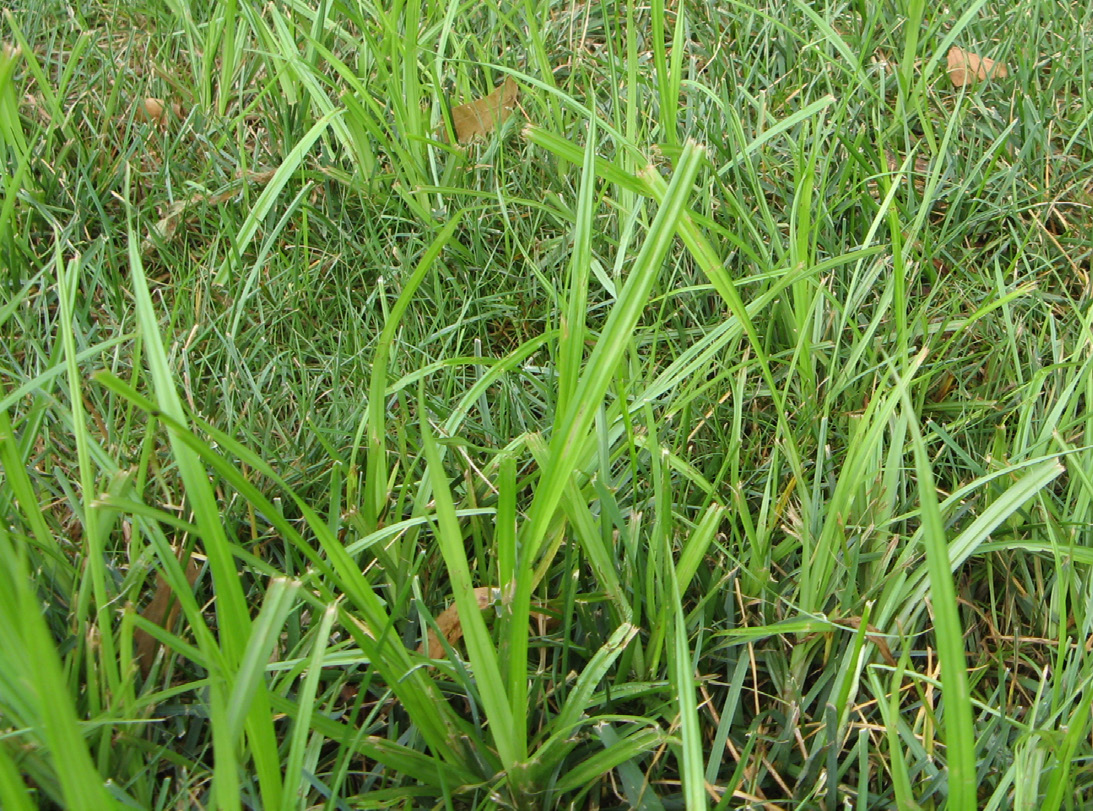
surrounding turf during the summer.
Yellow nutsedge can be identified by the triangular shape of its stem (Figure 6). You can feel the shape by rolling the stem in your fingertips.
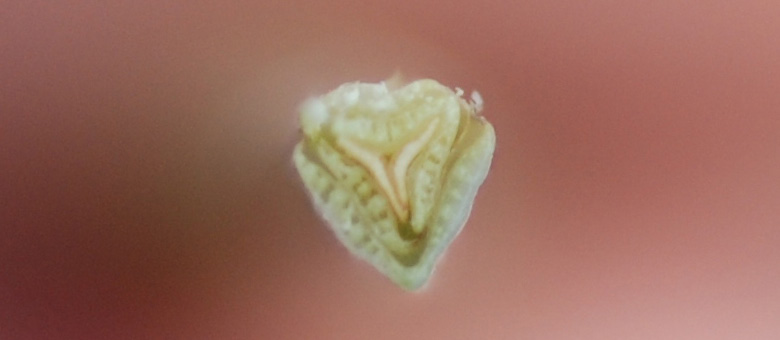
shows its triangular shape.
Yellow nutsedge leaves are arranged in groups of three (three-ranked), which also distinguishes it from grasses (Figure 7). The leaves are light green to yellowish, and each leaf has a long, tapered leaf tip. Each leaf also has a prominent midrib, and has a slick, shiny, or waxy appearance.
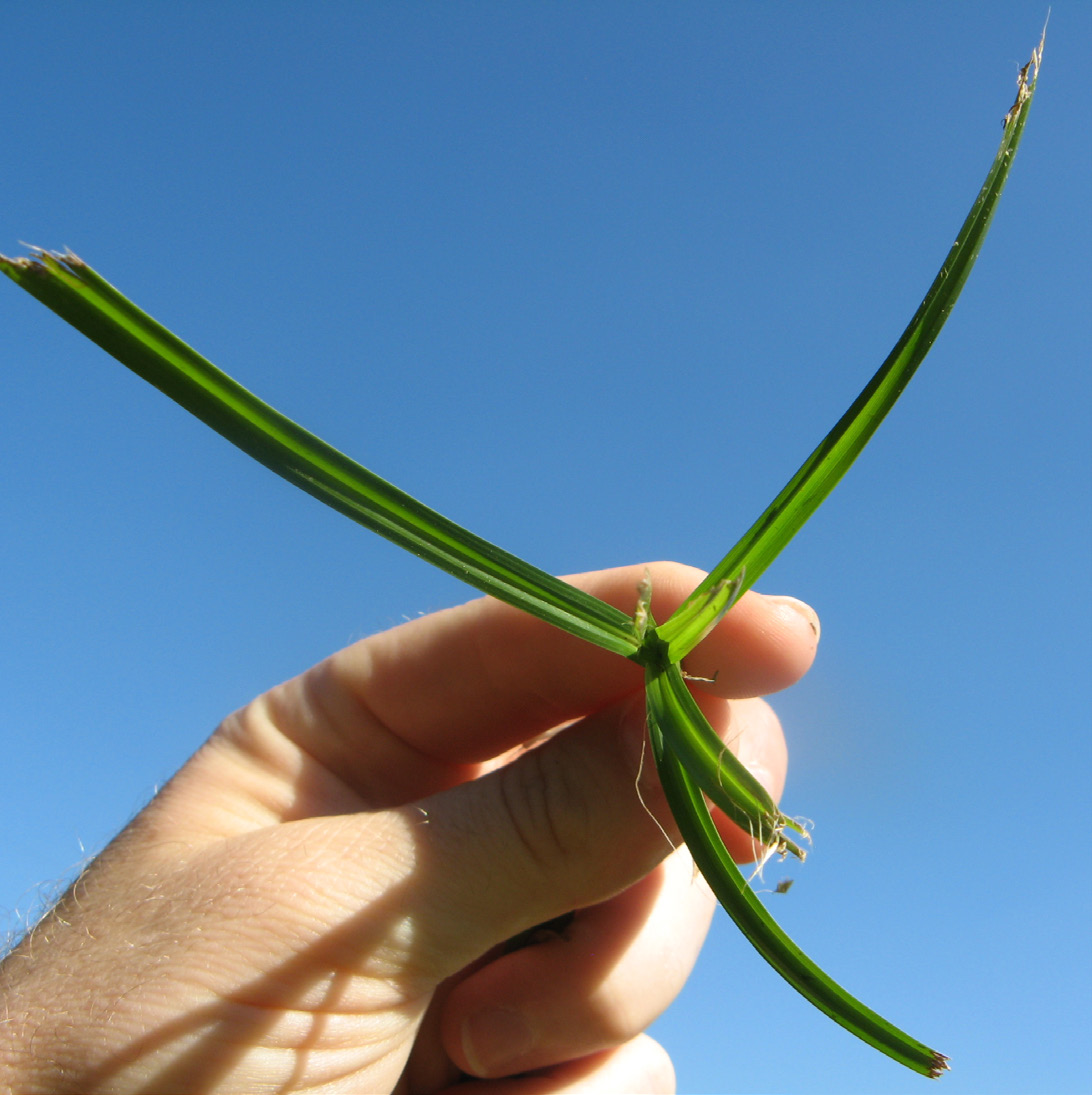
nutsedge.
While many grasses (such as crabgrass) have hairs on the leaf blades, yellow nutsedge does not. Yellow nutsedge will produce a golden seedhead, although the seedhead seldom forms in frequently mown turf (Figure 8).
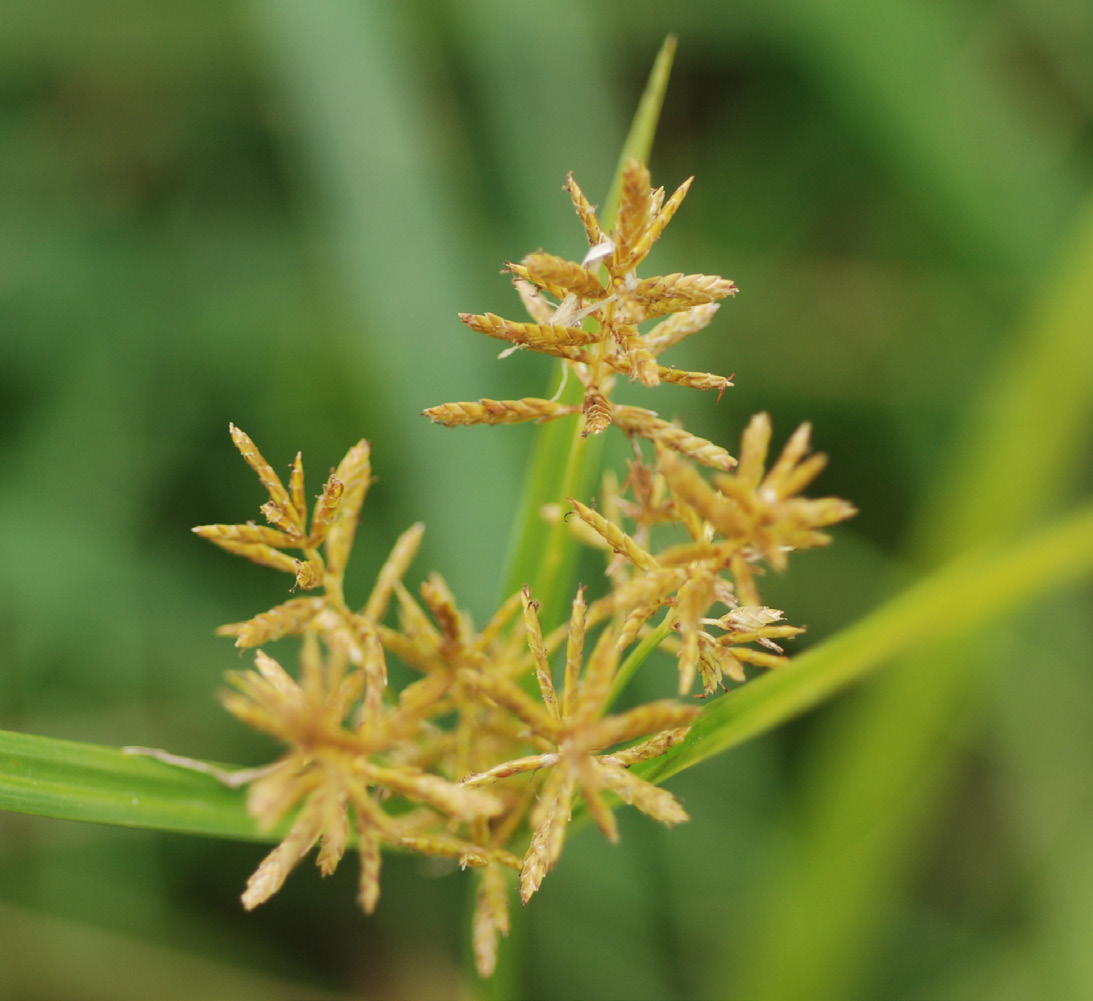
Site History and Cultural Control Methods
Yellow nutsedge is a problem in managed turf areas. It also is a troublesome weed in horticultural and nursery crop production. Yellow nutsedge tubers can easily be spread by soil (topsoil or fill dirt) from one area to another during construction. Additionally, people or equipment can spread yellow nutsedge any time they move soil while planting or dividing ornamental plants in the landscape.
The best method for controlling yellow nutsedge (and other weeds) is to grow a healthy, dense, vigorous stand of turf that can compete with weeds. Encourage dense turf stands by following proper turf maintenance practices, including fall fertilization, proper irrigation, frequent mowing at the proper height, and seeding as needed.
Yellow nutsedge is most problematic in turf that is mown too short, and it thrives in areas where soils remain moist from either poor drainage or over-watering. However, yellow nutsedge can also be a problem in well-drained areas, especially thin turf (Figure 9).
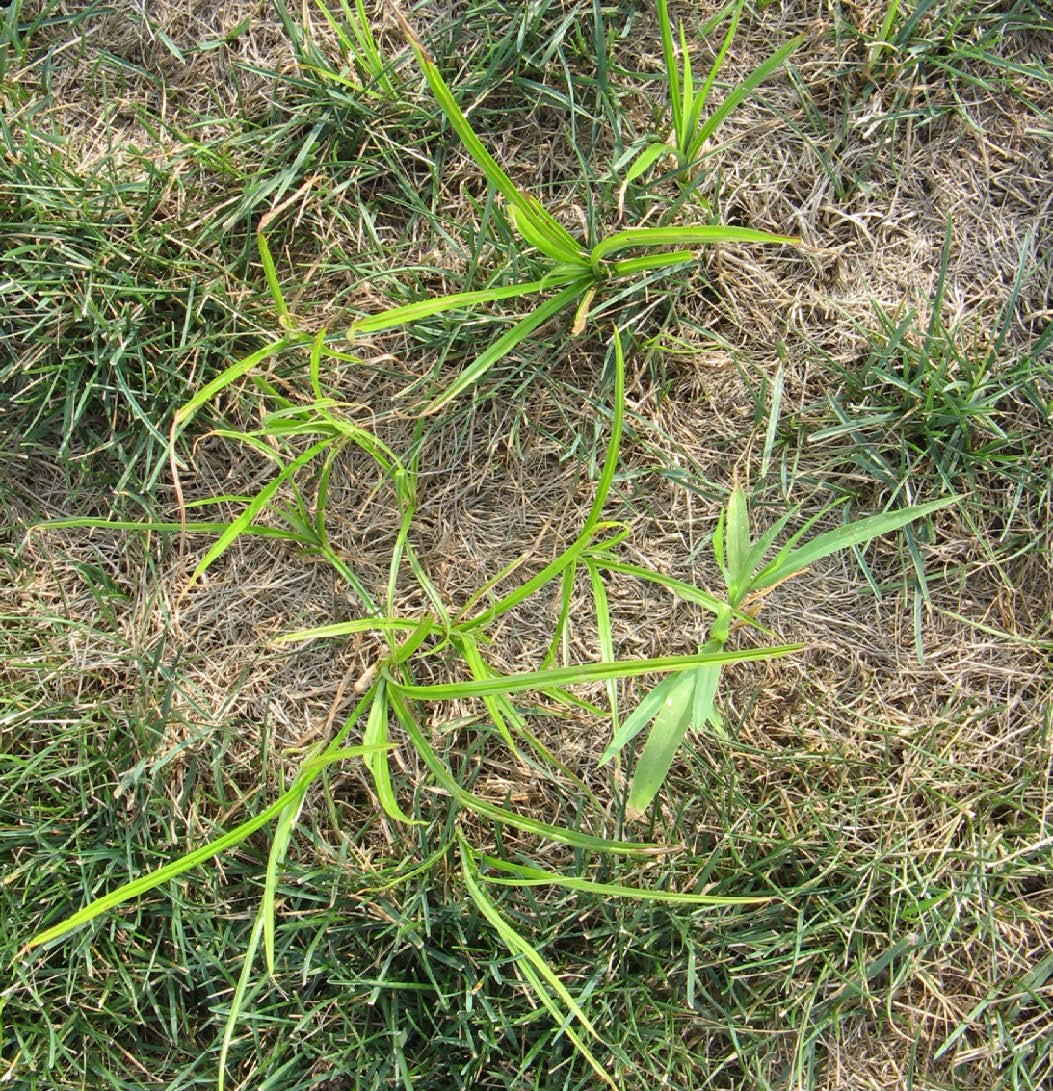
summer when turf is stressed.
Find Out More
Purdue Extension offers many publications about establishing, maintaining, and controlling pests in lawns. Get these publications from:- The Purdue Extension Education Store, https://www.edustore.purdue.edu/
- The Purdue Turf Program, https://turf.purdue.edu/
If only a few yellow nutsedge plants are present, hand pulling will help eliminate the weeds but will not remove the tubers in the soil. Several weeks after pulling yellow nutsedge, check the area to see if the plants have regrown from the tubers. For yellow nutsedge in landscape beds, it is best to remove the entire plant (including the root/rhizome system) by digging around the plant’s base. This will help ensure that you will not get regrowth from the nutsedge’s underground rhizomes.
Control with Herbicides
Herbicides may be required when large patches of nutsedge are present in the turf. The traditional herbicides used to control dandelions (Taraxacum officinale) and crabgrass (Digitaria spp.) are ineffective against yellow nutsedge since it is a sedge and not a
broadleaf or grass. Many herbicides are available for controlling yellow nutsedge.
Regardless of herbicide selection, yellow nutsedge is a difficult–to-control weed that may require multiple herbicide applications. Follow label directions on when to make follow-up applications, if needed.
Late spring/early summer is the ideal time to control yellow nutsedge when it is young. During its early growth stages, yellow nutsedge has not started producing tubers and is most susceptible to control with herbicides. As the summer progresses, nutsedge plants form seedheads and tubers. Since these tubers are the plants’ primary survival structure, it is key to control nutsedge early in the summer before it produces tubers.
Be patient. Two to three years of control using herbicides will be needed to reduce viable tubers in the soil by 90 percent. Herbicide applications will injure growing yellow nutsedge plants and help prevent more tubers from forming, but herbicide applications will not control tubers that are viable in the soil but have not yet produced plants.
Before using any herbicide, always refer to the product label for specific instructions on proper use and turfgrass tolerance. In most cases, herbicides will selectively eliminate yellow nutsedge from a turf area without damaging the desirable turf species; however,
these products are labeled for use only on specific turf species. Most herbicides are safe to use only on cool-season or only on warm-season turf species. Some can be used on both. Consult Table 1 and herbicide labels for more information about turf safety.
Before using any herbicide, consider the following steps for successful yellow nutsedge control:
- Read and follow all directions on the herbicide label.
- Treat the area with the proper rate of herbicide and volume of water listed on the product label. Add a surfactant when the label advises. Do not apply the herbicide if the turf is stressed due to drought or high temperatures (≥90°F).
- Six to ten weeks after the first application, repeat step 2 if the yellow nutsedge has recovered or regrown from tubers.
Cool-season Turf
In cool-season turf — such as Kentucky bluegrass (Poa pratensis), perennial ryegrass (Lolium perenne), tall fescue (Festuca arundinacea) and fine fescues (Festuca spp.) — some sulfentrazone products can provide both preemergence and postemergence control of annual sedge and yellow nutsedge. Echelon® (prodiamine + sulfentrazone) is labeled for preemergence yellow nutsedge and annual sedge control. Other products that contain sulfentrazone — such as Dismiss® and Solitare® (sulfentrazone + quinclorac) — are labeled for postemergence yellow nutsedge and annual sedge control, but they will also provide short-term preemergence control. Q4 Plus®, Surge®, SureZone®, and TZONE® are among the many combination herbicide products that contain sulfentrazone and are labeled for yellow nutsedge suppression, not control. That’s because these product formulations contain a lower amount of sulfentrazone.
Of the various sedge control herbicides, sulfentrazone will provide the quickest control, with injury symptoms appearing on yellow nutsedge within a few days after application. Though the rate of sulfentrazone affects the level of control, the rate will not affect the speed of activity. When using products that contain sulfentrazone, do not add a surfactant. If a second application is needed, apply six to eight weeks after the initial application.
Halosulfuron provides excellent yellow nutsedge control with very good turfgrass tolerance to all turf species. For best results, add 0.25% (v/v) nonionic surfactant (v/v=volume/volume; that is, 0.25 gal (1 qt) NIS volume per 100 gals water volume). Nonionic surfactant is a soaplike liquid that helps herbicide sprays better cover the leaf tissue and increase herbicide absorption to kill the weed. Expect to see injury to yellow nutsedge about two weeks after halosulfuron application (Figure 10).
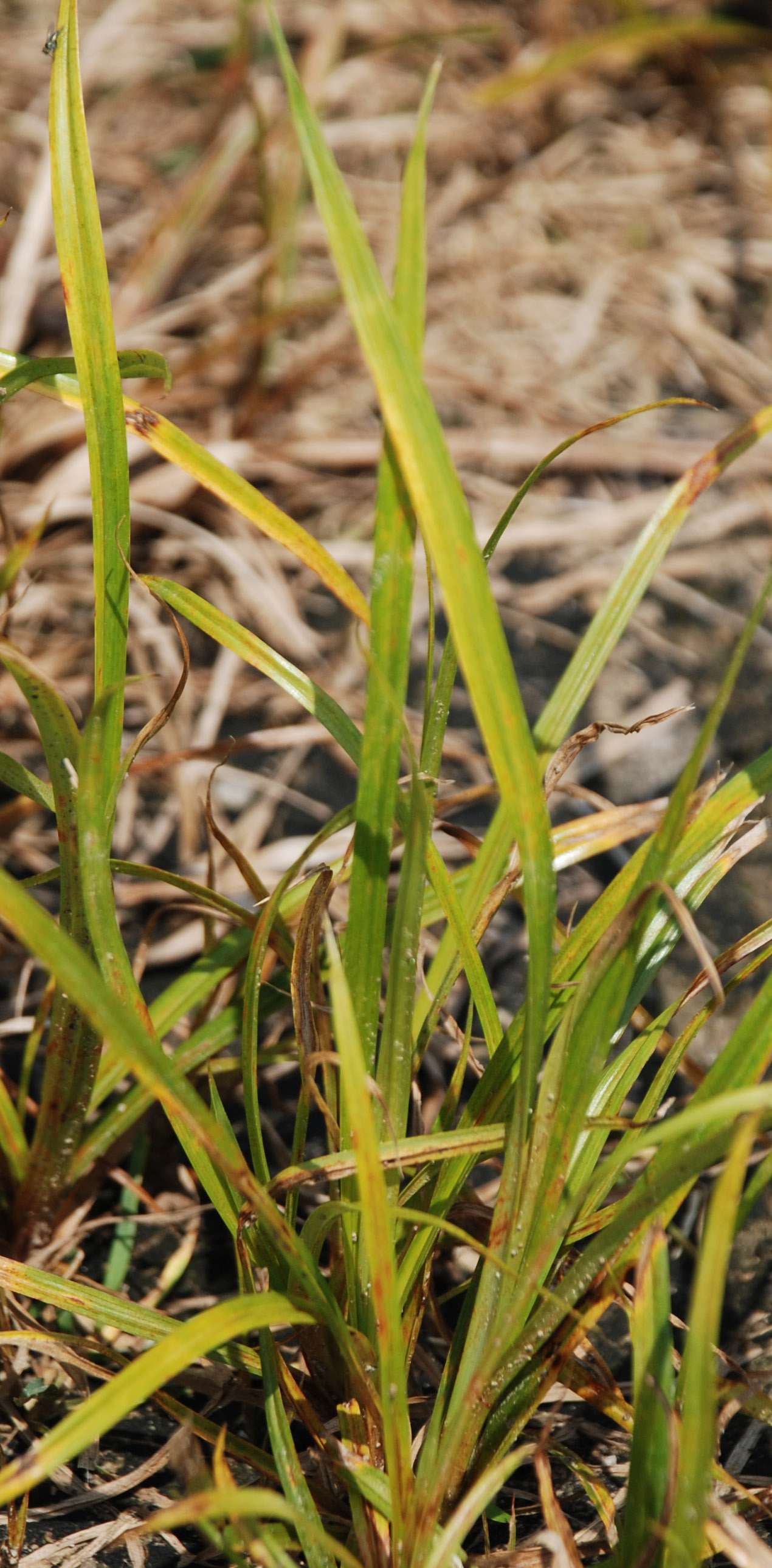
herbicide halosulfuron.
For spot treatments, mix a 0.9-gram packet of halosulfuron (see Table 1) and 2 teaspoons of nonionic surfactant in 1 gallon of water. For broadcast applications to larger areas, use 0.66 to 1.33 oz/A of halosulfuron.
A new formulation called SedgeHammer+® (pronounced SedgeHammer Plus) is available that already includes a surfactant, so adding a surfactant to this product is unnecessary. For spot treatment with SedgeHammer+®, use 0.5 oz/1,000 ft² and do not include a surfactant. If a second application is needed, apply six to 10 weeks after the initial application.
Imazosulfuron (Celero®) is a herbicide similar to halosulfuron, and it also provides excellent yellow nutsedge control with very good turfgrass tolerance and labeling for all major turfgrass species except annual bluegrass. Apply 8 to 14 oz of Celero® with a nonionic surfactant at 0.25% (v/v) for the control of yellow nutsedge.
Mesotrione (Tenacity®) is labeled for postemergence control of yellow nutsedge in Kentucky bluegrass, perennial ryegrass, tall fescue, and fine fescue. Some preemergence yellow nutsedge activity has also been observed with this herbicide, but it is not labeled for preemergence control. Mesotrione causes a bleaching (whitening) effect on susceptible weeds (Figure 11). Adding a nonionic surfactant according to label recommendations will improve control. Research shows that two applications of Tenacity®, 14 days apart, will be required for control.
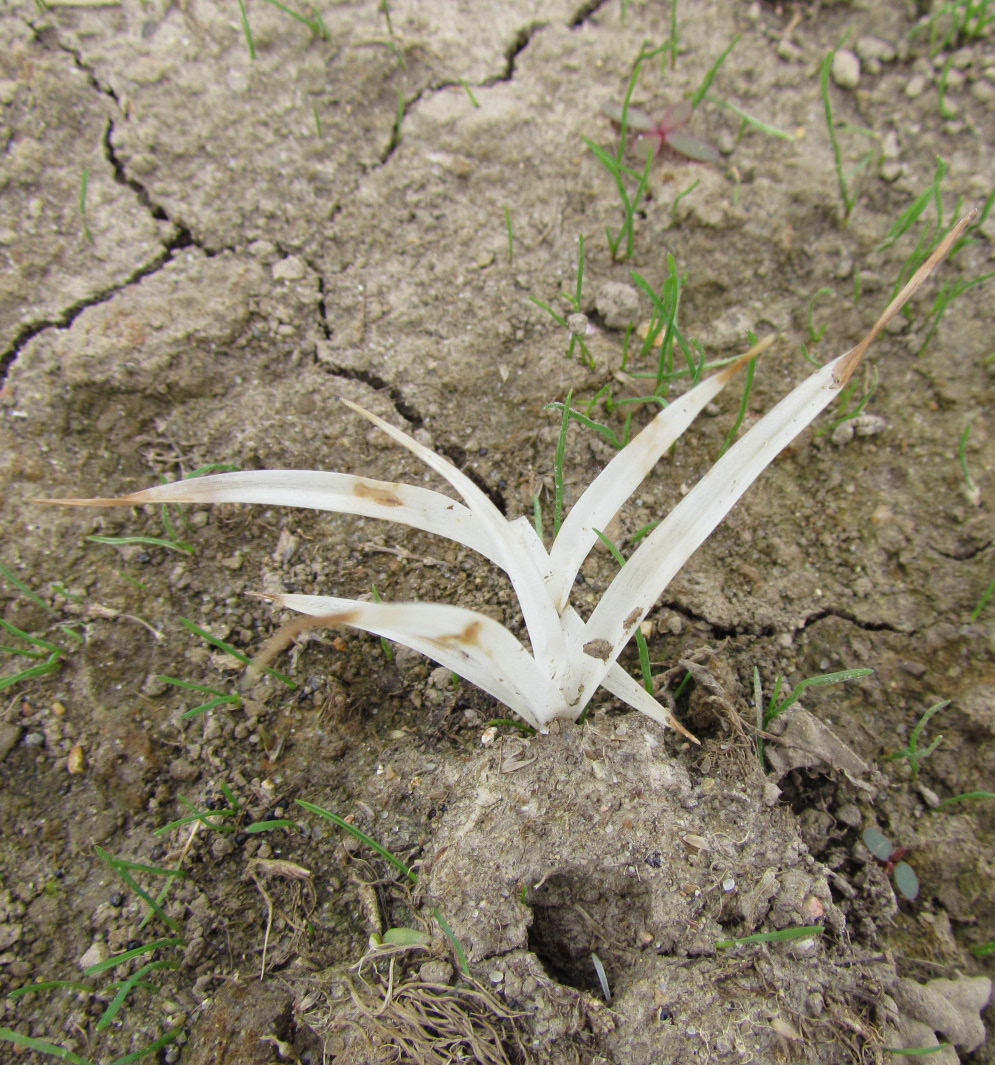
application on a yellow nutsedge plant.
Warm-season Turf
In warm-season turf (such as bermudagrass and zoysiagrass), professionals can use any of the sedge herbicides mentioned above except Tenacity®.
In addition, professionals can use some other sulfonylurea herbicides to control yellow nutsedge in bermudagrass and zoysiagrass. These products include Monument 75WG® at 0.53 oz/A, Katana® at 3.0 oz/A, or Certainty® at 1.25 oz/A. Expect to see injury to yellow nutsedge about two weeks following application. Repeat applications of these herbicides will often be needed if regrowth appears. Follow instructions on product labels about when to make follow-up applications. Add 0.25% (v/v) nonionic surfactant when applying these herbicides.
Other products — including Basagran T/O® (bentazon), Blindside® (metsulfuron + sulfentrazone), Tower® (dimethenamid), FreeHand® (dimethenamid + pendimethalin), and Pennant MAGNUM® — are also labeled for yellow nutsedge control in warm-season
grasses. Tribute TOTAL® (thiencarbazone + foramsulfuron + halosulfuron) is labeled for yellow nutsedge control in bermudagrass.
Weed Control Help for Professionals
More information about weed control for turfgrass professionals is available in Purdue Extension publication TURF-100, Turfgrass Weed Control for Professionals, available from the Purdue Extension Education Store: https://www.edustore.purdue.edu/
Other Problem Sedges
Purple nutsedge (Cyperus rotundus), annual sedge (Cyperus compressus), shining flatsedge (Cyperus bipartitus), and false-green kyllinga (Kyllinga gracillima) are other sedges found in Midwest turf. Purple nutsedge is not as cold hardy as yellow nutsedge, thus this species is limited to southern portions of Midwest.
Purple nutsedge has darker leaf blades than yellow nutsedge, and has a more blunt leaf tip (Figure 12). Purple nutsedge has a purple- to maroon-colored seedhead (Figure 13).
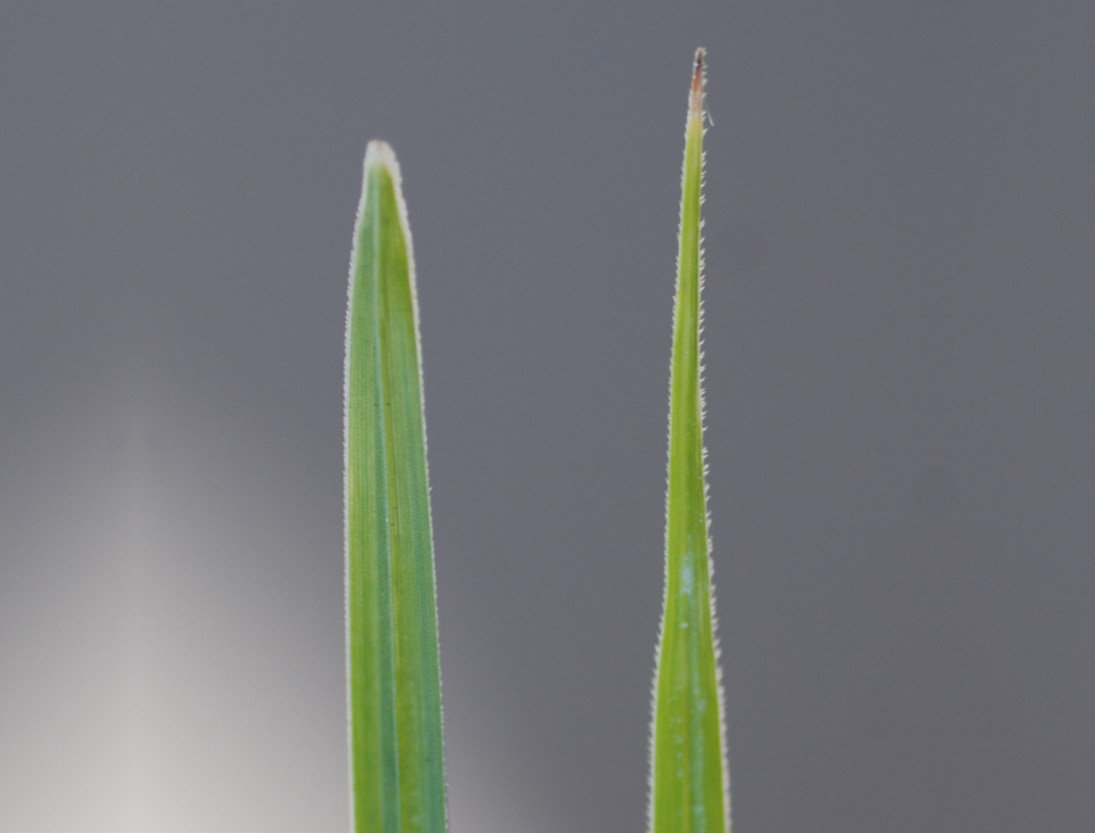
yellow nutsedge has a sharply pointed leaf tip.
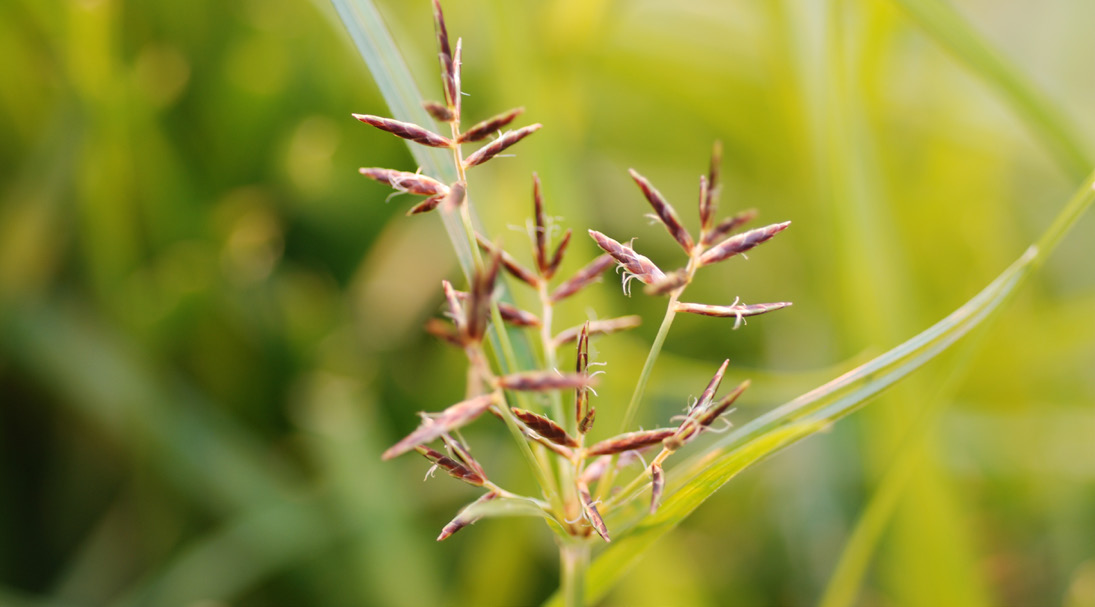
seedhead with the yellow nutsedge seedhead shown in
Figure 8.
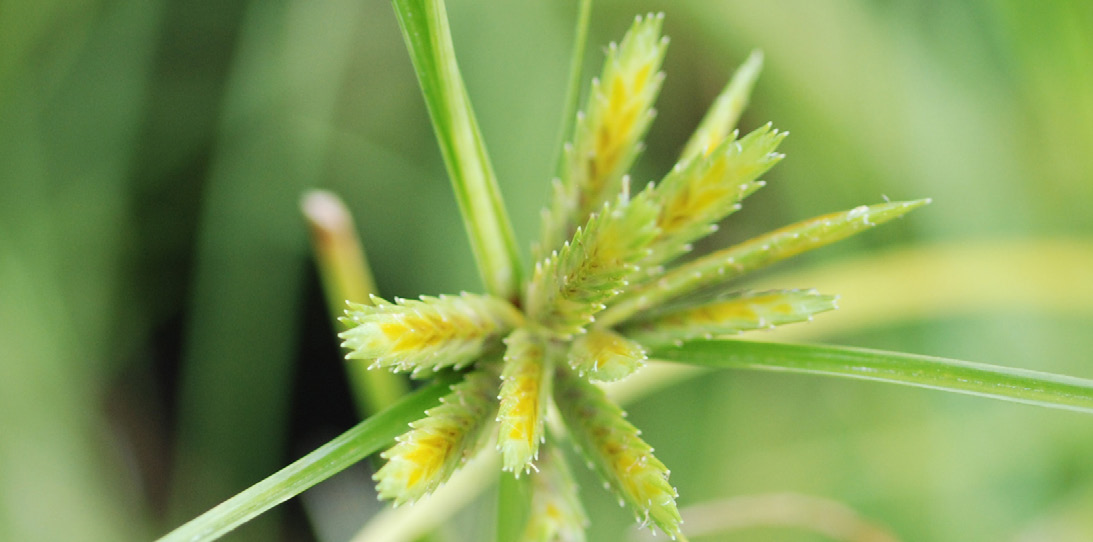
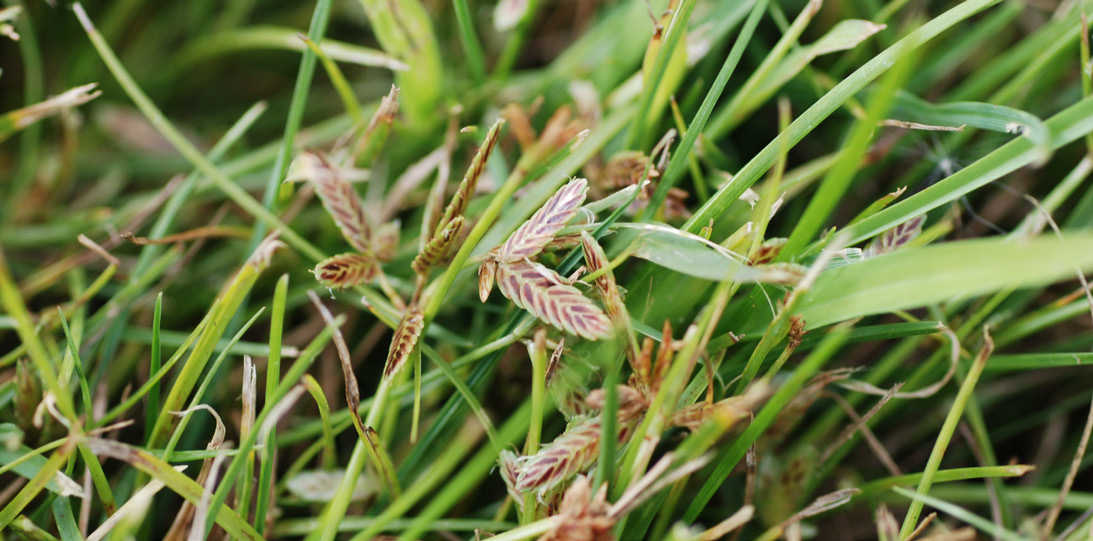
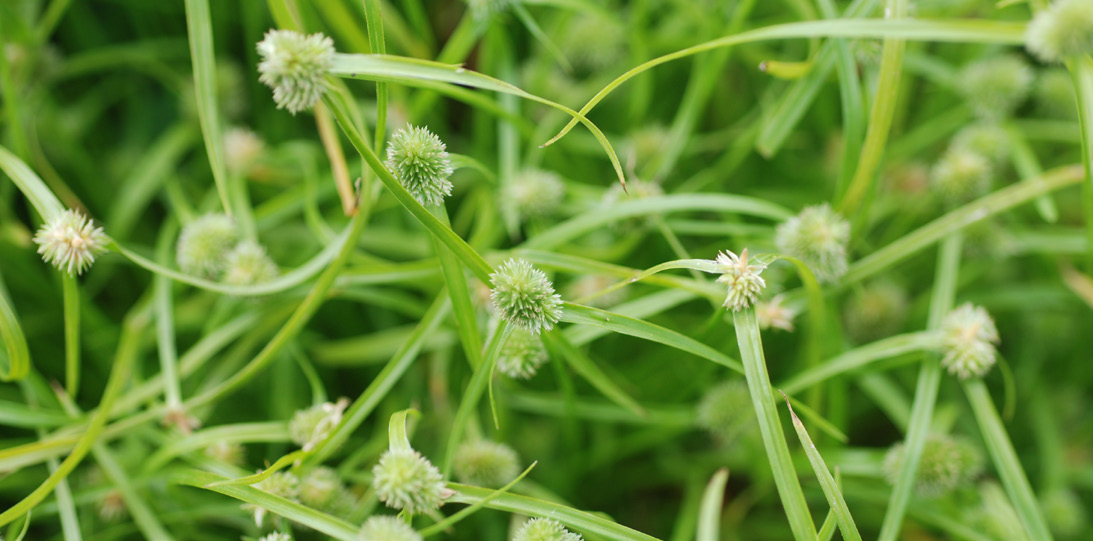
Annual sedge (Figure 14), shining flatsedge (Figure 15), and false-green kyllinga (Figure 16) are smaller sedge species that have more compact seedheads. These species spread by seed, and false-green kyllinga also spreads by rhizomes. Like yellow and purple nutsedges, annual sedge, shining flatsedge, and kyllinga can be identified by their triangular stems and three-ranked leaf arrangement. Annual sedge and kyllinga can survive lower mowing heights than yellow nutsedge and can be found in golf course fairways, tees, and putting greens, as well as other turf areas.
Cultural control practices for these other sedge species are limited, but similar to those yellow nutsedge. Purple nutsedge, false-green kyllinga, and annual sedge can be controlled with similar herbicides used to control yellow nutsedge with some exceptions. See Table 1 for the efficacy and safety of these herbicides.
Summary
In summary, sedges are problem weeds and require herbicide use for control. Many herbicides are available for sedge control, but proper herbicide use and application timing are critical to optimize control.
For best results, apply herbicides prior to tuber or seed production. The most common mistake is to apply herbicides too late in the season, after sedges are big, spreading by rhizomes, producing tubers, and for some species, producing viable seeds. A good sedge control program will need to be implemented early in the season and continue for consecutive years to reduce tuber populations in the soil and prevent the spread of this problematic weed.
Table 1. Sedge control and turfgrass tolerance ratings for professional products.
Rating:
E=excellent (≥90% control).
G=good (75-90% control).
F=fair (50-75% control).
P=poor control (≤50% control),
I=intermediate safety or some injury may occur, may cause minor damage to mature, healthy turf. Consider using the lower end of the rate range. Do not apply to turf under stress.
Blank=no data.
S=safe at labeled rates on healthy, mature turf.
NR=not registered for use on this species.
These are relative control rankings based on research of the efficacy of professional products. Weed control will vary with environmental conditions, application timing,
turfgrass vigor, and other factors. This table is intended only as a guide. Repeat applications are needed for complete control of sedges with all herbicides.
1For use on cool- and warm-season grasses on golf courses (see label) and warm-season use only on sod farms, commercial and recreational turf, and residential turf.
2For use on sod farms only.
3Safety varies by zoysiagrass cultivar.
4Labeled for preemergence control of sedges in addition to postemergence control.
| Sedge Control - Sedges and Kyllinga | Turf Tolerance: Cool-Season | Turf Tolerance: Warm-Season | |||||||||||
|---|---|---|---|---|---|---|---|---|---|---|---|---|---|
| Herbicide | annual sedge | false-green kyllinga | purple nutsedge | yellow nutsedge | annual bluegrass | creeping bentgrass | fine fescue | Kentucky bluegrass | perennial ryegrass | tall fescue | bermudagrass | buffalograss | zoysiagrass |
| 2,4-D + dicamba + sulfentrazone + penoxsulam (Avenue South) | P | P | P | F | S | NR | S | S | S-1 | S-1 | S | S | S |
| 2,4-D + fluroxypyr + triclopyr + sulfentrazone (Momentum 4-Score) | P | P | P | F | S | S | S | S | S | S | NR | NR | NR |
| 2,4-D + MCPA + dicamba + sulfentrazone (Triad SFZ Select) | P | P | P | F | S | S | S | S | S | S | S | S | S |
| 2,4-D + mecoprop + dicamba + sulfentrazone (Surge) | P | P | P | F | S | S | S | S | S | S | S | S | S |
| 2,4-D + quinclorac + dicamba + sulfentrazone (Q4 Plus) | P | P | P | F | S | NR | S | S | S | S | S | NR | S |
| 2,4-D + triclopyr + dicamba + sulfentrazone (Foundation) | P | P | P | F | S | NR | S | S | S | S | NR | NR | NR |
| 2,4-D + triclopyr + dicamba + sulfentrazone (TZONE SE) | P | P | P | F | S | NR | S | S | S | S | S | NR | S |
| bentazon (Basagran T/O) | G | F | P | F | S | S | S | S | S | S | S | S | S |
| dimethenamid (Tower¹) | G | G | F | F-G | NR | NR | NR | NR | NR | NR | S | S | S |
| dimethenamid + pendimethalin (FreeHand) | G | G | F | F-G | NR | NR | NR | NR | NR | NR | S | S | S |
| flazasulfuron (Katana) | G | G | G-E | G-E | NR | NR | NR | NR | NR | NR | S | S | S |
| halosulfuron (SedgeHammer) | G | F | G | G-E | NR | S | S | S | S | S | S | S | S |
| halosulfuron + dicamba (Yukon2) | G | F | G | G-E | NR | S | S | S | S | S | S | S-I | S |
| imazapic (Plateau) | F | F | F | F | NR | NR | NR | NR | NR | NR | S | S | NR |
| imazaquin (Image 70DG) | G | G-E | G | F | NR | NR | NR | NR | NR | NR | S | NR | S |
| imazosulfuron (Celero) | G | E | G-E | G-E | NR | S | S | S | S | S | S | NR | S |
| mesotrione (Tenacity) | P | P | P | G | NR | NR | S | S | S | S | NR | S | NR |
| metolachlor (Pennant MAGNUM) | G | F | F | G | NR | NR | NR | NR | NR | NR | S | NR | S |
| MSMA | G | F-G | P-F | F | S | I | I | S-I | S-I | S-I | S-I | I | S-I |
| pyrimisulfan (Vexis) | G | F | F | F-G | NR | S | S | S | S | S | S | S | S |
| sulfentrazone (Dismiss, Spartan 4F2) | G | F | P-F | G-E | NR | S-I | S-I | S | S | S-I | S | S | S3 |
| sulfentrazone + carfentrazone (Dismiss NXT) | G | F | P-F | G-E | NR | S | S | S | S | S | S | S | S3 |
| sulfentrazone + imazethapyr (Dismiss South) | G | F | E | G-E | NR | NR | NR | NR | NR | NR | S | S | S3 |
| sulfentrazone + metsulfuron (Blindside) | G | F | P-F | G-E | NR | NR | NR | S | NR | S-I | S | S | S3 |
| sulfentrazone + prodiamine (Echelon4) | G | F | P-F | G-E | NR | S | S | S | S | S | S | S | S3 |
| sulfentrazone + quinclorac (Solitare) | G | F | P-F | G-E | NR | NR | S-I | S | S | S | S | S | S3 |
| sulfosulfuron (Certainty) | G | G-E | E | G-E | NR | NR | NR | NR | NR | NR | S | S | S |
| thiencarbazone + foramsulfuron + halosulfuron (Tribute TOTAL) | G | G | G | G-E | NR | NR | NR | NR | NR | NR | S | NR | S |
| trifloxysulfuron (Monument) | G | E | E | G | NR | NR | NR | NR | NR | NR | S | S-I | S |