

Introduction
Five fine fescue taxa (strong creeping red fescue, slender creeping red fescue, Chewings fescue, hard fescue, and sheep fescue) are often grouped together and called “fine fescues.” This publication will help readers understand the differences between these five fine fescue species and what makes each species unique.
Authors
- Aaron Patton, Purdue University
- Ross Braun, Purdue University
- Michael Barnes, University of Minnesota
- Kristen Nelson, University of Minnesota
- Maggie Reiter, University of Minnesota
- Eric Watkins, University of Minnesota
- Alec Kowalewski, Oregon State University
- Paul Koch, University of Wisconsin, Madison
- James Murphy, Rutgers University
Take-Home Points
- There are more than 450 species of fescue, but only 10 are suitable for turfgrass.
- Five fine fescue taxa (strong creeping red fescue, slender creeping red fescue, Chewings fescue, hard fescue, and sheep fescue) are often grouped together and called “fine fescues.”
- There are known performance and management differences among these fine fescues.
- In the past, these species were all called fine fescues, but it is beneficial to refer to each fine fescue species (taxa) individually to distinguish the strengths and weaknesses of each, which helps in the selection and management of individual species.
Fescues
The term “fescue” is one that you may often hear during televised golf broadcasts or in dialogue with a person about planting, maintaining, controlling, etc., some kind of grass at a home garden center. However, just using the term “fescue” doesn’t tell you much about this grass because there are many kinds – more than 450 fescue species. However, only 10 species or subspecies have characteristics that allow them to be suitable for turfgrass areas (Christians et al., 2017). Turfgrass fescues can be easily divided into two groups: fine and coarse, which refers to either narrow or wide leaf blade textures, respectively (Fig. 1). There is also a lack of information and confusion around the common and scientific naming of fine fescues. This, in combination with the misidentification of fine fescues, often leads practitioners to infer that individual fine fescue grasses all respond to management and environmental stresses in a similar manner. That is a misleading and significant barrier to transitioning to these low-input turfgrasses (Barnes et al., 2020).
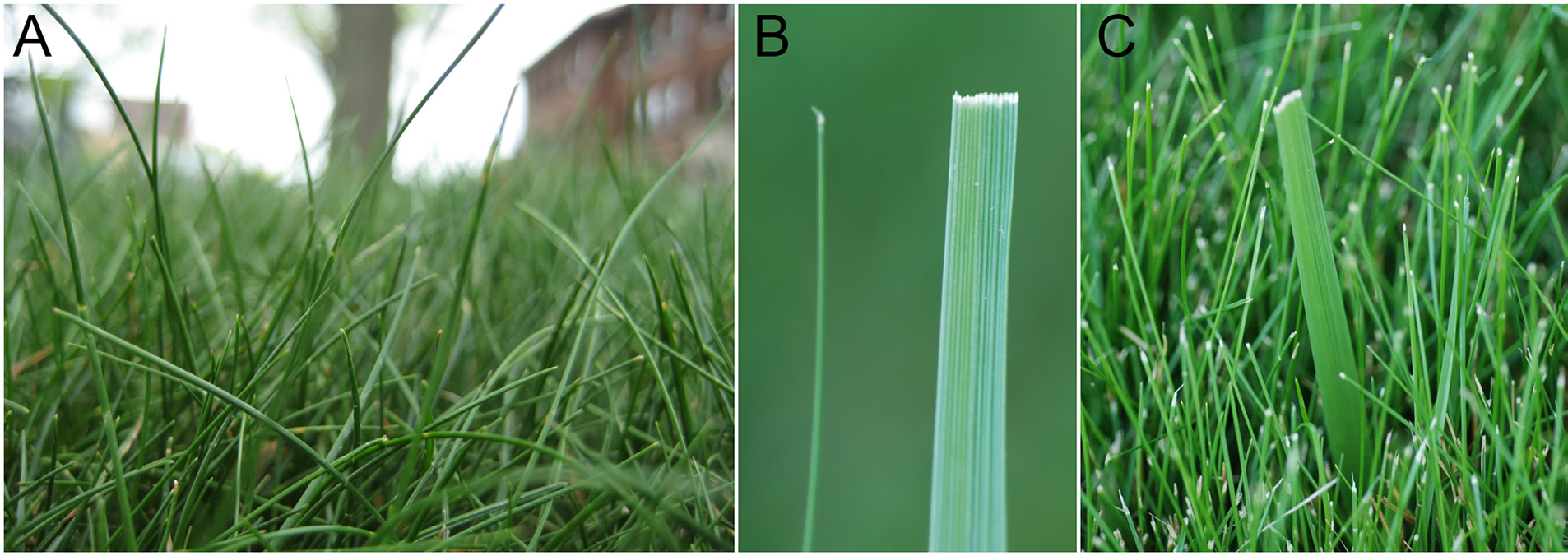
leaf texture differences between fine fescue (left) vs. coarse, tall fescue (right) (B);
and a tall fescue leaf (middle) in a stand of fine fescue (C).
Photos by Ross Braun and Aaron Patton.
Coarse Fescues (wide leaf blades)
Festuca is a Latin word meaning stem or stalk, and it is the genus (first word in scientific name) for fescue grass species. Hence, Festuca grasses are named Fescue. Tall fescue (Festuca arundinacea, synonym Schedonorus arundinaceus, synonym Lolium
arundinaceum) and meadow fescue [Schedonorus pratensis (formerly Festuca pratensis)] are two of the common coarse fescues used in turfgrass areas (Table 1). The coarse-leaved tall fescue and meadow fescue are similar. Meadow fescue is used sparingly
for overseeding in warm-season turfgrass or as a forage grass; tall fescue is commonly used in lawns, roadsides, and pastures (Fig. 2). The common turf-type tall fescue and fine fescues both have finer (narrow) leaf texture than old forage-type tall fescue cultivars, such as ‘Kentucky-31’ or ‘K-31’ tall fescue.
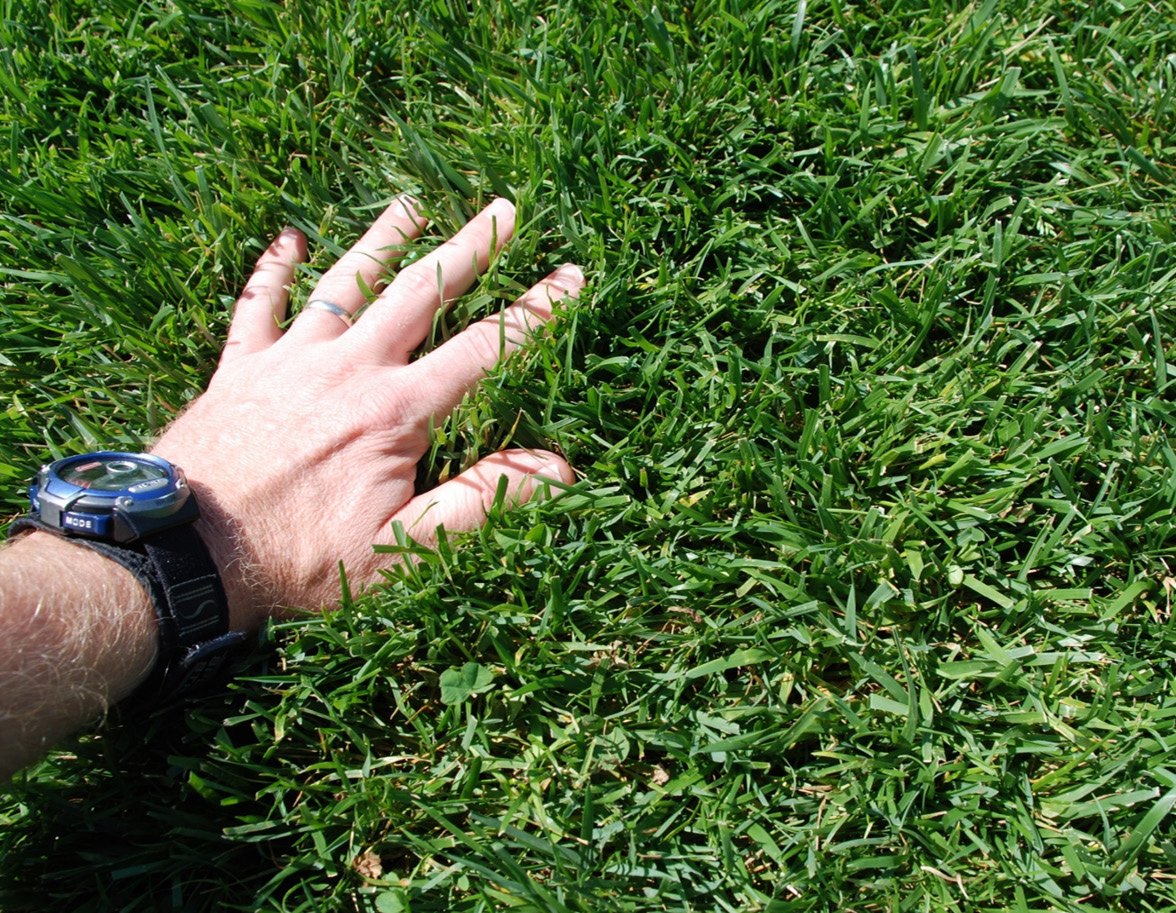
Fine Fescues (narrow leaf blades)
Fine fescues are used across a range of turfgrass systems, including home lawns, commercial properties, golf courses, parks, roadsides, low-input sites, and other utility turf. Five fine fescue turfgrasses are commonly used in turfgrass systems: strong creeping red fescue (Festuca rubra L. ssp. rubra), slender creeping red fescue (Festuca rubra L. ssp. littoralis), Chewings fescue (Festuca rubra L. ssp. commutata, synonym Festuca rubra L. ssp. fallax) (see footnote on the common name of Chewings fescue in Table 2), sheep fescue (Festuca ovina L., synonym Festuca ovina L. ssp. hirtula), and hard fescue (Festuca brevipila) (Table 1). These five fescues are often grouped together and called “fine fescues” because of their similar appearance of fine (narrow or bristle) leaves, which means they are difficult to distinguish from one another (Figs. 1, 3, and 4). In addition to the previously mentioned five, many other fescues share a similar appearance of this fine leaf texture, but they are not commonly used in turfgrass systems. One
example is blue fescue (Festuca glauca), which is more commonly used as an ornamental grass.
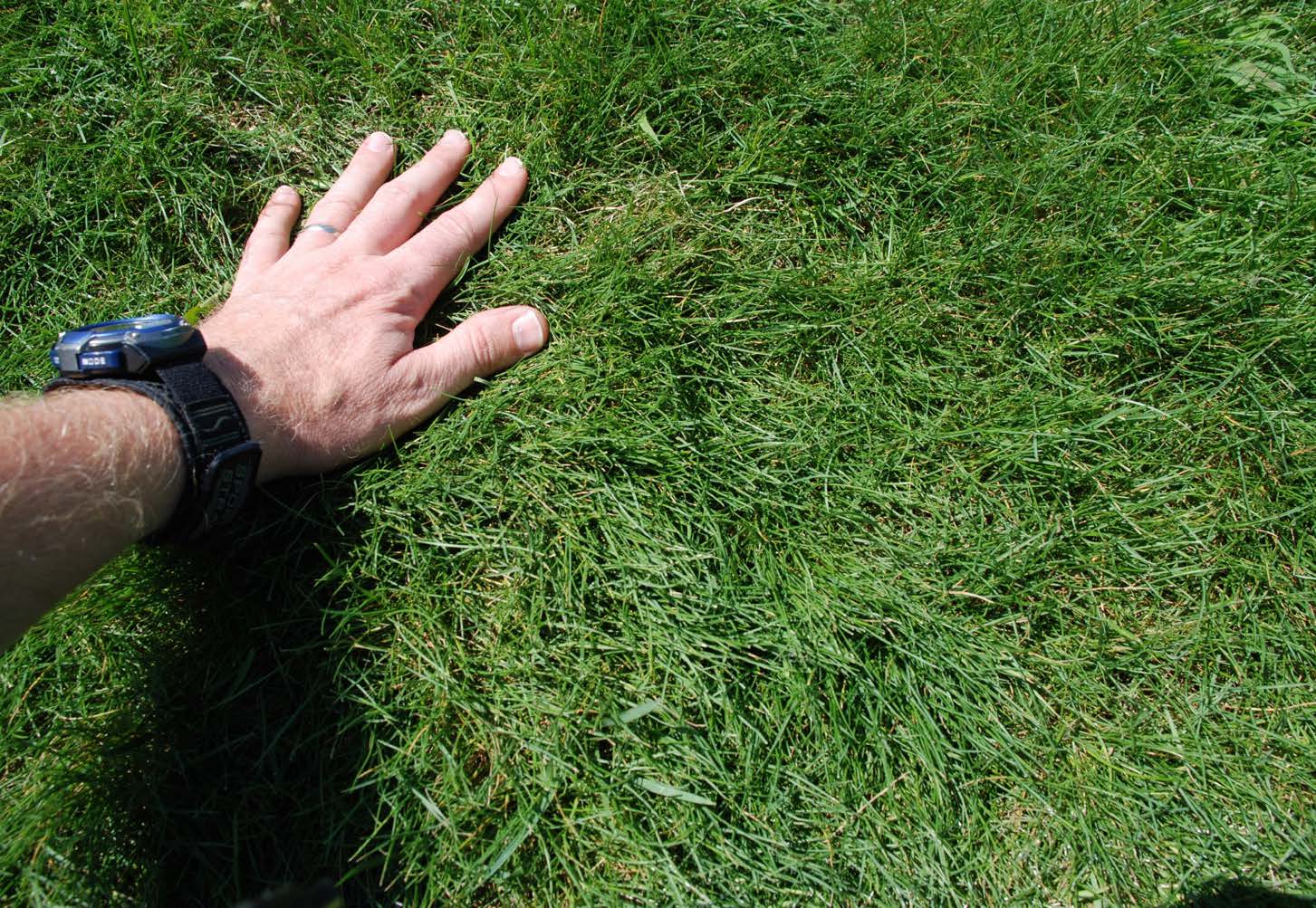
width) compared to tall fescue in Figure 2. Photo by Aaron Patton.
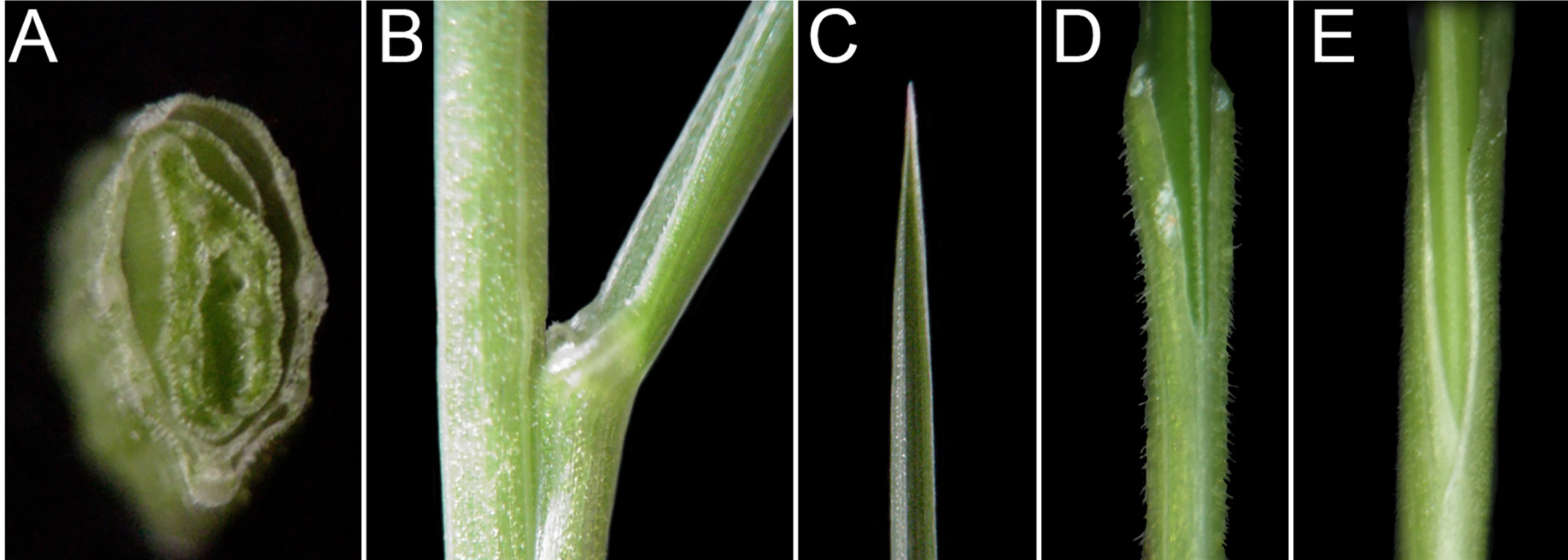
vernation (A), small or absent ligule and auricles (B), and pointed leaf tip (C). Differences can be observed among tiller
leaf-sheaths, with a fused tiller leaf-sheath characteristic of strong creeping red fescue, slender creeping red fescue, and
Chewings fescue (D). An overlapping tiller leaf-sheath characteristic of sheep fescue and hard fescue (E).
Photos by Ross Braun.
There is a lot of confusion and debate regarding the scientific (taxonomic) classification of fine fescues (Braun et al., 2020) (Table 2). Recently, a team of researchers working on a grant from the USDA-NIFA through the Specialty Crop Research Initiative put together an exhaustive scientific review of the fine fescue turfgrass species. The review clearly documents differences in growth, production, establishment, management, utilization, pest tolerance, and stress tolerance of the fine fescue taxa (Braun et al., 2020). Taxa, plural of taxon, is a group of one or more populations of an organism(s) used in the science of biological classification, or taxonomy. In the review by Braun et al. (2020), the recommended taxonomic classification is presented (Table 2) to hopefully bring greater clarity and accuracy to the use of scientific names for these grasses in the future.
Table 1. Fescue grasses used in turfgrass or ornamental landscapes
| Common Name | Common Uses |
|---|---|
Coarse fescues Tall fescue (turf-type and forage-type) | Turf-type tall fescue is used in home lawns, athletic fields, golf courses (i.e., roughs and tall grass natural “native” rough areas), commercial properties, parks, low-input sites, and other utility turfgrass areas (e.g., roadsides). Some tall fescue cultivars produce short rhizomes and may be marketed as RTF (Rhizomatous Tall Fescue). These rhizome-forming cultivars are not a different species. Forage-type tall fescue cultivars, like Kentucky-31, are typically used as forage or utility grasses for roadsides. |
| Meadow fescue (also known as English bluegrass) | Mainly a forage grass, but can be used for overseeding in warm-season turfgrass. |
Fine fescues commonly used in turfgrass systems Strong creeping red fescue | Home lawns, shaded sites, commercial properties, golf courses (i.e., fairways and tall grass natural “native” rough areas), parks, no-mow areas, low-input sites, other utility turfgrass (e.g., roadsides). |
Slender creeping red fescue | Home lawns, shaded sites, commercial properties, golf courses (i.e., putting greens, fairways, and tall grass natural “native” rough areas), parks, no-mow areas, low-input sites, other utility turfgrass (e.g., roadsides). |
Chewings fescue | Home lawns, shaded sites, commercial properties, golf courses (i.e., putting greens, fairways, and tall grass natural “native” rough areas), parks, no-mow areas, low-input sites, other utility turfgrass (e.g., roadsides). |
Sheep fescue | Home lawns, shaded sites, golf courses (i.e., tall grass natural “native” rough areas) parks, no-mow areas, low-input sites, other utility turfgrass (e.g., roadsides). |
Hard fescue | Home lawns, shaded sites, golf courses (i.e., tall grass natural “native” rough areas), parks, no-mow areas, low-input sites, other utility turfgrass (e.g., roadsides). |
Other fine fescues Blue fescue | Common ornamental grass in landscape beds |
Fine-leaf sheep fescue (also known as hair fescue, fine-leaved sheep fescue, or slender fescue) | Easily confused with sheep or hard fescue, but it is known for being a ruderal weed and has |
Shade fescue (also known as various-leaved fescue) | Mainly found in woodland areas and dry, sandy soils. |
Idaho fescue (also known as blue bunchgrass or bluebunch fescue) | Mainly found in grasslands and open forest communities in western North America. |
California fescue | A valued grass because of its name, but it is not a fine‐leaved fescue, instead it has a coarser |
Molate fescue | A rhizomatous red fescue often used in grassland restoration or no-mow landscape settings. |
Table 2. Recommended taxonomic classification for the five fine fescues used in turfgrass systems.
† Recommended scientific name proposed by Braun et al. (2020) following a careful review of the history of fine fescue binomial nomenclature, a study of published literature on their taxonomy, and documentation of noteworthy misapplied and illegitimate names, the current and recommended taxonomic classification, synonyms, and etymology. Other incorrect scientific names that have been presented in past literature are not recommended due to no nomenclatural standing, misapplied taxonomic naming, misinterpretation of a species name, and erroneous identification made according to another author’s concept or sense of the species rather than the original author’s intention.
‡ Other common names found in the scientific literature, but not recommended for use.
§ Today, red fescue (Festuca rubra) is classified into two groups: 1) Slender creeping red fescue or 2) Strong creeping red fescue. However, some seed labels may still just say, red fescue or creeping red fescue.
¶ The name Chewings fescue is named after Mr. George Chewings (1855-1925), who first cultivated, harvested, and sold this grass called “Chewings fescue” in New Zealand (Ruemmele et al., 2003). This grass was originally imported from England and sold to the previous New Zealand farm’s owner (William Tarlton) as “hard fescue” (Morgan, 1998). After purchasing the farm, Mr. Chewings observed this unique patch of grass and began seed production (Morgan, 1998). In literature, the common name is sometimes misspelled with an apostrophe (Chewing’s or chewing’s) or lowercase chewings or chewing.
# A correctly used synonym for the recommended scientific name.
| Common name | Correct taxonomic classification† |
|---|---|
| Strong creeping red fescue (creeping or spreading red fescue)ठ| Festuca rubra L. ssp. rubra |
| Slender creeping red fescue (creeping red fescue)ठ| Festuca rubra L. ssp. littoralis |
| Chewings fescue¶ | Festuca rubra L. ssp. commutata Festuca rubra L. ssp. fallax# |
| Sheep fescue (sheeps or sheep’s fescue)‡ | Festuca ovina L. Festuca ovina L. ssp. hirtula# |
| Hard fescue | Festuca brevipila |
Until now, researchers and turfgrass practitioners have frequently referred to these five turfgrasses of the fine fescue taxa as a single group (“fine fescues”) which leads homeowners and turfgrass practitioners to infer that the individual taxon—strong creeping red fescue, slender creeping red fescue, Chewings fescue, hard fescue, and sheep fescue—perform similarly, which is not the case. There are significant barriers to transitioning to these low-input turfgrasses because of the misidentification of fine fescues and lack of information or confusion around the naming (fine fescues), which can lead practitioners to incorrectly conclude that each fine fescue taxon grows and responds to management and environmental stresses in a similar manner (Barnes et al., 2020). Therefore, it is recommended that homeowners, turfgrass practitioners, and researchers of these grasses begin to refer to each fine fescue individually, by their specific common or scientific name—recommended above—here forward.
Fine fescues are generally selected for low-input turfgrass sites because of the following characteristics: low nitrogen fertilizer, irrigation, and pesticide requirements, and some species/subspecies have slow growth (less mowing). These grasses can be grown on a wide variety of soil (fertile to infertile) and site conditions (full sun to moderately dense shade). They are relatively quick to germinate, generally requiring 5 to 12 days to germinate after seeding. One key characteristic of these five grasses is their excellent shade tolerance, potentially the best shade tolerance among commonly used turfgrass species (Fig. 5).
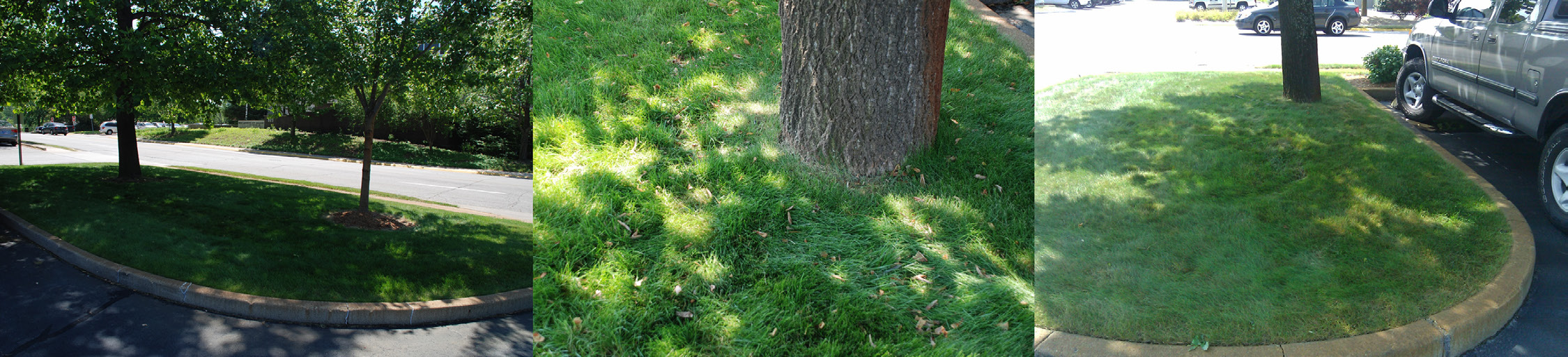
tree shade. Photos by Aaron Patton.
Although these five grasses are difficult to visually identify from one another (Fig. 4), new information attained from recent research on the performance of these five grasses and an understanding of their management, practitioners can capitalize on the strengths of individual fine fescue taxa, resulting in increased adoption and benefits from low-input turfgrass (Table 3). Characteristics and relative rankings of these five fine fescue taxa are listed in Table 3, which presents unique strengths and weaknesses of each: strong creeping red fescue, slender creeping red fescue, Chewings fescue, sheep fescue, and hard fescue. Using the information described in this publication, our goal is for homeowners and practitioners to have a better understanding and confidence in choosing and
utilizing fine fescue taxa (strong creeping red fescue, slender creeping red fescue, Chewings fescue, sheep fescue or hard fescue) or mixture of multiple fine fescue taxa based on site conditions, expectations, and management practices to enhance sustainability.
Table 3. Characteristics of fine fescues used in turfgrass systems and management and tolerance rankings relative to one another.
Sources: Braun et al. (2020), Brede (2000), Christians et al. (2017), NTEP (2003, 2008, 2014, 2018), and Shildrick (1984); Paul Koch, Bruce Clarke, James Murphy, personal communication.
† There has been limited testing of snow mold resistance of slender creeping red fescue and sheep fescue in comparison to other species in the US.
‡ Chewings typically has a bunch-type growth habit and, although very rare, it can have very few or very short rhizomes (Stace et al., 1992; Stace, 2019).
| Fine fescue | Chromosome number (2n) | Genetic color | Growth habit | Close mowing tolerance | Establishment rate | Nitrogen requirement | Shade tolerance | Drought resistance | Wear tolerance | Salt tolerance | Summer patch resistance | Dollar spot resistance | Red thread resistance | Snow mold resistance† |
|---|---|---|---|---|---|---|---|---|---|---|---|---|---|---|
| Strong creeping red | 56 | Medium to dark green | Thick, long and numerous rhizomes | Good | Intermediate to fast | Low to moderate | Good to excellent | Good | Poor to fair | Good | Poor to good | Poor to fair | Fair | Fair to good |
| Slender creeping red | 42 | Light to dark green | Slender, short or few rhizomes | Good to excellent | Intermediate to fast | Low to moderate | Good to excellent | Good to excellent | Good | Excellent | Poor to fair | Poor to fair | Fair | Fair† |
| Chewings | 42 | Light to dark green | Bunch‡ | Good to excellent | Intermediate to fast | Low to moderate | Excellent | Good to excellent | Good | Good | Fair to good | Fair | Fair to good | Poor |
| Sheep | 28 | Powdery blue-green | Bunch | Fair | Slow to intermediate | Very low | Fair to good | Excellent | Poor to fair | Fair | Poor | Fair | Good to excellent | Fair† |
| Hard | 42 | Dark grayish-green to blue-green | Bunch | Fair | Slow to intermediate | Low | Good | Excellent | Fair to good | Fair | Poor to fair | Good to excellent | Good to excellent | Good |
For more information, see Establishment of Fine Fescues, Management of Fine Fescues, Maintenance Calendar for Fine Fescue Lawns, Fine Fescues in Minimal-to-no Mow Area, and Selecting Cultivars of Fine Fescues Extension publications.
This publication was developed with funding support by the National Institute of Food and Agriculture, U.S. Department of Agriculture, Specialty Crop Research Initiative under award number 2017-51181-27222.
References
Barnes, M.R., Nelson, K.C., Meyer, A.J., Watkins, E., Bonos, S.A., Horgan, B.P., Yue, C. (2018). Public land managers and sustainable urban vegetation: The case of low-input turfgrasses. Urban Forestry & Urban Greening, 29, 284–292. https://doi.org/10.1016/j.ufug.2017.12.008
Barnes, M.R., & Reiter, M. 2020. Fringe fescues: An initial exploration of native fine fescues for turfgrass applications in California. Crop, Forage & Turfgrass Management, e20052. https://doi.org/10.1002/cft2.20052
Braun, R.C., Patton, A.J., Watkins, E., Koch, P., Anderson, N.P., Bonos, S.A., & Brilman, L.A. (2020). Fine fescues: A review of the species, their improvement, production, establishment, and management. Crop Science, 60, 1142–1187. https://doi.org/10.1002/csc2.20122
Brede, A. D. (2000). Turfgrass maintenance reduction handbook: Sports, lawns, and golf. Ann Arbor Press, Chelsea, MI.
Christians, N.E., Patton, A.J., & Law, Q.D. (2017). Fundamentals of turfgrass management. Hoboken, NJ: John Wiley & Sons. pp. 49-55.
Darbyshire, S.J., & Pavlick, L.E. (2007) Festuca L. In: M.E. Barkworth, K.M. Capels, S. Long, L.K. Anderton, & M.B. Piep, editors, Flora of North America north of Mexico. Vol. 24 (pp. 389–443) Magnoliophyta: Commelinidae (in part): Poacea, part 1. Oxford, UK:
Oxford University Press.
Morgan, A. (1998). The Chewings story. TurfNews 22(6):33-35.
NTEP (National Turfgrass Evaluation Program). (2003). 1998 national fineleaf fescue test, 1999-2002 data. Final Rep. NTEP No. 03-9. USDA-ARS, Beltsville, MD.
NTEP (National Turfgrass Evaluation Program). (2008). 2003 national fineleaf fescue test, 2004-07 data. Final Rep. NTEP No. 08-9. USDA-ARS, Beltsville, MD.
NTEP (National Turfgrass Evaluation Program). (2014). 2008 national fineleaf fescue test, 2009-13 data. Progress Rep. NTEP No. 14-9. USDA-ARS, Beltsville, MD.
NTEP (National Turfgrass Evaluation Program). (2018). 2014 national fineleaf fescue test, 2017 data. Progress Rep. NTEP No. 18-10. USDA-ARS, Beltsville, MD.
Ruemmele, B.A., Wipff, J.K., Brilman, L., & Hignight, K.W. (2003). Fine-leaved fescue species. In: M.D. Casler & R.R. Duncan, editors, Turfgrass biology, genetics, and breeding. Wiley, New York. p. 129-174.
Shildrick, J.P. 1984. Turfgrass manual. The Sports Turf Research Institute, Bingley, West Yorkshire, England.
Stace, C.A. (2019). New flora of the British Isles. 4th ed. C & M Floristics Middlewood Green, Suffolk, United Kingdom.
Stace, C.A., Al-Bermani, A.-K. K.A. & Wilkinson, M.J. (1992). The distinction between the Festuca ovina L. and Festuca rubra L. aggregates in the British Isles. Watsonia, 19, 107-112.
Turf Programs
| State | University | Turf Program Website |
|---|---|---|
| Indiana | Purdue University | turf.purdue.edu |
| Minnesota | University of Minnesota | turf.umn.edu |
| New Jersey | Rutgers University | turf.rutgers.edu/ |
| Oregon | Oregon State University | horticulture.oregonstate.edu/beaverturf |
| Wisconsin | University of Wisconsin | https://turf.wisc.edu/ |