

Introduction
Five fine fescue species/subspecies (strong creeping red fescue, slender creeping red fescue, Chewings fescue, hard fescue, and sheep fescue) are often grouped together and called “fine fescues.” This publication covers recommended establishment practices of fine fescues, such as optimal seeding dates, seeding rates, establishment rates, fertilization rates during establishment, and sod establishment.
Authors
Aaron Patton
Purdue University
Ross Braun
Purdue University
Take-Home Points
- Five fine fescue species/subspecies (strong creeping red fescue, slender creeping red fescue, Chewings fescue, hard fescue, and sheep fescue) are often grouped together and called “fine fescues.”
- Seeding date is an important factor to consider when establishing a new turfgrass site.
- Each of these species establishes at different speeds.
- Seeding rates vary depending on the selection of fine fescue species/ subspecies, site conditions, and expectations.
- Establishment rate can be increased with nitrogen fertilization during the first three months; then fertilization programs should be lowered to match the low-input adaptability characteristics of the species.
- Fine fescue establishment using sod is another establishment method.
Fine Fescues
Fine fescues (Festuca spp.) are a common group of turfgrasses used in home lawns, commercial properties, golf courses, parks, roadsides, low-input sites, and other utility turf (Table 1 and Fig. 1). Fine fescues consist of a group of five species and
subspecies:
- Strong creeping red fescue (Festuca rubra ssp. rubra)
- Slender creeping red fescue (Festuca rubra ssp. littoralis)
- Chewings fescue (Festuca rubra ssp. commutata, synonym Festuca rubra ssp. fallax)
- Sheep fescue (Festuca ovina, synonym Festuca ovina ssp. hirtula)
- Hard fescue (Festuca brevipila)
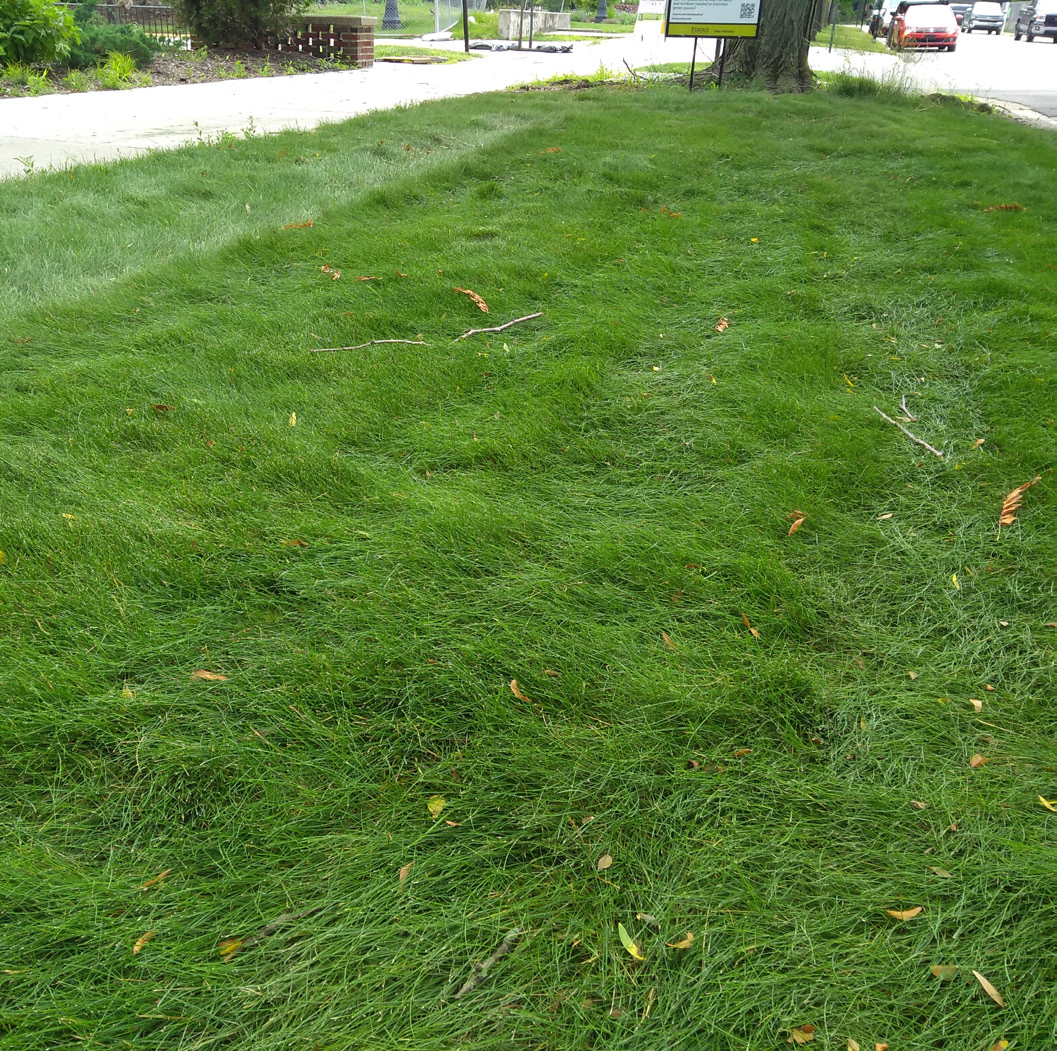
creeping red fescue, 25% Chewings fescue, and 25% hard fescue
on a shaded demonstration site on the campus of Purdue University
mowed at 3 inches. Photo by Ross Braun.
Although these five turfgrasses are often grouped together as “fine fescues” because of their similar appearance of fine (narrow or bristle) leaves, there are differences in establishment vigor of these grasses. This publication covers recommended establishment
practices of fine fescues, such as optimal seeding dates, seeding rates, establishment rates, fertilization rates during establishment, and sod establishment.
Optimal Seeding Timing
Research on optimal seeding dates has shown that the best time of year to seed fine fescues is between late July and late September in Indiana (Braun et al., 2021a) (Table 1). The second best timing is in early spring between mid-March and mid-April in Indiana. However, these seeding windows may fluctuate one to two weeks depending on site conditions and current weather conditions. Non-optimal seeding dates, such as seeding fine fescues in late spring or summer, will subject the young turfgrass to harsh environmental (heat and drought) stresses and increased weed competition from summer annual weeds. Also, seeding too early in the spring or too late in the fall may fail due to unfavorable (i.e., too cold) growing conditions and/or not enough time for the young turf to fully mature before winter, during which newly seeded turfgrasses exhibit a very slow or imperceptible establishment rate.
Seeding and Establishment Rates
The seeding rates (pounds of seed per 1,000 ft2) slightly vary among the five fine fescue species/subspecies due to differences in seed size and number of seeds per pound (Table 1). The establishment vigor of a turfgrass is the time required for seed germination and emergence, which is also influenced by growth rate and growth habit (Table 1). Overall, fine fescues have intermediate germination rates (5 to 12 days under favorable conditions) (Fig. 2) and establishment rates compared to other turfgrass species. Specifically, fine fescues establish faster than Kentucky bluegrass (Poa pratensis), similar to tall fescue (Festuca arundinacea, synonym Schedonorus arundinaceus), but are slower than perennial ryegrass (Lolium perenne) (Braun et al., 2020a).
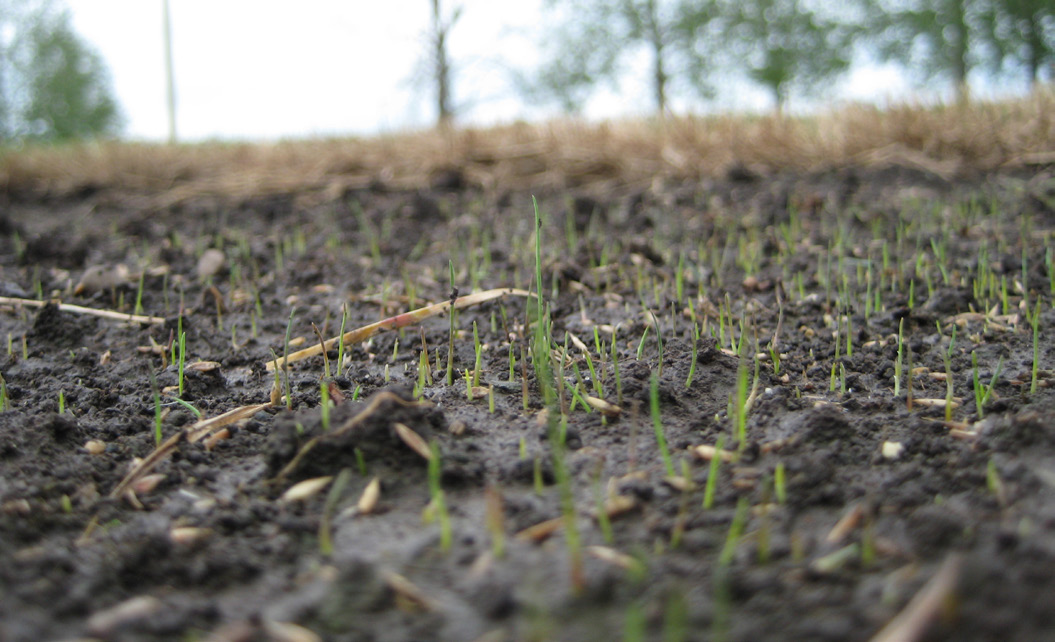
red fescue, Chewings fescue, and hard fescue seedlings at six days
after seeding on June 14 in West Lafayette, IN. Photo by Ross Braun.
Fertilization
We have observed that germination and establishment rates of fine fescues have little to no response to the application of phosphorus (P) in a starter fertilizer (i.e., contains nitrogen, P, and potassium) at the time of planting. Therefore, a starter fertilizer application with P is not needed unless a soil test indicates nutrient deficiencies present in the soil (Braun et al., 2020b). This also highlights the importance of conducting a soil test to test for P and other nutrients a few months prior to establishing turfgrass at a site.
Hard fescue and sheep fescue generally have slower establishment rates than strong creeping red fescue, slender creeping red fescue, and Chewings fescue. Research has shown that a total of 0.25 to 1.0 pound of nitrogen (N) per 1,000 ft2 during the first two months after seeding will help establish and fill in bare areas more quickly, and that N fertilization rates higher than 1.0 pound of N per 1,000 ft2 will have minimal benefits (Braun et al., 2022a) (Table 1). Once the turfgrass has completely filled in and regular mowing is required, then long-term N fertilization levels can be reduced to 0.5 to 2.0 pounds of N per 1,000 ft2 per year (Table 1). Providing the mature fine fescue turf with more than 2.0 pounds of N per 1,000 ft2 each growing season can actually decrease turfgrass quality in fine fescues, increase thatch, and increase weed competition. In addition, some years the soil may require no fertilization of mature fine fescues.
Fine Fescue Sod
Little research has been conducted on fine fescue sod production. However, research at Purdue University and the University of Minnesota has demonstrated that the rhizomatous growth habit of both strong creeping red fescue and slender creeping red fescue
provides excellent sod potential (Braun et al., 2021b,c; 2022b; Braun and Patton, 2022). Bunch-type growth habits of Chewings fescue, hard fescue, and tall fescue will result in less sod strength and poor sod handling. Turf formed by strong creeping red fescue and slender creeping red fescue has the ability to hold together and produce high sod strength and handling similar to Kentucky bluegrass, the most common cool-season grass used in the sod industry. Based on this recent research, and an increase in demand for low-input sod, there may be an increase in commercially available fine fescue sod in the near future.
Seeding Other Areas (“no-mow” or natural areas)
If the area to be seeded is a native “natural” golf course rough area, or a “no-mow” or “minimal-mow” area, then seeding rates provided in Table 1 should be lowered (Fig. 3). Generally, for thin stands of natural golf course rough areas, a seeding of 0.25 to 1 pound per 1,000 ft2 is often recommended, and we suggest utilizing the lower seeding rates of this recommended range. However, these seeding rates may depend on the fine fescue species/subspecies seed size and cultivar used.
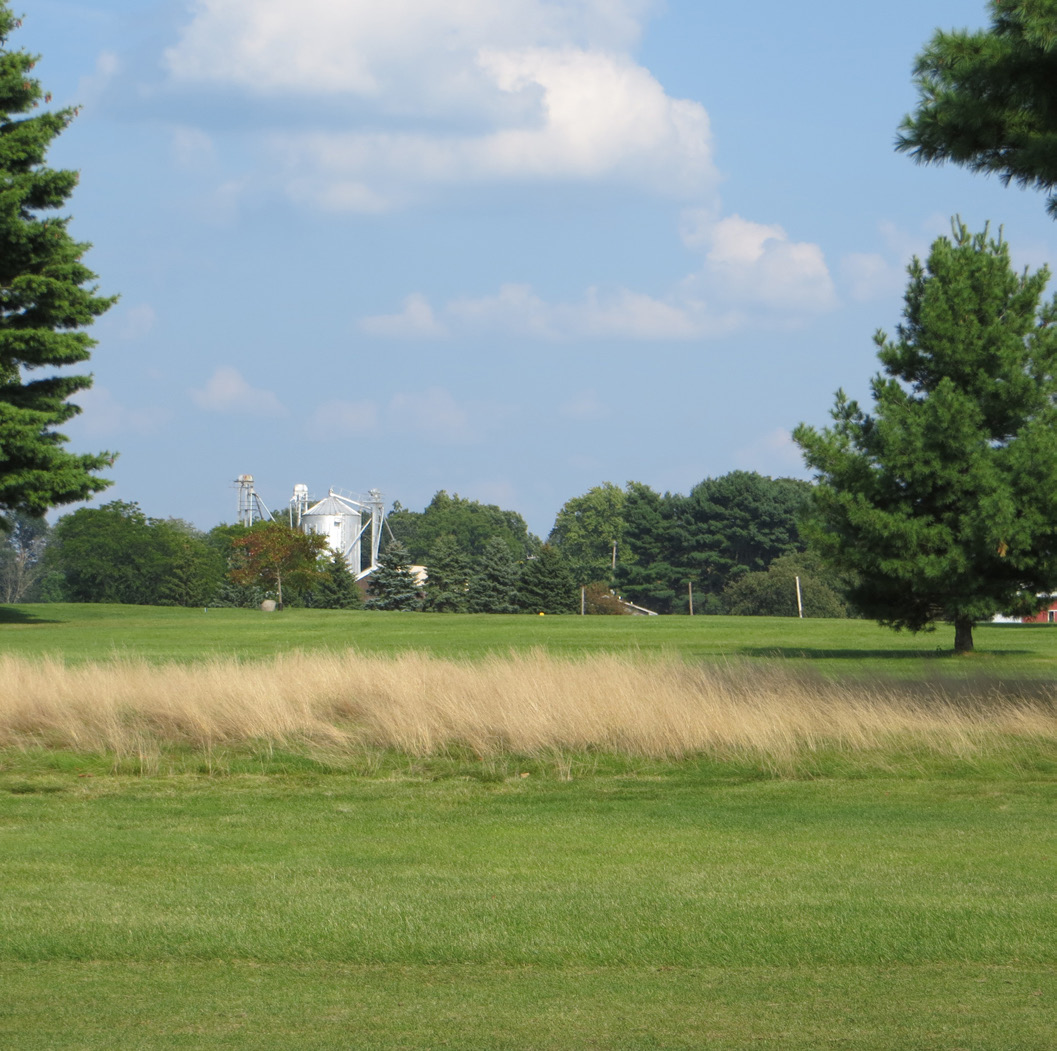
holes in Indiana. Photo by Aaron Patton.
Table 1. Establishment and management characteristics of fine fescues used in turfgrass systems.
Sources: See reference list; Ross Braun, Aaron Patton, Eric Watkins, James Murphy, Alec Kowalewski, and Bradley Park, personal observation.
† Seeding rate for a lawn, seeding rates for “no-mow” natural grass areas will be substantially lower (0.25 to 1 pounds per 1,000 ft2).
‡ Approximate days to germination under optimum germination temperatures of 59-77 °F.
₧ Establishment rate is a combination of seed germination and emergence, and seedling growth rate, which varies due to seed germination differences and growth habit differences.
§ Chewings typically has a bunch-type growth habit and, although very rare, it can exhibit few or very short rhizomes (Stace et al., 1992; Stace, 2019).
| Fine fescue taxa | Optimal seeding timing (second best option) | Seeding rate† (lb/1000 ft2) | Approximate days to germination‡ | Establishment rate₧ | Nitrogen requirement during establishment (lb N/1000 ft2) | Nitrogen requirement of mature grass (lb N/1000 ft2) | Growth habit | Sod potential |
|---|---|---|---|---|---|---|---|---|
| Strong creeping red | Late July to late September. (mid-March to mid-April) | 4 to 6 | 5 to 12 | Intermediate to fast | Low to moderate (0.25 to 1.0 lb) | Low to moderate (<2 lb) | Thick, long and numerous rhizomes | Excellent |
| Slender creeping red | Late July to late September. (mid-March to mid-April) | 4 to 6 | 5 to 12 | Intermediate to fast | Low to moderate (0.25 to 1.0 lb) | Low to moderate (<2 lb) | Slender, short or few rhizomes | Good to excellent |
| Chewings | Late July to late September. (mid-March to mid-April) | 3.5 to 6 | 5 to 12 | Intermediate to fast | Low to moderate (0.25 to 1.0 lb) | Low to moderate (<2 lb) | Bunch§ | Poor to good |
| Sheep | Late July to early September. (mid-March to mid-April) | 3 to 6 | 7 to 14 | Slow to intermediate | Moderate (0.5 go 1.0 lb) | Low (<1.0 lb) | Bunch | Poor |
| Hard | Late July to early September. (mid-March to mid-April) | 3 to 6 | 7 to 14 | Slow to intermediate | Moderate (0.5 to 1.0 lb) | Low (<1.0 lb) | Bunch | Poor |
Fine Fescue Seeding Tips
- Prepare the area
- Glyphosate (e.g., Roundup Pro, etc.) is a nonselective herbicide that can be applied for complete control of existing vegetation (including undesirable grasses) where a uniform stand of fine fescue is desired. It is advantageous to wait until the herbicide has provided complete control before taking the next step(s) as application irregularities and the existence of tough-to-control vegetation may necessitate additional applications. For more information, see Identifying and Controlling Perennial Grassy Weeds Extension publication.
- Prepare the soil – once existing vegetation has been completely killed – by one of three methods:
- On non-compacted soils with no thatch, an aerifier can be used to expose the soil by punching at least 20 to 40 holes/ft2 with the largest tines possible. This will create seed-soil contact and improve germination and establishment rate. Over-aerifying at this time is not a concern; make as many passes over the lawn as feasible. A power rake set to cut 1/8 to 1/4 inch into the soil will also work well.
- On compacted soils, till the soil to a depth of 4 inches or more, rake smooth, allow it to settle for a week with irrigation or rainfall and/or compact slightly with tractor wheels or other implement, and then rake the surface to a loose and smooth final finish before seeding.
- On lawns with significant thatch, a power rake should be used to loosen and remove as much of the thatch as possible. If the thatch is more than 1 inch thick, either use a sod cutter to remove the thatch or till the soil, turning under the thatch.
- Apply a starter fertilizer (optional, based on soil test results)
- Depending on soil test results, it may be necessary to apply a starter fertilizer (high in phosphorus) over the entire lawn area. In the absence of soil test results, apply no more than 0.5 to 1.0 pound of P2O5 per 1,000 ft2 before seeding.
- Apply the seed
- Apply the seed with either a dropseeder or a power overseeder (also known as a slit-seeder), which is a machine that will drop the seeds into small grooves that it cuts into the soil. It is best to make at least 2 passes over the lawn in different
directions with either the dropseeder or the power overseeder to ensure a uniform seeding.
- Apply the seed with either a dropseeder or a power overseeder (also known as a slit-seeder), which is a machine that will drop the seeds into small grooves that it cuts into the soil. It is best to make at least 2 passes over the lawn in different
- Incorporate the seed
- After seeding, lightly rake the soil to incorporate the seed in the top 1/4 inch. Rolling the lawn with a light roller after raking will improve seed-to-soil contact and emergence of seedlings.
- Water regularly!
- Lightly water the newly seeded area three to four times daily during dry, sunny weather to keep the soil surface moist. Light, frequent irrigation is the rule. Irrigation should be gradually reduced as the leaves and roots of the new lawn grow.
- Additional fertilization
- Between 30 to 90 days after seeding, apply an additional one to two fertilizer applications for a total of 0.25 to 1.0 pounds of N per 1,000 ft2 with a N fertilizer to hasten establishment of fine fescues, especially hard fescue and sheep fescue.
- First mowing
- Mow as soon as the first few blades reach about 2.5 to 3 inches tall, which generally occurs 40 to 70 days after seeding, depending on weather conditions. Be sure to adjust your mower to the recommended mowing height, which is 2.5 to 4.0 inches for fine fescue lawns.
- Fertilization of established turf
- During the first couple years after the fine fescue turf is fully established, fertilization rates should be 1.0 to 2.0 pounds of nitrogen per 1,000 ft2 per year, with the majority of the N fertilization being applied in the fall. Longer term, annual fertilization rates of 0.5 to 2.0 pounds of nitrogen per 1,000 ft2 per year can be used.
For more information, see Fine Fescues: Understanding the Differences, Management of Fine Fescues, Maintenance Calendar for Fine Fescue Lawns, Fine Fescues in Minimal-to-no Mow Areas, Selecting Cultivars of Fine Fescues, and Purchasing Quality
Seed, and Establishing a Lawn from Seed Extension publications.
This publication was developed with funding support by the National Institute of Food and Agriculture, U.S. Department of Agriculture, Specialty Crop Research Initiative under award number 2017-51181-27222.
References
Braun, R.C., Braithwaite, E.T., Kowalewski, A.R., Watkins, E., Hollman, A.B., & Patton, A.J. (2022a). Nitrogen fertilizer and clover-inclusion effects on the establishment of fine fescue taxa. Crop Science, in press. https://doi.org/10.1002/csc2.20704
Braun, R.C., Patton, A.J., Watkins, E., Hollman, A.B., Murphy J.A., Park, B.S., Kowalewski, A.R., & Braithwaite, E.T. (2021a). Optimal fine fescue mixture seeding dates in the northern United States. Agronomy Journal. https://doi.org/10.1002/agj2.20859
Braun, R.C., Patton, A.J., Watkins, E., Koch, P., Anderson, N.P., Bonos, S.A., & Brilman, L.A. (2020a). Fine fescues: A review of the species, their improvement, production, establishment, and management. Crop Science, 60, 1142–1187. https://doi.org/10.1002/csc2.20122
Braun, R.C., Patton, A.J., Braithwaite, E.T., & Kowalewski, A.R. (2020b). Establishment of low-input turfgrass from seed with patch and repair mixtures: Mulch and starter fertilizer effects. Crop Science, 60, 3362–3376. https://doi.org/10.1002/csc2.
Braun, R.C., Watkins, E., Hollman, A.B., Mihelich, N.T., & Patton, A.J. (2022b). Management, harvest, and storage characteristics of low-input cool-season turfgrass sod mixtures. Agronomy Journal, in press. https://doi.org/10.1002/agj2.21051
Braun, R.C., & Patton, A.J. (2022). Species, clover-inclusion, and nitrogen fertilizer effects on sod tensile strength of fine fescue taxa. Agronomy Journal, in press. https://doi.org/10.1002/agj2.21039
Braun, R.C., Watkins, E., Hollman, A.B., Mihelich, N.T., & Patton, A J. (2021b). Investigation of cool-season species, seeding rate, and nitrogen fertilization in sod production: I. Establishment and sod tensile strength. Agronomy Journal, 113, 4176–4189. https://doi.org/10.1002/agj2.20810
Braun, R.C., Watkins, E., Hollman, A.B., Mihelich, N.T., & Patton, A.J. (2021c). Investigation of cool-season species, seeding rate, and nitrogen fertilization in sod production: II. Management and shelf-life. Agronomy Journal, 113, 3460–3474. https://doi.org/10.1002/agj2.20777
Brede, A.D. (2000). Turfgrass maintenance reduction handbook: Sports, lawns, and golf. Ann Arbor Press, Chelsea, MI.
Christians, N.E., Patton, A.J., & Law, Q.D. (2017). Fundamentals of turfgrass management. Hoboken, NJ: John Wiley & Sons.
Stace, C.A. (2019). New flora of the British Isles. 4th ed. C & M Floristics Middlewood Green, Suffolk, United Kingdom.
Stace, C.A., Al-Bermani, A.-K. K.A. & Wilkinson, M.J. (1992). The distinction between the Festuca ovina L. and Festuca rubra L. aggregates in the British Isles. Watsonia, 19, 107-112.