

Introduction
Five fine fescue taxa (strong creeping red fescue, slender creeping red fescue, Chewings fescue, hard fescue, and sheep fescue) are often grouped together and called “fine fescues.” This publication addresses recommended management practices for fine fescues and differences among the five fine fescue species.
Authors
Aaron Patton
Purdue University
Ross Braun
Purdue University
Take-Home Points
- Five fine fescue species/subspecies (strong creeping red fescue, slender creeping red fescue, Chewings fescue, hard fescue, and sheep fescue) are often grouped together and called “fine fescues.”
- Fine fescues can tolerate a wide range of mowing heights, but for home lawns and similar properties, it is best to maintain at a 2.5- to 4.0-inch mowing height.
- Adjust mowing frequency as growth rate changes through the growing season and return the grass clippings to the turf.
- Practice a low to moderate nitrogen fertilization program of 0.5 to 2.0 lb N per 1000 square feet per year, with the majority of the N fertilization being applied in the fall.
- Supplemental irrigation is typically required only on mature lawns during stressful summer months. Irrigation should be applied deeply and infrequently.
- A higher mowing height and fertilization will significantly help reduce weed invasion and pesticide requirements.
Fine Fescues
Fine fescues (Festuca spp.) are commonly a component of home lawns, commercial properties, golf courses, parks, roadsides, low-input sites, and other utility turf (Table 1). Fine fescues consist of a group of five turfgrasses, which include
- Strong creeping red fescue (Festuca rubra ssp. rubra)
- Slender creeping red fescue (Festuca rubra ssp. littoralis)
- Chewings fescue (Festuca rubra ssp. commutata, synonym Festuca rubra ssp. fallax)
- Sheep fescue (Festuca ovina, synonym Festuca ovina ssp. hirtula)
- Hard fescue (Festuca brevipila)
Fine fescues are recommended in a blend or as a mixture with other cool-season grasses in home lawns with full sun to shaded conditions in the northern half of Indiana. For the southern half of Indiana, fine fescues are only recommended for moderately dense
shaded areas (Fig. 1). This is due to the more extreme summer stress conditions of southern Indiana, which will reduce the quality and result in some thinning of the fine fescue. Tall fescue (Festuca arundinacea, synonym Schedonorus arundinaceus) is often a better option for shaded areas in southern Indiana.
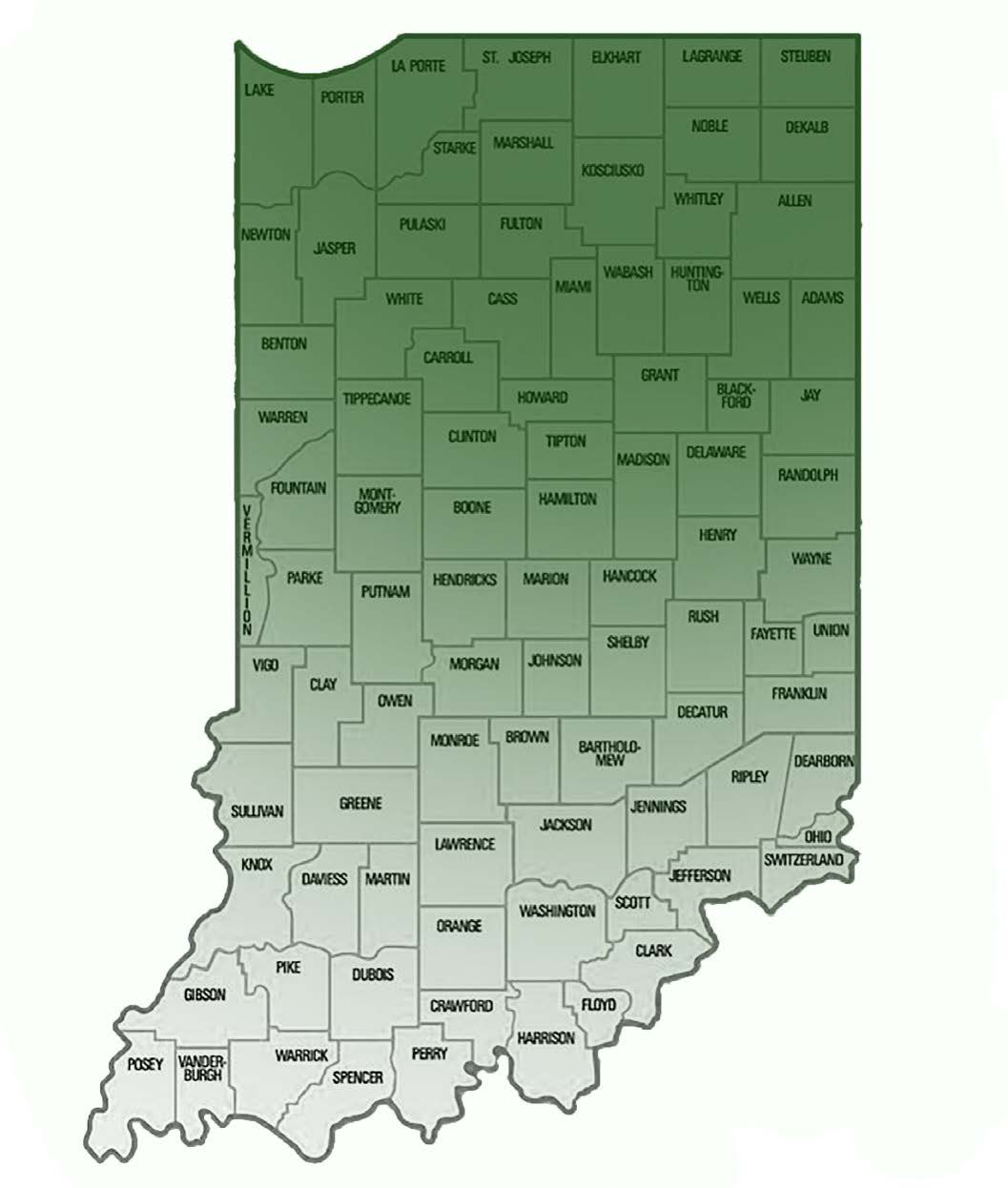
northern half of Indiana, but can be grown throughout the state.
Although these five turfgrasses are often grouped together as “fine fescues” because of their similar appearance of fine (narrow or bristle) leaves, there are differences in management (i.e., mowing, fertilization, irrigation, and pest control) of these grasses (Table
1, Fig. 2). This publication addresses recommended management practices of fine fescues, such as mowing, fertilization, irrigation, and weed and other pest control. Before each management practice is discussed, readers should understand that there are
differences among these five fine fescue grasses—in growth habit, genetic color, shade tolerance and more (Table 1). Also, in 2018, researchers found there was a 66% likelihood that lawn seed products sold at retail outlets in the Northern U.S. would contain at least one of the fine fescues, most likely strong creeping red fescue or Chewings fescue (Table 1) (Braun et al., 2020). Understanding the subtle differences among these five turfgrasses and the required management practices will help select the most appropriate fine fescue to improve the overall quality of the lawn and enhance sustainability at each location.
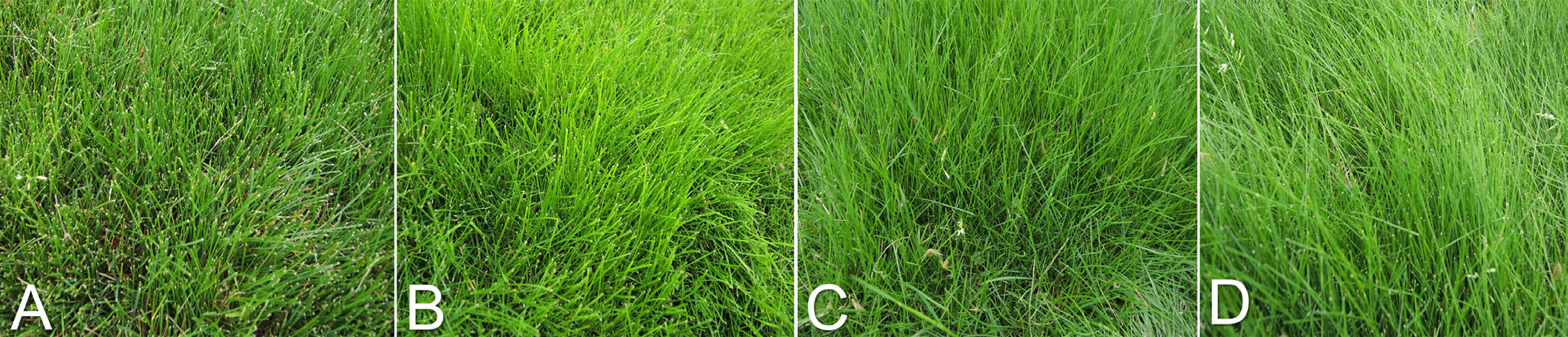
creeping red fescue; (B) slender creeping red fescue; (C) Chewings fescue; and (D) hard fescue. Photo by Ross Braun.
Table 1. Characteristics and rankings of the five fine fescue species/subspecies relative to each other.
Source: Braun et al. (2020)
† Likelihood to be found in a Northern lawn seed product. 232 total lawn seed products (152 products containing fine fescues and 78 products containing no fine fescues) were evaluated at 5 retail outlets in both IN and MN in April and May 2018, respectively.
‡ At a rate of lb N/1,000 ft2. Do not apply more than 1 pound of nitrogen per 1,000 square feet with a quick-release nitrogen fertilizer at one application.
₧ Chewings typically has a bunch-type growth habit and, although very rare, it can exhibit few or very short rhizomes (Stace, 2019).
| Fine fescue taxa | Likelihood of finding in a bag of seed† | Growth habit | Genetic color | Shade tolerance | Close mowing tolerance | Traffic wear tolerance | Annual nitrogen fertilization‡ | Drought resistance | Weed invasion resistance |
|---|---|---|---|---|---|---|---|---|---|
| Strong creeping red | 64% | Thick, long and numerous rhizomes | Medium green | Good to excellent | Good | Poor to fair | Low to moderate (<2 lb) | Good | Good to excellent |
| Slender creeping red | 2% | Slender, short or few rhizomes | Light to medium green | Good to excellent | Good to excellent | Good | Low to moderate (<2 lb) | Good to excellent | Good to excellent |
| Chewings | 27% | Bunch₧ | Medium green | Excellent | Good to excellent | Good | Low to moderate (<2 lb) | Good to excellent | Good to excellent |
| Sheep | 0% | Bunch | Powdery blue-green | Fair to good | Fair | Poor to fair | Low (<1.0 lb) | Excellent | Poor to good |
| Hard | 7% | Bunch | Dark gray-green to blue-green | Good | Fair | Fair to good | Low (<1.0 lb) | Excellent | Poor to good |
Mowing
Maintain mowing height above 2 inches, preferably 2.5 to 4 inches for home lawns, parks, and commercial properties. (Fig. 3). Some fine fescues—Chewings fescue and slender creeping red fescue—can tolerate lower mowing heights better than other fine fescues (Table 1). Regardless, a higher mowing height (i.e., 2.5 to 4 inches) will help reduce common weed invasion (Fig. 3). These turfgrasses can also be maintained as “minimal mow” or “no mow” sites (Fig. 4). Mowing frequency should be determined on the growth rate of the turfgrass species in a mixture or blend; therefore, mowing more frequently during the spring and late fall, and potentially less often in the hot summer months when turfgrass growth slows. In general, mow as often as needed to maintain the desired height of cut, but avoid removing more than 1/3 of the leaf blade during any single mowing. In addition, let the clippings return to the turf surface to supply/recycle nutrients to the soil. Avoid “clumping” of excessive clipping buildup on the lawn surface.
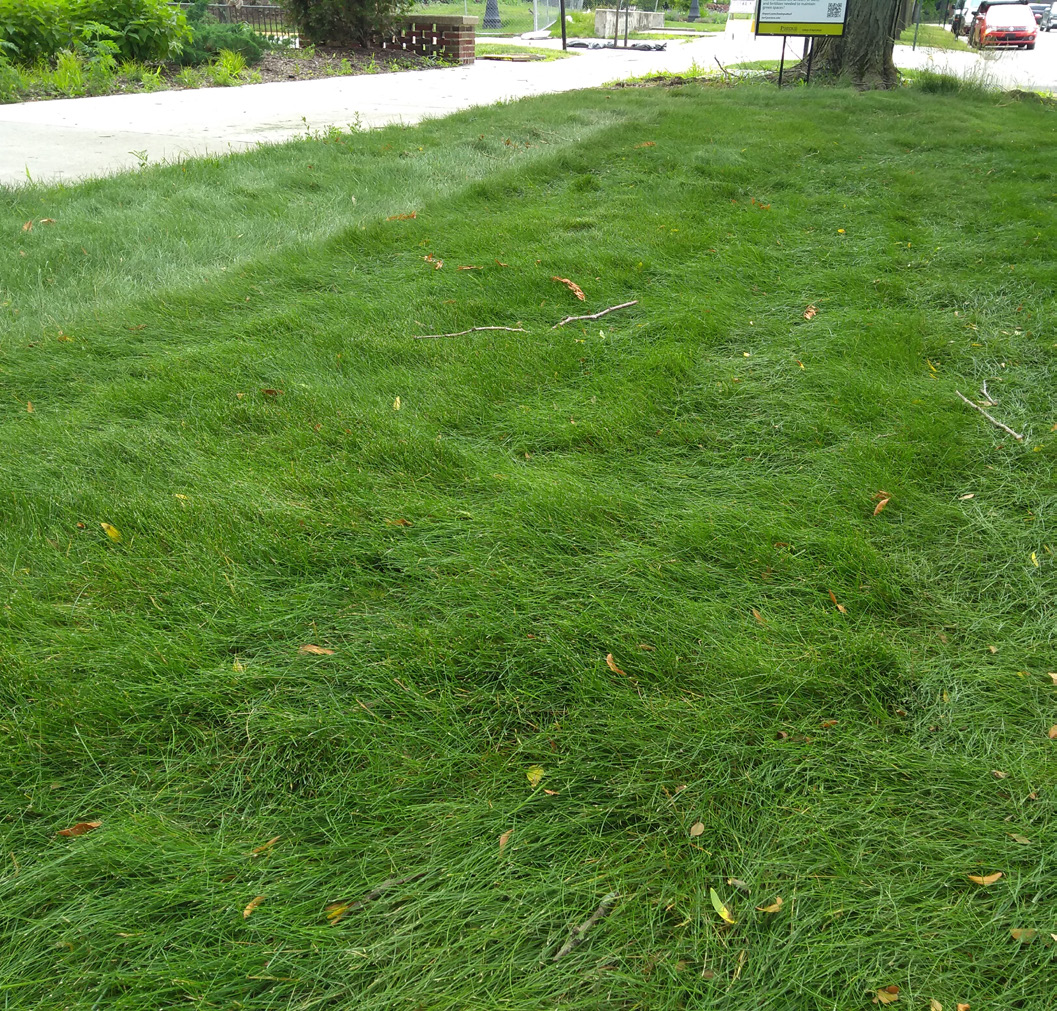
creeping red fescue, 25% Chewings fescue, and 25% hard fescue on
a shaded demonstration site on the campus of Purdue University;
it’s mowed weekly at 3 inches. Photo by Ross Braun.
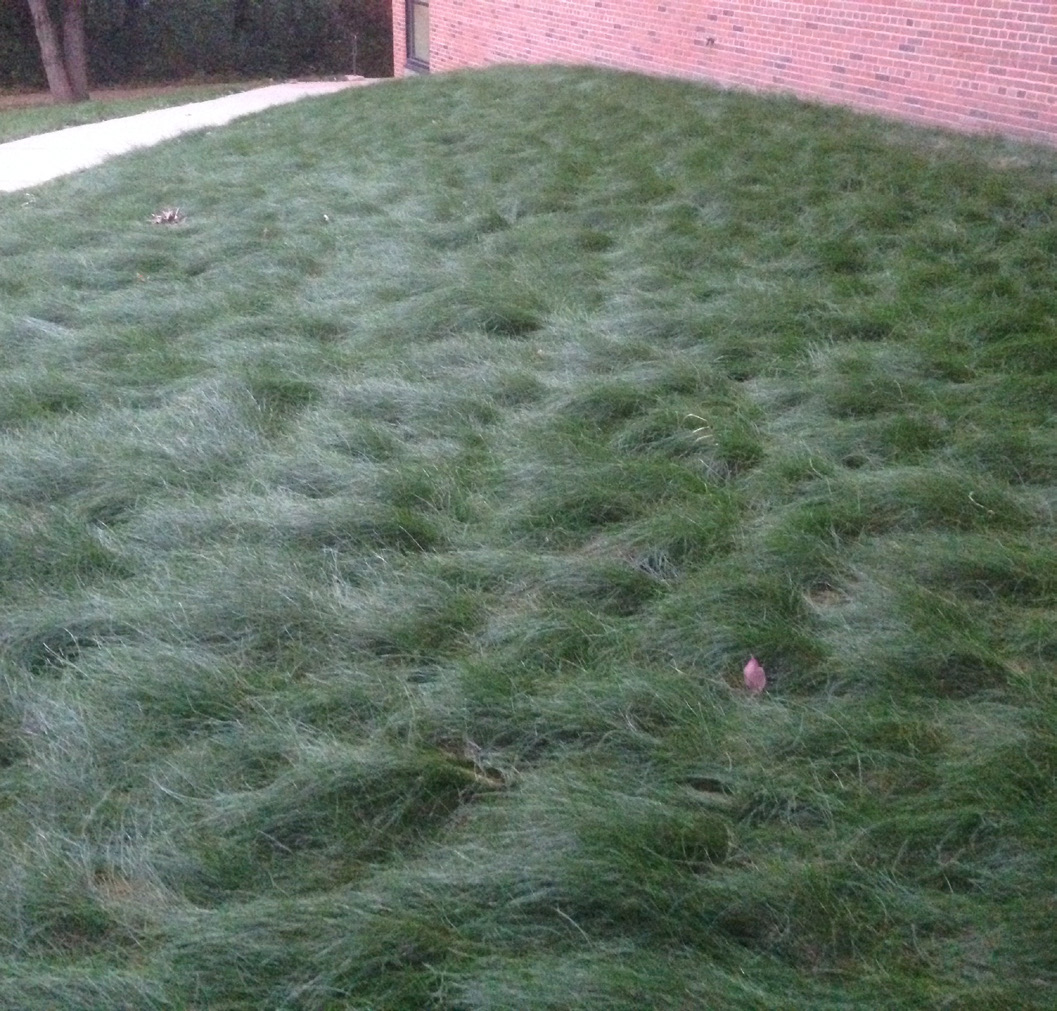
red fescue, Chewings fescue, and hard fescue being maintained as
a “minimal-to-no mow” low-input turfgrass site on the campus of
University of Minnesota. Photo by Sam Bauer.
All five fine fescues are known for excellent and improved shade tolerance compared to other cool-season turfgrasses; however, there are differences in shade tolerance among the five fine fescues and variation among cultivars within each (Table 1). Regardless, if the site has areas of shaded turfgrass, it would be beneficial to the health and quality of the turfgrass to mow the shaded areas at a slightly higher height of cut (0.5 to 1.0 inch higher) than turfgrass areas in full sun. For more information about mowing, see Mowing Your Lawn Extension publication.
There are differences in traffic wear tolerance among the fine fescues, Chewings fescue and slender creeping red fescue have a slighter higher tolerance (Table 1). However, mowing or trafficking turfgrass under moisture stress can cause extensive damage
to all fine fescue turf; such damage resembles small pitted areas ranging from baseball-size to softball-size areas or mower line tracks (Fig. 5). In general, do not mow turfgrass that is under mild or severe moisture stress; in summer months, mow only after at least 1 inch of rainfall or irrigation to ensure that no moisture stress is present.
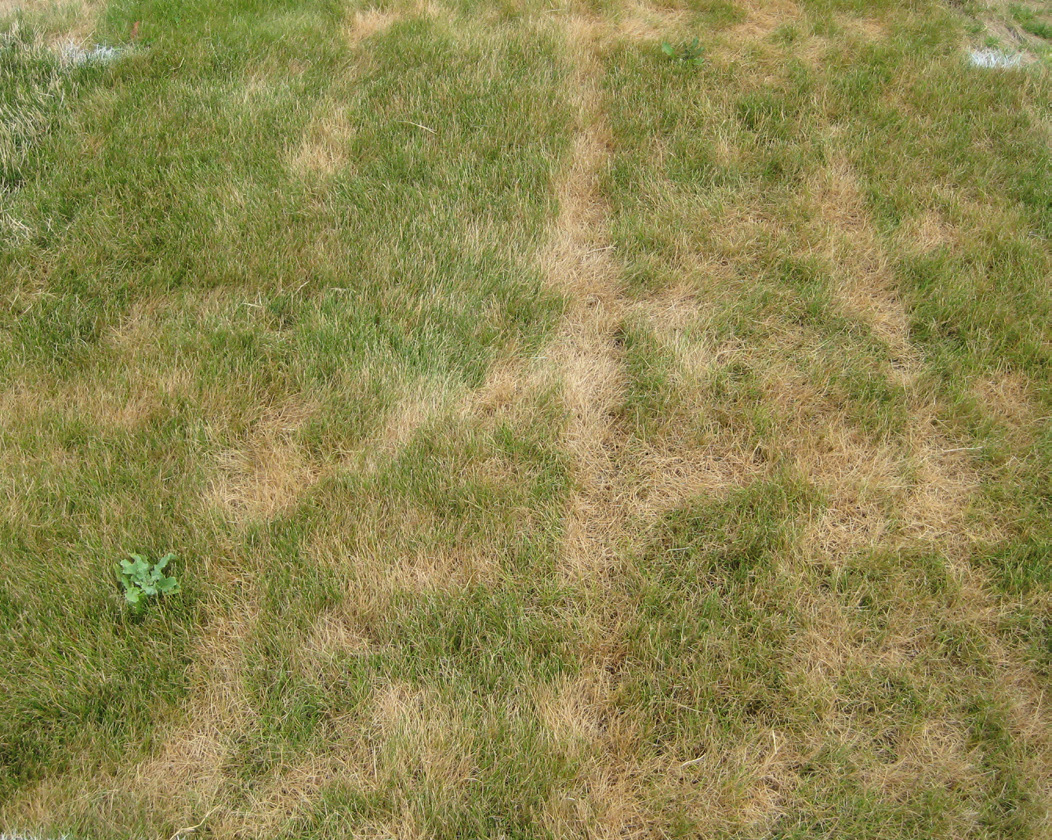
damage on strong creeping red fescue from mower traffic during
hot summer drought conditions in late July. Photo by Ross Braun.
Fertilization
Fine fescues will persist with minimal maintenance and fertilizer inputs. For established fine fescue lawns, nitrogen fertilization should be 1 to 2 applications per year, supplying a total of 0.5 to 2 pounds of nitrogen per 1,000 square feet per year throughout the growing season, and not exceeding 2 pounds of nitrogen per 1,000 square feet per year (Fig. 6). Fertilizer rates exceeding 2 pounds of nitrogen per 1,000 square feet per year can actually decrease fine fescue turfgrass quality, encourage turfgrass diseases, and weed infestation.
It is also important to note that some fine fescues—sheep fescue and hard fescue—can persist at lower nitrogen fertilization levels than other fine fescues (Table 1). Overall, the preferred time to fertilize fine fescues is in the fall (September-October); the second-best time is the spring (April or May) (Fig. 6). Avoid fertilization during the summer months (June-August). Fine fescues tolerate a wide range of soil pH and poor soil conditions. For more information on specific fertilizer recommendation and optimum time periods, see Maintenance Calendar for Fine Fescue Lawns, Establishment of Fine Fescues, Fertilizing Your Lawn, and Soil Testing for Lawns Extension publications.
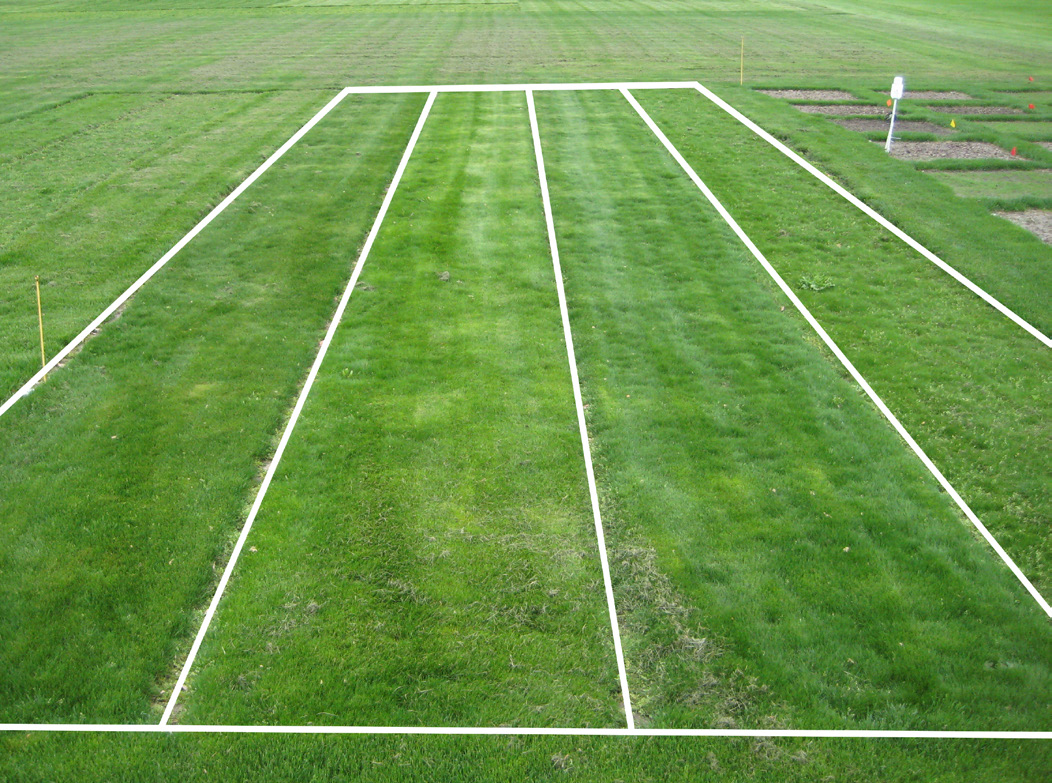
creeping red fescue, Chewings fescue, and hard fescue plots on
April 24, 2019, in West Lafayette, IN. All four fine fescue species/
subspecies were seeded the previous fall (September 14, 2018) and
fertilized at less than 1 pound of nitrogen per 1000 square feet on
October 24, 2018. Photo by Ross Braun.
Irrigation
For mature fine fescue lawns, supplemental irrigation is seldom needed during the spring and fall months in Indiana. If dry, unseasonably warm conditions occur for an extended period during spring or fall, then supplemental irrigation may be necessary. Overall,
these grasses generally prefer drier soil conditions and are fairly drought tolerant; however, they will respond to supplemental irrigation (1” of water per week during summer). Species such as creeping red fescues and Chewings fescue prefer well-drained and droughty soils; the hard and sheep fescues prefer well-drained, droughty, sandy soils, with very low nitrogen fertility and generally have better drought tolerance (Table 1).
Irrigation during brief summer drought periods is not necessary, as fine fescue lawns will usually recover with increased rainfall or irrigation and cooler temperatures in the fall. However, if the drought period continues for an extended time, it is recommended
you do not completely discontinue irrigation in midsummer. Instead, water deep and infrequently: Enough to soak the top 4 to 6 inches of the soil and infrequently enough to allow the turfgrass to become slightly stressed before the next irrigation event. Depending on irrigation system and soil type, this may require more than one hour total irrigation time, with wait times between irrigation cycles to allow for absorption and prevent runoff. Probe with a screwdriver to help determine the irrigation need. The lawn needs watering when the screwdriver will not penetrate more than 1 to 2 inches. Also, minimize foot and mower traffic on these lawn areas when the fine fescue is under summer stress (heat and drought) because damage from equipment (cart and mowing) and foot traffic will occur. For irrigation recommendations on newly seeded or sodded lawns, see Establishment of Fine Fescues Extension publication.
Cultivation/Thatch Management
Due to the bunch-type growth habit, there is less potential for excessive thatch problems with Chewings, hard, and sheep fescue. If fine fescue turfgrass areas contain strong creeping red fescue or slender creeping red fescue, then thatch removal may be required once every 2 to 4 years. Cultivation and thatch removal should be performed when turfgrass is actively growing and there is optimal growing temperatures, such as in the months of April, early May, September, or early October. Avoid cultivation
practices (renovation, dethatching, and aerification) during the summer months (June, July, and August) due to summer heat stress, slow turfgrass growth and recovery, and competition with weeds. Thatch removal can be accomplished by core aerification,
which will help in organic matter removal and alleviate compacted areas to improve rooting, water infiltration and soil aeration. Power raking is an alternative thatch removal option, but it is a less preferred practice because it is more damaging to the turf, adds the need to remove the discarded lawn debris, and it does not alleviate soil compaction often found in urban soils. Instead, utilize core aerification for thatch removal.
Weed Control
Some fine fescues can resist weed invasion better than other fine fescues due to better turf density, faster establishment rates, and allelopathic characteristics—the chemical inhibition of surrounding plants (Table 1). Regardless, weed control will vary by site and
pressure of specific problematic weeds at a particular site. If summer annual grassy weeds (e.g., crabgrass, goosegrass, and foxtail) are problematic at your site, then apply a preemergence herbicide in late March to mid-April. Preemergence herbicides containing dithiopyr (Dimension), pendimethalin (Pendulum) and prodiamine (Barricade) can be used safely on fine fescue. Avoid using the preemergence herbicides oxadiazon (Ronstar) and benefin+trifuralin (Team) because they will injure fine fescue. Postemergence summer annual grass control can be achieved with sethoxydim (Segment) or fluazifop (Fusilade II) in 100% stands of fine fescue. Topramezone (Pylex) or quinclorac (Drive XLR8) are options to control summer annual grasses in mixed stands of other cool-season turfgrasses with fine fescue. See Crabgrass Control and Other Summer Annual Grasses Extension publication for more weed control information.
If dandelion and other perennial broadleaf weeds are a concern, then herbicide applications in the fall (October) will provide safer and more efficient control than an application in the spring. Apply postemergence broadleaf herbicides containing 2,4-D, dicamba, or mecoprop. Follow all label directions. Either treatments of directed spot applications on the targeted weeds or broadcast application across the entire can be effective. See Control of Broadleaf Weeds in Home Lawns and Controlling Tough Broadleaves in
Lawns for more information. Contact a professional lawn care company for assistance with control. See Should I Hire a Professional Lawn Care Service? for more information.
Disease and Insect Control
Common diseases of fine fescues include summer patch, snow molds, red thread, pink patch, and dollar spot. Each of these diseases typically occur at a specific time of the year when environmental conditions favor the pathogen. Specific cultural practices will typically help prevent or reduce activity of most of these diseases. Fungicides are rarely necessary in home lawns, commercial properties, or other low-input turf areas. The fungicide chlorothalonil is phytotoxic to some fine fescues cultivars, and caution should be exercised when using this product. Detailed Extension publications on Gray Snow Mold, Pink Snow Mold, Red Thread, and Leaf Spot/Melting Out, Rhizoctonia Brown Patch, Summer Patch, Necrotic Ring Spot, and Dollar Spot are available free at www.turf.purdue.edu. If turfgrass diseases are present, contact the Purdue University Plant and Pest Diagnostic Laboratory (www.ppdl.purdue.edu) for assistance with identification. Contact a professional lawn care company for assistance with control. See
Should I Hire a Professional Lawn Care Service? for more information.
Common insect pests of fine fescues include white grubs, billbugs, and chinch bugs. The majority of these insects pests are active in the summer months, so scouting for insect pests should begin in early June into July. If the lawn has a history of white grub or billbug damage, an insecticide may need to be applied as a preventative in early July or as a curative treatment later in the summer when insect damage is evident. Chinch bug damage typically appears during hot and dry periods during July or August. It is
recommended that any insecticide application should be handled by a professional lawn care company. For more information see Turf Insect Management, Turfgrass Insects: Managing White Grubs in Turfgrass, and Managing Billbugs in Turfgrass Extension
publications.
New Cultivars
The term cultivar is short for “cultivated variety.” The term cultivar, which is commonly used in the turf industry, is equivalent to the term variety, which is more commonly used in other horticultural and agronomic industries. Ongoing breeding efforts in both North America and Europe continue to produce new and improved turfgrass cultivars and evaluate them at different geographic regions and different management regimes in the United States (Braun et al., 2020). Many cultivars have been adapted to the environmental conditions for our region of the country, the North Central region of the United States. However, it is important to identify and select top-performing cultivars for our region to increase the likelihood of long-term success of the turfgrass at your site and potentially reduce inputs (water, fertilizer, mowing, pesticides) as well. Selecting new and improved cultivars will likely result in a turfgrass sward with higher turfgrass quality and density, greater stress tolerance, lower nutrient and water requirements, and fewer pest problems compared to older, less-improved cultivars. For more information see Selecting Cultivars of Fine Fescues Extension publication.
Fine Fescue Management Summary
- Mowing: Mow at 2.5- to 4.0-inch height, adjust mowing frequency as growth rate changes through the growing season, and return the grass clippings to the turfgrass. Do not mow during drought.
- Fertilization: Practice a low to moderate nitrogen fertilization program of 0.5 to 2.0 lb N per 1000 square feet per year, with the majority of the fertilization being applied in the fall.
- Irrigation: Supplemental irrigation on mature lawns is typically needed only during periods of drought stress in the summer months. It should be applied deeply (soak 4 to 6 inches of soil profile) and infrequently (once every two to three weeks)
- Cultivation: If turfgrass areas contain the rhizomatous fine fescues (strong creeping red fescue or slender creeping red fescue), then thatch removal may be necessary once every 2-4 years.
- Pest Control: A higher mowing height and fertilization will significantly help reduce weed invasion and pesticide requirements. If pesticides are needed, be sure to follow all label directions and apply the proper rate and at the proper time of the year for best control.
- Use New Cultivars: New and improved cultivars will provide greater turfgrass quality and density, greater stress tolerance, lower nutrient and water requirements, and fewer pest problems than older, less-improved cultivars. For more information see Selecting Cultivars of Fine Fescues Extension publication
For more information, see Fine Fescues: Understanding the Differences, Establishment of Fine Fescues, Maintenance Calendar for Fine Fescue Lawns, Fine Fescues in Minimal-to-no Mow Areas, and Selecting Cultivars of Fine Fescues Extension publications
available at www.turf.purdue.edu.
This publication was developed with funding support by the National Institute of Food and Agriculture, U.S. Department of Agriculture, Specialty Crop Research Initiative under award number 2017-51181-27222.
References:
Braun, R.C., Patton, A.J., Watkins, E., Koch, P., Anderson, N.P., Bonos, S.A., & Brilman, L.A. (2020). Fine fescues: A review of the species, their improvement, production, establishment, and management. Crop Science, 60, 1142–1187.
https://doi.org/10.1002/csc2.20122
Stace, C.A. (2019). New flora of the British Isles. 4th ed. C & M Floristics Middlewood Green, Suffolk, United Kingdom.