

Introduction
Five fine fescue taxa (strong creeping red fescue, slender creeping red fescue, Chewings fescue, hard fescue, and sheep fescue) are often grouped together and called “fine fescues.” This publication provides information to select recommended fine fescue cultivars that have performed well in recent experiments.
Authors
Aaron Patton
Purdue University
Ross Braun
Purdue University
Take-Home Points
- Recommended cultivars in this publication have been evaluated for at least four or more years in Indiana or neighboring states.
- Recommended cultivars are new and improved cultivars that will improve a turfgrass sward with higher turf quality and density, greater stress tolerance, lower nutrient and water requirements, and fewer pest problems than older cultivars.
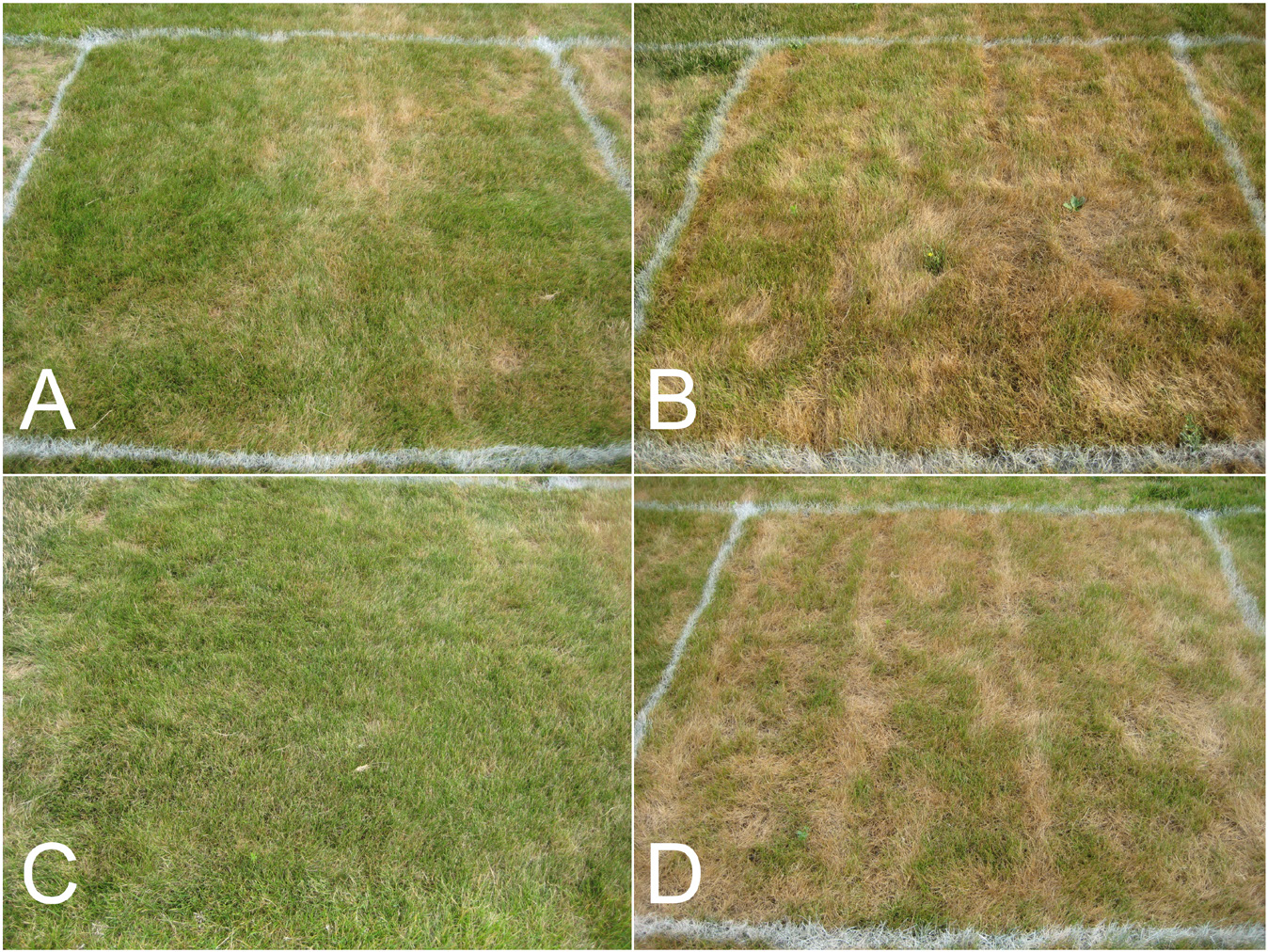 Figure 1. Comparison of new vs. old fine fescue cultivars on July 16, 2019, managed under minimal N fertilization, pest control, and no supplemental irrigation in West Lafayette, Indiana: (A) improved Chewings fescue cultivar released within the last 10 years vs. (B) old Chewings fescue cultivar released in early 1990s; and (C) improved strong creeping red fescue cultivar released within the last 10 years vs. (D) old strong creeping red fescue cultivar release in the 1960s. Photos by Ross Braun
 To identify cultivars that will perform well for specific geographic regions and different management regimes, cultivar trials at universities (including Purdue University) and breeding institutes are conducted at numerous testing sites over multiple years across
North America. These cultivar research trials are conducted in collaboration with the National Turfgrass Evaluation Program (NTEP) (www.ntep.org), which is a program that coordinates uniform evaluation research trials led by turfgrass scientists for multiple turfgrass species across the United States and Canada. These trials are typically conducted for five or more years. Data recorded throughout the duration of these trials include turfgrass quality, color, texture, density, spring green-up, establishment, drought tolerance, winter injury, pest tolerance (disease, insect, and weed), traffic damage, recovery, and more.
To determine which fine fescue cultivars are best adapted for Indiana, researchers at Purdue University carefully reviewed the last 20 years of NTEP data for Indiana and neighboring states and identified the top statistical performers. These best performing
cultivars for use in Indiana must have been evaluated for at least four or more years (i.e., growing seasons). In addition, these top performing cultivars were then checked to find out which have been commercially available in the last three years. Within each fine
fescue taxon list, recommended cultivars that are listed in black are known to be commercially available; recommended cultivars listed in italics may not yet be commercially available.
The goal of this publication is to provide current fine fescue cultivar recommendations for Indiana turf sites. Selecting from these recommended cultivars will likely result in a turfgrass sward with higher turfgrass quality and density, greater stress tolerance, lower nutrient and water requirements, and fewer pest problems than stands of older, less-improved cultivars. In the following sections, cultivar recommendations are listed for each fine fescue taxon:
- Strong creeping red fescue (Festuca rubra ssp. rubra)
- Slender creeping red fescue (Festuca rubra ssp. littoralis)
- Chewings fescue (Festuca rubra ssp. commutata, synonym Festuca rubra ssp. fallax)
- Hard fescue (Festuca brevipila) and sheep fescue (Festuca ovina, synonym Festuca ovina ssp. hirtula)
Cultivar Recommendations
For each fine fescue taxon, recommended cultivars known to be commercially available are listed in alphabetical order. Other recommended cultivars listed in italics may not yet be commercially available. In addition, we have also listed in a footnote some “cultivars to avoid,” which are older cultivars but still commonly sold.
Strong creeping red fescue (Festuca rubra ssp. rubra)
- Cardinal II
- Celestial
- Chantilly
- Cindy Lou
- Class One
- Epic
- Garnet
- Jasper II
- Kent
- Navigator II
- Pathfinder
- Rev
- Rosecity
- Shademaster III
- SR 5250
Cultivars to avoid: Boreal, common creeping red, common spreading red, VNS (“variety not stated”)
Slender creeping red fescue (Festuca rubra ssp. littoralis)
- Beudin
- Seabreeze GT
- SeaLink
- SeaMist
- Shoreline
Cultivars to avoid: Pennlawn, Dawson, common creeping red, VNS (“variety not stated”)
Chewings fescue (Festuca rubra ssp. commutata, synonym Festuca rubra ssp. fallax)
- 7 Seas
- Ambassador
- Bolster
- Cascade
- Castle
- Compass II
- Culumbra II
- Fairmont
- Intrigue 2
- J-5
- Lacrosse
- Longfellow 3
- Momentum
- Radar
- Sandrine
- Seducer
- Shadow III
- Silhouette
- SR 5130
- Treazure II
- Wrigley 2
- Zodiac
Cultivars to avoid: common Chewings, VNS (“variety not stated”)
Hard fescue (Festuca brevipila) and [sheep fescue (Festuca ovina, synonym Festuca ovina ssp. hirtula)]
- Beacon
- Bighorn GT
- Chariot
- Eureka II
- Gladiator
- Gotham
- Hardtop
- Jetty
- Minimus
- MNHD-14
- Nordic
- Oxford
- Quatro (sheep)
- Reliant IV
- Rescue 911
- Resolute
- Spartan II
- Sword
Cultivars to avoid: Durar, common hard, common sheep, VNS (“variety not stated”)
More Information
For more information, contact your local Extension office or see Fine Fescues: Understanding the Differences, Establishment of Fine Fescues, Maintenance Calendar for Fine Fescue Lawns, Management of Fine Fescues, Fine Fescues in Minimal-to-no Mow Areas, Purchasing Quality Seed, and Establishing a Lawn from Seed Extension publications available at www.turf.purdue.edu.
This publication was developed with funding support by the National Institute of Food and Agriculture, U.S. Department of Agriculture, Specialty Crop Research Initiative under award number 2017-51181-27222.
References
Braun, R.C., Patton, A.J., Watkins, E., Koch, P., Anderson, N.P., Bonos, S.A., & Brilman, L.A. (2020). Fine fescues: A review of the species, their improvement, production, establishment, and management. Crop Science, 60, 1142–1187. https://doi.org/10.1002/csc2.20122