

Introduction
Five fine fescue species/subspecies (strong creeping red fescue, slender creeping red fescue, Chewings fescue, hard fescue, and sheep fescue) are often grouped together and called “fine fescues.” This publication covers recommended establishment and management practices of fine fescues used in minimal-to-no mow naturalized areas.
Authors
- Aaron Patton, Purdue University
- Ross Braun, Purdue University
- Maggie Reiter, University of Minnesota
- Eric Watkins, University of Minnesota
- Alec Kowalewski, Oregon State University
- Paul Koch, University of Wisconsin, Madison
- James Murphy, Rutgers University
Fine Fescues
Five turfgrasses make up the group we call “fine fescues” (Tables 1 and 2).
- Strong creeping red fescue (Festuca rubra ssp. rubra)
- Slender creeping red fescue (Festuca rubra ssp. littoralis)
- Chewings fescue (Festuca rubra ssp. commutata, synonym Festuca rubra ssp. fallax)
- Sheep fescue (Festuca ovina, synonym Festuca ovina ssp. hirtula)
- Hard fescue (Festuca brevipila)
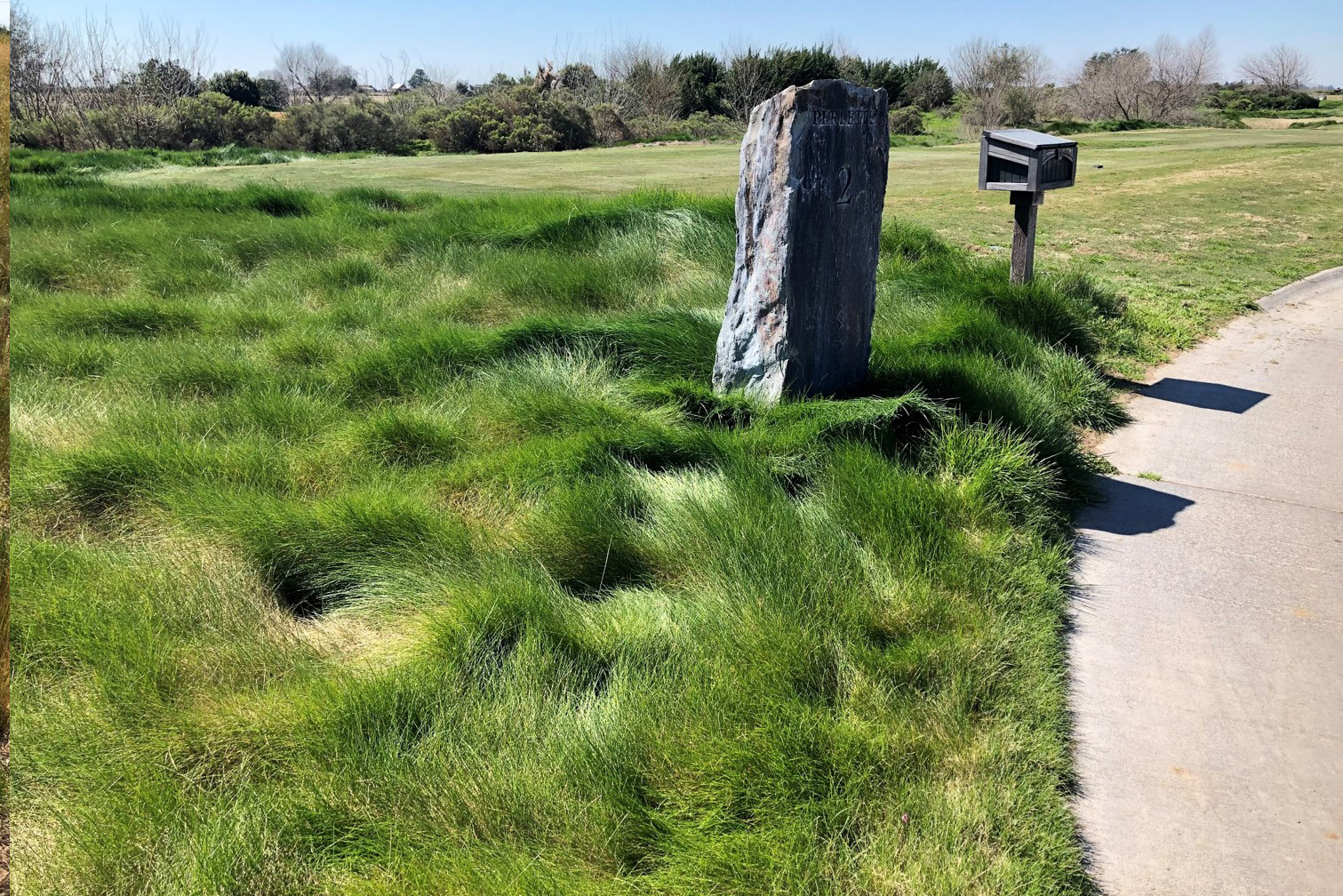
It is well known that fine fescues are quite versatile and can be used in a variety of golf course management situations, including regularly mowed areas on the golf course, such as putting greens, tees, fairways, roughs, and minimal mow to “no-mow”
naturalized rough areas (Fig. 1 and 2). All five fine fescues, either in monocultures or mixtures, have exhibited the ability to produce acceptable turfgrass areas for golf course fairway and rough turf under a variety of environmental conditions in the Northeast, North Central, and Pacific Northwest of the U.S (Braun et al., 2020) (Tables 1 and 2). Learning the subtle differences among these five turfgrasses will help you implement proper management practices to improve the overall turfgrass quality and enhance sustainability at your site (Tables 1 and 2).
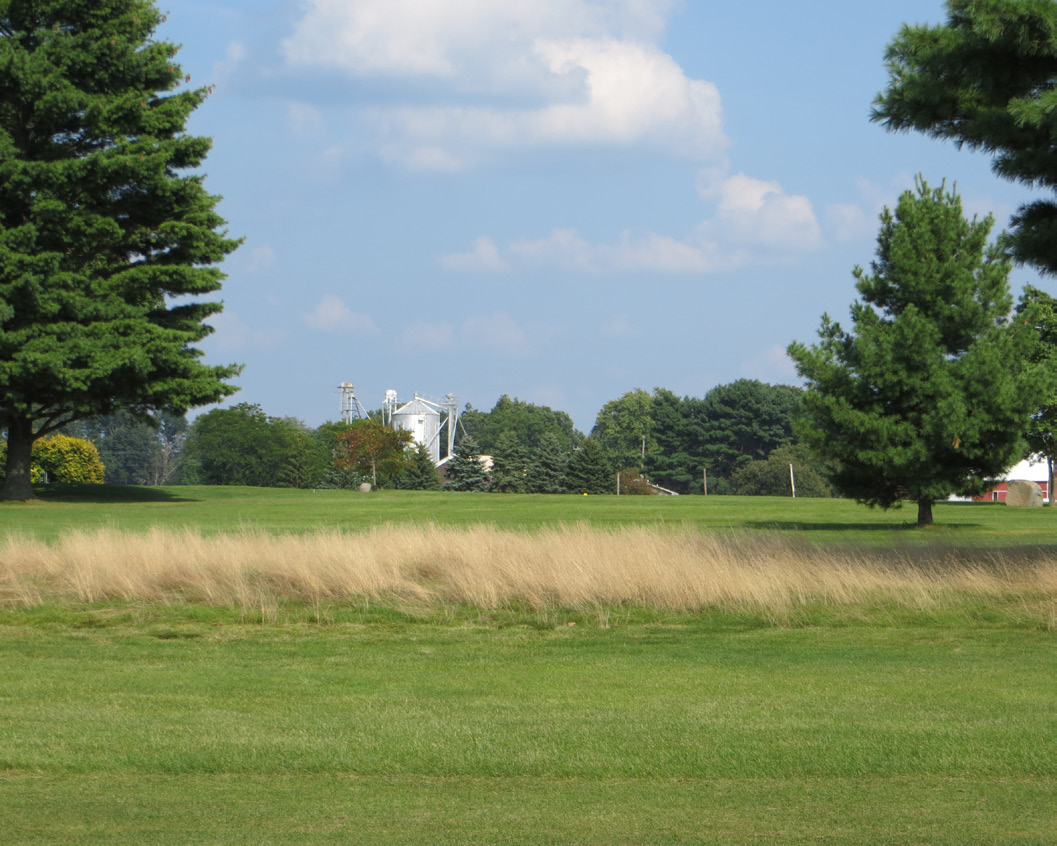
Figure 1. Unmown fine fescues with seedheads separating
two golf holes in Indiana. Photo by Aaron Patton.
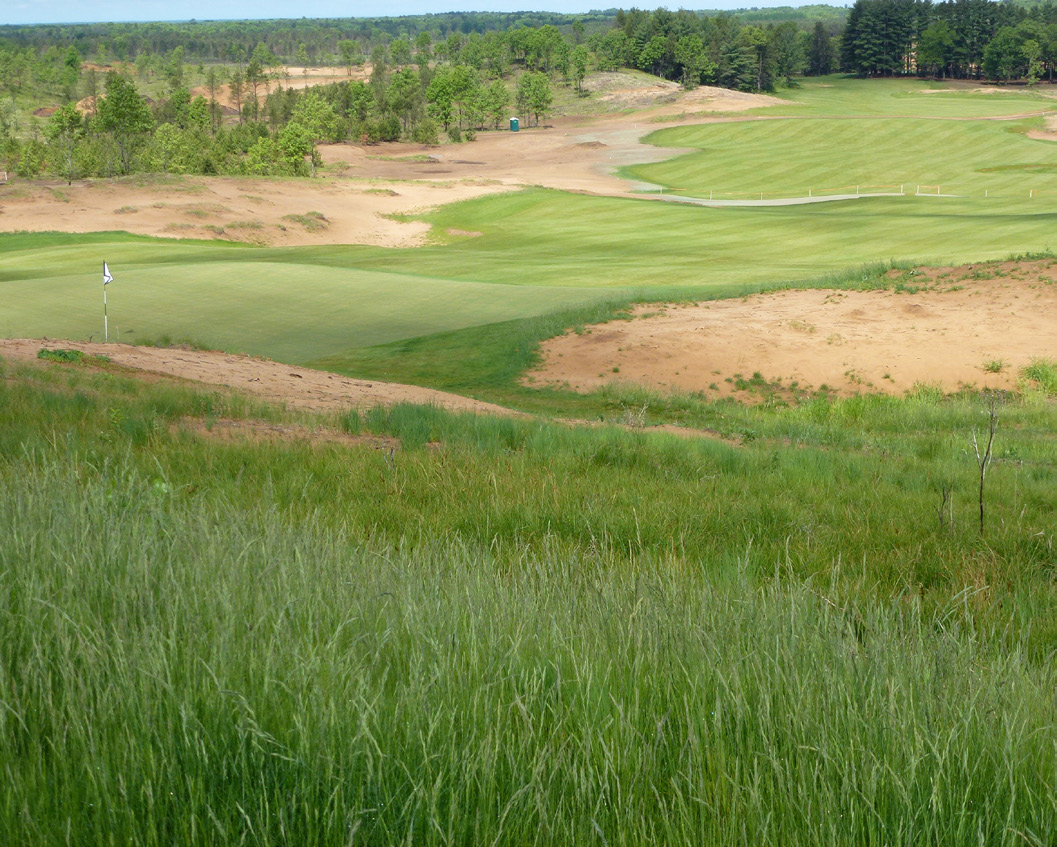
course fairways composed of 30% slender creeping red fescue +
30% Chewings fescue + 20% strong creeping red fescue + hard
fescue surrounded by waste bunker areas at Sand Valley Golf Resort,
Nekoosa, WI. Photo by Leah Brilman.
Table 1. Management and establishment characteristics of the five fine fescues relative to each other.
| Fine fescues | Genetic color | Growth habit | Turfgrass density | Establishment vigor | Nitrogen requirements | Close mowing tolerance |
|---|---|---|---|---|---|---|
| Strong creeping red | Medium green | Thick, long and numerous rhizomes | Good | Intermediate to fast | Low to moderate | Good |
| Slender creeping red | Light to medium green | Slender, short or few rhizomes | Good | Intermediate to fast | Low to moderate | Good to excellent |
| Chewings | Medium green | Bunch | Excellent | Intermediate to fast | Low to moderate | Good to excellent |
| Sheep | Powdery blue-green | Bunch | Fair | Slow to intermediate | Very low | Fair |
| Hard | Dark gray-green to blue-green | Bunch | Good | Slow to intermediate | Low | Fair |
Table 2. Stress resistance and tolerance rankings of the five fine fescue species and subspecies relative to each other.
Source: Braun et al. (2020)
† Based on research by Cavanaugh et al. (2011) and Hollman et al. (2018).
| Fine fescues | Drought resistance | Full-sun tolerance | Shade tolerance | Lodging resistance† | Water submersion tolerance | Weed invasion resistance |
|---|---|---|---|---|---|---|
| Strong creeping red | Good | Poor to good | Good to excellent | Good to excellent | Fair | Good to excellent |
| Slender creeping red | Good to excellent | Poor to good | Good to excellent | Fair | Fair | Good to excellent |
| Chewings | Good to excellent | Fair to good | Excellent | Fair to good | Fair | Good to excellent |
| Sheep | Excellent | Good | Fair to good | Good to excellent | Poor | Poor to good |
| Hard | Excellent | Good | Good | Excellent | Poor | Poor to good |
Selection
Generally, for minimal-to-no mow areas it is best to use a mixture of fine fescues because of differences in abiotic (e.g., drought, salinity, heat, traffic, shade, and temperature) and biotic (e.g., weeds, diseases, and insects) stress resistance among the five turfgrasses (Tables 1 and 2) (Braun et al., 2020). Incorporating multiple fine fescue species and subspecies in a mixture will ensure a more dynamic turf sward able to better withstand different environmental conditions and stresses. Additionally, careful selection of the proportion (ratio) of each fine fescue in the mixture should depend on preferences, expectations, and site conditions. Also, it is important to utilize new, improved cultivars of each fine fescue, which have improved adaptation and tolerance to many different
environmental and management practices.
A recommended fine fescue mixture for minimal-to-no mow rough areas in full sun is composed of multiple fine fescue species and subspecies that contain a higher ratio of hard, sheep, and/or Chewings fescue (Table 2). For golf course areas that are more “in-play” (i.e., more likely to have a golf shot occur) then these areas are often managed to be less dense (i.e., thin turf) to allow for the golfer to easily find an errant shot. It may be wise to consider the bunch-type grow habits of hard, sheep, and Chewings fescue and avoid the creeping red fescues.
Most seed companies offer a “native seed” or “Scottish” mixture that includes various fine fescue species and subspecies in which the composition of the mix and the cultivars in the mix may change over time based on seed availability and availability of new cultivars. Dernoeden (1998) recommended a 40% hard fescue, 40% sheep (blue sheep) fescue, 10% creeping red fescue, and 10% Chewings fescue mixture for natural or unmown areas that are allowed to seed. If the site has more areas with shade, then it
may be beneficial to incorporate more strong creeping red fescue, slender creeping red fescue, or Chewings fescue than hard fescue or sheep fescue (Table 2).
Establishment
- Fine fescues have intermediate germination and establishment rates compared to other grasses.
- There are differences in speed of establishment among the five fine fescues (Table 1).
- Seeds typically require 5-12 days to germinate, with sheep and hard fescue requiring the most days.
- Average seeding rate is about 5 pounds per 1,000 square feet for home lawns, but do slightly vary among the fine fescues due to differences in seed size.
- There is a wide range of recommended seeding rates for minimal-to-no mow areas, depending on desired density of the turf sward, seed size, cultivars, fine fescue species or subspecies, and other factors (Braun et al., 2020).
- Seed at 3 to 5 pounds per 1,000 square feet for a high density turf sward (Fig. 1, 2, and 3). Seed at 0.25 to 1 pound per 1,000 square feet for a low-density turf sward, which will help golfers find errant golf shots and speeds play (Fig. 4).
- Seeds do not have good long-term storage, so use seed tested within the past six months and do not store extra quantities of seed for more than a year.
- Seed between early August and mid-September for optimal results and minimal weed pressure.
- As plants become mature enough (tillering) to withstand mowing later in fall and the following spring, mow (3 to 4 inch height) 2 to 3 times monthly to improve aesthetics and to help reduce weed pressure during the first year.
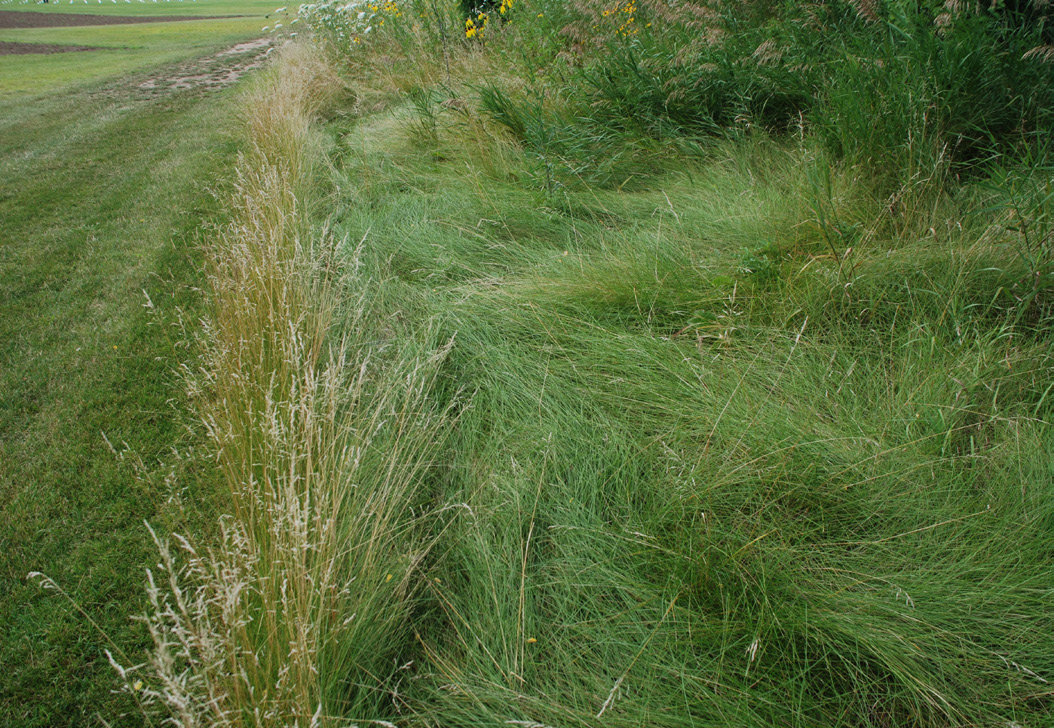
the right). Photo by Aaron Patton.
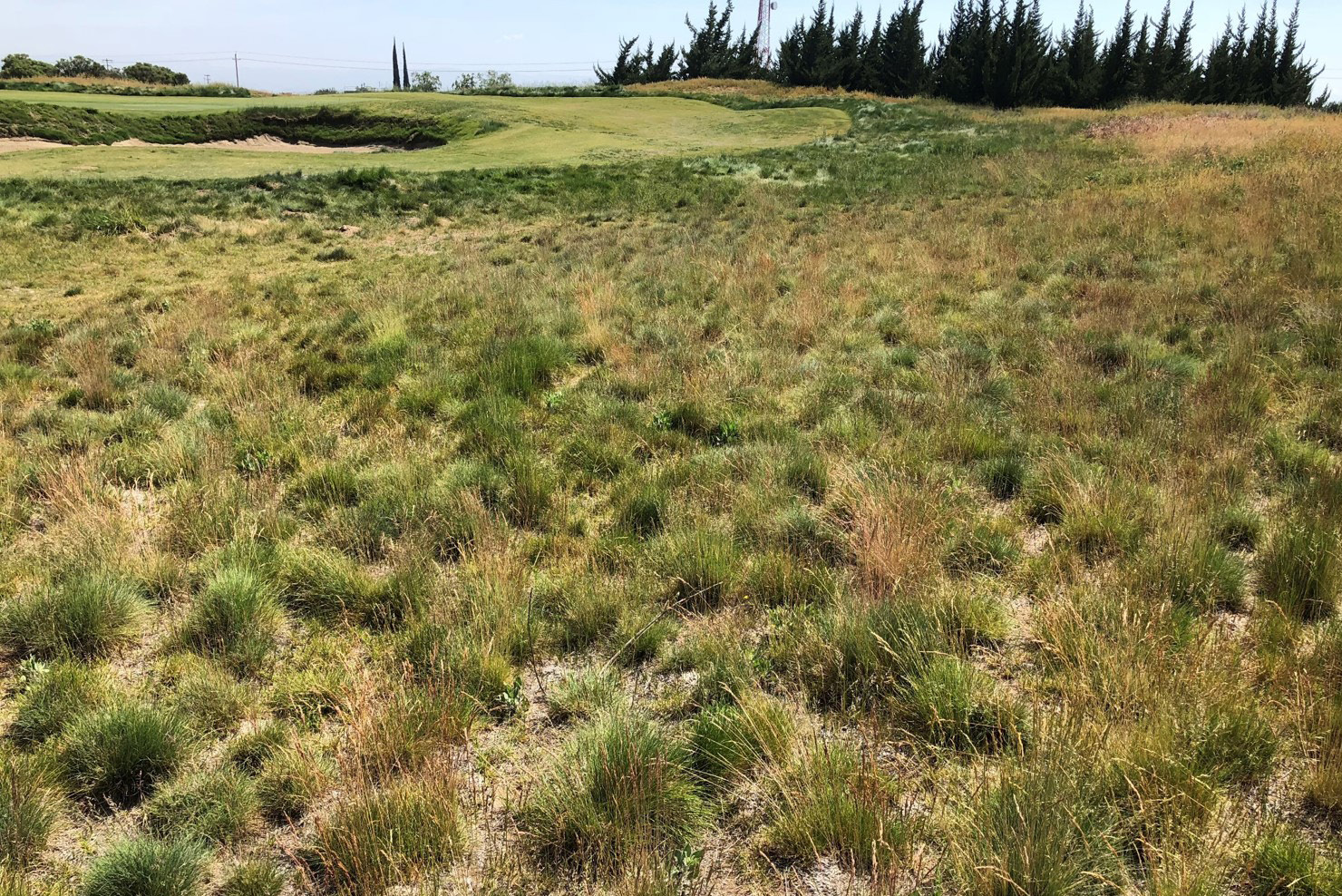
Photos by Maggie Reiter.
Mowing
- Mowing frequency will depend on site preferences and expectations.
- It may be as frequent as once or twice per month during the late fall and early spring after planting.
- In the summer months, mowing should be either entirely avoided or conducted infrequently.
- Mowing can be reduced to as little as 2-3 times annually. Fine fescue grow to a height of 6-12 inches when left unmown.
- Mowing once or twice in early spring and/or late fall is typically the most recommended practice because it does not disturb desired summer fine fescue seedhead formation.
- For aesthetics in no-mow areas, delay any summer or late summer mowing until after seedheads have senesced in mid-summer. Therefore, only early spring and late fall mowings are preferred (Fig. 1 and 2).
- Do not mow turfgrass that is under mild or severe drought stress; in summer months mow only after at least 1 inch of rainfall to ensure that no drought stress is present.
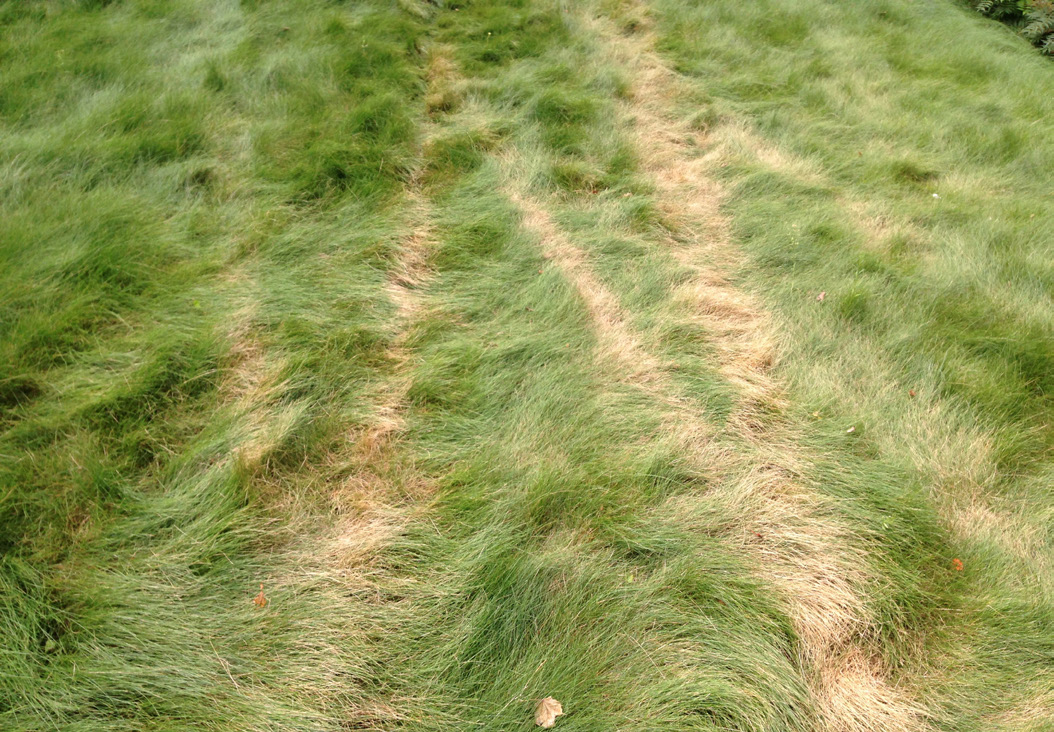
- Mowing or trafficking turfgrass under drought or heat stress will cause extensive damage (Fig. 5).
- Mower injury from mowing under drought stress can cause small pitted areas ranging from baseball-size to softball-size areas and also can cause mower tracks.
- Mowing high (>4 inches) in no-mow areas will help discourage summer annual grassy weed invasion from crabgrass, barnyardgrass, foxtails, etc.
- Stem lodging (i.e., the bending over of the grass stems) can be a common problem in higher density stands compared to thinner stands (Fig. 3). Stem lodging in minimal mow to “no-mow” native golf course rough areas can decrease the aesthetics and
playability. Differences among fine fescue species and subspecies in their ability to resist lodging have been reported, with hard fescue most resistant (Cavanaugh et al., 2011; Hollman et al., 2018) (Table 2).
Fertilization
- Fine fescues are able to maintain acceptable turfgrass quality and better resist weed invasion when maintained at low nitrogen fertilization levels (0.5 to 1.0 pound of N per 1,000 square feet per year) (Table 1).
- During the first year of establishment, fertilize a total of 0.5 to 1.0 pounds of N per 1,000 square feet during the first three months of establishment. Also, if soil test results indicate a need, include an application of a starter fertilizer containing phosphorus at
establishment. In the first year, a second application of nitrogen fertilizer in October may be necessary if seedlings appear nutrient deficient or stunted. - After the first year of establishment, fertilize with no more than 1 pound of N per 1,000 square feet per year in the fall. If the quality of a well-established stand is good and turfgrass density is at the desired thickness, then it is possible to skip a year of fertilization.
- Too high of a fertility regime can make the turfgrass too thick for golf course roughs, making the turfgrass unplayable or slowing golfer play.
- Fines fescues tolerate a range of soil pH. Lime may be necessary if soil pH drops below 5.5.
- These grasses are generally drought tolerant and do not need irrigation, especially in minimal-to-no mow areas (Table 2).
- Irrigation will increase turfgrass density, increase chance for stem lodging, and make it difficult for golfers to find errant shots.
- Do not traffic (from carts, equipment, or mowers) these areas when soils are dry.
- Avoid the use of fine fescues, especially hard fescue and sheep fescue, in concave, lower-lying areas and sites with poor drainage due to their poor tolerance to wet or poorly drained soils (Table 2).
Weed Control
- Perennial weeds should be controlled with herbicides or mechanical alternatives before seeding. Effective control of existing vegetation will pay dividends by improving the success of fine fescue establishment.
- Results from field studies across various locations indicate noticeably different weed suppressive tendencies among fine fescues and cultivars, which should not only be associated with the characteristics of a quick establishment and dense canopy, but also potential allelopathic traits (Braun et al., 2020) (Table 1 and 2).
- Allelopathy is defined as the chemical inhibition of surrounding plants and is an important characteristic that Chewings fescue, strong creeping red fescue, and hard fescue utilize to suppress weed invasion (Bertin et al., 2009).
- Strong creeping red fescue, slender creeping red fescue, and Chewings fescue have been reported to have better crabgrass suppression abilities than hard fescue or sheep fescue (Breuillin-Sessoms et al., 2021).
- Some broadleaf herbicides will have some mild phytotoxicity on fine fescues, especially seedlings. Therefore, do not apply a broadcast herbicide application until seedlings are tillering and mature enough to withstand mowing.
- Broadleaf weed control may be required once annually. Typically, three-way herbicides can be used with some mild and temporary injury/yellowing. Herbicide applications in the fall (October) will provide safer and more efficient broadleaf weed control than applications in the spring.
- Many common three-way mixtures or mixtures with clopyralid provide effective broadleaf weed control.
- The preemergence herbicides dithiopyr (Dimension), pendimethalin (Pendulum) and prodiamine (Barricade) can be used safely on fine fescue. Pendimethalin is a common choice for native areas. Avoid using the preemergence herbicides oxadiazon
(Ronstar) and benefin+trifuralin (Team) as they will injure fine fescue. - Postemergence summer annual grass control can be achieved with fluazifop (Fusilade II) or sethoxydim (Segment) (Patton et al., 2021). These herbicides control only grasses and not broadleaves.
- Research at Purdue has also shown good results with topramezone (Pylex), quinclorac (Drive XLR8), or quinclorac + sulfentrazone (Solitare) for postemergence weed control.
- Herbicide application timing can be important for control of difficult perennial weeds like Canada thistle, which are common in these areas. Mowing in the fall, then waiting for perennial weeds to begin growing through residual material before spraying a broadleaf herbicide is a common strategy that targets growing weeds; the fall timing helps to move the herbicide to vegetative parts where much of the new growth is occurring.
Disease Control
- Common diseases of fine fescues include summer patch, snow molds, red thread, pink patch, and dollar spot. Each of these diseases typically occurs at a specific time of the year when environmental conditions favor the pathogen.
- Disease resistance among the fine fescues varies, with no single fine fescue consistently more resistant to all diseases than the others. However, hard fescue, sheep fescue, and Chewings fescue tend to be less susceptible to many of the common diseases.
- The fungicide chlorothalonil is phytotoxic to some fine fescues cultivars; therefore, exercise caution.
- Generally, under low-input maintenance and high mowing heights, fungicides are rarely necessary.
- Detailed Extension publications on Gray SnowMold, Pink Snow Mold, Red Thread, and Leaf Spot/Melting Out, Rhizoctonia Brown Patch, Summer Patch, Necrotic Ring Spot, and Dollar Spot are available. If turfgrass diseases are present, contact the Purdue University Plant and Pest Diagnostic Laboratory (www.ppdl.purdue.edu) for assistancewith identification.
Insect Control
- Common insect pests of fine fescues include white grubs, billbugs, and chinch bugs. The majority of these insect pests are active in the summer months.
- Begin scouting the soil and turfgrass at your site in early June into July if the area has a history of insect problems.
- An insecticide application is rarely required on these minimal-to-no mow areas; however, if large areas are severely damaged then it may be warranted.
- Periodic overseeding of damaged areas with new and improved fine fescue cultivars with endophytes will help these damaged areas.
- For more information see Integrated Management of Turfgrass Insects: Managing White Grubs in Turfgrass, and Managing Billbugs in Turfgrass Extension publications.
Playability
- Playability in naturalized areas is defined as the method of visually locating a golf ball and advancing the ball forward.
- In general, an area with a thinner (i.e., less dense) turfgrass stand will allow the golfer to more easily locate and hit the golf ball than a more dense turfgrass stand.
- Areas that are closer to the regularly mowed golf course rough and other landing areas, such as those surrounding putting greens, should be considered to be more “in-play” than “out-of-play” areas, such as areas surrounding tee boxes and areas further away from the regularly mowed golf course rough and fairway.
- This is no consensus on how to measure playability, but there are metrics that can be monitored and managed for desired outcomes:
- Aboveground biomass and stand height—can be managed with plant selection, irrigation inputs, and mowing or grazing.
- Plant density—can be managed with seeding rates, overseeding, or preemergent herbicides.
- Lodging—can be managed with species selection (Table 2).
Other Notes
- Fine fescue is not particularly traffic tolerant, especially in summer, so keep carts out of these areas (Fig. 5).
- Fine fescue can be established by sod. This is especially helpful on bunker faces and other niche areas.
For more information on fine fescues, see Fine Fescues: Understanding the Differences, Establishment of Fine Fescues, Management of Fine Fescues, Maintenance Calendar for Fine Fescue Lawns, and Selecting Cultivars of Fine Fescues Extension
publications available at www.turf.purdue.edu.
This publication was developed with funding support by the National Institute of Food and Agriculture, U.S. Department of Agriculture, Specialty Crop Research Initiative under award number 2017-51181-27222.
References
Bertin, C., Senesac, A.F., Rossi, F.S., DiTommaso, A., & Weston, L.A. (2009). Evaluation of selected fine-leaf fescue cultivars for their turfgrass quality and weed suppressive ability in field settings. HortTechnology, 19, 660-668.
Braun, R.C., Patton, A.J., Watkins, E., Koch, P., Anderson, N.P., Bonos, S.A., & Brilman, L.A. (2020). Fine fescues: A review of the species, their improvement, production, establishment, and management. Crop Science, 60, 1142–1187. https://doi.org/10.1002/csc2.20122
Breuillin-Sessoms, F., Petrella, D.P., Trappe, J.M., Mihelich, N.T., Patton, A.J., & Watkins, E. (2021). Field evaluation of weed suppression in fine fescue (Festuca spp.). Crop Science, 61, 2812–2826. https://doi.org/10.1002/csc2.20506
Cavanaugh, M., Watkins, E., Horgan, B., & Meyer, M. (2011). Conversion of Kentucky bluegrass rough to no-mow, low-input grasses. Applied Turfgrass Science, 8(1):1-15. https://doi.org/10.1094/ATS-2011-0926-02-RS.
Dernoeden, P. (1998). Fine fescues on golf courses. Golf Course Management, April issue. p.56-60.
Hollman, A., Watkins, E., & Heineck, G. (2018). The effect of fine fescue species and seeding rate in no-mow areas. Poster number 1220. Poster presented at the annual meeting of ASA & CSSA, Baltimore, MD. Retrieved from https://scisoc.confex.com/scisoc/2018am/meetingapp.cgi/Paper/113724
Patton, A.J., Braun, R.C., Bearss, R.C., & Schortgen, G.P. (2021). Herbicide tolerance in eleven grass species for minimal-to-no-mow golf course rough. Agrosystems, Geosciences & Environment, e20204, https://doi.org/10.1002/agg2.20204
Stace, C.A. (2019). New flora of the British Isles. 4th ed. C & M Floristics Middlewood Green, Suffolk, United Kingdom.
Turf Programs
| State | University | Turf Program Website |
|---|---|---|
| Indiana | Purdue University | turf.purdue.edu |
| Minnesota | University of Minnesota | turf.umn.edu |
| New Jersey | Rutgers University | turf.rutgers.edu/ |
| Oregon | Oregon State University | horticulture.oregonstate.edu/beaverturf |
| Wisconsin | University of Wisconsin | https://turf.wisc.edu/ |