

Data Driven Agriculture Minor
Contact
Bruce Erickson
Agronomy Education Distance & Outreach Director
berickso@purdue.edu
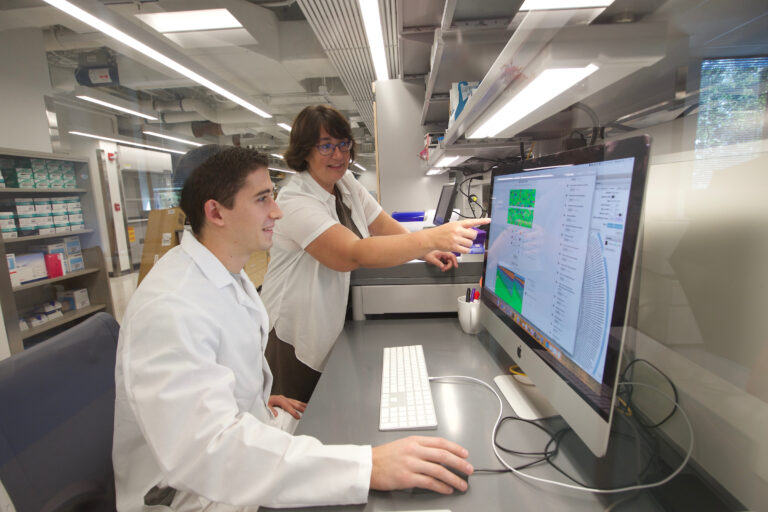
Pursuing the Data Driven Agriculture Minor allows you to gain valuable skillsets to leverage the complex data sources that are becoming increasingly important in all aspects of the agriculture industry. The minor includes courses that map to these skill sets:
- Foundation in mathematics and statistics
- Knowledge of data origination (sensors, surveys, web-scraping, etc.)
- Data literacy, ethics, and management
- Data application in agriculture disciplines
- Data architecture and organization
- Data-driven decisions
Why Digital Agriculture?
- The increase in intensity and volume of data collected generates the need for increased programming and data skills.
- Agricultural domain expertise is needed within the coding, artificial intelligence, and cloud computing communities.
- Sensing and communication technologies continue to evolve and their applications in agriculture are growing.
- Even with artificial intelligence and machine learning, human input will continue to be a critical input to assist with decision-making and data-inference.
Requirements for the Minor (21 Credits)
Below are the categories of the minor with common course options indicated; for full lists of courses applicable in these categories, visit the course catalog.
- Foundation in Statistical Methods – Elementary Statistical Methods (STAT 30100)
- Foundation in Data Literacy, Management & Analytics – Data Science (ENTM 24200)
- Knowledge of how data is used in agriculture – Data Science for Agriculture (AGR 33300)
- Foundation in Computation – Computing Technology with Applications (ASM 10500), Introduction to Computing for Biologists (HORT 53000), or Programming with Multimedia Objects (CS 17700)
- Data Acquisition - Design of Electronic Systems (ABE 31400), Sensors and Process Control (ABE 46000), Remote Sensing of Land Resources (AGRY 54500)
- Data Architecture & Usage - Computations for Engineering Systems (ABE 20500), Introduction to Data Analytics for Agricultural Business (AGEC 20201), Applied Econometrics AGEC (45100)
- Data to Decisions - Agricultural Prices (AGEC 30500), Weather Analysis and Forecasting (AGRY 44400), Animal Breeding and Genetics (ANSC 31100)
Why ADD a Data Driven Agriculture Minor?
Hear Purdue alum Josh Bailey (BS ‘23 Agricultural Economics and MS’26 Agricultural and Biological Engineering ) discuss his experience with the Data Driven Agriculture Minor as an undergraduate.
Transcript for Purdue University's Data Driven Agriculture Minor Josh Bailey
Complementary Credentials
With good planning, students obtaining this Data Driven Agriculture Minor can also receive a Certificate in Applications of Data Science.
For more information regarding the Data Driven Agriculture Minor, please contact Bruce Erickson, berickson@purdue.edu