

Katy Rainey Researcher Spotlight
researcher spotlight
This month’s IDAAS Affiliate Spotlight features Katy Rainey, Professor of Agronomy and Director of the Purdue Soybean Center. Her research focuses on improving soybean productivity and resilience through genetics, genomics, breeding, and innovative data-driven approaches. By combining traditional plant breeding with advanced phenotyping, genomic analysis, and emerging digital technologies, Rainey is helping develop the next generation of soybean varieties while strengthening Purdue’s role in soybean research and innovation.
Katy Rainey
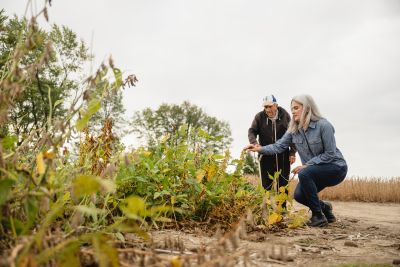
Dr. Rainey’s research brings together genetics, plant breeding, agronomy, and technology to address one of agriculture’s most important challenges: how to develop higher-yielding, more resilient crops that can meet growing global demands for food, feed, and other agricultural products.
As Director of the Purdue Soybean Center, Rainey works across disciplines and with industry, producers, breeders, and researchers to advance soybean improvement. Her work is particularly focused on understanding the genetic factors that influence soybean yield, seed quality, adaptation, and other traits important to producers and consumers.
Katy Rainey
Professor of Agronomy and Director, Purdue Soybean Center
Katy Rainey Professor of Agronomy and Director, Purdue Soybean Center
About the research
Rainey’s research program sits at the intersection of translational genomics and crop improvement, using genetic diversity and advanced technologies to better understand soybean performance and accelerate the development of improved varieties.
A major component of her work involves soybean breeding and genetics. Soybean production has steadily increased over time, but continued progress requires researchers to identify new sources of genetic diversity and understand how those traits can be incorporated into productive, commercially relevant varieties. Rainey’s work helps bridge that gap by connecting genetic discovery with practical crop improvement.
Her research also increasingly incorporates digital phenotyping and advanced imaging technologies. Through collaborations with researchers in engineering and other disciplines, Rainey has explored the use of drone imagery to evaluate soybean growth and biomass across large breeding populations. This work provides researchers with new ways to collect detailed information about plants while reducing the time and labor required for traditional field measurements.
One example is Purdue’s involvement in the SOYGEN3 project, which brings together public soybean breeding programs across the North Central United States. Through this work, Rainey and her collaborators are using drone imagery and other data to evaluate approximately 1,200 soybean varieties across multiple states. These technologies can help researchers identify differences in plant growth and performance and ultimately improve the efficiency of soybean breeding.
Rainey’s work also highlights the importance of genetic diversity in the future of soybean improvement. In 2026, Purdue acquired the KenAvis soybean germplasm collection, a unique collection containing soybean lines with numerous underexploited traits, including unusual pod structures and other characteristics with potential value for future breeding. Rainey is helping lead efforts to evaluate and utilize this genetic resource through the Purdue Soybean Center.
The collection represents decades of breeding work and provides Purdue researchers with new opportunities to identify genes and traits that could contribute to improved yield, seed quality, specialty soybean production, and resilience. By combining this genetic diversity with modern breeding and phenotyping tools, researchers can explore new pathways for increasing soybean productivity.
Rainey’s research demonstrates how data, genetics, imaging, and plant science can work together to accelerate agricultural innovation. Rather than relying solely on traditional field observations, researchers can increasingly collect large, detailed datasets that reveal how plants respond to genetics and environmental conditions.
As an IDAAS affiliate, Rainey contributes an important crop-science perspective to Purdue’s broader digital agriculture community. Her work creates opportunities for collaboration among agronomy, engineering, data science, artificial intelligence, and other disciplines, helping translate emerging technologies into tools that can support real-world crop improvement.
Through her research and leadership of the Purdue Soybean Center, Rainey is helping position Purdue at the forefront of soybean innovation—connecting fundamental genetics and breeding research with the digital technologies and data-driven approaches that will shape the future of agriculture.
Q&A
I am a soybean geneticist and plant breeder focused on improving yield, seed composition, and resilience using quantitative genetics and large, multi‑environment field trials. My group works on traits including oil and meal quality, protein content, food‑grade characteristics, and resilience to pre‑emergent herbicides, integrating genomic selection, high‑throughput phenotyping (drone and satellite imagery), and predictive modeling to accelerate cultivar development and better match public lines to farmer and processor needs in the North Central region.
In my lab we use machine‑learning and AI models to predict soybean biomass, yield, and stress responses from time‑series drone imagery and genomic data, helping breeders select superior lines earlier in the pipeline. I previously developed drone image‑analysis software for breeding trials that was acquired by Corteva and am now using generative AI with high‑resolution satellite data to track growth and development in soybean plots and build scalable decision‑support tools for breeding programs and independent seed companies.
I lead the Purdue Soybean Breeding Program and serve as Director of the Purdue Soybean Center, coordinating multi‑state research on yield, nutritional quality, phenomics, and value‑added traits in public germplasm. I am the lead PI and breeder for Purdue’s new KenAvis soybean diversity collection and currently work with ~six independent seed companies on projects ranging from placement of public lines to development of specialty and food‑grade varieties supported by drone and satellite‑based predictive tools. I am heavily engaged with the private sector and I have influenced soybean breeding on ~60% of acres in the U.S.
Yes. I welcome new M.S. and Ph.D. students with prior degrees in agronomy, plant breeding, crop or plant science, biological engineering, data science, statistics, or related quantitative fields who are excited about large-scale agriculture, field applications, and AI‑enabled breeding.
I would especially value additional applied plant pathologists since there is high demand. I am looking to pair system-of-systems modeling with biological insights to indicate where new bio‑based markets for domestic soybean use are most viable and what kinds of cultivars will be needed there. I also welcome collaborators from computer science and related disciplines who can help develop image‑processing tools tailored to plant breeding that run quickly, cheaply, and reliably at scale on drone and satellite data, without relying on expensive GIS or heavy georeferencing pipelines.