

Yaguang Zhang Researcher Spotlight
researcher spotlight
This month’s IDAAS Affiliate Spotlight features Yaguang Zhang, a Clinical Assistant Professor in Purdue’s Department of Agricultural and Biological Engineering. His work centers on data science and digital agriculture, with an emphasis on expanding digital skills, workforce development, and educational opportunities across agricultural communities. As an IDAAS affiliate, Zhang helps connect emerging technologies, data-driven approaches, and real-world agricultural applications to support a more innovative and accessible digital agriculture future.
Yaguang Zhang
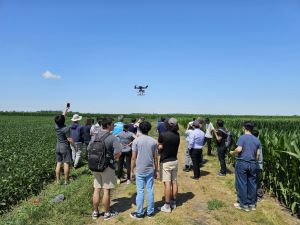
Yaguang Zhang is a Purdue clinical faculty member whose work connects data science, rural telecommunications, STEM education, and digital agriculture. His efforts focus on helping students and agricultural communities build the digital skills needed to engage with emerging technologies and data-driven agricultural systems. Through mentoring and educational initiatives that reach learners from 4-H through undergraduate and graduate programs, he uses agriculture as a real-world context for teaching broadly applicable skills in areas such as data science, engineering, and communication. Overall, his goal is to help make digital agriculture more accessible, practical, and inclusive, especially for rural communities and the next generation of agricultural innovators.al challenges.
Yaguang Zhang
Clinical Assistant Professor
Yaguang Zhang Clinical Assistant Professor
About the research
Yaguang Zhang is a Clinical Assistant Professor at Purdue University whose work sits at the intersection of digital agriculture, data science, rural telecommunications, and education. His efforts focus on helping agricultural communities and students better access, understand, and apply emerging technologies that can strengthen the future of farming and rural life.
A central part of Zhang’s work addresses the rural digital divide. Through research and educational initiatives, he explores how data collection, wireless communications, sensor systems, and data analysis can be used more effectively in agricultural settings—particularly in rural areas where reliable access to technology and digital learning resources can be limited. His work recognizes that successful digital agriculture depends not only on advanced tools, but also on ensuring that people have the skills, connectivity, and confidence to use them.
Zhang is also actively involved in creating educational pathways that introduce digital agriculture to learners at multiple stages, from 4-H and middle and high school students to undergraduate and graduate students. Through programs such as AgBridge, he helps use agriculture as a meaningful, real-world setting for teaching broadly applicable skills in areas such as coding, data science, engineering, telecommunications, and agronomy. His approach makes digital agriculture more tangible by connecting technical learning to challenges students can see in their own communities.
His teaching is also shaped by a lifelong connection to music. Zhang was the lead vocalist and guitarist for several bands, an experience that continues to influence how he introduces technical concepts in the classroom. He often draws on the evolution of recording technology and digital audio processing to help students understand data representation and signal processing, demonstrating how computers interpret, organize, and manipulate information.
Each semester, Zhang records and edits music live in the classroom to show students how raw signals are transformed into structured data. This hands-on approach creates an intuitive bridge to more advanced topics such as machine learning and artificial intelligence, while helping students build a stronger appreciation for the underlying concepts that make modern digital systems possible. Music remains an important creative outlet for Zhang and a meaningful way to help students see how the same principles behind music production also support today’s intelligent technologies.
His research and collaborative work have also included projects involving rural Internet of Things systems, underground sensor communications, autonomous navigation in agricultural environments, and data-supported tools for agricultural operations. Across these efforts, Zhang’s broader goal is to make digital agriculture more accessible, practical, and inclusive while preparing the next generation of students, educators, and rural communities to participate in an increasingly technology-driven agricultural future.
As an IDAAS affiliate, Zhang brings an important people-centered perspective to digital agriculture—one that connects advanced technologies with education, workforce development, rural connectivity, and real-world adoption. His work reflects Purdue’s commitment to ensuring that innovation in agriculture reaches beyond the lab and into the classrooms, communities, and farms where it can make a lasting difference.
Q&A
My research focuses on UAV-assisted wireless communication systems, channel measurement and modeling, intelligent transportation systems for digital agriculture, proactive road maintenance technologies, and innovations in engineering education.
Machine learning and AI play a central role in our wireless channel modeling research, enabling strong generalizability despite limited ground-truth measurement data. Our recent work demonstrates the feasibility of developing learning frameworks that integrate high-fidelity simulations with sparse real-world measurements to predict site-specific propagation conditions. Notably, these models perform well even in previously unseen environments without direct measurement data. While the initial focus was on rural connectivity to help bridge the digital divide, the robustness and transferability of our approach enabled our student team, BoilerSignal, to place 4th worldwide in the International Telecommunication Union (ITU) 2025 competition, “Estimation of Site-Specific Radio Propagation Loss with Minimal Information,” which emphasized urban scenarios.
In parallel, our spectrum monitoring station, established with support from CableLabs, leverages AI-driven analytics to characterize wireless channel utilization patterns and identify strategies to improve throughput through intelligent, site-specific frequency management.
In grain tracking and traceability, we developed a fully automated expert system that determines product origin and destination during wheat harvesting at fine spatial scales using GPS data. This capability supports site-specific field management, strengthens supply chain transparency, and enables data-driven recall decisions. Building on this work, we are advancing the Tractor Auto Pilot (TAP) program funded by the NSF Engineering Research Center for the Internet of Things for Precision Agriculture (IoT4Ag), Nokia, and the Purdue 2024–26 Laboratory and University Core Facility Research Equipment Program (Track 2). TAP integrates AI to support next-generation rural wireless systems and more autonomous cyber-physical systems composed of coordinated tractors, all-terrain vehicles, and unmanned ground and aerial vehicles, while keeping farmers actively engaged in the decision-making loop.
Our roadside vehicle monitoring system, funded by the Indiana Department of Transportation (INDOT), also applies AI to precisely detect vehicle position and determine whether tires are directly over embedded road surface sensors. This enables more accurate analysis of traffic loading effects and highway aging.
In education, we are developing AI-focused instructional materials and leading curriculum updates within the Department of Agricultural and Biological Engineering, the College of Agriculture, and Purdue Online to enhance AI literacy among students. We host digital agriculture talks, workshops, competitions, and seminars focused on AI, programming, robotics, and related STEM fields for 4-H and K–12 students, as well as pre-service and in-service teachers, to strengthen “train-the-trainer” capacity and expand sustainable STEM education impact. These efforts have been supported by IoT4Ag, Purdue Experiential Education (ExEd), and EducationProjects.org.
Beyond IDAAS, our initiatives are strongly supported by the Purdue Open Ag Technologies and Systems (OATS) Center. Both entities play critical roles in shaping our research vision, facilitating farm partnerships, and fostering meaningful student engagement and mentorship.
I lead several machine learning/AI-enabled research initiatives, including the Wireless Channel Modeling Project, the CableLabs Spectrum Monitoring Station, and a GPS-based grain tracking and traceability expert system. I serve as PI of the Tractor Auto Pilot (TAP) Program, Workforce Development Co-Lead for the NSF IoT4Ag Engineering Research Center, and Co-PI of Enhancing Pavement Instrumentation and Monitoring (INDOT SPR-4918). In parallel, I lead K–12 and teacher-focused digital agriculture outreach and advance AI-centered curriculum innovation through IDAAS, the OATS Center, IoT4Ag, and Purdue Ag Online.
Yes. We are seeking additional graduate students with prior degrees in Electrical and Computer Engineering, Computer Science, Mechanical Engineering, Agricultural and Biological Engineering, and Education.
We welcome new collaborators with expertise in advanced AI/machine learning theory (e.g., foundation models, physics-informed learning, uncertainty quantification), wireless communications and radio propagation modeling, cyber-physical systems, and autonomous systems integration. We are particularly interested in partners working on autonomous tractors and off-road vehicles, edge AI, distributed sensing, digital twins, robotics and multi-agent coordination (including drones/UAVs), spectrum policy and security, and resilient infrastructure systems. Expertise in agricultural systems modeling, transportation infrastructure analytics, human-centered AI, and workforce development in emerging technologies would further strengthen interdisciplinary impact and translational outcomes.