

Introduction
The sweet potato (Ipomoea batatas) is best suited for southern gardens due to the need for a long, frost free growing season. However, Indiana gardeners can produce enough for home use. Sweet potatoes belong to Convolvulaceae, the morning glory family. The sweet potato flower is very similar to ornamental morning glories—funnel-shaped and about the same color and size. Blooms are rare but are sometimes seen in southern Indiana gardens. Sweet potatoes are perennial in growth habit but are grown as an annual vegetable in Indiana.
The sweet potato evolved in tropical America and ranked second only to the Irish potato as an important vegetable until World War II. The nutritive value of the sweet potato is high. It is a good source of sugars, carbohydrates, calcium, iron, and other minerals and vitamins, particularly A and C.
Author
B. Rosie Lerner
Types
The edible part of the sweet potato is a swollen storage root. It contrasts with the Irish potato, which produces a fleshy underground stem known as a tuber. The color of both the skin and flesh of sweet potato roots range from white to orange to red, depending on the cultivar.
There are two types of sweet potatoes, often described as “dry-fleshed” or “moist-fleshed.” This refers to the mouth feel, not the actual moisture present in the root. Actually, soft versus firm fleshed types would be a more accurate description. “Moist-fleshed” types tend to convert more of their starch to sugars and dextrines during cooking, becoming softer and sweeter than the “dry-fleshed” types. The “moist-fleshed” types are often called “yams.” However, the true yam is an entirely different plant species, grown only in tropical climates.
The common sweet potato is a trailing vine normally of considerable length. These vigorous vines make the sweet potato an impractical crop in gardens with limited space. Some cultivars are of a different plant form, called a “bush” or “bunch type, and are more practical for small gardens because they produce shorter vines. With extra attention to watering and fertilizing, bush types may also be grown successfully in containers.
Location
Since the sweet potato is a tropical plant, both warm days and warm nights are essential for a quality and quantity crop. A 4-5 month outside growing season is desired for optimum yield, but acceptable home garden quantities can be harvested in a shorter growing season. To prevent buildup of disease organisms and insect pests, do no grow more than once every 3-4 years on a site.
Acquiring Plants
Sweet potatoes are grown from slips (transplants). Because there is a possibility of transmitting disease from saved roots to new plants and of a delay in having plants available early in the year, home gardeners often find it more practical to purchase disease-free plants from reputable growers and garden supply stores. If buying through mail-order firms, be sure to order early to get the cultivars you desire. Recommended cultivars for Indiana gardens and sources for purchasing plants are listed at the end of this publication.
Growing Your Own Slips
For gardeners wishing to produce their own slips, roots can be saved from the previous year’s harvest. Starter roots should be about 1 1/2 inches in diameter, selected from high-yielding hills, and be smooth, well-shaped, and free from disease and insect injury. Each root produces several slips, so only a few starter roots are needed for the home grower.
An electrically-heated hotbed is preferred for producing sweet potato slips (see HO-53: Hotbeds and Cold Frames). Cold frames are seldom satisfactory for starting sweet potato vines in Indiana, as slips often grow too slowly to accommodate the short growing season. Temperatures should be maintained between 75 and 80°F. Place roots about 1 inch apart and 2 inches deep in clean sand or good quality potting soil and water to settle the media around the roots. Ventilate the beds on warm, sunny days. Water regularly to prevent roots from drying out, but do not overwater. Mulch can be used to conserve moisture—remove it when sprouts appear. Plants should be ready for transplanting in about 6 weeks or when 6-10 well-developed leaves are present. Gently pull each sprout along with its newly developed root system away from the starter root.
There are a couple of old, but not necessarily wise, methods of propagating sweet potato starts. A small number of slips can be produced by partially covering starter roots with water in a jar or other container. Water-rooted slips are pulled and treated as described above, but often have an inferior root system due to lack of proper aeration. The other questionable practice is that of growing slips from store-bought sweet potatoes. These sweet potatoes are not likely to be locally grown. The cultivar will probably be unknown and may not be culturally adapted to Indiana conditions.
Soils
A fertile, well-drained, sandy soil is preferred. Heavy, clay soils can result in the formation of long, stringy, or misshapen roots. Poorly-drained soils hold excessive moisture which may promote root rot.
A moderate to slightly acid soil with a pH of 5.6 to 6.5 is recommended for sweet potatoes. As soil pH approaches neutral (pH 7.0), diseases are more common. Such diseases can be controlled by lowering soil pH with sulfur. However, do not attempt to alter the soil pH without first having the soil tested. Information on how to sample and have your soil tested is available through your local county Extension office and HO-71: Collecting Soil Samples for Testing. Also remember that other vegetables in the crop rotation may not require the same pH as sweet potatoes.
Soil Preparation
Prepare the soil 2 weeks before planting. Dig 6-8 inches deep with a rototiller, plow, or spade when the soil is dry enough to work. Prepare a ridge about 18 inches wide to allow soil too warm and dry faster. On heavy and/or compacted soils where drainage is slow, ridges 12-15 inches high are especially helpful. Space the ridges 36-48 inches apart. On light, sandy soils, ridges 8-10 inches high, spaced 30 inches apart are usually adequate. Allow the ridges to settle for a few days, then flatten the tops.
Fertilization
A soil test is the best guide for rates of fertilizer to use. However, in the absence of a soil test, a fertilizer containing moderate amounts of nitrogen and relatively high proportions of phosphorus and potassium, such as 5-10-10 or 10-10-10, can be used at the rate of about 3 pounds per 100 square feet.
Only moderate amounts of nitrogen are required by sweet potatoes. Excessive amounts may encourage excessive vine growth and result in cracked and misshapen roots and poor storage quality.
Results are improved when half the fertilizer is applied before planting, either directly under the ridge or a few inches to the sides of the centerline of the ridge. Make the first application of fertilizer 10-14 days before planting time. The second half of the fertilizer can be applied as a side-dressing after plants have begun new growth.
Planting
Sweet potato plants are sensitive to cool soils as well as frost. Transplant to the garden 3-4 weeks after the frost-free date (see Figure 1 for range of planting dates in your area). Try to purchase or harvest plants the same day you plan to set them. Be sure to keep roots moist. In sunny, hot weather, set plants in evening hours to reduce excessive wilting. Set plants 12-18 inches apart in the row and gently firm the soil around each plant. Water immediately to establish good soil-to-root contact. A starter-solution (1-2 tablespoons of low-analysis fertilizer, such as 12-12-12, per gallon of water) can be used to water the plants.
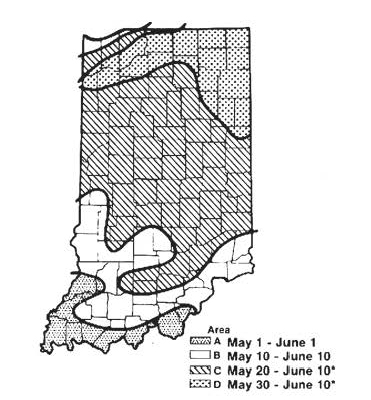
Figure 1. Recommended planting date for sweet potatoes.
*Potential yield may be reduced due to relatively short growing
season and cool soil temperatures at planting time.
Maintenance
At least one inch of water per week supplied by natural rainfall and/or irrigation is required for optimum yields. Wide fluctuations in soil moisture can cause the roots to crack.
Do not cut back the vines during the growing season. Any kind of damage to the vines before roots are mature can cause the roots to sprout in the soil. However, sprouted roots can be salvaged by “rubbing off” the sprouts and curing the roots immediately.
Weed Control
Cultivation controls weeds and maintains ridge height and shape. Control weeds with shallow cultivation or a mulch. In large plantings, herbicides can be used (see ID-56: Midwest Vegetable Production Guide 2001 for the latest recommendations).
Insect Control
Sweet potatoes in Indiana have few insect pests. Control may be necessary for flea beetles, particularly on young plants. Severe damage may necessitate replanting. Sweet potato leaf beetles, which are shiny, blue-green, and about 1/4 inch long, and tortoise beetles, which are oval, flattened beetles about 1/4 inch long resembling small turtles, may also be damaging. (see E-21: Managing Insects in the Home Vegetable Garden for control recommendations). Follow label recommendations.
Disease Control
Effective disease control is closely associated with proper maintenance, harvesting, and storage methods to prevent disease before it happens. Sweet potatoes should be rotated with other crops on a 3- or 4-year cycle so that soil-borne pathogens do not progress.
Always use disease-free starter plants. Inspect transplants and/or roots for disease symptoms (soft rot, dry rot, discolored lesions) and discard all diseased planting material. Grow disease-tolerant cultivars whenever possible.
Harvesting
Sweet potatoes should be harvested by the time frost kills the vines or soon thereafter. Usually 130-170 days from planting are needed to give highest yields, although “baby bakers” or smaller roots can be harvested up to a month earlier. Roots continue to grow until frost kills the vines. However, an extremely hard frost can cause damage to roots near the surface. Chilling injury also results to roots when soil temperatures drop to 50°F or lower, and this can result in internal decay in storage. Direct sunlight for over an hour can sunburn the roots, so dig only those that can be picked up immediately.
The greatest danger from delayed digging is in the effect wet soil has on the roots. Excessive moisture can prevent digging injuries from healing properly allowing decay of the roots. Keep in mind that disease control continues through harvesting and storing.
Care should be taken during digging and handling to avoid skinning and bruising the roots. Even a small wound can easily become infected with decay organisms. If possible, line containers with rags or other soft material to avoid scratching the roots. Put healthy roots directly into clean storage containers at harvest. Although large amounts of soil clinging to roots during storage is not desirable, freshly-dug sweet potatoes are easily damaged during the washing process. Allow roots to dry and cure before removing excess soil.
Curing
Sweet potatoes should be cured before storing to heal wounds and improve flavor. It is during the curing process that starch is converted to sugar. Cure sweet potatoes by holding them for about 10 days at 80-85°F and high relative humidity (85-90%). In the absence of better facilities, they can be cured near your furnace. If the curing area’s temperature is between 65-75°F, the curing period should last 2-3 weeks. To maintain the required high humidity (85-90% R.H.), stack storage crates or boxes and cover them with paper or heavy cloth. Packing in perforated plastic bags will also keep humidity high.
Storing
Once the sweet potatoes are cured, move them to a dark location where a temperature of about 55-60°F can be maintained. Select only sound, whole roots that are free from disease and insect damage for long-term storage. Use cut pieces and damaged roots soon after digging.
Sweet potatoes are subject to chilling injury at or below 50°F. Good results can be obtained by merely wrapping cured sweet potatoes in newspaper and storing them in a closet in which the temperature is 55-60°F. Outdoor pits are not recommended for storage because the dampness encourages decay.
Sweet potatoes that are well-matured, carefully handled, and properly cured should store well until April or May. For more information on storing produce at home, see HO-125: Storing Vegetables and Fruits at Home.
Recommended Cultivars
Beauregard: Large, elongated, red-skinned tubers with orange flesh. Matures in just 90 days.
“Bush or Bunch” Porto Rico: Short vines (18 inches), suitable for limited space gardens. Good sized, tapered roots. Copper-colored skin with light red flesh.
Centennial: A moist-fleshed sweet potato of good quality. The potato is tapered to cylindrical, medium to large, and has orange skin with deep-orange flesh. Vines are vigorous, thick, long, trailing, reddish-purple except at terminal ends. Leaves large and light green. Very prolific, heavy yielder. Stores well. Moderately susceptible to stem rot and internal cork; susceptible to black rot, scurf, soil rot, and root-knot nematodes.
Georgia Jet: Early, high yielding purplish red skin and deep orange, moist flesh.
Jewel: Narrow, cylindrical shape with red skin and orange flesh. High yielding, good for storing.
Vardaman: Also a bush-plant, high yielding with golden yellow skin and deep orange flesh.
Sources of Slips (Plants)
Sweet potato slips can be difficult to locate for the small-scale grower. Following is a list of companies known to sell slips in small quantities. This list is not exhaustive, and no discrimination or endorsement is intended.
- W. Atlee Burpee, 300 Park Avenue, Warminster, PA 18991, 800-333-5808,www.burpee.com
- Hastings, 434 Marietta Street N.W., P.O. Box 4274, Atlanta, GA 30302-4274
- Johnny’s Selected Seeds, Foss Hill Road, Albion, ME 04910, (207) 437-4301, www.johnnyseeds.com
- J.W. Jung Seed Company, 335 S. High St., Randolph, WI 53957, 800-297-3123, www.jungseed.com
- Earl May Seed & Nursery, Shenandoah, IA 51603, 712-246-1020, www.earlmay.com
- Mellinger’s, 2310 West South Range Rd., North Lima, Ohio 44452, 800-321-7444, www.mellingers.com
- Geo W. Park Seed Company, 1 Parkton Ave, Greenwood, SC 29649, 800-213-00767, www.parkseed.com
- Steele Plant Company, P.O. Box 191, Gleason, TN 38229, 901-648-5476
- Vermont Bean Seed Company, Garden Lane, Fair Haven, VT 05743-0250, 803-663-0217, www.vermontbean.com