

Introduction
Selecting an appropriate grape variety is a major factor for successful production in Indiana and all parts of the Midwest. There are literally thousands of grape varieties available. Realistically, however, there are only a few dozen that are grown to any extent worldwide, and fewer than 20 make up the bulk of world production. Consistent production of high quality grapes requires properly matching the variety to the climate of the vineyard site.
This publication identifies these climactic factors, and then examines wine grape varieties and table grape varieties. Tables 1, 2, and 3 provide the varieties best adapted for Indiana, their relative cold hardiness and disease susceptibility, and their yield performance at two test locations in the state.
Author
Bruce Bordelon, Purdue Horticulture and Landscape Architecture
All photos by Bruce Bordelon and Steve Somermeyer
Weather and Variety Selection
The major climatic factors affecting Indiana grape production are:
- Winter cold and spring frosts
- Length of the growing season and heat unit accumulation
- Rainfall during the ripening period
Matching the variety’s characteristics to the site climate is critical for successful grape production. Varieties differ significantly in their cold hardiness, ripening dates, tolerance to diseases, and so on, so some are better suited to certain sites than others.
The most important considerations in variety selection are:
- Matching the variety’s cold hardiness to the site’s expected minimum winter temperatures
- Matching the variety’s ripening season with the site’s length of growing season and heat unit accumulation
The minimum temperature expected for an area often dictates variety selection. In Indiana, midwinter minimum temperatures range from 0 to -5°F in the southwest corner, to -15 to -20°F in the northwest and north central regions.Very hardy varieties can withstand temperatures as cold as -15°F with little injury, while tender varieties will suffer significant injury at temperatures slightly below zero.
Remember, cold hardiness is a genetically controlled trait and the full expression of that trait can be adversely affected by stresses such as over cropping, drought, and disease. Furthermore, the timing of the cold event relative to the vine acclimation and the rate and amount of temperature change can dramatically affect the amount of cold injury sustained.
The length of the growing season is determined by the dates of first and last frosts of the year. Often referred to as frost-free days, this period lasts 190 to 200 days in the south and 150 to 160 in the north. In general, early ripening varieties require at least 150 frost-free days, and late ripening varieties require180 days or more.
Another important consideration is the heat unit or growing degree-day accumulation, which is the cumulative amount of heat that occurs during the growing season. Growing degree-days are generally calculated using the base 50 method: subtract 50 from the average daily temperature, and add up the daily accumulation across all days from April through October.
In the south, the growing season has approximately 3,800 degree days, in the north, it’s about 2,500 degree days. How early or late a variety ripens will determine the best region to grow that variety for optimum fruit quality. Generally, late ripening varieties for red wine need the most heat accumulation, while early ripening white wine varieties are best suited to cooler sites.
Grape varieties are classified into three groups: American, French hybrids, and European. French hybrids are the main varieties grown for wine production in Indiana. The European, or vinifera varieties, generally lack the necessary cold hardiness to be grown successfully in Indiana except on the very best sites.American varieties are grown to some extent and are used primarily for juice, jam, and jelly.
Wine Grape Varieties
French Hybrid and Other Interspecific Varieties
In the mid-1800s, the insect pest phylloxera (Daktulosphaira vitifoliae) and the disease downy mildew (Plasmopara viticola) devastated European grape-growing enterprises. Grape breeders responded by developing new interspecific varieties by crossing wild American species resistant to phylloxera, downy mildew, and other diseases with the Vitis vinifera varieties of Europe.
Nurseries rushed these crosses to market in an effort to solve the crisis. They were usually identified with the name of the originator plus a number, and many have been given varietal names since their initial release (for example, Ravat 51 was later named Vignoles). Some of the selections were developed as rootstocks, while others were developed for fruit production (hybrid direct producers). European varieties must be grafted onto phylloxera-resistant rootstocks to be successfully cultivated in most parts of the world.
The first products of these programs (developed by breeders and nurserymen such as Seibel, Couderc, Kuhlmann, Ravat, and Seyve) were planted widely in Europe, but their wine quality was disappointing compared to traditional varieties. Breeders needed additional time to hybridize and select improved types, and later products of French breeding programs such as Chambourcin, Vidal, and Vignoles, received acclaim. Once phylloxera-resistant rootstocks became widely available, hybrid varieties were planted less often and in many cases forbidden from certain wine regions.
Breeders rarely used the classic American grape Vitis labrusca to develop the French hybrids so as not to impart its strong flavor to the new selections. However, many other wild American species were used, especially V. aestivalis lincecumii (the Post Oak Grape), V. rupestris (the Sand Grape), and V. riparia (the River Bank or Frost Grape). The flavors of the French hybrids are variable but much more subtle than those of many varieties derived from V. labrusca. While these original French hybrids were not bred for North American climates, their wild species parentage made them well-adapted to regions east of the Rocky Mountains.
More recent introductions from North American breeding programs in New York, Minnesota, and Arkansas have been based on further crosses using French hybrids, native American species, and V. vinifera varieties. These are sometimes referred to as French-American hybrids to distinguish them from the original French hybrids. While it was only coincidental that some of the French-bred varieties were adapted to conditions in the Eastern and Midwestern United States, North American breeding programs have selected varieties specifically for their adaptation to local conditions.
Most French-American varieties are resistant to, or tolerant of, soilborne pests such as phylloxera and can be grown on their own roots. However, several interspecific varieties, such as Baco noir, De Chaunac, Ventura, and Vidal, are sensitive to soilborne virus diseases of the ringspot complex. Susceptible varieties should be grafted onto virus-resistant rootstocks in areas known to have high populations of dagger nematodes. Ringspot virus is endemic in the Northeast and Midwest, and infects a wide range of deciduous fruit crops and weeds. Some hybrid varieties show low vigor on their own roots and should be grafted onto rootstocks to increase productivity.
There are several wine grape varieties adapted to Indiana and most can be made into excellent wines. However, the industry currently utilizes only a few. Those described below are the major varieties grown in the state for commercial wine production.
Hybrid Varieties for Red Wine Production
Chambourcin (SHAM-bore-sin) (Joannes Seyve 26.205) has been available since 1963 and is one of the most widely planted hybrids in France. It is a late-ripening grape that produces a highly rated red wine when the fruit fully matures. It requires a long growing season and a site with mild winter temperatures. The large, moderately loose bunches set medium-sized, blue berries. The vine can be very productive, and cluster thinning is required to prevent reduction in vine vigor. The foliage is resistant to downy mildew, but moderately susceptible to powdery mildew. Wines from this grape are ranked among the best of the hybrid varieties. Because of its late ripening and moderate cold hardiness, Chambourcin is recommended for the southern half of Indiana only.
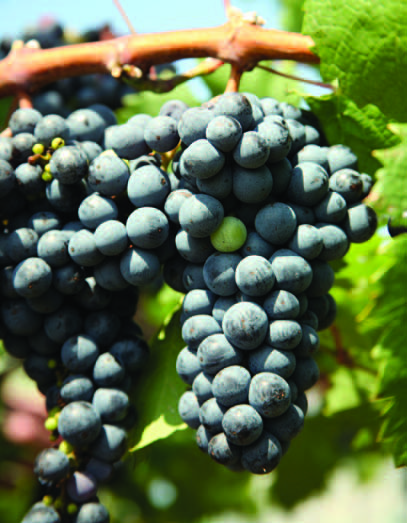
Maréchal Foch (Kuhlmann 188-2), usually referred to as simply Foch (FOE-sh), is an early-ripening, black grape with small berries and clusters. The vines are cold hardy and medium in vigor and production. Grafted vines are recommended to improve vigor, especially on heavy soils. Its small, black berries are attractive to birds. This variety is particularly sensitive to 2,4-D herbicide drift, which is commonly used in row crops, turf, and right-of-ways. Foch is one of the most popular red wine grapes grown in northern Indiana. Wine styles can range from fruity, light red table wines, to hearty, full-bodied reds.
Norton (aka Cynthiana) is a seedling of Vitis aestivalis, a species native to eastern North America. There is some disagreement as to its origin. Some claim it came from Virginia (Norton’s seedling) and others claim it originated in Arkansas (Cynthiana). That argument may never be solved and most growers today consider the varieties synonymous with each other. It is widely grown in Missouri and is known for excellent wine quality. The vine is vigorous, resistant to most diseases, and well-adapted to the region. It ripens late in the season so is best suited to southern Indiana. Both berries and clusters are small and yields can be low. Wine quality can be excellent with careful handling in the vineyard and winery.
Recently Introduced Varieties from Cornell University in New York
Noiret™ (NWAHR-ay) is a complex interspecific hybrid resulting from a cross between NY65.0467.08 (NY33277 x Chancellor) and Steuben. It is a mid- to late-season red wine grape suitable for the production of varietal wines. The distinctive red wine is richly colored and has aromas of green and black pepper along with raspberry, blackberry, and mint. A major distinguishing characteristic of this variety is its tannin structure, the absence of any hybrid aromas, and the low acidity at harvest. The vine is winter hardy and moderately resistant to powdery mildew and Botrytis bunch rot. The vine is productive with good vigor on a variety of soil types. It has performed very well in our trials in Indiana and is a good alternative to Chambourcin for the northern part of Indiana.
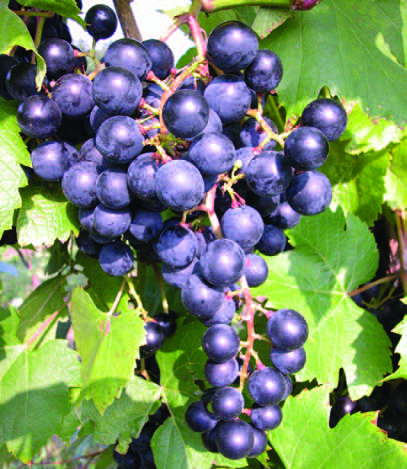
Corot noir™ (KOR-oh nwahr) is a complex interspecific hybrid resulting from a cross between Seyve Villard 18-307 and Steuben. It is a mid- to late-season red wine grape suitable for either blending or producing varietal wines. The wine has a deep red color, decent tannins, and attractive cherry and berry aromas. Its fruit ripens with relatively low acidity compared to other hybrids, resulting in wines that are not overly tart. The vine is winter hardy and moderately resistant to powdery mildew and Botrytis bunch rot. It is, however, susceptible to downy mildew and Phomopsis cane and leaf spot. Vines are vigorous on a wide range of soil types and quite productive. Like its half-sibling Noiret, it has performed well in our trials. One fault of this hybrid is its tendency to produce a secondary crop on summer lateral shoots.
Recently Introduced Varieties from the University of Minnesota
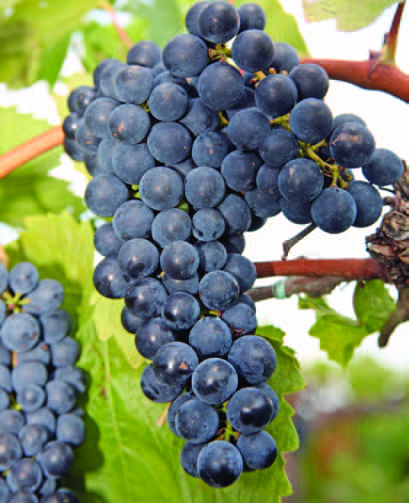
Frontenac (fron-tin-ACK) reflects the best characteristics of its parents, V. riparia 89 and the French hybrid Landot 4511. This vine is extremely winter hardy and has borne a full crop even after winter temperatures went as low as -33ºF. It is disease resistant with near immunity to downy mildew. Frontenac is productive, with small, black berries in medium to large clusters. Fruit ripens midseason with very high sugar and acid. Frontenac’s deep garnet color complements its distinctive cherry, blackberry, black currant, and plum aromas. This versatile grape can be made into a variety of wine styles, including rosés, reds, and Port style dessert wines. Because of its high acidity, it may be best suited to blending.
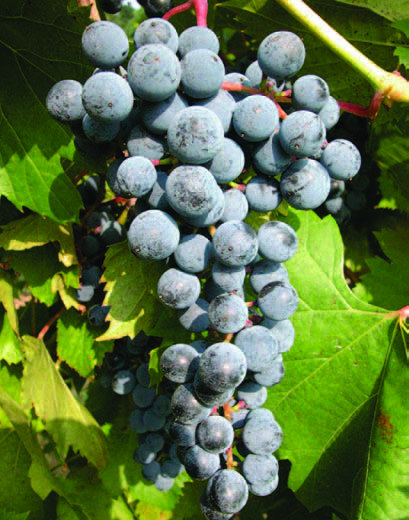
Marquette (mar-KETT) is a cousin of Frontenac and grandson of Pinot noir. It originated from a cross of MN 1094 (a complex hybrid of V. riparia, V. vinifera, and other Vitis species) and Ravat 262. Marquette has outstanding cold hardiness, and good resistance to downy mildew, powdery mildew, and black rot. Marquette’s high sugar and moderate acidity at ripeness make it very manageable in the winery. Finished wines are complex, with an attractive ruby color, pronounced tannins, and desirable aromas of cherry, berry, black pepper, and other spices. It has performed well in trials in Indiana and ripens early enough for production even in the northern part of the state.
Hybrid Varieties for White Wine Production
Seyval (SAY-vall) (Seyve Villard 5-276) is one of the most widely planted hybrid grapes east of the Rocky Mountains. When grapes are harvested at optimal maturity, wines have attractive aromas of honeysuckle, grapefruit, melons, and fresh-cut grass. The body tends to be thin, and either malolactic fermentation or barrel fermentation followed by oak aging will enhance mouthfeel. The vine tends to overbear and its clusters and shoots must be thinned to ensure proper ripening and vine size. Grafting is recommended on all but the most fertile sites. Fruit clusters are very susceptible to Botrytis bunch rot. In recent years, newer varieties have been replacing Seyval.
Vidal (vee-DAHL) (Vidal 256) is a productive white grape that produces excellent quality wine when the fruit reaches reasonable maturity. It requires sites with long growing seasons and moderate winter temperatures. Budbreak is late, which reduces the risk of spring freeze injury. It bears small berries on very large, loose, tapering clusters. Cluster thinning is sometimes required to prevent overcropping. The berries have thick skins, and fruit rots are seldom a problem, so the variety is often used in ice wine production, which requires long hang times. The variety lends itself to a number of other wine styles from sparkling and still wines to the production of brandy, as one of its parents is the grape of Cognac, Ugni blanc (St. Emilion).
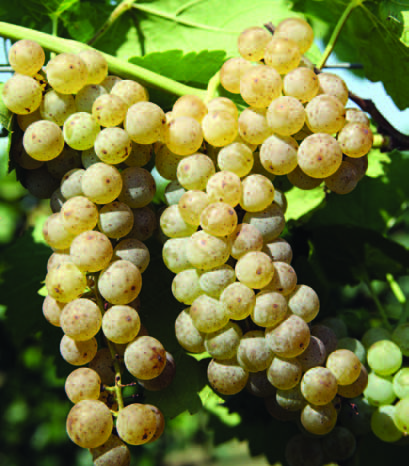
Vignoles (vin-YOLES) (Ravat 51) produces excellent wines of many different styles. It is favored for dessert wines, especially when picked late in the season. The fruit can develop a high sugar content while retaining high acidity. Vines are hardy with low to moderate vigor and productivity. Budbreak is late, reducing the risk of spring freeze injury. Its clusters are small, very compact, and highly susceptible to Botrytis bunch rot. Vine vigor can be poor on heavy soils, so grafting is recommended to increase vigor and yield.
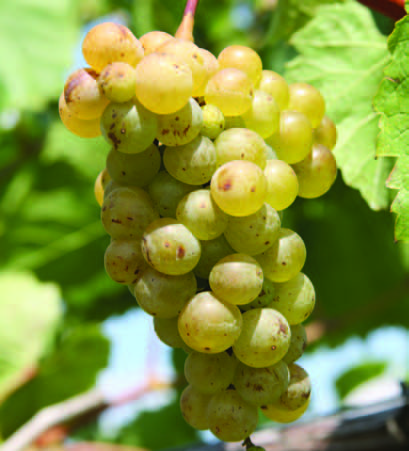
Traminette (tram-e-NET) was introduced by Cornell University in 1996 and has quickly become one of the top new white wine varieties in the region. Traminette resulted from a cross between Joannes Seyve 23.416 and Gewürztraminer. It is a mid-late season grape that produces wine with pronounced floral (roses and jasmine) and spicy (nutmeg, black pepper, cloves and cinnamon) varietal characteristics similar to its Gewürztraminer parent. Its vines are vigorous and moderately productive. Traminette’s cold hardiness is much better than that of it’s V. vinifera parent, Gewürztraminer, and appears to be sufficient for all regions of Indiana. Trunk injury on young vines has been observed occasionally. The fruit and wine qualities of Traminette have been excellent in our trials. Good fruit exposure is necessary for developing the varietal aroma compounds. Because the vine is vigorous, good canopy management is necessary. The vines are susceptible to downy mildew and Phomopsis cane and leaf spot, and the fruit is resistant to Botrytis bunch rot.
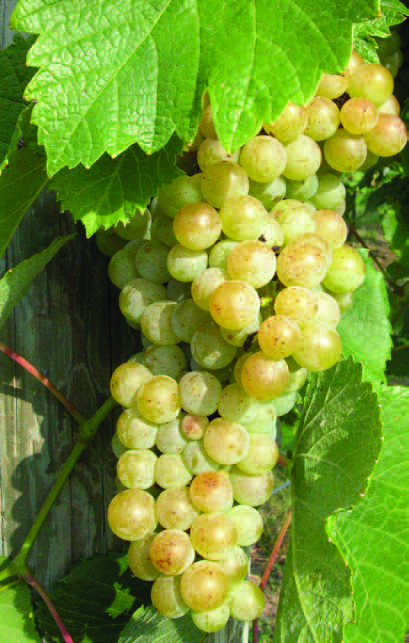
Chardonel (SHAR-doh-nell) (Plant patent 7860) was released by Cornell University in 1990 based on its superior performance in the Midwest. Its cold hardiness has been nearly as good as Seyval and it is widely grown in Indiana. Chardonel is cross of Seyval and Chardonnay, and produces an excellent wine when mature fruit are used, with aromas characteristic of both parents. Its potential for sparkling wine production appears to be good. It is susceptible to Phomopsis cane and leaf spot, which must be controlled to prevent fruit rots.
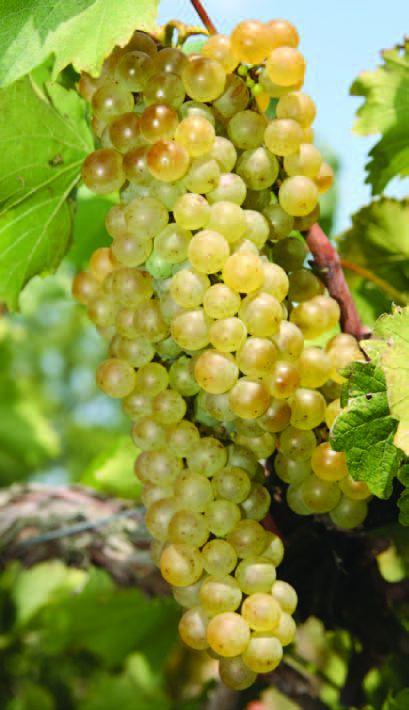
Cayuga White (kai-YU-guh wite), released by Cornell University in 1972, is one of the most productive and disease-resistant varieties grown in the Eastern United States. Its wines, which have medium body and acquire good balance between acid, alcohol, and residual sugar, have been highly rated. This versatile grape can be made into a semisweet wine, which brings out the fruit aromas, or, into a dry, less fruit-driven wine using oak aging. When harvested early, it may produce a very attractive sparkling wine with good acidity, good structure, and pleasant aromas. Its excellent cultural characteristics and high wine quality make it a recommended variety. It is not quite as cold hardy as other hybrids, so it may suffer winter injury in colder than average winters.
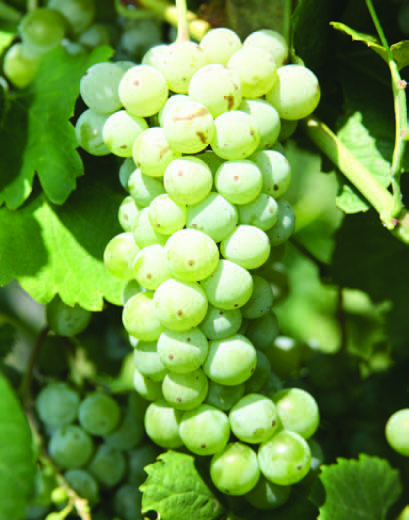
La Crosse (Plant patent 5588) is a fruity, white wine grape derived from Seyval, but its vine is more cold hardy, its fruit ripens slightly earlier, and its wine is somewhat fruitier than Seyval. La Crosse has performed very well in Indiana and is a good choice for the northern half of the state.
Recently Introduced Varieties from Cornell University in New York
Valvin Muscat™ (val-VEEN mus-CAT) is a complex interspecific hybrid resulting from a cross between Couderc 299-35 (Muscat du Moulin) and Muscat Ottonel. It is a midseason white wine grape with a distinctive muscat flavor. It is suitable for producing highly aromatic varietal wines or for blending. It is more winter hardy and disease resistant than pure V. vinifera muscat grapes. On their own roots, the vines are low in vigor, so grafting to a phylloxera-resistant rootstock such as 5C or Couderc 3309 is recommended.
Recently Introduced Varieties from the University of Minnesota
La Crescent (luh CREH-sant) combines St. Pepin and a Swenson selection from V. riparia x Muscat Hamburg. With this hardy heritage, La Crescent trunks have survived an amazing -36°F. Moderately disease resistant, its leaves sometimes exhibit downy mildew, which can be controlled with a standard spray program. Proper conditions and care result in very productive harvests. La Crescent’s intense nose of apricot, peach, and citrus lends itself to high-quality, off-dry or sweet white wines. Produced in a stainless steel, cold fermented style, La Crescent wine is reminiscent of Vignoles or Riesling. The grape’s high acidity provides good structure for fine dessert or late-harvest style wines.
Frontenac gris (frawn-tin-ACK GREE), the white wine version of Frontenac, started as a single bud mutation that yielded gray fruit (thus named gris) and initially amber-colored juice. The vine exhibits the same optimum growth characteristics as Frontenac and requires the same cultural practices. Arching canes and minimal tendrils provide easy training and pruning to simplify vine management. In Indiana, Frontenac and Frontenac gris ripen in late midseason and are good sugar producers with 24-25 Brix not uncommon. Frontenac gris wines present aromas of peach and apricot with hints of enticing citrus and tropical fruit. Its good balance of fruit and acidity creates lively, refreshing wines. Unique and complex flavors make this an excellent grape for table (dry or sweet, less than 14 percent alcohol), ice, and other dessert wines.
Leading American Varieties
American varieties are typically derived from the species Vitis labrusca, a grape native to the Eastern United States. These varieties are characterized by soft flesh and tough skins that separate readily from the flesh (slipskin). In addition, most varieties have a pronounced “grapey,” “foxy,” or “labrusca” flavor normally associated with this species.
While this flavor is preferred for juice, jelly, and jam, it is not always preferred for table wines. Wines made from American grapes are normally finished with some residual sweetness to balance the strong flavor — these wines are very popular in the Midwest.
Concord is grown on a greater variety of soils and under a wider range of climatic conditions than any other American grape variety. Its vine is vigorous and productive, ripening in mid- to late September in Indiana. It is the most important variety for sweet juice, jelly, and preserves, and it also is used in quantity for wine production and fresh market sales. Concord produces medium-sized clusters that bear large, blueblack berries. It is typical of the American V. labrusca derived grapes in that it has a tough skin that separates readily from the pulpy flesh (slipskin). Concord’s pronounced fruity labrusca (American) flavor makes it a desirable table grape.
Concord is best suited to the northern half of Indiana. In southern areas, it may exhibit a condition known as uneven ripening. Uneven ripening is a condition in which some of the berries within each cluster fail to ripen normally despite reaching full size, and instead remain green and hard. The condition appears to be physiological and only occurs on Concord grown in warm climates.
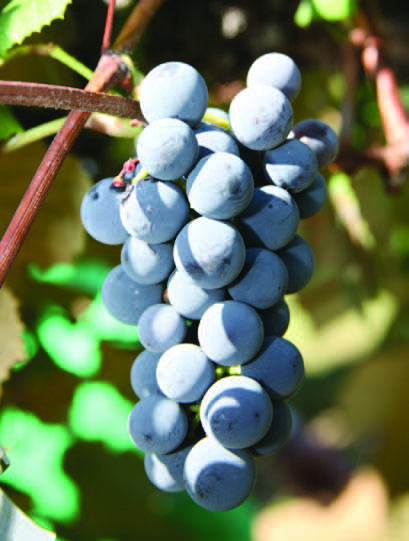
Catawba (kuh-TAW-buh), discovered in the early 1800s, is a spicy-flavored, slipskin grape with a pronounced labrusca flavor and aroma. The vines are vigorous, hardy, and productive, but the foliage is somewhat more susceptible to downy mildew than Concord. Ozone pollution also can cause foliar injury in Catawba. This grape is used primarily in white or pink dessert wines, but it also is used for juice production and fresh market sales. This grape was widely grown in the Cincinnati area during the mid-1800s.
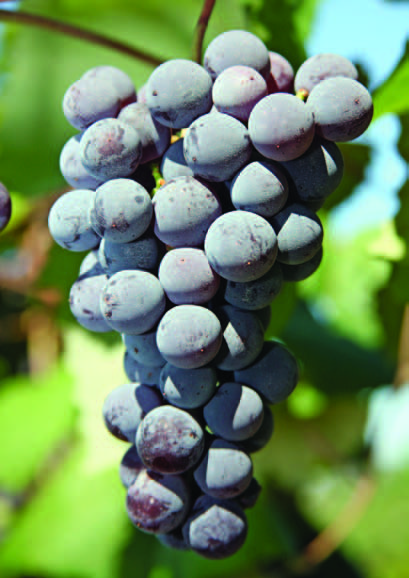
Niagara is a floral white grape with a strong labrusca flavor used for juice, wine, and fresh consumption. It is less cold hardy than Concord and ripens somewhat earlier. On favorable sites, yields can equal or surpass those of Concord. Its acidity is lower than most other American varieties. Niagara is more susceptible to black rot and downy mildew than Concord.
Steuben (STOO-bin) is a reddish-blue grape that produces long, tapering, compact clusters that are among the most attractive of all American varieties. The flavor is sweet with a spicy tang. The vines are hardy, vigorous, productive, and easily grown by home gardeners. Steuben is one of the most disease-resistant varieties available and usually requires cluster thinning. Steuben is grown commercially for wine production, especially in the northeast part of Indiana.
Other American Varieties
There are several other V. labrusca-derived varieties that are suitable for production in Indiana. Delaware, Fredonia, and Swenson Red have all performed well in our trials. There are many others available from commercial nurseries that should perform well in Indiana.
European (Vitis vinifera) Wine Grape Varieties
The first European colonists in North America attempted to grow European grapes but failed, as did all successive attempts until the 1960s. Invariably, the vineyards failed because of winter cold injury and several underlying factors contributed to poor cold hardiness.
The major reason V. vinifera vines failed is that they are generally less cold hardy than American grape species.
European grape varieties also have little or no inherent resistance to several pests and diseases native to the Eastern and Midwestern United States, including grape root aphid, phylloxera, and several fungal diseases (powdery mildew, black rot, and downy mildew). This lack of resistance killed many vines outright, and weakened many others, making them more susceptible to cold damage. It was not until breeders identified satisfactory phylloxera-resistant rootstocks and researchers developed modern fungicides that even the limited potential cold hardiness of these varieties could be attained in the field.
Another important factor that limited the success of these old varieties was the health of the nursery stock from which they were produced. During its many centuries of culture, certain virus and virus-like diseases have become widespread in V. vinifera. In regions with less stringent climates, such as California, these diseases may have only marginal impact on yield or grape quality. It has been suggested that the vines may even benefit from a dwarfing effect.
In Eastern and Midwestern climates, however, anything that detracts from normal vine function is likely to reduce winter cold tolerance. Certified planting stock that has been tested for known virus pathogens is now available. There are a number of clones available of most vinifera varieties.We do not have sufficient experience to recommend specific clones.
It is important to recognize the vulnerability of European grape varieties. Only sites that promote good vine function, such as good soil and air drainage, moderate soil fertility, and long growing seasons, should be used for V. vinifera. In addition, growers must use stringent measures to control diseases and insects, employ superior pruning and training methods, and practice canopy management techniques that will enhance wood maturity and minimize disease.
Vitis vinifera Varieties for White Wine Production
Chardonnay (SHAR-doh-NAY) is probably the most widely planted V. vinifera variety in the Eastern United States. It is cold hardy, but not as hardy as Riesling or Cabernet franc. Its advantages include high quality wines, early and reliable fruit and wood maturity, and moderate vigor. Its primary disadvantage is its relatively high susceptibility to Botrytis bunch rot. For that reason, vertical shoot training combined with summer pruning and leaf removal are necessary for best results.
Riesling (REECE-ling) is planted widely because of its relative cold hardiness and excellent quality wines. Its major disadvantages are the fruit’s susceptibility to Botrytis bunch rot and the variety’s relatively late harvest date. Although used in certain parts of the world to make extraordinary, late-harvest “botrytized” dessert wines, Botrytis infections of Riesling (and other) grapes grown under Indiana conditions do not normally constitute desirable “noble rot.” Riesling’s susceptibility to bunch rot dictates the use of additional canopy management techniques such as leaf removal and extra sprays.
Pinot gris (PEE-no GREE) (grigio) is the “gray” (light red) form of Pinot noir. It is being grown in more Midwest locations and appears to be hardier than Pinot noir. It also appears to resist bunch rot. Pinot gris makes a fullbodied white wine. It offers an interesting alternative to Chardonnay or Riesling for high-quality wine production.
Leading Vitis vinifera Varieties for Red Wine Production
Cabernet Franc (CAB-er-NAY frahnk) can be considered the most suitable red vinifera variety in very cool climates. A parent to Cabernet Sauvignon, it is the preferred red grape variety in one of France’s most northern grape growing areas, the Loire Valley, because it is the most cold hardy V. vinifera variety. The fruit ripens earlier and may produce good-quality wines more consistently than Cabernet Sauvignon.
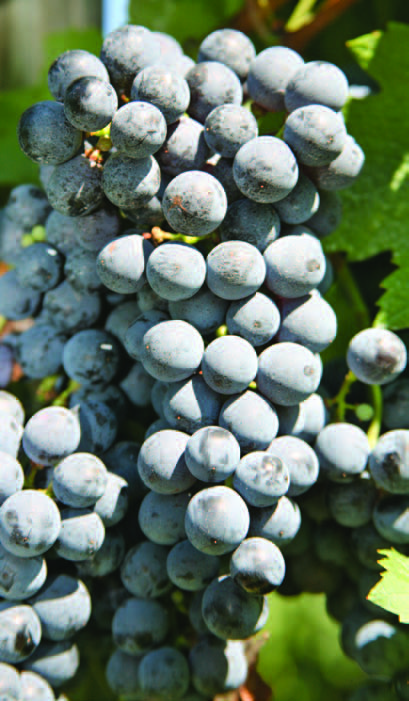
Cabernet Sauvignon (CAB-er-NAY SAHV-een-YON), the main variety of many of the great wines of Bordeaux, is also one of the most cold hardy and disease-resistant V. vinifera varieties. However, it ripens late and satisfactory sugar concentration (Brix) is rarely attained. Sugar alone does not determine wine quality, but consistently good wines can be produced only in the warmer production areas in Indiana. In shorter season areas, a green bell pepper aroma dominates the typical varietal aroma of the wines.
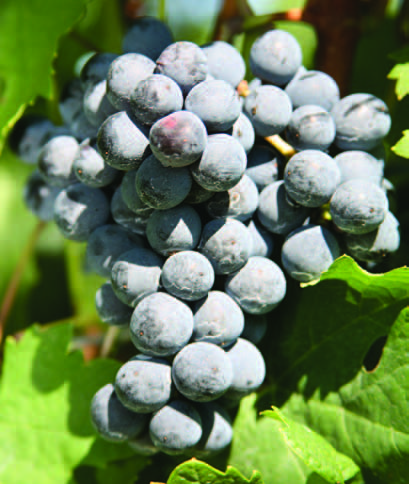
Lemberger (LEHM-ber-gur) is grown under several different names in Europe’s northern wine production areas (for example, it’s called Blaufränkisch in Austria). It has not been widely grown commercially, but to date, results have been favorable in southern Indiana. Lemberger’s cold hardiness appears acceptable, and its Botrytis resistance is good. Its clusters are large and its yield potential is high, which may dictate the need for crop control in some years. Lemberger wines have been rated highly and can have deep red color and sufficient tannins.
Sunbelt is a Concord-type grape variety developed by the University of Arkansas. Sunbelt withstands high summer temperatures better than Concord and does not exhibit the uneven ripening phenomenon so common to Concord grown in warm areas. Sunbelt is cold hardy and more disease resistant than Concord.
Table Grape Varieties for Indiana
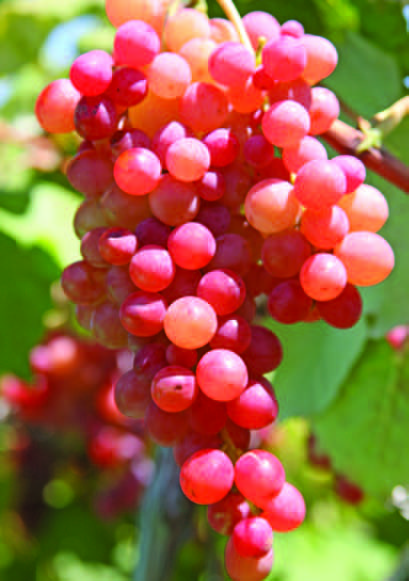
Many consumers prefer seeded and seedless table grapes for fresh eating and for making jams, jellies, and pies. Table grape production requires more attention to detail than wine or juice grape production because table grape clusters must be well-filled with large berries and the fruit must be free from all rot and insect damage to meet consumer demands.
Growers are often required to girdle canes, apply gibberellic acid, and thin clusters to produce high quality table grapes. Table grapes are best suited for local farmers markets and pick-your-own sales due to their short post-harvest shelf life.
The traditional V. vinifera table grapes grown in California such as Thompson Seedless and Flame Seedless are not hardy enough for Indiana. Only seedless table grapes specifically developed for production in the Eastern United States should be considered.
Seeded Grapes
Golden Muscat produces very large clusters of large, oval, amber berries. The late-ripening fruit may be high in acid if not fully ripened and its clusters are susceptible to bunch rot. The flavor is a rich combination of muscat and labrusca grape types. The vine is moderately hardy and productive.Wine producers also use this variety.
Steuben, mentioned earlier under American wine grapes, also is a popular table grape.
Swenson Red produces large bunches with large, red berries that may turn reddish-blue if harvested late. The variety easily withstands winters throughout Indiana. The berries are medium to large, firm in texture, and have an adherent skin. The flavor is mildly fruity and pleasant. However, downy mildew infections can be severe. The University of Minnesota and private grape breeder Elmer Swenson of Osceola,Wisconsin released this variety jointly in 1980.
Seedless Grapes
Grape breeders have responded to consumer preferences for seedless grapes by developing numerous improved varieties. Breeders originally derived the seedless trait in grapes from cultivars of ancient origin such as Sultanina (Thompson Seedless) and Black Monukka. Most seedless grapes suitable for the Eastern and Midwestern United States are descended from crosses with these two cultivars. But because the seedless trait originated in cultivars unsuited to cold, Midwestern winters, many seedless varieties are only marginally winter hardy, although they are much hardier than their parents.
Recently named seedless cultivars (Mars, Reliance, Marquis, and Vanessa) represent a distinct improvement in cold hardiness. Breeding programs in New York, Ontario, Arkansas, and elsewhere continue to produce seedless selections with improved hardiness and quality.
The degree of seedlessness varies greatly among seedless grape varieties. Most seedless grapes have vestigial seed traces that range from very small to large and noticeable. Even in berries of the same variety, seed traces may vary greatly in size and in seed coat hardness. Climate also is known to affect trace size. Occasionally, consumers find the seed traces in some seedless grapes large enough to be objectionable.
Skin cracking can be a problem with some varieties when rain occurs near harvest. The thin skins and high sugar content of seedless varieties make the berries particularly susceptible to cracking as water moves into the berry after rainfall.Very little can be done to reduce cracking and fruit quality is severely compromised if cracking occurs.
Himrod was released from the Cornell University grape breeding program in 1952. It produces large bunches of white, seedless grapes with an excellent, honey-like flavor and melting, juicy texture. The clusters are loosely filled, but growers may girdle canes, make gibberellic acid treatments, or thin clusters to increase cluster compactness and improve berry size. Himrod has a brittle rachis (stem), which may break when handled, and the berries may fall off (shell) in storage. Its vines are moderately cold hardy.
Mars (Plant patent 5680), a release from the University of Arkansas, is a vigorous, blue, seedless grape. The flavor is mildly labrusca-like, and has slipskin berries. Mars clusters are medium sized, cylindrical, and well-filled. Its cold hardiness has been very good in Indiana, and its vines are resistant to the major leaf diseases. The vines may bear fruit precociously, so growers should control production on young vines to prevent delays in establishment. Mars has been recommended as a home garden grape, but has shown potential for commercial marketing. It makes excellent pies and preserves. Fruit cracking is not a problem.
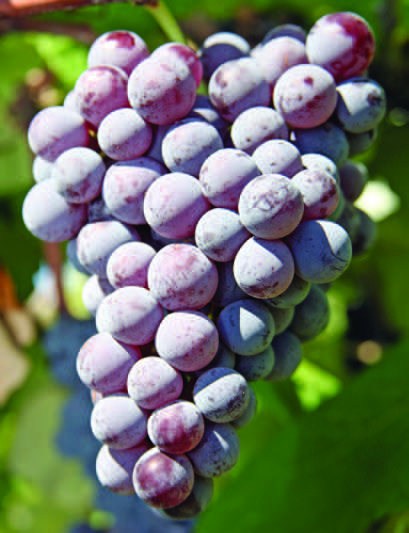
Jupiter (Plant patent 13309) produces large, oval, firm, seedless, dark red berries on medium-sized clusters. Maturity is early to midseason. It has an excellent flavor, with a mild muscat character. Jupiter is very productive and often requires cluster thinning. It is more winter hardy than Marquis and Himrod, but not as hardy as Reliance and Mars. Growers must control downy mildew for best results, and fruit cracking can be a problem in wet years.
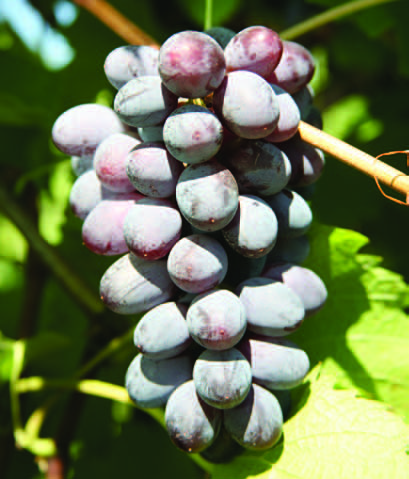
Marquis (Plant patent 11,012) was named and released by Cornell University in 1996. Its clusters are very large, medium compact, and attractive, with large, round, yellow-green berries. It has a melting texture, and is very flavorful. Ripe fruit holds well on the vine, and it goes from a mild, fruity flavor when first ripe, to a stronger labrusca flavor two weeks later. Gibberellic acid treatment is not recommended, but well-timed cluster thinning and cane girdling can increase berry size and improve cluster compactness. Marquis vines are moderately hardy, medium in vigor, and productive. Its main fault is its susceptibility to fungal diseases, but with a good spray program, this variety has excellent potential.
Neptune (Plant patent 12,302), a 1998 release from the University of Arkansas, is a yellow-green, seedless grape cultivar of moderate vigor. The clusters are large and very showy, but its productivity is moderate. It has a mild and fruity flavor, with a firm fruit texture and relatively thick skin. There is little experience growing Neptune in Indiana and it appears to be only moderately winter hardy, making it best adapted to the southern part of the state. It matures mid- to late season.
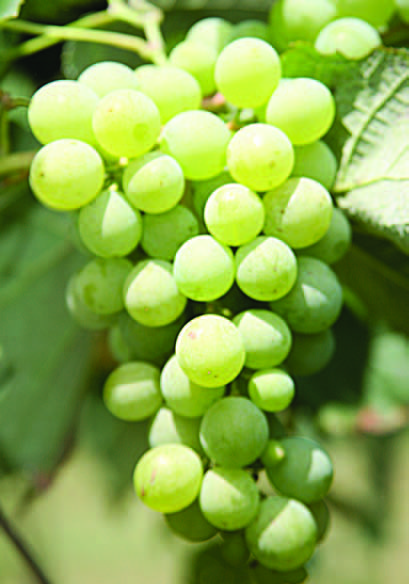
Reliance (Plant patent 5174), also a variety from the University of Arkansas, produces large clusters of round, red, medium-sized berries. The skins are tender and the flesh is melting in texture, with a sweet labrusca flavor. In warm years, it may have poor coloring, and in wet seasons, the fruit often cracks. However, its cold hardiness is among the highest of the seedless varieties. Growers must control downy mildew for best results.
Suffolk Red produces medium to large clusters of mildflavored, red berries. The clusters are loose but may be made more compact by applying gibberellic acid or girdling canes. It has moderate cold hardiness, and may experience excessive vine vigor following poor crops and winter bud damage.
Vanessa was developed in Ontario, Canada, and is a red grape of excellent quality. It has medium-sized berries and clusters. The flavor is mild and fruity, and its texture is firm to crisp. The vine is moderately vigorous and hardy. Grafting may be desirable on many sites to increase vine size. Vigorous vines have shown poor fruit set and loosely filled clusters, but cane girdling, gibberellic acid treatments, or thinning may be used to increase cluster compactness and improve berry size. The seed remnant is usually large and soft; when noticeable it is sometimes a cause for limited marketability. It has good storage potential and the fruit quality is among the best of the red seedless types.
Summary
Selecting the appropriate grape variety is a key to successful production in Indiana and all parts of the Midwest. Among the dozens of varieties that are adapted to the Midwest climate are types suitable for juice, wine, and table use.
Remember, the major climactic factors to consider when selecting a variety are winter cold, spring frosts, length of the growing season and heat accumulation, and rainfall during the ripening period. It’s also important to pay attention to the major disease problems that can affect grapes: black rot, powdery mildew, downy mildew, and Phomopsis.
Growers who take these factors into account when selecting a variety, will have a much better chance of success.
Find Out More
The Purdue Fruit and Vegetable Connection aims to provide the most up-to-date, useful information for Indiana’s commercial fruit and vegetable producers.Visit HLA Extension: Fruit Crops and follow the fruit crops link to grapes.
Other grape publications include:
- Growing Grapes in Indiana (Purdue Extension publication HO-45-W)
- Controlling Pests in the Home Fruit Planting (Purdue Extension publication ID-146)
- Midwest Grape Production Guide (Ohio State University Extension bulletin 919-05)
- Midwest Small Fruit Pest Management Handbook (Ohio State University Extension bulletin 861)
Purdue Extension publications are available from the Purdue Extension Education Store.
Ohio State University Extension publications are available from Ohioline.
TABLE 1. RELATIVE SUSCEPTIBILITY OF GRAPE VARIETIES
(1) WH=winter hardiness ratings (temperatures in parentheses indicate critical temperature for bud survival).
- 1=too tender for all but a few select sites (0˚F)
- 2=tender (-5˚F)
- 3=slightly hardy (-10˚F)
- 4=moderately hardy (-15˚F)
- 5=hardy (-20˚F)
- 6=very hardy (-25˚F)
- Indiana climate falls within two USDA hardiness zones: 5 (-10 to -20˚F) and 6 (0 to -10˚F).
(2) Disease ratings.
- +=slightly susceptible or sensitive;
- ++=moderately susceptible or sensitive;
- +++=highly susceptible or sensitive;
- ?=relative susceptibility or sensitivity not established.
BR = Black rot, DM = Downy mildew, PM = Powdery mildew, BOT = Botrytis, PHOM = Phomopsis, EU = Eutypa, CG = Crown gall
(3) Sulfur=sensitivity to sulfur spray injury.
| Sensitivity | |||||||||
|---|---|---|---|---|---|---|---|---|---|
| Variety | WH (1) | BR (2) | DM (2) | PM (2) | BOT (2) | PHOM (2) | EU (2) | CG (2) | Sulfur (2) |
| Wine and Juice Grapes | ㅤ | ㅤ | ㅤ | ㅤ | ㅤ | ㅤ | ㅤ | ㅤ | ㅤ |
| Cabernet Franc | 3 | +++ | +++ | +++ | + | ? | +++ | +++ | No |
| Cabernet Sauvignon | 2 | +++ | +++ | +++ | + | +++ | +++ | +++ | No |
| Catawba | 5 | +++ | +++ | ++ | + | +++ | + | + | No |
| Cayuga White | 4 | + | ++ | + | + | + | + | + | No |
| Chambourcin | 3 | +++ | ++ | + | ++ | ? | ? | ++ | Yes |
| Chardonel | 4 | ? | ++ | +++ | ++ | ? | ? | ++ | No |
| Chardonnay | 2 | ++ | +++ | +++ | +++ | +++ | ++ | +++ | No |
| Concord | 5 | +++ | + | ++ | + | +++ | +++ | + | Yes |
| Corot noir | 5 | + | +++ | + | + | + | + | + | No |
| Frontenac | 6 | ++ | + | ++ | ++ | + | ? | + | No |
| Frontenac gris | 6 | ++ | + | ++ | ++ | + | ? | + | No |
| La Crescent | 6 | ++ | ++ | ++ | + | + | ? | + | ? |
| La Crosse | 6 | +++ | + | ++ | +++ | ? | ? | + | ? |
| Lemberger | 2 | +++ | +++ | +++ | + | ? | +++ | +++ | No |
| Maréchal Foch | 6 | ++ | + | ++ | + | ? | +++ | + | Yes |
| Marquette | 6 | + | + | + | ++ | ++ | ? | + | ? |
| Niagara | 4 | +++ | +++ | ++ | + | +++ | + | ++ | No |
| Noiret | 5 | ++ | ++ | ++ | + | + | ? | ++ | No |
| Norton (Cynthiana) | 5 | + | + | + | + | ++ | ? | + | Yes |
| Pinot gris | 2 | +++ | +++ | +++ | ++ | ? | +++ | +++ | No |
| Riesling | 3 | +++ | +++ | +++ | +++ | ++ | ++ | +++ | No |
| Seyval | 5 | +++ | ++ | +++ | +++ | + | + | +++ | No |
| Steuben | 5 | ++ | ++ | + | + | + | ? | + | No |
| Traminette | 4 | + | ++ | + | + | +++ | ? | ++ | No |
| Vidal | 3 | + | ++ | +++ | + | + | + | +++ | No |
| Vignoles | 5 | + | ++ | +++ | +++ | ++ | ++ | +++ | No |
| Table Grapes | ㅤ | ㅤ | ㅤ | ㅤ | ㅤ | ㅤ | ㅤ | ㅤ | ㅤ |
| Golden Muscat | 3 | ? | ++ | ++ | +++ | ? | ? | + | No |
| Himrod | 4 | +++ | + | ++ | + | ? | ? | + | No |
| Jupiter | 4 | ++ | +++ | +++ | + | + | ? | ? | ? |
| Marquis | 4 | + | +++ | + | + | +++ | ? | ? | ? |
| Mars | 4 | + | + | + | + | ? | ? | + | No |
| Neptune | 3 | ++ | ++ | ++ | + | ++ | ? | ? | ? |
| Reliance | 4 | +++ | ++ | ++ | +++ | ? | ? | + | ? |
| Suffolk Red | 3 | ? | + | ++ | ++ | ? | ? | ++ | Yes |
| Sunbelt | 5 | + | ++ | ++ | + | + | ? | ? | ? |
| Swenson Red | 5 | ? | +++ | ++ | ++ | ? | ? | + | ? |
| Vanessa | 4 | +++ | ++ | ++ | + | + | ? | ++ | ? |
TABLE 2. GRAPE VARIETY PERFORMANCE IN SOUTHWEST INDIANA (1)
(1) Data averaged over 14 years (1995-2008) for most varieties. Trials performed at the Southwest Purdue Agriculture Center, Vincennes, Indiana.
(2) Yield in pounds per vine can be converted to pounds per acre. At standard 8 x 10 spacing, there are 545 vines per acre. So a variety that with a yield of 10 pounds per vine would yield 2.7 tons per acre.
(3) 1 pound=454 grams. Clusters that weigh about 150 grams are approximately 1/3 pound.
(4) Berry weights are relative to variety type. Wine grape varieties are selected for small berries to increase skin to pulp ratio. Table and juice grapes tend to have much larger berries.
(5) Juice chemistry parameters: Brix=percent sugar content; pH=juice pH (strength of acid); TA=juice titratable acidity (amount of acid). These parameters are important in wine making, and perception of flavor.
(6) Pruning weight. This is provided as pounds of 1-year-old canes pruned. The appropriate range is 1-3 pounds. A pruning weight less than 1 pound indicates low vigor and weak growth, or considerable fall dieback of canes. Pruning weights greater than 3 pounds indicate very high vigor.
(7) Crop Load is the ratio of yield (yld) to pruning weight (pw), which is a measure of vine balance. The appropriate range is 8-12. Higher ratios indicate that too much fruit was retained per vine (often due to large cluster size), or low pruning weight because of fall dieback of canes. Low ratios indicate low fruitfulness relative to vegetative vigor. It is important to note that these yield figures have been adjusted through pruning and cluster thinning. Many varieties would over crop if improperly pruned or cluster thinning was not performed. Growers should use these data as a general guideline only.
| Variety | Average Harvest Date | Yield (2) (lbs/vine) | Cluster Weight (3) (g) | Berry Weight (4) (g) | Brix (5) | pH (5) | TA (5) (g/L ml) | Pruning Weight (6) (lb/vine) | Crop Load (7) (yld/pw) |
|---|---|---|---|---|---|---|---|---|---|
| Cayuga White | 8/27 | 27.2 | 206.5 | 2.9 | 17.7 | 3.22 | 7.7 | 1.0 | 27.2 |
| Chambourcin | 9/14 | 18.8 | 189.9 | 2.4 | 20.7 | 3.28 | 9.1 | 1.1 | 17.1 |
| Chardonel | 8/27 | 14.3 | 173.6 | 2.1 | 21.0 | 3.15 | 10.6 | 0.9 | 15.9 |
| Concord | 9/8 | 23.0 | 143.4 | 3.6 | 16.4 | 3.51 | 5.1 | 4.0 | 5.8 |
| Corot noir | 9/3 | 18.3 | 225.2 | 2.6 | 17.7 | 3.28 | 10.0 | 2.0 | 9.2 |
| Foch | 8/20 | 23.5 | 95.5 | 1.2 | 19.9 | 3.42 | 9.4 | 2.2 | 10.7 |
| Frontenac | 8/19 | 12.2 | 128.6 | 1.2 | 22.3 | 3.38 | 12.6 | 1.2 | 10.2 |
| Frontenac gris | 8/23 | 8.5 | 96.4 | 1.1 | 25.3 | 3.51 | 10.6 | 0.6 | 14.2 |
| Jupiter | 8/22 | 12.7 | 161.9 | 4.2 | 20.5 | 3.62 | 4.0 | 0.6 | 21.2 |
| La Crescent | 8/19 | 8.6 | 82.4 | 1.3 | 24.1 | 3.43 | 12.2 | 1.6 | 5.4 |
| La Crosse | 8/21 | 20.9 | 115.9 | 1.7 | 17.9 | 3.25 | 9.2 | 2.4 | 8.7 |
| Marquis | 8/30 | 17.6 | 225.4 | 4.0 | 17.5 | 3.42 | 5.8 | 2.0 | 8.8 |
| Neptune | 8/29 | 13.8 | 297.0 | 3.9 | 18.3 | 3.31 | 7.9 | 0.9 | 15.3 |
| Noiret | 9/9 | 20.0 | 209.6 | 2.1 | 17.6 | 3.27 | 7.2 | 3.7 | 5.4 |
| Norton (Cynthiana) | 9/18 | 17.2 | 91.5 | 1.1 | 21.2 | 3.38 | 8.8 | 3.2 | 5.4 |
| Seyval | 8/24 | 22.0 | 204.5 | 1.9 | 19.5 | 3.24 | 7.6 | 0.9 | 24.4 |
| Steuben | 9/1 | 26.2 | 251.8 | 3.4 | 18.5 | 3.40 | 4.5 | 1.7 | 15.4 |
| Suffolk Red | 8/27 | 11.0 | 156.9 | 3.0 | 21.0 | 3.32 | 5.5 | 1.1 | 10.0 |
| Sunbelt | 8/31 | 10.4 | 119.2 | 4.5 | 17.9 | 3.43 | 5.8 | 1.5 | 6.9 |
| Traminette | 9/2 | 16.5 | 144.8 | 1.8 | 18.9 | 3.21 | 7.1 | 3.1 | 5.3 |
| Valvin Muscat | 8/25 | 17.5 | 101.8 | 2.5 | 15.9 | 3.39 | 8.1 | 1.9 | 9.2 |
| Vidal | 9/4 | 20.4 | 195.9 | 1.9 | 19.9 | 3.13 | 7.5 | 1.2 | 17.0 |
| Vignoles | 8/23 | 15.0 | 110.9 | 1.5 | 21.4 | 3.16 | 2.7 | 1.9 | 7.9 |
TABLE 3. GRAPE VARIETY PERFORMANCE IN WEST CENTRAL INDIANA
(1) Data averaged over seven years (2002-2008) for most varieties. Trials performed at the Meigs Memorial Horticulture Research Farm, Lafayette, Indiana.
(2) Yield in pounds per vine can be converted to pounds per acre. At standard 8 x 10 spacing, there are 545 vines per acre. So a variety that with a yield of 10 pounds per vine would yield 2.7 tons per acre.
(3) 1 pound=454 grams. Clusters that weigh about 150 grams are approximately 1/3 pound.
(4) Berry weights are relative to variety type. Wine grape varieties are selected for small berries to increase skin to pulp ratio. Table and juice grapes tend to have much larger berries.
(5) Juice chemistry parameters: Brix=percent sugar content; pH=juice pH (strength of acid); TA=juice titratable acidity (amount of acid). These parameters are important in wine making, and perception of flavor.
(6) Pruning weight. This is provided as pounds of 1-year-old canes pruned. The appropriate range is 1-3 pounds. A pruning weight less than 1 pound indicates low vigor and weak growth, or considerable fall dieback of canes. Pruning weights greater than 3 pounds indicate very high vigor.
(7) Crop Load is the ratio of yield (yld) to pruning weight (pw), which is a measure of vine balance. The appropriate range is 8-12. Higher ratios indicate that too much fruit was retained per vine (often due to large cluster size), or low pruning weight because of fall dieback of canes. Low ratios indicate low fruitfulness relative to vegetative vigor. It is important to note that these yield figures have been adjusted through pruning and cluster thinning. Many varieties would over crop if improperly pruned or cluster thinning was not performed. Growers should use these data as a general guideline only.
| Variety | Average Harvest Date | Yield (2) (lb/vine) | Cluster Weight (3) (g) | Berry Weight (4) (g) | Brix (5) | pH (5) | TA (5) (g/L ml) | Pruning Weight (6) (lb/vine) | Crop Load (7) (yld/pw) |
|---|---|---|---|---|---|---|---|---|---|
| Cayuga White | 9/7 | 23.5 | 154.7 | 2.8 | 19.1 | 3.21 | 8.8 | 1.1 | 21.4 |
| Chardonel | 9/19 | 13.6 | 151.3 | 2.0 | 21.9 | 3.26 | 9.2 | 0.7 | 19.4 |
| Concord | 9/22 | 19.8 | 104.3 | 3.1 | 18.0 | 3.66 | 2.5 | 1.1 | 18.0 |
| Corot noir | 9/20 | 17.7 | 147.8 | 2.3 | 19.0 | 3.46 | 6.0 | 1.1 | 16.1 |
| Foch | 9/5 | 8.1 | 50.4 | 0.9 | 23.3 | 3.39 | 8.6 | 0.7 | 11.6 |
| Frontenac | 9/15 | 8.7 | 79.7 | 1.0 | 22.7 | 3.36 | 15.7 | 1.0 | 8.7 |
| Frontenac Gris | 9/11 | 9.0 | 87.0 | 1.1 | 24.1 | 3.37 | 13.7 | 0.9 | 10.0 |
| Jupiter | 9/2 | 13.4 | 139.3 | 3.3 | 19.7 | 3.43 | 4.9 | 0.7 | 19.1 |
| La Crescent | 9/5 | 11.4 | 76.1 | 1.3 | 22.6 | 3.39 | 14.4 | 1.3 | 8.9 |
| La Crosse | 9/4 | 9.0 | 80.1 | 1.4 | 21.2 | 3.28 | 8.5 | 1.0 | 9.0 |
| Mars | 9/18 | 18.1 | 147.4 | 3.5 | 18.7 | 3.41 | 4.4 | 2.8 | 6.5 |
| Marquette | 9/8 | 5.5 | 58.7 | 1.0 | 25.5 | 3.37 | 9.7 | 1.0 | 5.5 |
| Noiret | 10/1 | 14.8 | 142.3 | 2.1 | 19.9 | 3.24 | 6.8 | 2.7 | 5.5 |
| Norton (Cynthiana) | 10/3 | 11.1 | 66.6 | 1.0 | 23.5 | 3.38 | 10.0 | 1.6 | 6.9 |
| Seyval | 9/12 | 11.2 | 120.7 | 1.7 | 21.7 | 3.35 | 7.5 | 0.5 | 22.4 |
| Steuben | 9/23 | 20.4 | 182.7 | 3.3 | 20.4 | 3.44 | 4.3 | 1.0 | 20.4 |
| Sunbelt | 9/25 | 12.0 | 117.0 | 4.1 | 18.3 | 3.42 | 3.8 | 1.6 | 7.5 |
| Traminette | 9/15 | 13.8 | 102.4 | 1.8 | 21.6 | 3.28 | 6.2 | 1.8 | 7.7 |
| Valvin Muscat | 9/25 | 13.2 | 68.9 | 1.2 | 24.0 | 3.31 | 8.8 | 1.2 | 11.0 |
| Vanessa | 9/14 | 8.0 | 110.0 | 2.3 | 19.5 | 3.76 | 2.5 | 0.5 | 16.0 |
| Vidal | 9/29 | 19.4 | 153.5 | 1.7 | 23.4 | 3.29 | 7.5 | 1.0 | 19.4 |
| Vignoles | 9/22 | 6.8 | 85.4 | 1.2 | 24.4 | 3.30 | 10.5 | 0.5 | 5.7 |