

Introduction
Plants obtain nearly all their nutrients from the soil, but not all the nutrients present in the soil are accessible to plants. That’s because soil pH affects the form and, therefore, solubility of nutrients (Figure 1). High soil pH will lead to deficiencies of micronutrients such as iron and manganese, whereas low soil pH can lead to toxicities of certain elements such as aluminum.
This publication describes what soil pH is, how it is measured, and how it affects plants.
Authors
Michael V. Mickelbart and Kelly M. Stanton, Purdue Horticulture and Landscape Architecture
James J. Camberato, Purdue Agronomy
Brad D. Lee, University of Kentucky Department of Plant and Soil Sciences
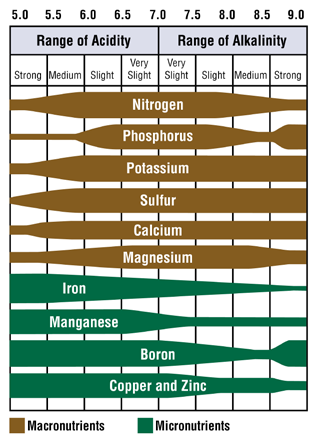 , opens larger image Figure 1. This graph shows how nutrient availability changes with the pH of mineral soils. Nutrients are most available when the band is wide. When the band is narrow, the nutrients are less available. Graphic adapted from the Corn & Soybean Field Guide (Purdue Extension publication ID-179). Source: Brady and Weil, 2007.
 The pH is the concentration (number) of hydrogen ions (H+). It is calculated by the following equation:
pH = -log10[H+]
The more acidic a solution is, the higher the concentration of H+ ions it contains. The pH scale is logarithmic, which means that soil with a pH value of 6 is 10 times more acidic than a soil with a pH value of 7 and 100 times more acidic than a soil with a pH value of 8.
How Is Soil pH Measured?
The pH of a soil solution can be measured with pH meters, which range from expensive, very accurate lab instruments to relatively cheap and portable field-ready meters. A pH meter consists of a glass electrode that changes its voltage output in response to the pH of the solution in which it is immersed. The instrument compares the changed output to the constant voltage of a reference electrode that is calibrated with solutions of known pH values.
To use one of these meters, insert the probe into a solution made from the soil sample — for more information, see Commercial Greenhouse Production: pH and Electrical Conductivity Measurements in Soilless Substrates, Purdue Extension publication HO-237-W, available from the Education Store.
Dye-based methods are also available, but are less precise. They are similar to the pH strips used to test the pH of swimming pools or aquariums.
How and where the soil sample is obtained is important. Soil pH can change with the horizontal location in the landscape and soil depth. It’s best to obtain soil samples from the rooting zone of the plants of interest. For example, if you collect a sample where turf grass is grown, collect the soil from a shallower depth than you would for an area where trees are grown. It is a good practice to combine several soil samples from the planting area to obtain a representative sample.
You can send soil samples to a commercial laboratory to determine pH. Your Purdue Extension county office can provide you with the name of a reputable lab (to find your county office, visit www.extension.purdue.edu/counties.html). Before sending any sample, be sure to follow the lab’s sampling instructions — improper sampling is often the greatest source of error in soil testing.
What Is the Difference Between pH and Buffer pH?
Soil pH is a measure of the concentration of hydrogen ions in the soil solution. It describes the acidity the roots experience.
Buffer pH (also referred to as reserve or stored acidity) is a measures of the soil pH in a weak base (pH 8 in some methods). Certain kinds of soil particles tend to “store” acidity more than others — that is, some soil particles have a reserve supply of acidic ions bound to them. To change the soil pH effectively, this reserve supply of acids bound in the soil must be neutralized along with the free acids in the soil.
The buffer pH value accounts for this difference. Soils that have a lower buffer pH value require more lime to neutralize the acidity than soils with a higher buffer pH value. For example, a soil that has a buffer pH of 7.2 will require more lime to neutralize than a soil with a buffer pH of 7.7.
How Does pH Affect Plants?
A soil’s pH is one of a number of environmental conditions that affect the quality of plant growth. Soil pH directly affects nutrient availability and can influence plant growth (Figure 1).
Plants require 17 different nutrients to grow. Three elements — nitrogen (N), phosphorus (P), and potassium (K) — are required in comparatively large amounts. They are called macronutrients and are frequently applied as fertilizers. Plants require micronutrients in smaller amounts but these nutrients are just as vital to plant growth. When the supply of any nutrient is less than the plant requires, plant growth is inhibited, regardless of the abundance of other nutrients.
Soil pH affects whether a given nutrient is more or less available to the plant. Both too little and too much of a nutrient can cause problems. Plants absorb most nutrients from the soil through their roots. If plants do not have access to the micronutrients they need because the soil pH is high, their growth will be suppressed and nutrient deficiency symptoms such as chlorosis (yellowing) may appear (Figure 2).
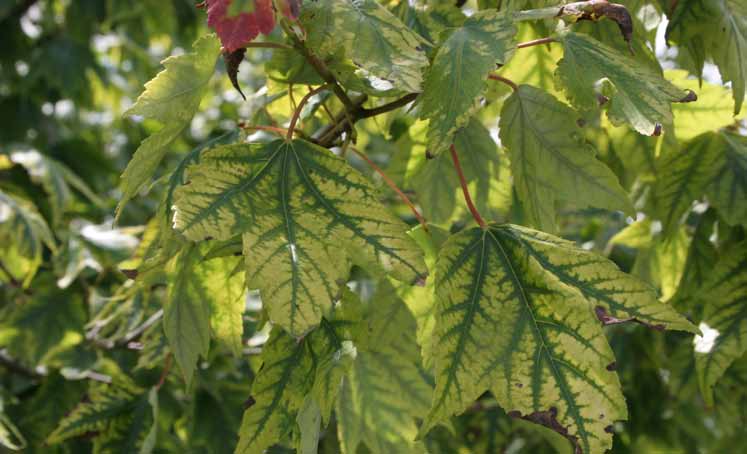 Figure 2. Severe interveinal chlorosis on leaves is a typical symptom of a micronutrient deficiency caused by high-pH soils.
 When soils are acidic (have a low pH), some nutrients are available in excess and plants take up more than they need (often with toxic results).
Soil pH can also affect important microorganisms in the soil, which in turn affects nutrient availability. Plants cannot take up nutrients that are stored in organic matter until the organic complexes are broken down by microorganisms that help make more nutrients available in a form that plants can take up. Many of these microorganisms are most active when the soil pH is around 8. When soil pH is less than 6, their activity is severely depressed. The natural decomposition of organic matter is a reaction that produces acid. That reaction can be accelerated by tilling the soil.
Most nutrients are at their optimal availability to plants when the soil pH is between 6 and 7. Many plants grow best in soils in this pH range. However, there are some plants (such as azaleas and blueberries) that are adapted to growing in more acidic soils.
Factors Affecting Soil pH
In general, soils in natural settings have a pH ranging from 4 to 8.5, depending on several environmental factors, including the soil parent materials from which the soil was derived. Soils developed from basic rocks (such as basalt or limestone) generally have higher pH values than those formed from acidic rocks (such as granite or shale).
Rain can also affect soil pH because it leaches basic nutrients such as calcium and magnesium from the soil, leaving behind acidic ions such as aluminum and hydrogen in the soil in greater concentrations. For this reason, soils formed under high rainfall conditions (such as soils in Georgia), are more acidic than those formed under arid (dry) conditions (such as soils in Arizona).
Much of the soil parent material in Indiana is derived from limestone or contains lime (calcium carbonate). When this basic rock decomposes, it produces a high pH (alkaline) soil. Fortunately, much of that alkalinity has been reduced in the upper portion of the soil because it has been leached out by rain.
However, the pH of much of the unweathered parent material that is deep in the soil profile remains high. Construction practices often bring these highly alkaline soils to the surface, making the plant root zone too alkaline for most plants to thrive.
Modifying Soil pH
You can modify soil pH to encourage plant growth. In the soil, substances such as ammonium- and urea-based fertilizers, organic matter, and elemental sulfur undergo acid-producing reactions, which will lower the soil pH. More information about strategies for lowering soil pH are available in Commercial Greenhouse and Nursery Production: Lowering Soil pH for Horticultural Crops (Purdue Extension publication HO-241-W, available from the Education Store).
Adding lime, an alkaline material, will raise soil pH. More information about liming to increase soil pH can be found in Soil Acidity and Liming of Indiana Soils (Purdue Extension publication AY-267-W).
Before modifying the pH of any soil, always consider the optimum pH of the plants being grown, the current pH of the soil, and any effects the potential amendments could have beyond modifying the pH. In some cases, it may be more practical to select plants that grow well in the existing soil pH than trying to change the soil pH.
References
Brady, N.C. and R.R. Weil. 2007. The nature and properties of soils. 14th ed. Prentice Hall, Upper Saddle River, NJ.
Craul, P.J. and C.J. Klein. 1980. Characterization of streetside soils of Syracuse, New York. Metropolitan Tree Improvement Alliance Proc. 3:88-101.
Jones, J. 2001. Laboratory guide for conducting soil tests and plant analysis. CRC Press, Boca Raton, FL.
Lehmann, A. and K. Stahr. 2007. Nature and significance of anthropogenic urban soils. J. Soils Sediments. 7:247-260.
Marjan, K. and B. Lippert. 1999. Changing the pH of your soil. Clemson University Extension publication HGIC 1650.
Spies, C.D. and C.L. Harms. 1988. Soil acidity and liming of Indiana soils. Purdue Extension publication AY-267-W.
Tinus, R.W. 1980. Nature and management of soil pH and salinity. Proceedings, North American Forest Tree Nursery Soils Workshop, July 28-August 1, Syracuse, NY. pp. 72-86
To see other publications in this series, visit the Purdue Extension Education Store.
Reference in this publication to any commercial product, process, or service, or the use of any trade, firm, or corporation name is for illustrative purposes only and does not constitute an endorsement, recommendation, or certification of any kind by Purdue Extension.
Individuals using such products assume responsibility for their use in accordance with current directions of the manufacturer.