USDA Guidance
USDA Guidance and Purdue Extension Instructions for Demographic Data Collection
October 2023
USDA Expectations
- USDA requires Extension to gather race, ethnicity, and gender information about youth and adults who participate in our programs.
- The demographic survey is voluntary. Participants are not required to give this information.
- Purdue Extension asks participants to complete demographic surveys because the information provided will be used to improve programs, to help USDA design additional opportunities for program participation, and to monitor enforcement of laws that require equal access to programs for eligible persons.
- Participation in clubs, activities and programs reflects the demographics of the potential service population (parity),
- Recruiting efforts increase and/or maintain parity in program participation by underrepresented groups,
- Clubs are inclusive (reasonable efforts), and
- All clubs, activities, and programs are open to all individuals, regardless of their race, ethnicity, gender, and/or disability.
- Parity - Each race, ethnicity, and gender group’s representation in the eligible group needs to be reflected within 80% of those who benefit from a program or activity. For example, if a state’s population is 26% Hispanic, Latino, Latinx, or Spanish, this group’s participation in each program category needs to be at or above 21%.
USDA expects Extension to have an adequate system for collecting and maintaining race, ethnicity, and gender data for all programs and activities
- Extension has tools and systems in place for demographic data.
- Surveys are available for Purdue Extension personnel to use for events.
- Demographic surveys for youth or adults – paper (PDF) and Qualtrics versions.
- 4-H Online and 4-H Common Measures contain demographic questions.
- HHS Survey Builder (adults only) surveys contain demographic questions.
- Surveys are available for Purdue Extension personnel to use for events.
- Purdue Extension maintains demographic data.
- Paper versions are stored in locked file drawers/cabinets.
- Online versions are stored in Qualtrics, or a limited-access drive, via a Purdue computer.
- Extension personnel report participant self-reported demographic totals in Symplectic Elements (Elements) on the Learning Events screen.
- Purdue Extension’s Evaluation Team runs Elements learning events demographic data reports and compares to the Indiana Census data for parity.
- County Extension Directors complete the annual County Compliance Report documenting Extension participant demographic data and county census data.
- 4-H Program Area administrative staff pull 4-H online demographic data reports annually.
- Purdue Extension is required to ask about participant demographic information and to give participants the opportunity to self-identify race, ethnicity, and gender.
- Purdue Extension personnel may not make any kind of guess about demographic information including observation of participants.
- Purdue Extension is to make sure race, ethnicity, and gender data are reported for those who participate in programs.
- For individuals who “sign-up” or “register” for a program, but do not show-up or take part in the program, Purdue Extension may not include their demographic data in the totals.
PURDUE EXTENSION PERSONNEL: PREPARATION FOR COLLECTING DEMOGRAPHIC DATA
- Extension personnel are to read and become familiar with the race, ethnicity, and gender descriptions.
- For reporting gender:
- Gender
- Female
- Male
- Non-binary – A person who is not exclusively male or female, who is more than one gender, or experiences fluid gender.
- Gender
- For reporting ethnicity and race:
- Overview of 2015 National Content Test Research Study - The 2015 National Content Test (NCT) provides the U.S. Census Bureau with empirical research that contributed to the planning for the content of the 2020 Census race/ethnicity question(s).
- RACE, ETHNICITY, OR ORIGIN
- In the 2015 National Content Test, an individual’s response is based upon self-identification. People may choose one or more response categories to represent their identity or identities. The categories included in the questionnaire generally reflect social definitions recognized in this country, and do not attempt to define groups biologically, anthropologically, or genetically.
- The major categories and examples are listed in order of population size, from largest to smallest. Examples represent the different geographic regions in each of the major categories.
- The following descriptions define each of the categories:
- White - The category “White” includes all individuals who identify with one or more nationalities or ethnic groups originating in Europe. Examples of these groups include, but are not limited to, German, Irish, English, Italian, Polish, and French. The category also includes groups such as Scottish, Norwegian, Dutch, Slavic, Cajun, Roma, etc.
- Hispanic, Latino, [Latinx], or Spanish - The category “Hispanic, Latino, or Spanish” includes all individuals who identify with one or more nationalities or ethnic groups originating in Mexico, Puerto Rico, Cuba, Central and South American, and other Spanish cultures. Examples of these groups include, but are not limited to, Mexican or Mexican American, Puerto Rican, Cuban, Salvadoran, Dominican, and Colombian. The category also includes groups such as Guatemalan, Honduran, Spaniard, Ecuadorian, Peruvian, Venezuelan, etc.
- Black or African American - The category “Black or African American” includes all individuals who identify with one or more nationalities or ethnic groups originating in any of the black racial groups of Africa. Examples of these groups include, but are not limited to, African American, Jamaican, Haitian, Nigerian, Ethiopian, and Somali. The category also includes groups such as Ghanaian, South African, Barbadian, Kenyan, Liberian, Bahamian, etc.
- Asian - The category “Asian” includes all individuals who identify with one or more nationalities or ethnic groups originating in the Far East, Southeast Asia, or the Indian subcontinent. Examples of these groups include, but are not limited to, Chinese, Filipino, Asian Indian, Vietnamese, Korean, and Japanese. The category also includes groups such as Pakistani, Cambodian, Hmong, Thai, Bengali, Mien, etc.
- American Indian or Alaska Native - The category “American Indian or Alaska Native” includes all individuals who identify with any of the original peoples of North and South America (including Central America) and who maintain tribal affiliation or community attachment. It includes people who identify as “American Indian” or “Alaska Native” and includes groups such as Navajo Nation, Blackfeet Tribe, Mayan, Aztec, Native Village of Barrow Inupiat Traditional Government, Nome Eskimo Community, etc.
- Middle Eastern or North African - The category “Middle Eastern or North African” includes all individuals who identify with one or more nationalities or ethnic groups originating in the Middle East or North Africa. Examples of these groups include, but are not limited to, Lebanese, Iranian, Egyptian, Syrian, Moroccan, and Algerian. The category also includes groups such as Israeli, Iraqi, Tunisian, Chaldean, Assyrian, Kurdish, etc.
- Native Hawaiian or Other Pacific Islander - The category “Native Hawaiian or Other Pacific Islander” includes all individuals who identify with one or more nationalities or ethnic groups originating in Hawaii, Guam, Samoa, or other Pacific Islands. Examples of these groups include, but are not limited to, Native Hawaiian, Samoan, Chamorro, Tongan, Fijian, and Marshallese. The category also includes groups such as Palauan, Tahitian, Chuukese, Pohnpeian, Saipanese, Yapese, etc.
- Some other race, ethnicity, or origin - “Some other race, ethnicity, or origin” includes all other responses not included in the categories above.
SOURCE: 2015 National Content Test Race and Ethnicity Analysis Report: A New Design for the 21st Century, Issued February 28, 2017, Version 1.0, Prepared by Kelly Matthews, Jessica Phelan, Nicholas A. Jones, Sarah Konya, Rachel Marks, Beverly M. Pratt, Julia Coombs, Michael Bentley. Source Link
Purdue Extension Personnel: Instructions
- Two demographic surveys are available – one for youth and one for adults – in both English and Spanish.
- Paper Surveys
- ¼ page and ½ page PDFs are available for both Youth and Adult participants
- Qualtrics Surveys
- Qualtrics Survey Files (QSF) are available to be copied to Extension personnel Purdue Qualtrics accounts to create the youth and/or adult demographic surveys, or to add to a post-survey.
- Paper Surveys
- Demographic Survey Link
- Names and addresses cannot be collected with race, ethnicity, and gender.
- Ask race, ethnicity, and gender of participants who attend the event, not the registrants who sign up, because they may not attend.
- Collect demographics just ONCE for the Learning Event – with the first/only session. o Do not continue to collect demographic data for programs that are a series and may have “new” participants showing up at future sessions.
- In-person events
- During onsite check-in / registration – ask participants to fill out the demographic survey.
- Keep completed demographic surveys private. Individuals fill out their own form. They do not fill out a public sign-in sheet where they are asked to document their race, ethnicity, and gender.
- If programs collect demographic information at the time of a program, individual survey forms would be used instead of public participant sign-in sheets.
- Collecting race, ethnicity, and gender data on participant sign-in sheets raises privacy concerns because such sign-in sheets allow participants to view other participants’ information. This method of collection could also result in fewer participants self-identifying their race, ethnicity, and gender data and more difficulty accurately determining parity in participation.
- If programs collect demographic information at the time of a program, individual survey forms would be used instead of public participant sign-in sheets.
- The Qualtrics survey QR Code or a shortened URL could be posted at the check-in table where individuals could access and complete the survey via their mobile phone or device.
- Virtual events
- Post the Qualtrics URL and/or QR Code on the opening slide.
- Post the Qualtrics URL in the Chat at beginning, during breaks, or at the end of event.
- Recorded/Posted events
- Post the Qualtrics URL and/or QR Code on the opening slide.
- Statewide, signature, collaborative, multi-session programs – for collecting race, ethnicity, and gender – ask participants at the start of the program.
- Avoid asking race, ethnicity, and gender in the post-survey.
- May include other types of descriptive information (# of acres, age ranges, education level, etc.) in the post-survey.
- However, there may be exceptions for collecting race, ethnicity, and gender with post-surveys for comparative analysis or for external/grant funder requirements.
- Youth demographic information
- For in-school, 4-H, or other youth programs, race, ethnicity, and gender data for students previously collected by schools, may be used.
- For programs for youth younger than 4th grade, educators may ask the parent / legal guardian to complete the demographic survey.
- For 4-H educators using Common Measures 2.0 surveys, race, ethnicity, and gender data will be included, so demographic data will not need to be collected separately.
- Purdue Extension personnel are to provide the following instructions to participants. Instructions are at the top of the demographic surveys, can be posted on the check-in table, or may be read aloud as appropriate.
- YOUTH PARTICIPANTS
- You have been given this survey because you have participated in a Purdue Extension program. Your answers are important, and they will be kept private. But, if you don’t want to fill out the survey, you don’t have to or if there is a question you don’t want to answer, you can leave it blank. There are no right or wrong answers, so please answer all questions honestly. Thank you.
- ADULT PARTICIPANTS
- Purdue Extension programs are open to everyone. We are required to report race, ethnicity, and gender of program participants to the U.S. Department of Agriculture (USDA). Only total numbers across all programs are reported so USDA will not be able to identify your individual responses. Your responses are voluntary and help Purdue Extension improve its programming. Thank you.
- YOUTH PARTICIPANTS
- At the event
- Keep completed demographic surveys private. Individuals fill out their own form. They do not fill out a public sign-in sheet where they are asked to document their race, ethnicity, and gender.
- Place completed demographic surveys in a file folder, envelope, or box.
- After the event
- Keep completed paper surveys private and in a locked drawer/closet.
- For Qualtrics data, export data or run a report to get results. Store documents on a Purdue limited access drive. Do not keep data/results on a flash drive or private laptop or device.
- After one year
- Shred paper surveys.
- Delete electronic data or reports.
- Demographic data are reported in Elements on the Learning Event screen.
- Compilation of demographic survey data
- Sort completed surveys by youth and adult
- If under 18, they are youth
- If 18 or older, they are adult
- If response for age is “prefer not to answer”, put that response in the age group of the survey used – youth demographics or adult demographics.
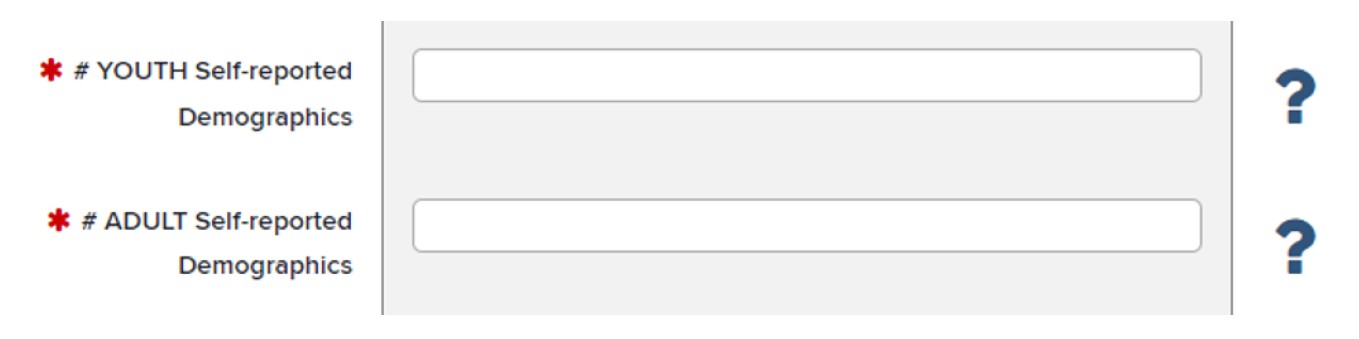
- Count the number of youth and the number of adults who completed the demographic survey.
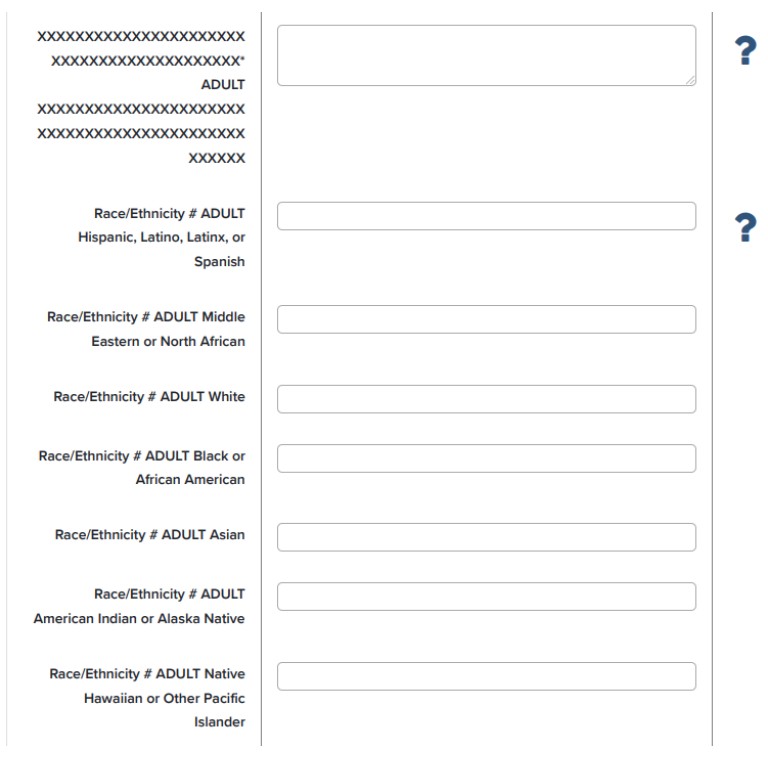
- Enter totals for youth and adults in Elements - “Number of individuals who self-report demographics (race/ethnicity/gender)”
- If you did not distribute the demographic survey or get the youth demographics from the classroom teacher or 4-H Online, you will put zeroes.
- Report demographics just ONCE for the Learning Event – with the reporting of the first/only session.
- Do not repeat reporting demographic data for programs that are a series of sessions and reported in separate months or by individual sessions.
- So, if reported separately, the first session will have numbers here, but the following sessions, will have zeroes.
- Sort completed surveys by youth and adult
- Tabulate survey demographic information.
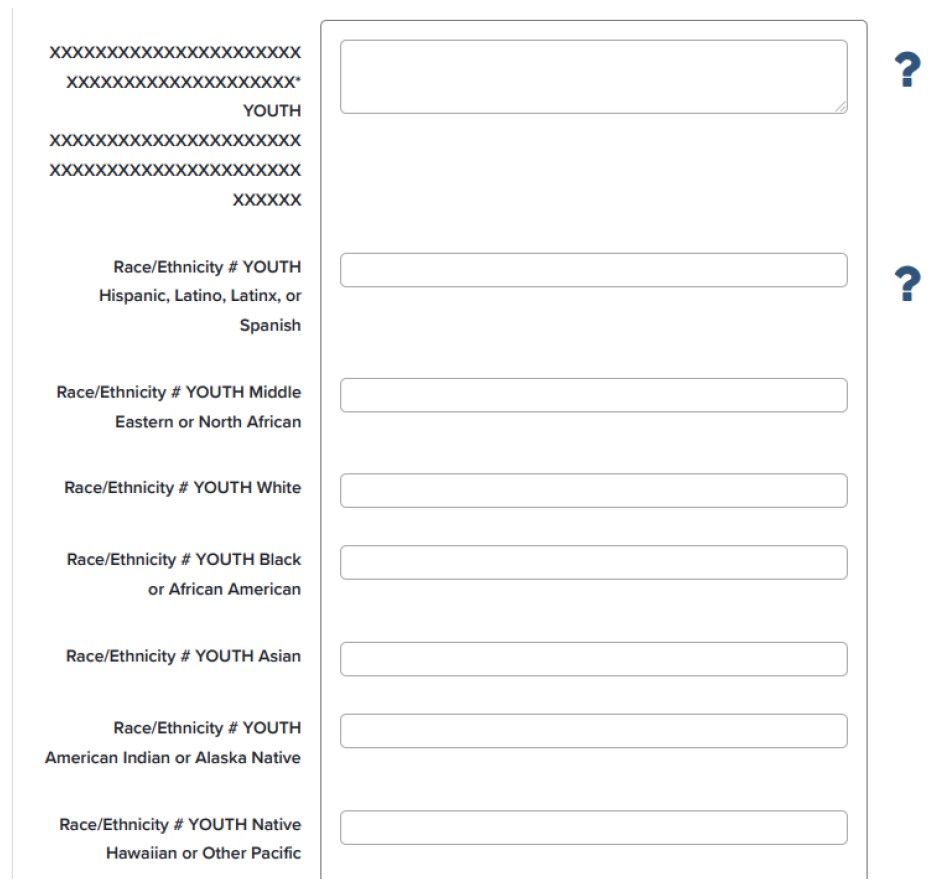
- Youth surveys - Race/Ethnicity - Document total number of responses for:
- Hispanic, Latino, Latinx, or Spanish
- Middle Eastern or North African
- White
- Black or African American
- Asian
- American Indian or Alaska Native
- Native Hawaiian or Other Pacific Islander
- Some other race, ethnicity, or origin
- I don’t know or I prefer not to answer
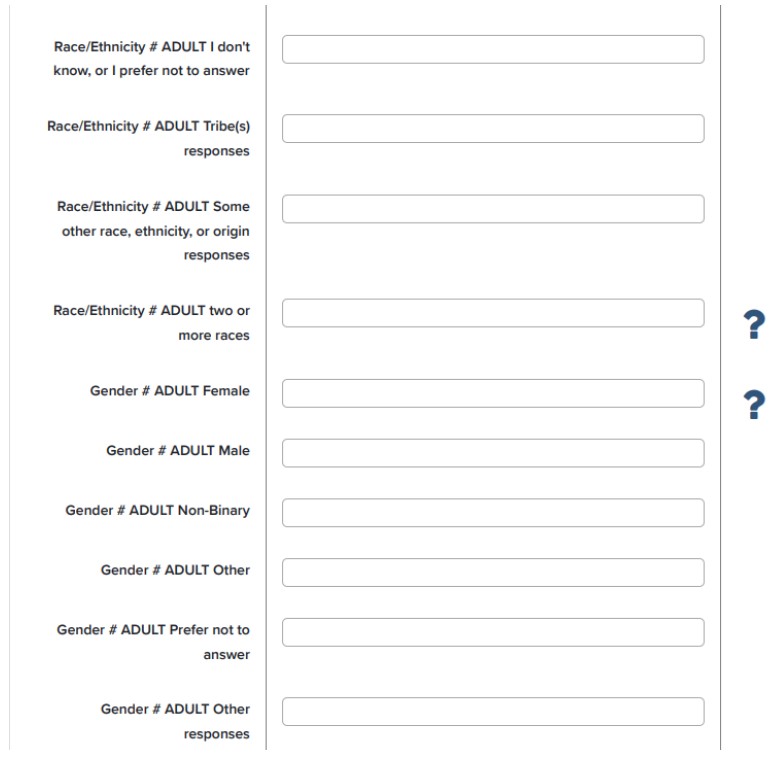
- Adult surveys - Race/Ethnicity - Document total number of responses for:
- Hispanic, Latino, Latinx, or Spanish
- Middle Eastern or North African
- White
- Black or African American
- Asian
- American Indian or Alaska Native
- Native Hawaiian or Other Pacific Islander
- Some other race, ethnicity, or origin
- In don’t know or I prefer not to answer
- Compile “Tribe” responses
- List each once, but do not document duplicates.
- Example:
- Responses: Cherokee, Cherokee, Miami, Delaware, Delaware, Delaware, Shawnee
- Document in Elements: Cherokee, Miami, Delaware, Shawnee
- Compile “Some other race, ethnicity, or origin” responses.
- List each once, but do not document duplicates.
- Count the number of individuals reporting two or more races.
- White, Black or African American, Asian, American Indian or Alaska Native, Native Hawaiian or Other Pacific Islander, and Some other race, ethnicity, or origin.
- Do not include Hispanic, Latino, Latinx, or Spanish, or Middle Eastern or North African.
- Document Gender total numbers of responses for:
- Female
- Male
- Non-Binary
- Other
- Prefer not to answer
- Compile Gender “Other” responses
- List each once, but do not document duplicates.
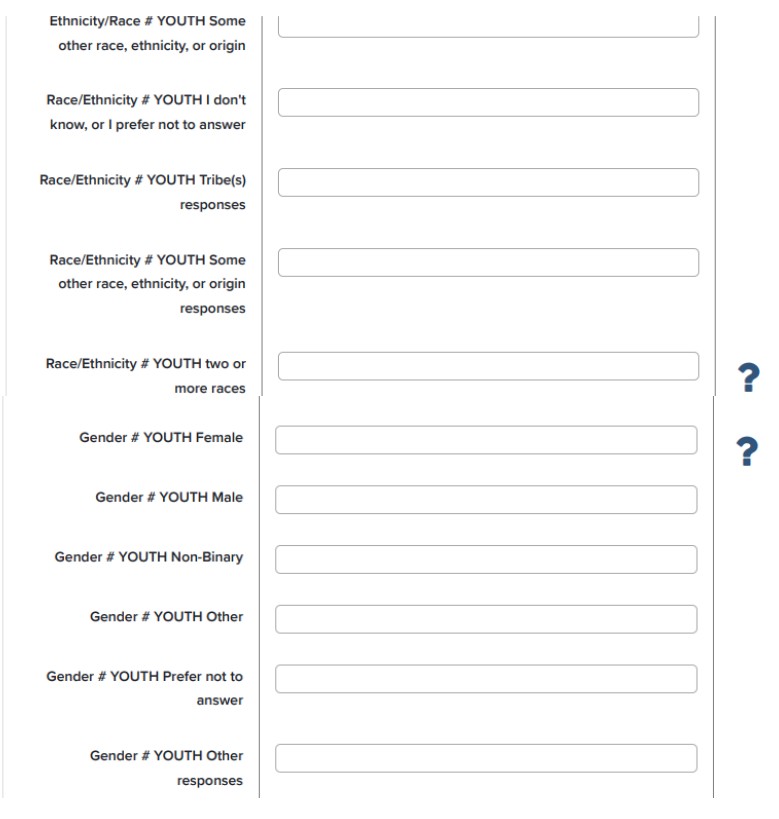
- Enter compilation of demographic survey responses in Elements.
- These data fields are located in the “Additional Information” section at the bottom of the Extension Learning Event screen.
- Only enter data for the ones that you have, leave others blank if no data. No need to fill all the others with zeroes
- If you reported a number for “individuals who self-reported demographics”, you will have data reported here.
- If you reported zeroes for “individuals who self-reported demographics” this section will be blank.
Youth Demographics
 Adult Demographics