
Education and Workforce Development
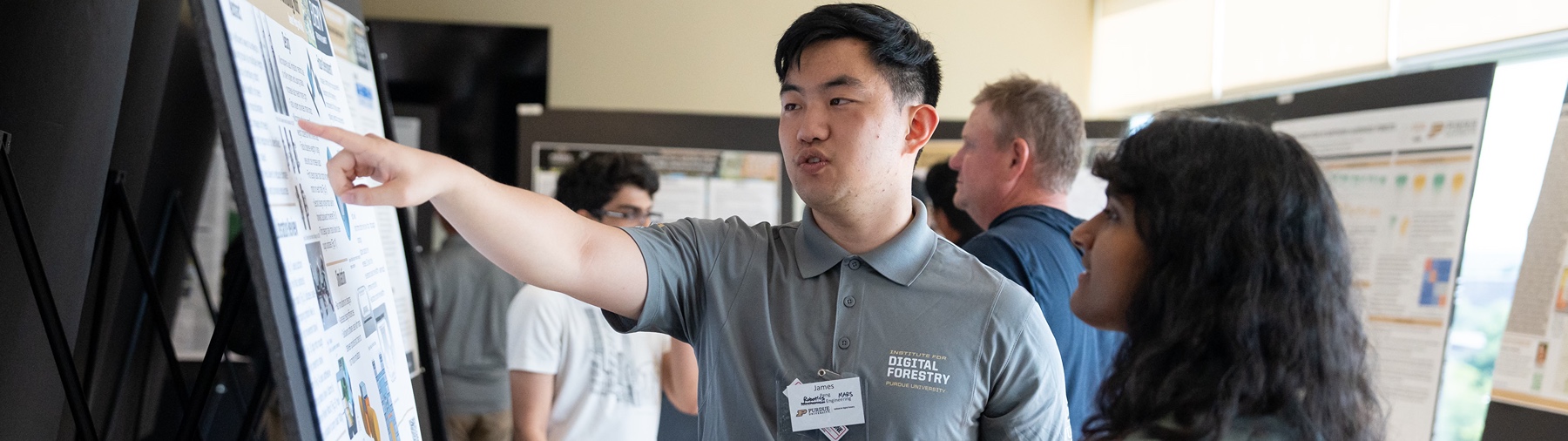
Empowering the Next Generation of Digital Foresters
Purdue's Institute for Digital Forestry is helping to redefine forestry education through next-generation digital technologies. Our mission is to empower students and professionals with the expertise needed to excel in the rapidly evolving forestry and natural resources sectors. By joining our programs, you'll gain hands-on experience with innovative tools and methodologies, positioning yourself at the forefront of forestry advancements and making a meaningful impact on the future of natural resource management. Explore how you can be part of this transformative journey and shape the future of forestry.
digital data acquisition camp
Digital Data Acquisition Camp (DDAC) is a three-week summer short course that provides an immersive, hands-on learning experience with advanced technology and techniques. Purdue faculty provide detailed instruction and one-on-one mentoring as participants gain skills that can help them excel in their current positions or move into new roles.
Attend DDAC this year: July 20-August 8, 2026
The camp consists fo four course credit hours:
- UAS Field Operations
- Photogrammetric Mapping
- LiDAR Mapping
- Sensor Arrays
Course costs includes tuition (based on four graduate credits, summer rate), course fee and housing, if needed. Participants must register as a non-degree student if not a current Purdue student.
DDAC is held in person at Purdue's John S. Wright Forestry Center, 1007 N. 725 W., in West Lafayette, Indiana. No classes are held on Sundays.
fellowship available - apply by june 30
A fellowship is available to help cover participant costs to attend DDAC, such as travel, lodging, childcare, etc. also receive
Fellowship recipients year-long mentoring and professional development from Purdue faculty and partners. The ongoing guidance helps participants integrate the skills acquired in DDAC into their current work.
Who should apply?
The fellowship is ideal for:
- Professionals in forestry, ecology, wildlife, environmental science or related areas who want to upskill or retrain
- Early-career professionals
- Graduate or upper-level undergraduate students
Applicants should have at least six credits of junior-level or above statistics and/or programming (coding) to be considered.
Read more about the fellowship.
Apply Now
The program year runs from July 2026 to July 2027. Applications for the 2027-2028 fellowship program year will open in the fall.
Questions? Email denr@purdue.edu.
The fellowship is made possible by the National Science Foundation through an ExLENT program, grant #2526215.
Professional Master (MS) in Digital Ecology and Natural Resources
The Department of Forestry and Natural Resources is launching a Professional Master of Science in Digital Ecology and Natural Resources (DENR). This program offers a pathway to leadership in the digital transformation of natural resource management. Participants will gain advanced skills in Unoccupied Aerial Systems (UAS) operations, photogrammetry, LiDAR, sensor arrays and laser scanning.
Learn more about the DENR professional master's degree.
Minor in digital natural resources
The Digital Natural Resources Minor at Purdue University is designed to empower students with the latest skills in digital technologies for sustainable resource management. This program emphasizes advanced data acquisition methods, including Unoccupied Aerial Systems (UAS), aerial and satellite platforms, combined with innovative data analysis and application techniques. By integrating these emerging technologies, the minor prepares you to tackle real-world environmental challenges with cutting-edge solutions.
Program Highlights
15-Credit Program: Complete 15 credits across four selective lists, allowing you to tailor your learning experience to your interests and career goals:
- Data Acquisition: Master the latest tools and methods for collecting data from various platforms, including drones, satellites, and sensor networks, to gather valuable information on natural resources.
- Data Analysis: Develop critical skills in analyzing complex data sets, using techniques such as remote sensing and GIS, to interpret and apply information effectively for resource management.
- Data Ethics: Learn the ethical considerations and best practices for managing digital data in environmental contexts, ensuring responsible and sustainable use of information.
- Data Applications: Explore the practical applications of digital data in natural resources, including biodiversity monitoring, forest management, and conservation planning.
JOIN THE MOVEMENT TO MEASURE EVERY TREE
CONTACT USJOIN THE MOVEMENT TO MEASURE EVERY TREE
CONTACT US