How are GMOs created?
Answers derived from interview with Stanton Gelvin, Edwin Umbarger Distinguished Professor of Biology and Member of Purdue’s Center for Plant Biology.
Key Takeaways
- Humans have genetically modified plants and animals to have beneficial traits for thousands of years through breeding. GMOs were developed to select for those traits faster and more precisely.
- GMOs can contain genes from a different species or native genes, which are from the same species but express themselves differently.
- Plants, animals and fungi can be genetically modified through several techniques: using agrobacterium, CRISPR-Cas9 gene editing, gene gun particle bombardment and protoplast transformation.
How are GMOs made?
In plants and other organisms humans use, we look for beneficial traits we’d like to maximize and minimize harmful traits that are undesirable. You might want a crop plant that uses fewer resources, like fertilizer and water, and has better resistance to disease, or maybe you’d like an animal that produces more meat, milk or wool.
Over the last several thousand years, humans have domesticated many plants and animals by breeding those with the most beneficial and fewest harmful traits. In the last 50 years, as scientists have learned more about how an organism's DNA encodes for specific characteristics, we can now overcome some of the limitations of traditional breeding methods by moving or modifying specific genes (DNA segments) using biotechnology methods.
Genetically modified organisms (GMOs) can contain foreign genes — from a different species — or native genes, which are from the same species but contain modifications to express themselves differently.
What technologies are currently used for genetic engineering?
1. Agrobacterium:
Agrobacterium tumefaciens, a common soil bacterium, can infect some plants, transferring a specialized piece of their DNA into the cells of the host plant, where it’s integrated into the plant’s genome. The genes contained in this piece of DNA alter how the plant grows, resulting in the formation of galls, or tumors, on the plant.
Scientists learned to remove the tumor-inducing genes from the DNA and replace them with other, more desirable genes to incorporate into plant genomes. Most GMOs are created using this mechanism of Agrobacterium.
Scientists co-opted the gene-transfer method of Agrobacteria to give beneficial traits to plants.
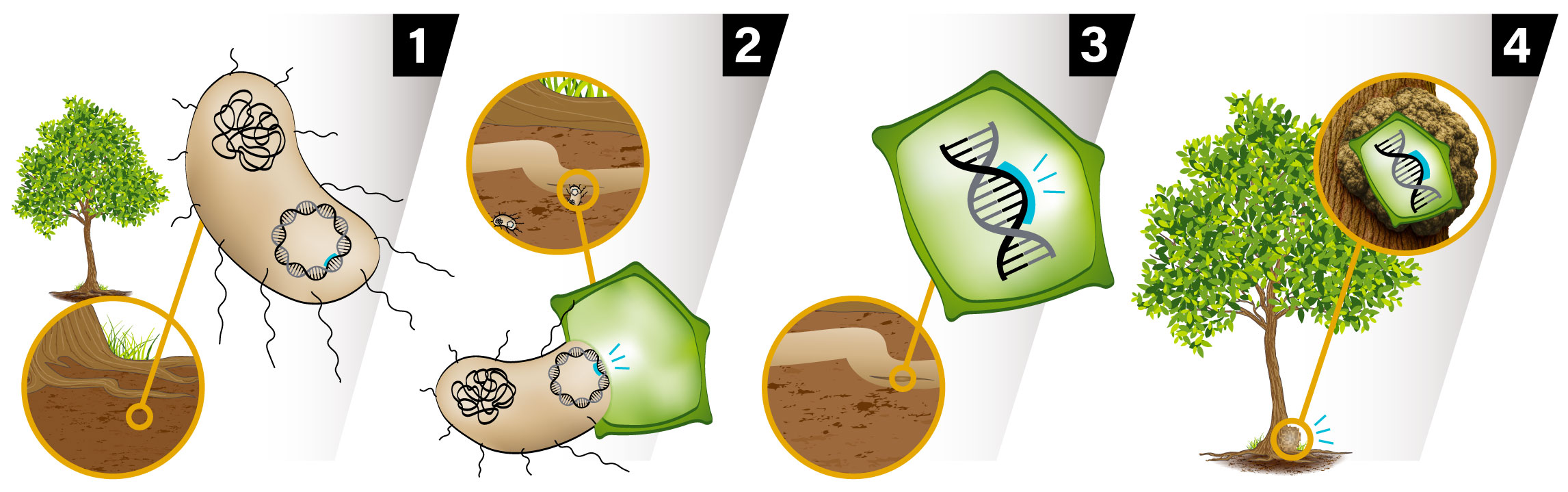 , opens larger image In nature, Agrobacteria (1) can enter plants through a wound in their roots (2). They contain a circle of DNA called a plasmid that can be inserted into plant cells (2), forcing the plant to incorporate that DNA into its own genome (3). Infected plants grow a crown gall, a tumor of plant tissue that houses the Agrobacteria (4).
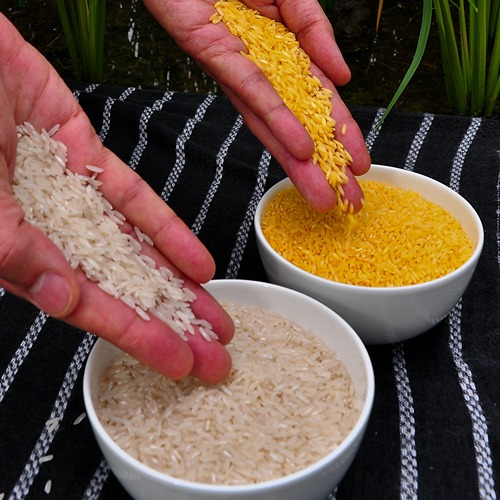
 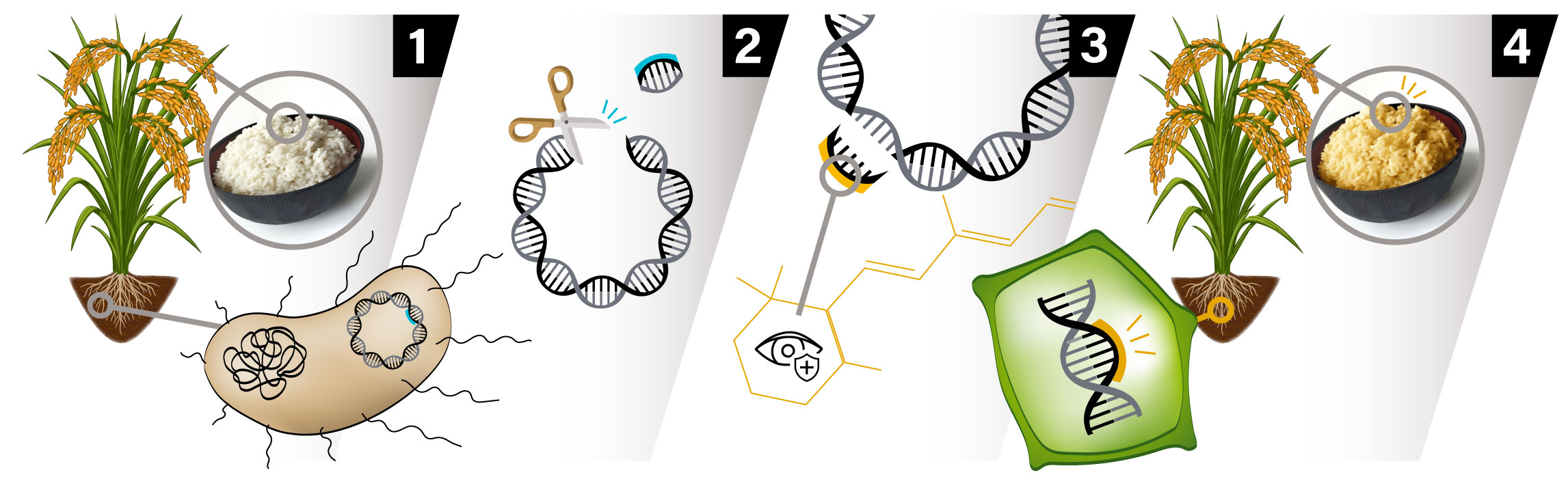 , opens larger image The staple crop rice (1) lacks some essential nutrients like vitamin A, important for vision (3). Scientists can cut out the tumor-producing (blue) region of the Agrobacteria plasmid (2) and replace it with the gene for provitamin A (3). The result: grains of golden rice rich in vitamin A (4).
 2. CRISPR-Cas9 gene editing:
CRISPR-Cas9 is based on a bacterial immune system that evolved to protect bacteria by recognizing and destroying the DNA of invading viruses. Scientists have worked out how to adapt this system to make targeted changes in the genome of an organism.
CRISPR-Cas9 has features that are like the editing functions find, cut and replace. CRISPR-Cas9 searches for a specific DNA sequence in a large genome. When this sequence is found, the Cas9 protein will cut the DNA at that location. The host cell’s DNA repair mechanisms recognize something has changed and work to repair it, which may introduce a mutation or genetic change. That fix can produce a variety of changes, including silencing (breaking a gene so it no longer functions), modification or replacement of a specific gene.
The CRISPR-Cas9 system can also be used to regulate gene sites, using proteins to activate or repress them.
3. Gene gun particle bombardment:
A gene gun works like the name suggests; it shoots DNA into plant cells. Spherical particles of metals like gold and platinum are coated with DNA and shot from the gun into plant tissue. The particles break through the cell walls and membranes of the plant cells where the DNA on the particle may be incorporated into the genome.
4. Protoplast transformation:
In some species, like tobacco and tomato, a plant can be broken down to a collection of single cells without cell walls, called protoplasts. Without the cell wall barrier, it’s easier to deliver DNA into protoplasts using a variety of methods. Once transformed, the protoplast can be grown into a whole plant.
Science on the horizon
Scientists are working towards “transgene-free editing,” in which the foreign DNA encoding the CRISPR-Cas9 system is eliminated after creating the desired modification. There are a number of benefits to this approach, including that these plants are not currently considered genetically modified and thus are not highly regulated in the U.S.
Within the last decade, de novo domestication — genetically modifying wild varieties of crops — has also grown popular.
Wild ancestors of cultivated crops have beneficial traits that are missing from modern varieties, but they don’t produce well under current agricultural practices. By genetically engineering wild species for these traits, such as to increase fruit size and farmability, plants can be cultivated without losing their special qualities or local hardiness within a few years.
How is genetically modified material turned into a whole plant?
Tissue culture is a practice used to grow plants from single cells or small pieces of plant tissue. This can occur after a genetic transformation has occurred. Scientists place the small amount of plant tissue, like a leaf, that was successfully modified onto specialized, artificial media to grow it. Different plant hormones are added to this media to force the original tissue to grow roots, shoots and eventually entire plants.
GMO FAQ