How do GMOs affect insects?
Answers derived from interview with Christian Krupke, Dean’s Fellow and Professor of Entomology.
Farm fields are not just for crops — they are actually home to a wide variety of insects: beetles, caterpillars, honeybees and more. Some are beneficial to the plants, pollinating fruits and vegetables that feed the world, but other bugs may eat and damage the crop, even spreading disease as they do.
Key Takeaways
- Some genetically modified crops contain insecticidal toxins — compounds that kill specific types of insects. These are different from insecticides, which are sprayed on plants or applied to seeds.
- While studies have shown that chemical pesticides harm pollinators like bees, butterflies and other beneficial insects, insecticidal toxins target only specific insects damaging the plant.
- Pests can become resistant to any management type over time, including GMOs with insecticidal toxins.
- Insects can also be genetically modified, usually to limit the population of those that spread disease.
What are insecticides, and why do we use them?
Pesticides are chemicals that are used to suppress or control different pest organisms. Insecticides are pesticides that specifically target insects.
While homeowners and gardeners may also supplement their farm management strategy by manually pulling bugs off of crops or adding beneficial predatory insects that eat the damaging ones, insecticides are often the most affordable and most efficient option for farmers to protect a field from insect damage.
Most insecticides act on contact with insects and are applied to the outside surface of a plant in order to stop insects from eating it. Although they are typically washed off by rainwater and cleaned after harvest, it is always good practice to clean your fruits and vegetables to remove any soil, debris or potential residues of pesticides.
Are there insecticides inside GMOs?
Genetically modified organisms (GMOs) do not contain insecticides nor create them. Instead, some GM crops do contain insecticidal toxins, or compounds that kill some types of insects. Some commercial insecticides may also contain these same toxins, but they are formulated to be sprayed onto plants or applied to seeds or soil.
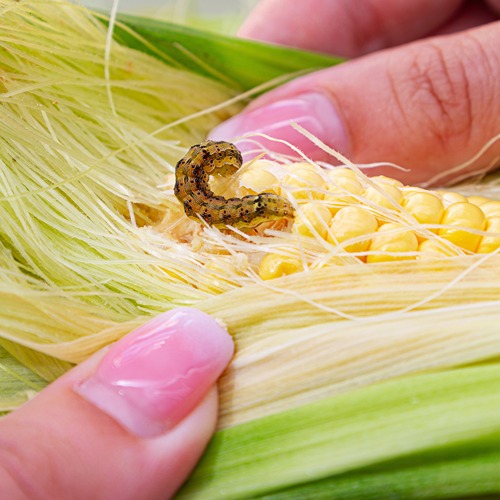
Bt crops like Bt corn and Bt cotton varieties produce insecticidal toxins. These toxins are derived from the bacterium Bacillus thuringiensis (Bt for short); the gene that produces the toxins is inserted into Bt crops. These toxins then target specific receptors in the insect’s digestive system, and work on only a few, specific pests — especially in the larval (often caterpillar) life stages of some insects that typically eat plants. In this way, Bt crops kill many key insect pests themselves, reducing the need for insecticide applications in the field.
By reducing insect populations and insect damage, toxins produced by Bt crops simultaneously reduce fungal infections and exposure to disease. With fewer insects feeding on a plant, there are fewer wounds that may make plants susceptible to bacterial or fungal infections.
What is the effect of GMOs on beneficial insects like pollinators?
While studies have shown that chemical pesticides harm pollinators like bees, butterflies and other beneficial insects, GMOs that produce insecticidal toxins do not have the same effect. The compounds present in these GMOs only target specific insects that feed on those plants. Bt corn and Bt cotton are not toxic to humans or the vast majority of insects that visit them.
A study done in 1999 sparked controversy by concluding that the pollen from Bt corn was lethal to monarch butterfly caterpillars when it landed on the milkweed leaves they ate. Other scientists tried to replicate the experiment and found that the amount of pollen monarch caterpillars would have to eat to become intoxicated or die was far larger than what they would ever encounter under natural field conditions.
The controversy can be likened to finding a dose of salt high enough to be lethal to a human being — though possible, it’s not probable.
Looking to help pollinators? The answer could be in your backyard. Bees and other pollinators are more likely to visit the flowers and fruits grown by gardeners than they are row crops. An Indiana field study found that because of this, many of the insecticides found on honeybees collecting pollen were associated with homeowner rather than agricultural products. Pollinators are also generally more susceptible to pesticides than the target pests, so reducing at-home pesticide use could make your garden more bee and butterfly friendly.
What are “superbugs,” and are they related to GMOs?
“Superbug” is a term used to refer to insects or bacteria that have developed resistance to some pest management approaches, including insecticidal toxins and commercial insecticide applications.
In agriculture, the term superbug has been used to draw attention to how GM crops like Bt corn and Bt cotton can lead to evolved resistance. When insecticides or insecticidal toxins are introduced, most insects die quickly, leaving only those with rare resistance to reproduce. Eventually, the population evolves to resist the insecticide.
While there are many examples of insect resistance to GM crops, this issue is not exclusive to GMOs, but arises under all pest management practices.
Can you genetically modify insects?
Insects can also be genetically modified. Gene drives genetically alter specific traits in a few individuals, then release them into an outside population to spread the trait.
Mosquitoes, for example, were genetically modified to increase sterility, then released in Florida, Texas, Brazil, the Cayman Islands, Panama and India to reduce mosquito populations there. Offspring of the local and altered mosquitoes showed less fertility and some were unable to reproduce at all. This reduced mosquito populations and associated infections like malaria.
GMO FAQ