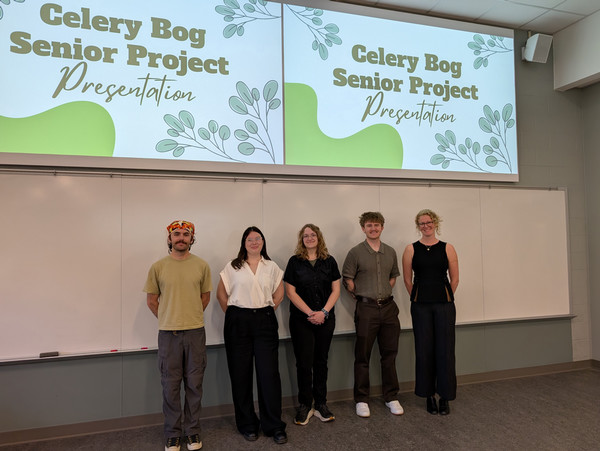
Celery Bog
Goals & Objectives
The initial objective for this project was to manage the forest understory across the entire forest & savanna of Celery Bog Nature Area. The goal of our project partner Kyle Gebhart was to both foster biodiversity and engage the public through foraging opportunities. This was going to be accomplished though means such as selective cutting, girdling, planting, and intentional seed dispersal. In order to make management recommendations on vegetation composition, our team and Kyle decided that we had to complete a survey of the current vegetation present on the property. Our survey planned to collect composition and structure data on woody regeneration, midstory, and canopy. While additionally noting the presence of invasive species, identifying potential crop trees, selecting girdle trees, and areas where foraging opportunities would be accessible to visitors. Due to weather delays, planned school breaks, and lack of experienced team availability, the first survey was completed much later than expected. Furthermore, the time estimated to collect the rest of the data required of the project did not fit within the timeline of when the deliverables were due. As a result, our team decided to approach Kyle to see if we could reach a compromise on the project or if he would rather have us pivot to another task.
Thankfully, Kyle had just the project in mind as he has been working on a plant garden directly adjacent to the nature center. Kyle described that he wanted to increase the number and diversity of plants in the garden since he plans on fencing the area off, hence protecting it from the public. The goal of fostering biodiversity mirrored that of the previous task, but now with a realistic scope that allowed our group to deliver a valuable and timely prescription. Kyle and our group agreed that to increase biodiversity and support the local ecosystem through such a small space, the heterogeneity of plant roles, structures, and ecological niches needed to be maximized. So our team got to work providing background information and a prescription that improved the usability of the area for the native fauna.
Community Project Partners
Kyle Gebhart, Parks Naturalist.
Team Members
- Julie Barber
- David Hall
- Cara Hornsby
- Grace McRoberts
- Sloane Wendel
Summary
While our plan covers many of the technical aspects of planting a native species garden, the hard part is actually building the garden. The amount of work needed is a significant barrier as it will take the consistent work of multiple people for the garden to be successful. One very effective way to solve this issue is to use volunteers from the community. This could also be paired with educational activities to allow school kids in K-12 to participate in the creation and maintenance of the garden. The primary concern shared by the team is the long-term sustainability of the garden. The future of water resources is uncertain around the world and we are worried that the water needs of the garden will outpace sustainable use of water.
- Soil Composition Analysis
- Site Mapping and Zonation Plan
- Curated Native Species Compendium
- Seasonal Maintenance and Care Schedule
- Educational Signage Mockup
- Economic and Resource Assessment