

NRES Capstone Projects Spring 2026
Learn more about each of the most recently completed NRES Capstone Projects.
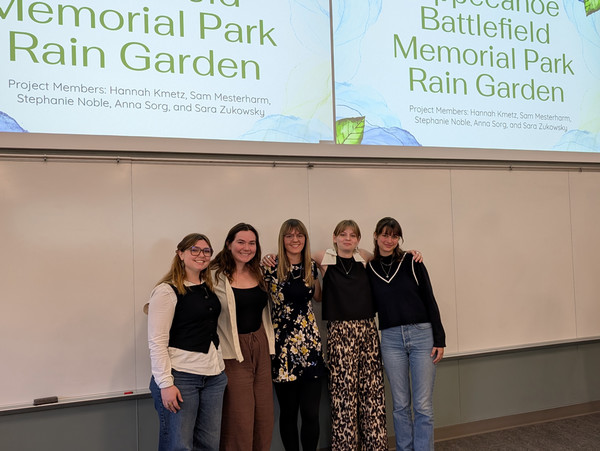
Battlefield Memorial Park
Team Members: Hannah Kmetz, Sam Mesterharm, Stephanie Noble, Anna Sorg, & Sara Zukowsky.
Goal: Our goals were to install a rain garden to reduce sediment pollution in Burnett Creek and develop a maintenance plan for its first two years. We also created an educational sign and pamphlet to inform the community about the rain garden’s benefits and encourage involvement. To protect the garden from foot traffic while plants establish, we also recommended signage and a temporary fence.
Community Project Partner: Amy Krzton-Presson is the watershed coordinator for the Wabash river, Mary Cutler is a naturalist for the area, and Joe Kallok is the Battlefield Memorial Park land manager.
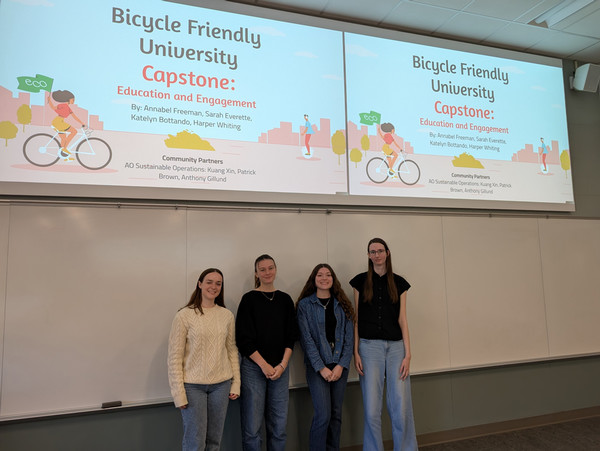
Bicycle Friendly University
Team Members: Katelyn Bottando, Sarah Everette, Annabel Freeman, & Harper Whiting.
Goal: Through conversations with Kuang Xin and our background research in the literature review, our goals included support for Purdue’s progress in the BFU “Education” and “Encouragement” categories, improve how bicycle safety information is communicated across campus, and strengthen engagement around safe riding and active mobility. Our objectives were to collect evidence on biking habits and safety concerns through a survey, benchmark Purdue’s bicycle education and outreach efforts against peer institutions, and create infographics that address bike safety, amenities, and any other bike related information. Through these goals and objectives, we will be able to address the identified needs for the BFU application.
Community Project Partner: Patrick Brown, the sustainability manager, Kuang Xin, a graduate student in the school of hospitality and tourism management, and Anthony Gillund.
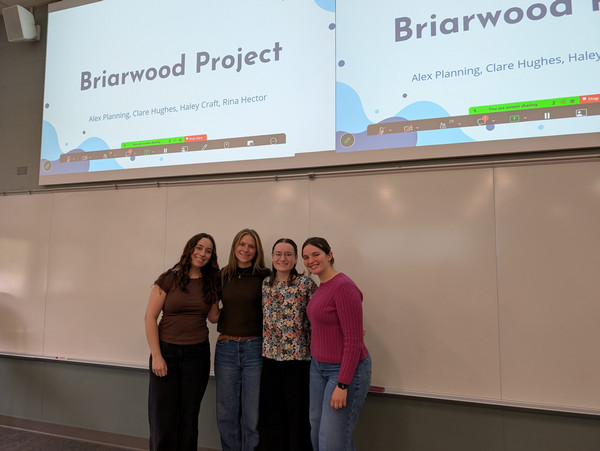
Briarwood Lake
Team Members: Haley Craft, Rina Hector, Clare Hughes, & Alexandra Panning.
Goal: To reduce algae blooms in Briarwood Lake, we evaluated aeration as a potential solution. Aerators have successfully limited algae growth in other smaller lakes on the property. Since temperature and nutrient distribution influence algal growth, water-lifting aerators may be particularly effective. Unlike traditional surface aerators, these devices mix deeper water layers, distributing algae throughout the water column and exposing them to less favorable growth conditions (Fu et al., 2026). This could help reduce algal productivity and bloom formation. Community acceptance may also be favorable, as aerators are already used elsewhere on the property. However, an economic evaluation is needed to determine whether the potential benefits justify the higher equipment and installation costs.
Community Project Partner: Briarwood Lake Association (BLA): Yvonne Hughett, Tonya Smith, and Mitch Fink.
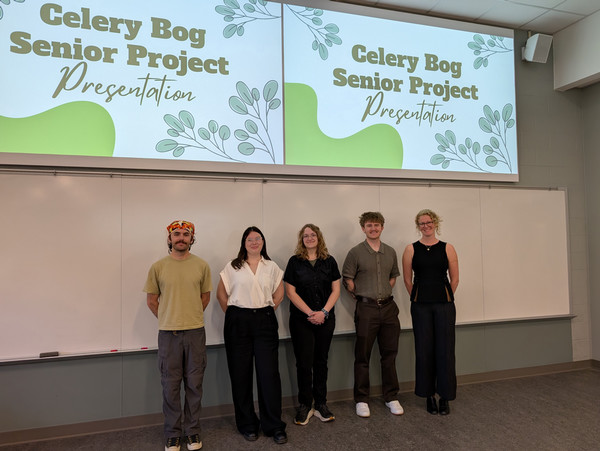
celery bog
Team Members: Julie Barber, David Hall, Cara Hornsby, Grace McRoberts, & Sloane Wendel.
Goal: The original project goal was to manage the forest understory at Celery Bog Nature Area to promote biodiversity and public foraging. However, weather delays and time constraints made the planned vegetation survey unrealistic. After consulting with our project partner, Kyle Gebhart, we shifted focus to a plant garden near the nature center. The new goal was to increase plant diversity and create habitat for native wildlife through a practical management plan that maximizes ecological value within the small space.
Community Project Partners: Kyle Gebhart, Parks Naturalist.
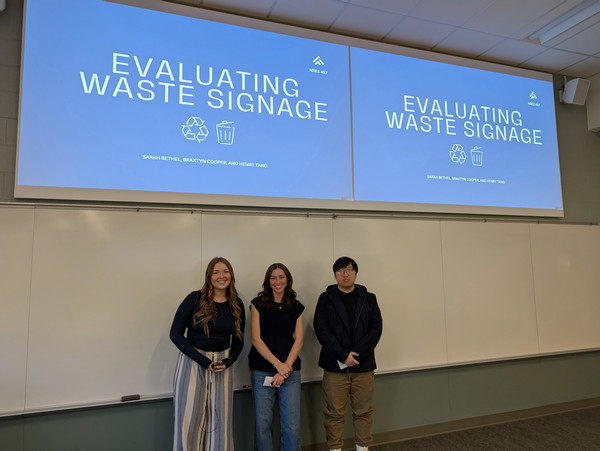
evaluating waste signage
Team Members: Sarah Bethel, Braxtyn Cooper, & Henry Tang.
Goals: Our original plan included developing signage and sustainability social media materials. However, due to time and staffing constraints, we focused on designing and implementing effective recycling signage. As discussed with Patrick, our goals were to research signage best practices, evaluate existing Purdue signage, identify areas for improvement, develop and refine new designs using class feedback, and implement the final signs. We then conducted a visual waste audit in Nelson Hall of Food Science to assess their impact on recycling behaviors.
Community Project Partners: Patrick Brown, Assistant Director at Purdue Sustainability Administrative Operations.
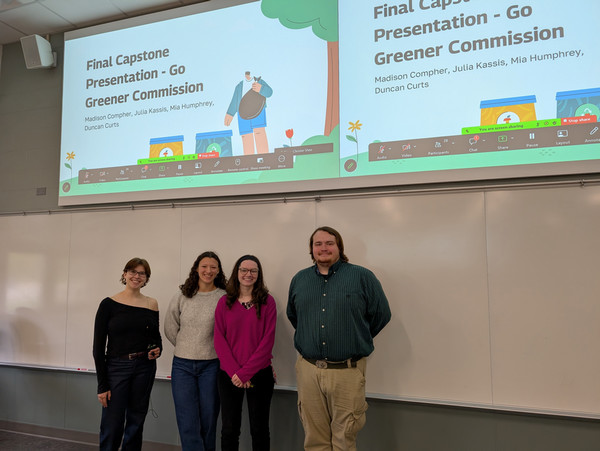
Go Greener Commission
Team Members: Madison Compher, Julia Kassis, Mia Humphrey, & Duncan Curts.
Goal: The Go Greener Commission requested educational materials about the anaerobic digester at the West Lafayette Water Resource Recovery Facility. Our team created a research paper, narrated presentation, and community pamphlet covering how anaerobic digestion works, its benefits, common questions, and how residents can participate by dropping off food waste. These materials aimed to increase community awareness and understanding of the digester.
Community Project Partners: Go Greener Commission, in communication primarily with Reed Davisson and Katie Effinger.
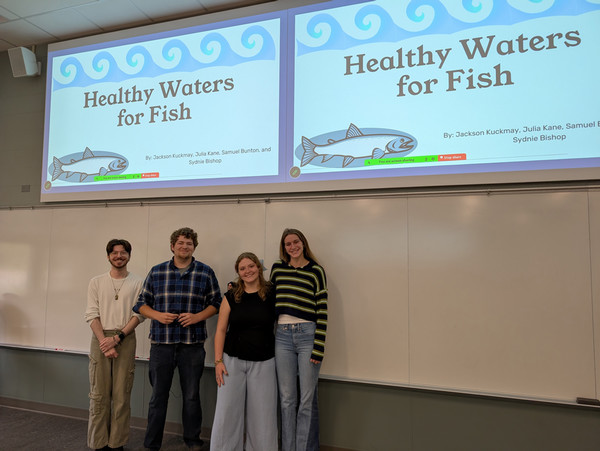
Healthy waters for fish
Team Members: Sydnie Bishop, Samuel Bunton, Jackson Kuchmay, & Julia Kane.
Goal: Our goal was to develop 4–5 agricultural and residential land management recommendations to reduce pollution and improve fish health in Tippecanoe County waterways. We also highlighted 10 charismatic local fish species to encourage community engagement, with a special focus on buffalo fish due to its historical connection to the county. Additional goals included proposing an interactive display for future Riverfests and providing detailed species information for the project website.
Community Project Partners: Robert Suseland , Mike Smith, and Sarah Vaughn.
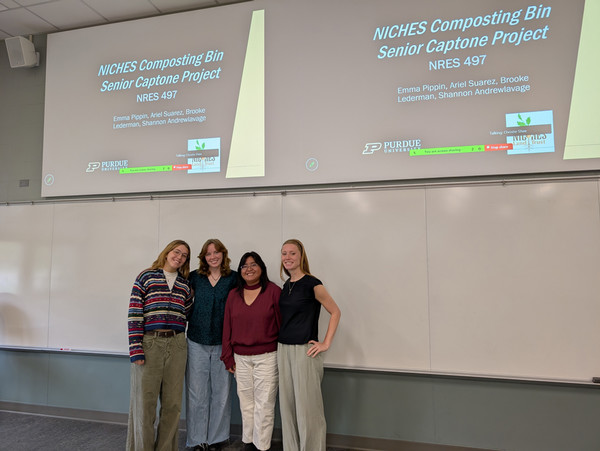
niches composting
Team Members: Shannon Andrewlavage, Brooke Lederman, Emma Pippin, & Ariel Suarez.
Goal: Our goal was to build an aerobic composting system at Clegg Memorial Garden to recycle NICHES’ organic waste, enrich garden soil, and educate visitors through composting signage. Originally, we planned three separate bins, but after consulting with our community partner, Greg Shaner, we redesigned the system as one 18-by-6-foot bin with separate compost piles for each stage. This design reduced construction costs and labor while making compost management more efficient.
Community Project Partners: Dr. Greg Shaner and Dr. John Graveel.
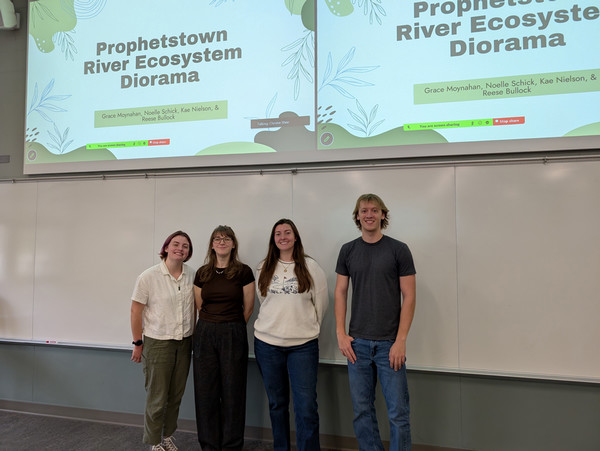
prophetstown river ecosystem diorama
Team Members: Reese Bullock, Grace Moynahan, Kae Nielson, & Noelle Schick.
Goal: Our goal was to develop educational materials for an interactive display at the Prophetstown Visitors Center. Deliverables included touchable mussel shells, buttons featuring original Miami pronunciations of the Tippecanoe and Wabash Rivers, and informational cards highlighting river conservation, native mussel and fish species, and Indigenous cultural connections. Special topics included river otter conservation success and the buffalo fish, which is tied to the Tippecanoe River’s name.
Community Project Partners: Jenna Parks-Freeman, the head interpretive naturalist at Prophetstown.
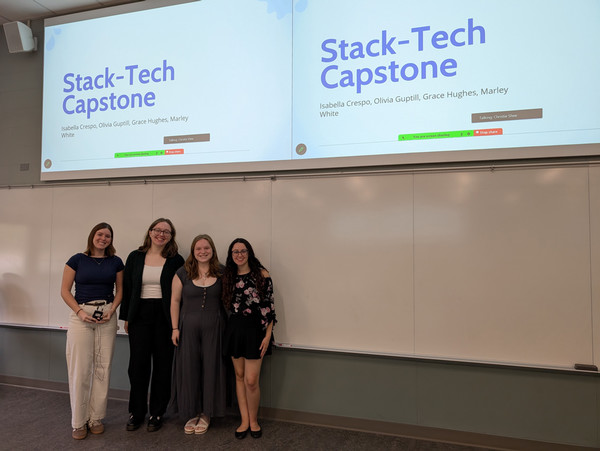
Stack-tech
Team Members: Isabella Crespo, Olivia Guptill, Grace Hughes, & Marley White.
Goal: Our initial goal was to develop a more equitable stormwater fee system for Logansport using impervious surface measurements and incentives for sustainable practices. After researching other Indiana cities, we identified the Equivalent Residential Unit (ERU) model as a potential solution. However, when Logansport announced a new fee system for 2027, we shifted our focus to advocating for stormwater credits that encourage green infrastructure. Our final recommendations include the ERU model in our report and emphasize stormwater credits in our city council handout.
Community Project Partners: Joseph Stackhouse, who is the owner of Stack-Tech.
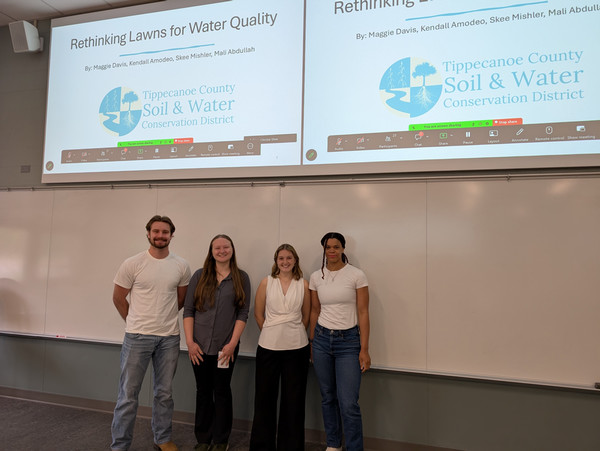
rethinking lawns for water quality
Team Members: Kendall Amodeo, Maggie Davis, Mali Abdullah, & Skee Mishler.
Goal: Our goal was to educate homeowners on sustainable lawn management practices that protect water quality by reducing nutrient runoff. Through research and discussions with our project partner, we developed a homeowner handout, detailed webpage, and yard sign promoting lawn practices that balance aesthetics with environmental protection. These resources address the social pressures behind maintaining perfect green lawns while offering practical ways to reduce nutrient pollution and improve water quality.
Community Project Partners: Soil and Water Conservation District of Tippecanoe County.
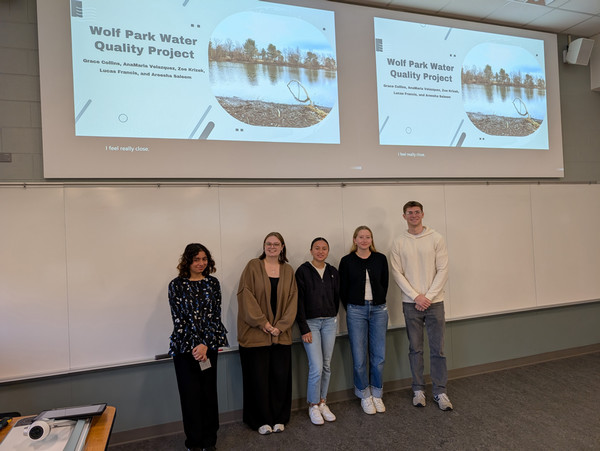
wolf park water quality
Team Members: Grace Collins, Lucas Francis, Zoe Krizek, Areesha Saleem, & AnaMaria Velazquez.
Goal: Following our initial meeting with Lucas Russo, we established goals and objectives aligned with Wolf Park’s vision for our capstone project. The primary goals were to reduce nutrient runoff in Turtle Lake, protect local wildlife, promote conservation, and improve the park’s appearance. Lucas shared recent water quality results showing low turbidity, neutral pH, and elevated phosphorus levels (Foster, 2025). Despite recent testing and treatment, algal blooms remain a concern. To address this, we planned to test phosphate and nitrate levels, compare results with previous data to identify nutrient trends, develop mitigation strategies to reduce pollution, and create a long-term monitoring framework to evaluate water quality and the effectiveness of mitigation efforts.
Community Project Partners: Wolf Park
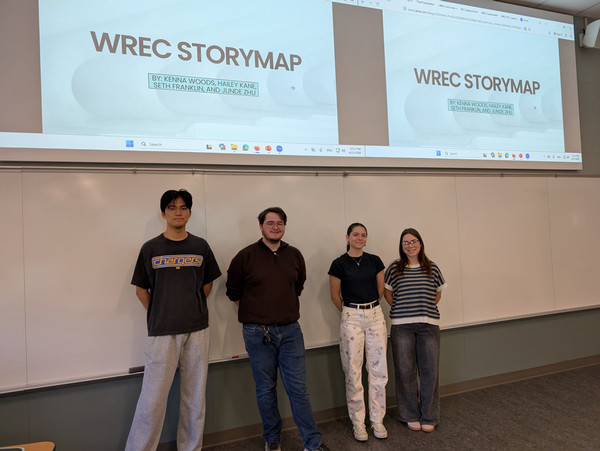
WREC storymap
Team Members: Seth Franklin, Zhu Junde, Hailey Kane, & Kenna Woods.
Goal: The project involved two main deliverables: an interactive map highlighting WREC’s completed and ongoing projects, and a story map explaining the projects’ locations, goals, and connection to WREC’s broader vision. Through biweekly meetings with community partners, we clarified each map’s purpose and gathered project locations, images, funding details, and priorities. We also established timelines, aiming to complete the interactive map by spring break before focusing on the story map. The story map would emphasize WREC’s Master Greenway Plan and serve as a resource WREC could continue updating after the project ended.
Community Project Partners: WREC