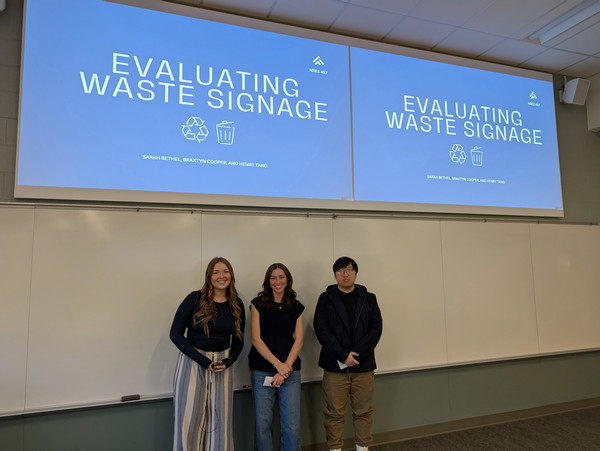
Evaluating Recycling Signage
Goals & Objectives
Originally, we were going to focus on the signage, as well as communication materials for the AO sustainability social media. However, due to time restrictions and our group only having three members,we decided to focus on designing and implementing the signage. This allowed us to provide the highest quality work.
As discussed with Patrick, our goals were:
- Research best practices in recycling signage and the psychology behind the decision making process. Much of this information was supported by behavioral studies we read for our literature review that guided our goals for signage.
- Evaluate current signage elements on Purdue’s campus.
- Identify opportunities for improvement in signage, including additions, or clarifications, comparing against best practices and studies to support decisions.
- Draft new signage which addressed gaps between current and researched best practices.
- Survey NRES 497 classmates to narrow down drafts and gain feedback on which signs were more visually appealing and understandable.
- Implement signs, conducting a visual waste audit in Nelson Hall of Food Science to see how our signage influenced recycling rates.
- At first we were hoping to perform a quantitative waste audit, but due to lack of time to establish waste collection methods, we performed a visual audit instead.
Community Project Partners
Patrick Brown, Assistant Director at Purdue Sustainability Administrative Operations.
Team Members
- Sarah Bethel
- Braxtyn Cooper
- Henry Tang
Summary
Improving recycling outcomes is possible when taking into account how individuals make decisions. By researching how common factors, like color, pictures, and size, influence sorting behavior, we were able to design a recycling sign draft to account for these behaviors. We found through our evaluation that organization, color contrast, and too much information can often contribute to confusion and contamination of recycling bins.
Our redesigned signage tries to solve these issues by emphasizing clarity, creating a standardized uniform appearance, and using clear wording to encourage accurate recycling behavior. For instance, we can add familiar examples, like cups and food waste, to signs to improve the efficiency of waste disposal. Feedback collected through our Qualtrics survey suggests that users prefer signage that is visually clean, easy to interpret, and directly tied to common and everyday items. Overall, small design changes on waste signs can have meaningful impacts on waste outcomes.
Our project works to aid in understanding the public perception of recycling signs and management across Purdue’s campus. While our new sign displayed continued contamination, an emphasis on marketing and educational campaigns can reach a larger audience and communicate more detailed information to improve recycling systems. Utilizing social media can encourage institutional trust in Purdue’s recycling process and engage with students on campus. Additionally, continued contamination with our new signage drafts allows us to analyze current procedures. For instance, constructed signs that convey what not to recycle may offer stronger cues to stimulate accurate waste separation.
- Gap Analysis
- Signage Development
- Classmate Survey
- Implementation