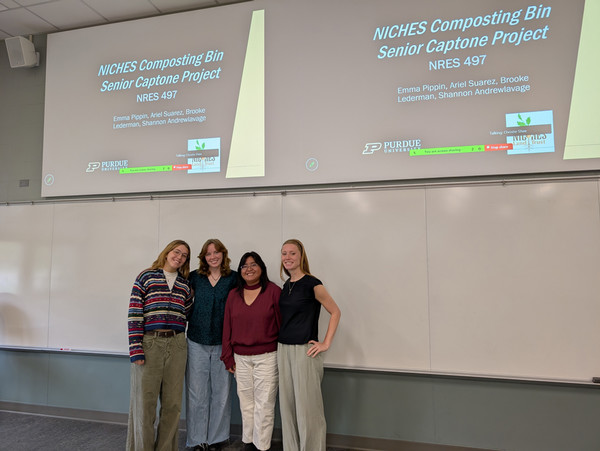
NICHES Composting
Goals & Objectives:
Our goal for this project was to create an aerobic composting system at Clegg Memorial Garden, the headquarters of NICHES Land Trust, to recycle organic waste produced by NICHES. Although this composting operation will not be open to the public, our project goal included creating educational signage that can be used to teach park visitors about composting, and hopefully inspire them to create their own composting operation at home. We want to help
fuel environmental action through education efforts. NICHES aims to use the compost created by this operation to enrich the soil of Clegg Memorial Gardens.
Our original goal for this project was to create three separate six-foot by six-foot composting bins, one for each stage of the composting process: mesophilic, thermophilic, and maturation. These bins would be made of wooden posts and mesh netting and would be located directly behind the stone wall. When we began clearing the area prior to construction, we had a conversation with our community partner, Greg Shaner, about rethinking the design of our bins. Creating three separate bins separated by mesh netting would make the process of shifting the compost from one stage to another highly inefficient and inconvenient. Instead, Dr. Shaner proposed that we should make one large 18-foot-long and six-foot-wide bin and separate the compost stages by piles. This would make the process of shifting the compost much easier. We decided together that this was a much better design to meet NICHES’ goals. Additionally, it decreased the amount of labor needed as well as the total cost of supplies since we were only going to be installing four posts rather than twelve, and we were going to need much less mesh netting. Having these conversations with our community partner helped us achieve the goal of building the compost bins efficiently, as well as making the maintenance of these bins as easy as possible.
Community Project Partners:
Dr. Greg Shaner and Dr. John Graveel.
Team Members
- Shannon Andrewlavage
- Brooke Lederman
- Emma Pippin
- Ariel Suarez
Summary:
Composting as an organic waste management method has proven itself to be well-suited for the growing challenge of organic waste management, both at the community level and beyond. The existing literature consistently demonstrates that diverting organic material from landfills through composting reduces greenhouse gas emissions, improves soil health, and lowers agricultural input costs, all while providing the benefits of a circular economy. While large-scale centralized systems currently dominate research and infrastructure development, smaller decentralized systems, like the one being implemented at Clegg Memorial Gardens, offer meaningful advantages, including simplified logistics, efficient resource usage, low technological barriers, and community engagement. Ultimately, composting does not need to operate at an industrial scale to be worthwhile. With thoughtful management and community involvement, even small-scale systems can provide meaningful contributions to reducing the negative environmental effects of organic waste and inefficient resource usage.