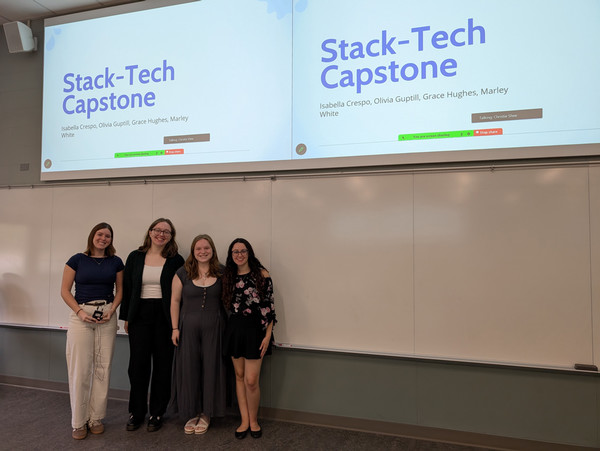
Stack-Tech
Goals & Objectives:
Our initial goal was to develop a more equitable stormwater fee system for Logansport based on actual impervious surface measurements. We also explored incentives for sustainable stormwater practices to help reduce costs for residential and commercial properties. Through research on similar Indiana cities and discussions with our community partner, we identified the Equivalent Residential Unit (ERU) model as a more equitable approach.
As the project progressed, Logansport Utilities and City Council announced a new stormwater fee system for 2027 that did not incorporate our recommendations. We adjusted our focus to advocating for a stormwater credit system that encourages green infrastructure through incentives. While our paper still includes the ERU-based model as a recommendation, we shifted our city council handout to emphasize green infrastructure and the benefits of implementing stormwater credits.
Community Project Partners:
Joseph Stackhouse, who is the owner of Stack-Tech.
Team Members
- Isabella Crespo
- Olivia Guptill
- Grace Hughes
- Marley White
Summary:
Through our capstone project, we created a report that recommended improvements to the Logansport Utilities fee system to enhance equity and efficiency. These recommendations align with the report Guidance for Municipal Stormwater Funding by the National Association of Flood and Stormwater Management Agencies. This is an EPA-funded report that provides guidance on the structuring of stormwater utilities. These recommendations can be used to create a more equitable and, overall, a more cost-efficient system. Through comparing different cities of a similar size to Logansport, we have concluded that using a measurement based on impervious surface, such as an ERU-based system, would best suit Logansport. We also found that employing green incentives along with nudges can bring both environmental and economic benefits to the community. These recommendations can be used to further efforts to implement cost-efficient stormwater infrastructure by providing a useful framework to meet the needs of the Logansport Utilities.
Given that a new stormwater fee structure was recently proposed, we are concerned with the likelihood of Logansport Utilities and Logansport City Council shifting again to our proposed ERU-based system. We have also summarized the information on stormwater credits for green infrastructure to better communicate the positive impacts of green infrastructure to the Logansport city council through a handout (Appendix B). In the future, work could be done, once more data is collected, to implement stormwater credits for green infrastructure. This is because, as green infrastructure is highly context-dependent, more detailed information about Logansport is needed for proper stormwater credit implementation.