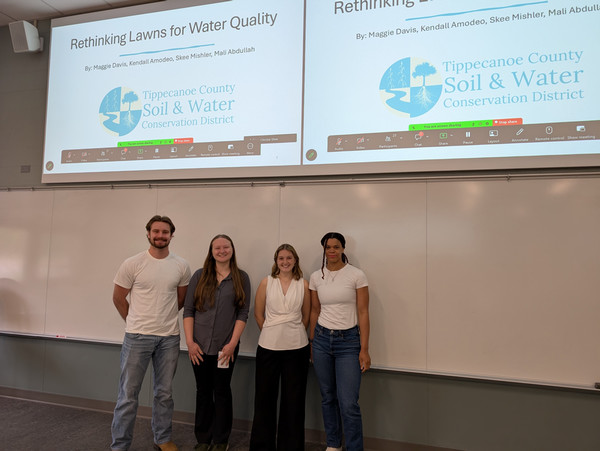
Rethinking Lawns for Water Quality
Goal & Objectives:
The goal of this project was to get homeowners to rethink their lawns for water quality. Our partners often receive calls from homeowners to investigate retention of ponds with excessive plant and algae growth due to excessive nutrients in the pond. Addressing these water quality concerns requires collective action at the neighborhood scale because home lawns are a significant contributor to their water quality concerns. Through conversations with the project partner, it was clear that relevant educational materials were needed to communicate with homeowners about better ways to manage their lawns and sustainable lawn management practices.
Our objectives were to create deliverables such as a handout for homeowners that outlined ways to maintain the aesthetics of a lawn while also minimizing the nutrients leaving it. Additional goals included creating a webpage that went into more detail about the handout and creating a small yard sign homeowners could place in their lawn to display their commitment to protecting water quality through their improved lawn management.
To achieve a deeper understanding of the problem, we conducted research using over 15 credible sources to educate ourselves on eutrophication, sustainable lawn management practices, and homeowner behavior. The problematic desire for a “perfect” green lawn was driven by a combination of formal and informal social pressures within the neighborhood which resulted in overfertilization and ultimately degraded water quality (Freedman, 2019). The deliverables created keep these factors in mind and provide several solutions where a homeowner can achieve both a sustainable lawn that protects water quality and looks aesthetically pleasing.
Community Project Partners:
Soil and Water Conservation District of Tippecanoe County.
Team Members
- Kendall Amodeo
- Maggie Davis
- Mali Abdullah
- Skee Mishler
Summary:
Nitrogen and phosphorus from lawn fertilizers are degrading water quality in streams, ponds, lakes, and wetlands. Though eutrophication happens naturally in the environment, human activities have a significant impact on its speed and scale. To make our deliverables fully usable, our partners will need to display and promote them within their office and community events, which are frequently visited by homeowners. Additionally, it is important that HOAs are on board with the solutions provided so that homeowners can better manage their lawns sustainably. Some HOAs enforce strict regulations and requirements to ensure lawns are “aesthetically pleasing” so that their property value is maintained. As a result, homeowners overfertilize to maintain this aesthetic regardless of environmental consequences. It is possible that some solutions provided within the deliverables conflict with some HOAs—this consideration is for the SWCD to navigate in the future.
Though the final steps for this project are not yet complete, our role as student consultants on the matter of eutrophication has reached its limit. It is our understanding that the Tippecanoe SWCD is satisfied with the educational materials we have planned, researched, and designed. We sincerely hope that the deliverables have an overwhelmingly positive impact on the environment, and, at the very least, provided homeowners with the information needed to manage their lawns sustainably.