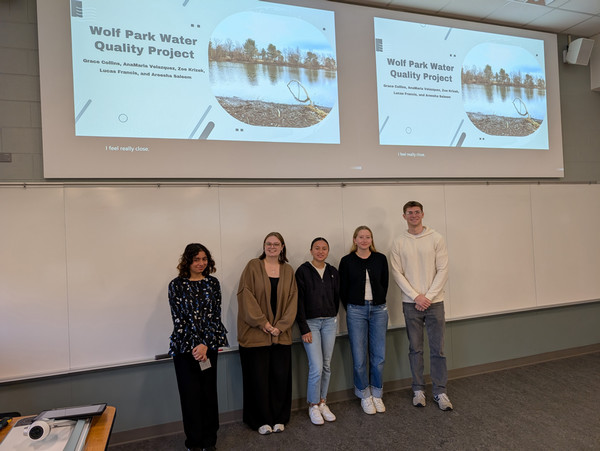
Wolf Park Water Quality
Goal:
After our first meeting with Lucas Russo, we formulated a list of goals and objectives that would satisfy Wolf Park’s vision for our capstone project. Lucas’s overall goals included addressing the issue of nutrient runoff in Turtle Lake to better protect the local wildlife, to promote stewardship and conservation, and to enhance the visual presentation of the park to the public. Lucas informed us that Wolf Park recently hired a private company to run water quality parameters on Turtle Lake, and their results were disclosed to us for analysis. These test results showed low turbidity and a neutral pH, but very high phosphorus levels (Foster, 2025). Despite this recent testing and treatment, Lucas explained that Wolf Park has continued to experience algal blooms on Turtle Lake. To complete our goals of assessing water quality moving through Wolf Park, we established a series of objectives with our community partner. We decided that we would conduct preliminary testing on two water quality parameters, phosphate and nitrate, and compare these values with previous results to evaluate any trends in nutrient concentration in Turtle Lake. Our next objective was to research and propose a mitigation plan outlining how to reduce nutrient pollution and protect the local wildlife, and we also aimed to formulate a continuous monitoring framework to aid Wolf Park in maintaining water quality and tracking the effectiveness of different mitigation strategies.
Community Project Partners:
Wolf Park
Team Members
- Grace Collins
- Lucas Francis
- Zoe Krizek
- Areesha Saleem
- AnaMaria Velazquez
Summary:
Our assessment of Turtle Lake shows that nitrate levels have improved since 2025, but on the other hand, phosphate concentrations have increased across all of the sampling locations. As noted, phosphate levels suggest an overall decline in this parameter over time making it the primary focus for future mitigation.
To address this issue, we recommend implementing riparian buffers, fencing in the bison pasture and exploring constructed wetlands to naturally reduce the phosphorous inputs and stabilize surrounding soils. Because advanced monitoring technologies are costly and vulnerable to wildlife, a practical next step for Wolf Park staff is to conduct regular manual testing using nitrate and phosphate kits similar to those we used in this project.
Continued monitoring, multi-season sampling and collaborations with upstream land managers will help Wolf Park track long term trends and evaluate the effectiveness of mitigation strategies. Future work may also include collaboration with upstream agricultural landowners to reduce the use of phosphorus inputs and instead encourage nutrient- management practices that
reduce runoff. These efforts will support healthier water quality, protect wildlife and strengthen Wold Park’s commitment to environmental stewardship.