What we do
Partnership History
Over the past 18 years the hellbender conservation efforts in Indiana have evolved and expanded to help better understand and protect the hellbender. Hellbender conservation efforts began in Indiana with the Department of Natural Resources (IDNR). IDNR approached Purdue University in 2007 to see if researchers would be willing to study the Eastern Hellbender. Researchers in the Purdue University Department of Forestry and Natural Resources (FNR) started studying hellbender populations in 2007.
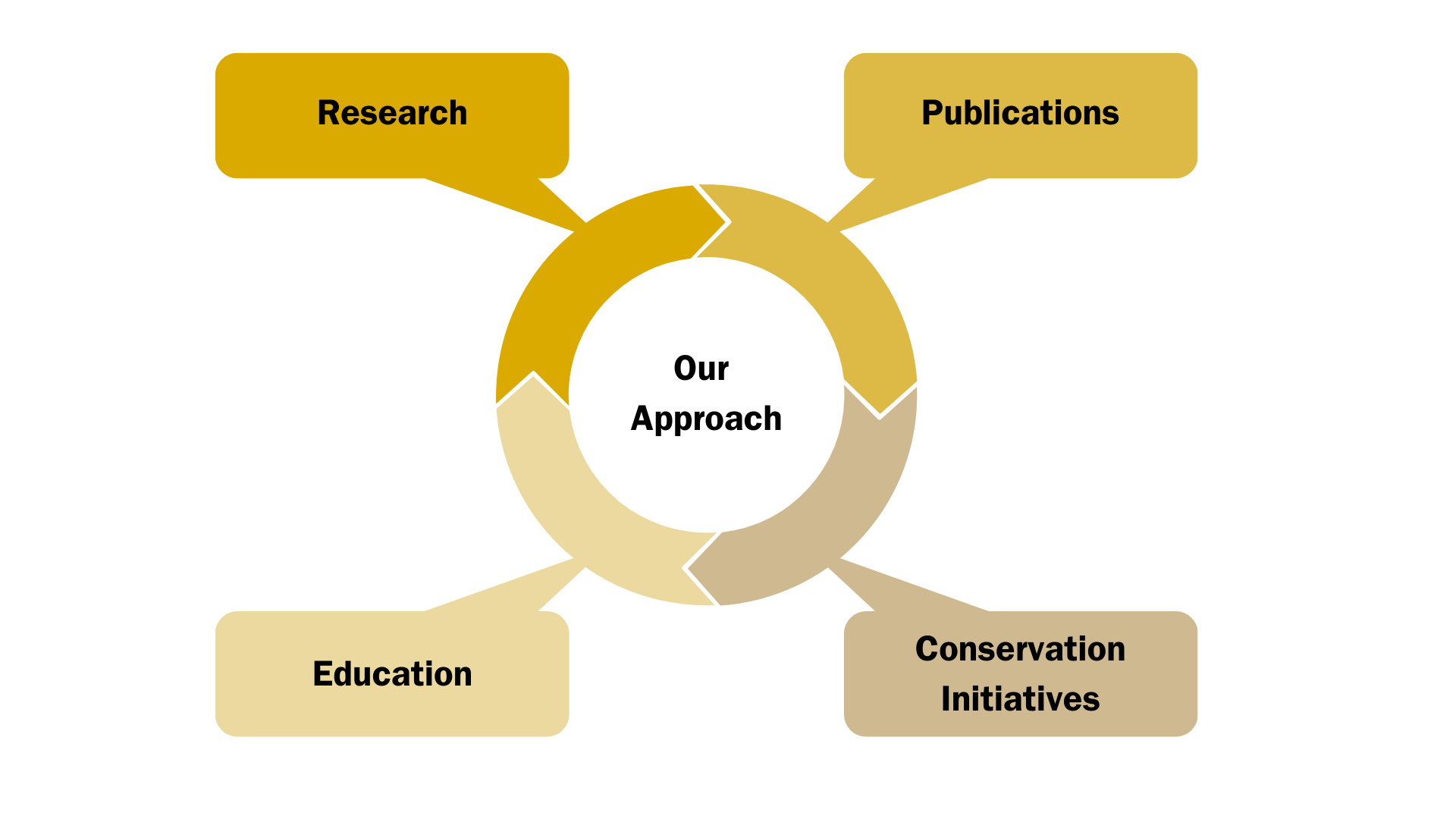
The Help the Hellbender program started by raising public awareness about population declines and threats to this species. Over time, it expanded into a comprehensive conservation initiative combining education, research, and habitat protection.
Help the Hellbender Partnerships
Help the Hellbender Partnerships
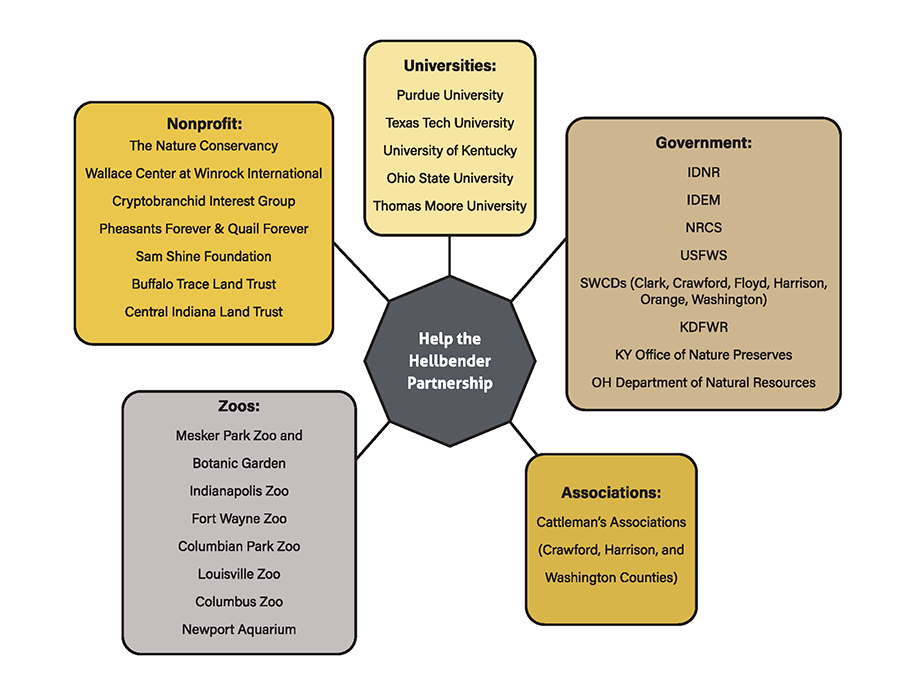
Nonprofit: The Nature Conservancy, Wallace Center at Winrock International, Cryptobranchid Interest Group, Pheasants Forever & Quail Forever, Sam Shine Foundation, Buffalo Trace Land Trust, & Central Indiana Land Trust
Zoos: Mesker Park Zoo & Botanic Garden, Indianapolis Zoo, Fort Wayne Zoo, Columbian Park Zoo, Louisville Zoo, Columbus Zoo & Newport Aquarium
Association: Cattleman's Associations (Crawford, Harrison & Washington Counties)
Government: Indiana Department of Natural Resources (IDNR), Indiana Department of Environmental Management (IDEM), Natural Resources Conservation Service (NRCS), U.S. Fish & Wildlife Service (USFWS), Soil & Water Conservation District (SWCD) - Clark, Crawford, Floyd, Harrison, Orange & Washington, Kentucky Department of Fish and Wildlife Resources (KDFWR), Kentucky Office of Nature Preserves & Ohio Department of Natural Resources
Research and Monitoring
Research and Monitoring
Hellbenders in many places have disappeared or reached such low numbers their populations are no longer self-sustaining. Reintroductions are a way to either reestablish populations in areas where they have disappeared, but the habitat is still suitable or to help improve an existing population’s ability to reproduce and recruit.
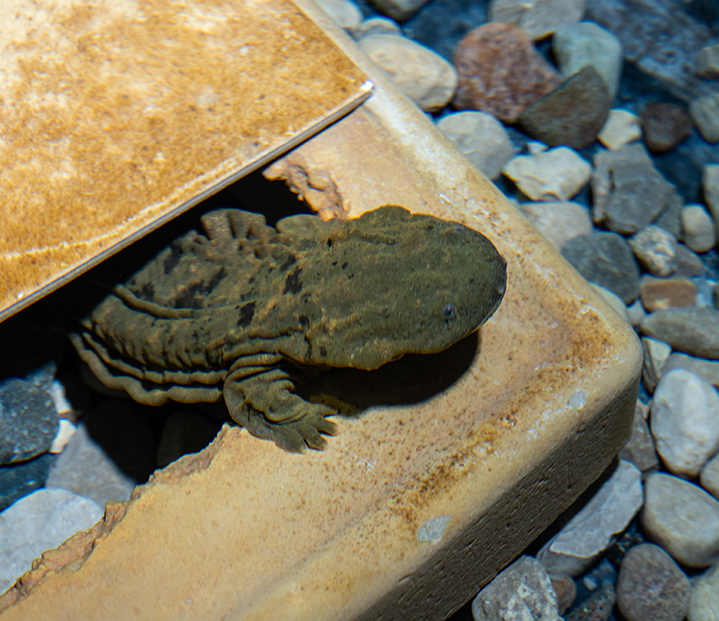
Head-starting is essential for hellbender conservation. Hellbender eggs and larvae have a very low survival rate in the wild. By collecting eggs and growing them up in captivity, they are getting a “head-start” at survival. This allows conservationists to release large numbers of individuals at an age/ size where they have a much higher survival. This increased survival ensures reintroduction efforts advance at a more rapid pace than would otherwise be possible.
 Hellbenders are released into their native streams in southern Indiana after 3-5 years of head-starting. Examples of research conducted while they were in captivity include captive animal densities at different age classes, shelter size preference, optimal food amounts, effects of water flow on behavior, and predator recognition. All of these efforts help improve hellbender health and ultimately survival after release.
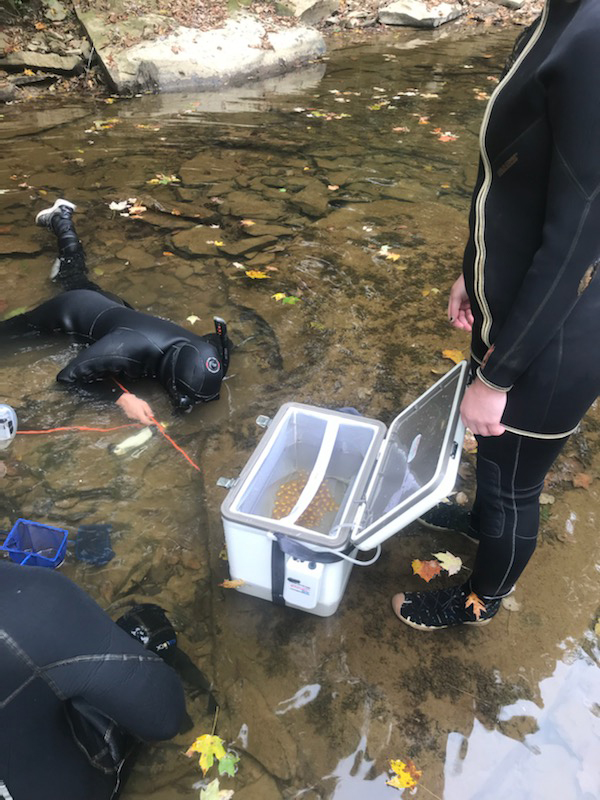
 A soft-release is a technique where a release is done in gradual steps rather than immediately releasing animals into their final habitat (hard release). This gives the animals an opportunity to destress and acclimate to their new environment before being fully allowed to disperse into the release site.
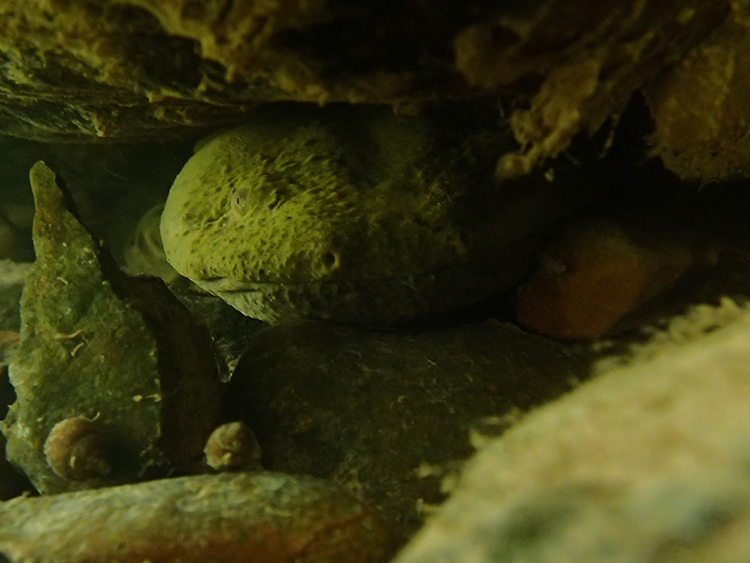 All hellbenders that are released have a passive integrated transponder (PIT) tag placed in the base of their tail before release. These small tags, similar to those placed in people’s pets, have a unique code to allow us to identify individuals and track their growth and survival.
The first hellbenders we released as part of this project had radio telemetry implants. This allowed us to reliably locate the animals to monitor their post-release survival. Animals that are part of certain research projects also received radio implants to monitor survival between different experimental groups.
Hellbenders are released into their native streams in southern Indiana after 3-5 years of head-starting. Examples of research conducted while they were in captivity include captive animal densities at different age classes, shelter size preference, optimal food amounts, effects of water flow on behavior, and predator recognition. All of these efforts help improve hellbender health and ultimately survival after release.
A soft-release is a technique where a release is done in gradual steps rather than immediately releasing animals into their final habitat (hard release). This gives the animals an opportunity to destress and acclimate to their new environment before being fully allowed to disperse into the release site.
All hellbenders that are released have a passive integrated transponder (PIT) tag placed in the base of their tail before release. These small tags, similar to those placed in people’s pets, have a unique code to allow us to identify individuals and track their growth and survival.
The first hellbenders we released as part of this project had radio telemetry implants. This allowed us to reliably locate the animals to monitor their post-release survival. Animals that are part of certain research projects also received radio implants to monitor survival between different experimental groups.
Fieldwork
Fieldwork
Adult/Juvenile Surveys
Recapturing adults and juveniles allows us to monitor growth, assess health metrics, and collect samples for disease testing. This helps us evaluate the status of our released animals and get a better sense of overall health of the population. We use a combination of radio transmitters, PIT tags, snorkel surveys, and hellbender huts to help us find animals.
Larval Searches
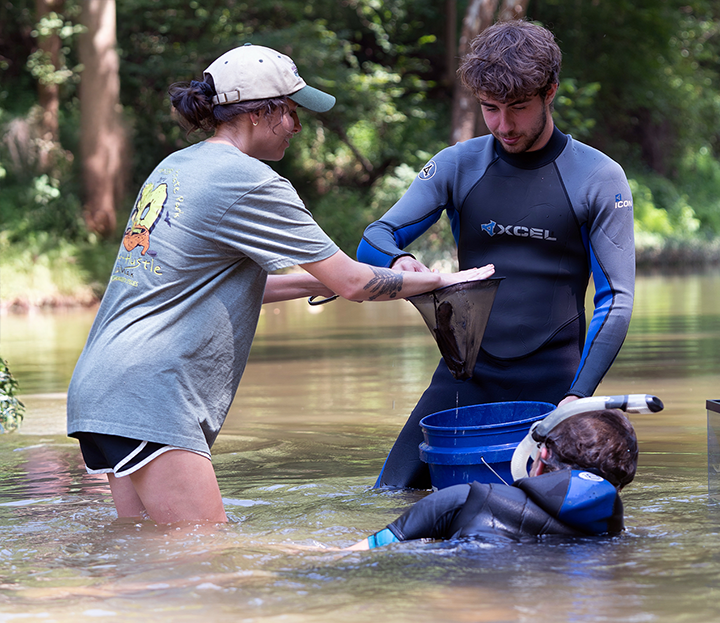
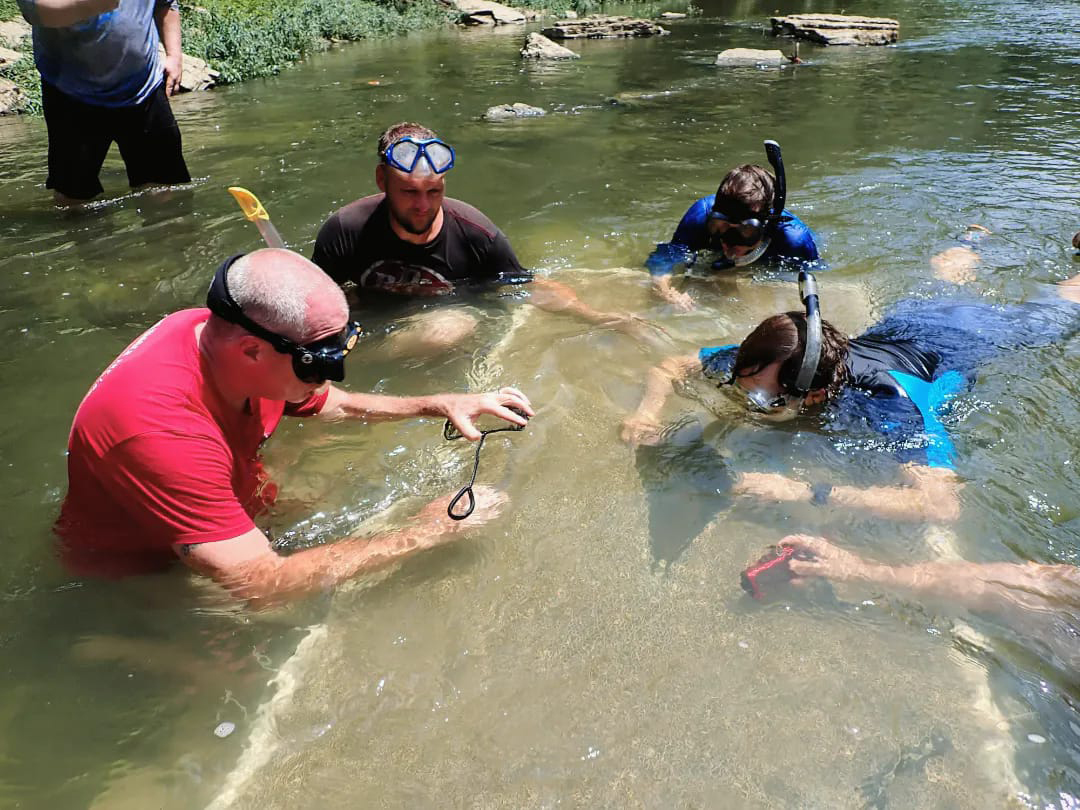
The 2-3” (5-8 cm) gilled larvae live under cobble and small boulders on the streambed. Biologists snorkel slowly along the bottom of the stream, sorting through these rocks looking for larvae. These surveys allow us to determine if recruitment is taking place, which is an important indicator of a healthy population.
Egg Searches
Biologists use snorkels and flashlights to search for guarding males under large boulders. If the eggs are to be collected for head-starting, a hooked probe is used to reach under the boulder to search for and collect eggs. These eggs are transported to zoos and other captive-rearing facilities for head-starting and eventual release back into the river.
Habitat Evaluations
Good habitat is crucial for the survival of hellbenders. Biologists kayak and wade creeks in the historic range for hellbenders to identify potential high-quality release sites. This is important for establishing new populations and ensuring hellbenders persist into the future.